
How to Choose a Web Design Company That Drives Results

Choosing the right web design company isn't about finding a vendor who can build a website. It's about finding a strategic partner who truly gets your business goals.
- Define your website goals and success metrics before evaluating any web design company.
- Critically assess portfolios, technical SEO capabilities, and long-term support options.
- Decode pricing models and contracts to avoid hidden costs and scope creep.
That process starts long before you ever type "web design company near me" into Google. It begins with defining your purpose, pinpointing your audience, and setting goals you can actually measure. Getting this internal clarity is the single most important factor in a successful partnership.
Defining Your Website Goals Before You Start Your Search

Before you can size up any web design company, you need a map of where you're going. Talking to agencies without a clear vision is like asking a builder to construct a house without blueprints. Sure, you'll get something, but it probably won't be what you actually need.
This initial planning phase is non-negotiable. It lays the groundwork for every single decision that comes next.
It all boils down to one fundamental question: What is the primary purpose of your website? The answer will drive every design choice, every feature, and every piece of content.
- Lead Generation: Is the main goal to get contact information from potential customers? If so, your site needs to be built around clear calls-to-action (CTAs), simple contact forms, and landing pages that convert.
- E-commerce Sales: Are you selling products directly? Then your focus has to be on user-friendly product pages, a rock-solid secure checkout process, and fantastic product photos.
- Brand Awareness & Authority: Is your objective to position your company as the go-to expert in your field? The design will need to support a strong blog, a resource center, and a portfolio that screams credibility.
Pinpoint Your Target Audience
Once you know your "why," you have to figure out your "who." A website built for tech-savvy millennials is going to look and feel completely different than one designed for retired executives.
Take a few minutes and sketch out a simple profile of your ideal visitor. What are their biggest headaches? What information are they desperately searching for? How comfortable are they with technology? Answering these questions ensures the user experience (UX) will actually connect with the people who matter most.
A website's success isn't measured by how it looks to you, but by how effectively it serves your target audience. Functionality and user-centric design must always come before personal aesthetic preferences.
Establish Measurable Success Metrics
How will you know if the new website is actually working? Vague goals like "getting more traffic" are useless because you can't measure them. Instead, you need to set specific, quantifiable key performance indicators (KPIs) that tie directly back to your primary purpose.
This gives you a real, tangible way to gauge the return on your investment.
For example:
- Increase qualified leads through our contact form by 25% within six months.
- Reduce our shopping cart abandonment rate from 40% to 25%.
- Decrease the website's overall bounce rate by 15% in the first quarter after launch.
Having this internal clarity completely changes the game. You'll go from asking generic questions to having strategic conversations with potential partners. A solid internal discovery process gives you the language and data to communicate your vision, confidently evaluate proposals, and pick a true partner.
For a deeper look into this crucial first step, you can learn more about a structured website discovery page and see how it shapes the entire project from the very beginning.
How to Critically Evaluate a Web Design Portfolio

A web design company’s portfolio is their single best piece of evidence. Forget the sales pitch for a minute—their past work is the real proof of what they can do. It's their living, breathing resume, showing how they solve real business problems with smart design.
But you have to know how to look past the surface-level polish. Your job isn't just to admire their work; it's to dissect it. A gallery full of generic, cookie-cutter templates might look clean, but it screams a one-size-fits-all approach that probably won't do much for your specific goals. You’re hunting for signs of strategic thinking.
Look for Strategic Depth and Industry Relevance
First things first, filter their portfolio for projects that feel like yours. Look for similar industries or similar functionality. If you're a Sacramento-based law firm, have they built professional, trustworthy sites for other service businesses? If you're launching a new e-commerce store, can you find examples of complex product catalogs and smooth, secure checkouts they've built?
Direct industry experience is a massive plus, but don't discount versatility. An agency that has delivered great results for a diverse mix of clients proves they can learn new markets and adapt. That adaptability can be even more valuable than narrow experience in a single niche.
As you look through their projects, start asking the hard questions:
- Did the design actually solve a problem? Look for case studies that explain the client’s original challenge and how the new site fixed it.
- Is the user's path obvious? When you click through to their live client sites, do you immediately get what the business does and what you're supposed to do next?
- Are there real results? Portfolios that mention metrics like "increased conversions by 40%" or "reduced bounce rate" show an agency that cares about business outcomes, not just making things look pretty.
Analyze User Experience and Technical Execution
A beautiful website that’s a pain to use is a failed website. Simple as that. User Experience (UX) and User Interface (UI) are the invisible magic that makes a site feel intuitive. This is where you have to stop looking at screenshots and start clicking around on their live projects.
Is the navigation logical? Are the buttons and links easy to spot? Most importantly, how does the site feel on your phone? A clunky mobile experience is a deal-breaker today. There’s a reason 52% of companies now say web developers with strong UX/UI skills are their top hiring priority.
A great portfolio doesn't just show you what a company can build; it shows you how they think. Each project is a window into their problem-solving process, their attention to detail, and their commitment to user-centric design.
The web design world has also changed. The talent pool is now global, with remote teams making up 64% of the workforce, which means you have access to a much wider range of experts. On top of that, a staggering 93% of web designers now use AI tools to work more efficiently. An agency that's on top of these shifts is better positioned to deliver a modern, high-performing site. You can get more details on the latest web design statistics to see where the industry is heading.
This kind of deep dive is what separates the agencies that build pretty digital brochures from those that build strategic business assets. One is a cost; the other is a growth engine.
Assessing an Agency's Technical and SEO Capabilities

A beautiful website that doesn’t work right is like a luxury car with no engine. It looks great in the driveway, but it's an expensive decoration that won’t take your business anywhere. When you're choosing a web design company, you have to look under the hood and really dig into their technical and search engine optimization (SEO) skills.
The slickest design in the world won't matter if the site is slow, invisible on Google, or a nightmare for your team to update. The technical foundation is where your long-term success is built.
The Mobile-First Imperative
Forget "mobile-friendly." The conversation today is all about mobile-first. This means the agency plans the entire experience for the smallest screen—a smartphone—and then scales it up for desktops and tablets.
With mobile devices projected to account for 75% of all eCommerce sales worldwide in 2025, this is completely non-negotiable.
A real mobile-first approach is more than just shrinking a desktop site. It’s about rethinking navigation for thumbs, simplifying forms for on-the-go users, and prioritizing what's most important. When you talk to an agency, ask them to walk you through their mobile-first design process. If they can't, that's a red flag.
SEO Is Not an Afterthought
A website that search engines can't find might as well not exist. SEO has to be baked into the design and development from day one, not just bolted on after the site launches.
Your potential partner needs to be fluent in the language of on-page SEO.
- Clean Code & Site Architecture: Search engine crawlers need to easily read and understand your site's code. It should be logical and clean.
- Logical URL Structures: Good URLs are simple and descriptive. Think
yourdomain.com/services/web-designinstead of a jumbled mess likeyourdomain.com/p?id=123. - Page Speed Optimization: Slow websites get penalized by Google and, worse, abandoned by impatient users. The agency must have a clear plan for optimizing images, using browser caching, and minimizing code to make the site load lightning-fast.
- Internal Linking Strategy: They should know how to strategically link pages within your site to spread authority and guide users to related content.
Don't mistake an agency that says they "do SEO" for one that builds SEO into the very fabric of the website. Ask for specific examples of how their development process directly improves search rankings.
As you evaluate an agency's skills, ask them about their strategies to increase website conversion rate—this question ties their technical work directly to your bottom line. A strong technical base is absolutely critical for search engine optimization SEO, and it's a topic you can't afford to skim over.
Essential Technical Capabilities Checklist
To help you drill down into the specifics, here's a checklist of key technical areas to discuss with any potential web design partner. Their answers will tell you a lot about their depth of knowledge.
| Technical Capability | Why It Matters | Key Questions to Ask |
|---|---|---|
| Mobile-First Design | The majority of your users will be on mobile. The experience must be seamless. | "Can you show me a site you built with a mobile-first approach? What challenges did you solve?" |
| SEO Foundation | A website needs to be built for search engines from the ground up to rank well. | "How do you incorporate on-page SEO into your development process from the very beginning?" |
| Page Speed | Slow sites lose visitors and rank lower. Speed is a crucial user experience factor. | "What specific techniques and tools do you use to ensure a website loads in under 3 seconds?" |
| Accessibility (WCAG) | An accessible site serves a wider audience and mitigates legal risks. | "What's your experience with WCAG 2.1 AA compliance? How do you test for it?" |
| CMS Expertise | The right CMS empowers your team to manage content easily and efficiently. | "Which CMS do you recommend for our business goals, and why is it better than the others?" |
| Security Protocols | Protects your data, your customers' data, and your reputation. | "What security measures do you implement during and after development to prevent breaches?" |
Don't be afraid to dig deep with these questions. A truly expert agency will welcome the discussion and have solid, confident answers.
Accessibility Is a Business Necessity
Website accessibility, guided by standards like the Web Content Accessibility Guidelines (WCAG), ensures your site is usable by people with disabilities. This isn't just about being inclusive; it's a smart business move that expands your potential audience and helps protect you from legal trouble.
A competent agency integrates accessibility from the start. This means adding alt text for images, ensuring high color contrast for readability, and making sure the site can be navigated with just a keyboard. Ask them directly about their experience with WCAG compliance.
Choosing the Right Content Management System
The Content Management System (CMS) is the engine of your site. It’s what lets your team add blog posts, edit pages, and manage content without having to call a developer.
The agency you hire should help you pick the right platform for your needs, not just push the one they know best. For example, WordPress is fantastic for its flexibility, while Shopify is the king of e-commerce. A platform like Webflow offers incredible design control but can be trickier for non-technical users.
A good partner will analyze your business goals and team's skills before recommending a CMS. They'll make sure you have a platform that empowers your team for years to come.
Decoding Proposals, Contracts, and Pricing Models
After you’ve checked out portfolios and talked tech, the proposal is where things get serious. This document is far more than just a price tag; it's the actual blueprint for your entire project. Learning how to read it with a critical eye is one of the most important parts of choosing the right web design partner.
A flimsy proposal is usually a dead giveaway of a disorganized agency. If you see vague language, missing details, or an unclear scope, treat those as massive red flags. You’re looking for a comprehensive document that leaves no room for guesswork and proves the agency genuinely listened to what your business needs to achieve.
What a Strong Proposal Must Include
A great proposal doesn't just list services. It tells a story. It should clearly outline the agency's understanding of your challenge and present a clear, strategic path forward. It needs to feel less like a generic quote and more like the first chapter of a collaboration.
Here’s what you should demand:
- A Detailed Scope of Work: This is the heart of the proposal. It must explicitly list every single deliverable, from the exact number of unique page templates they'll design to specific features like an e-commerce checkout or a custom blog.
- A Clear Project Timeline: Look for key milestones with estimated completion dates. A real timeline breaks the project into phases for discovery, design mockups, development, content integration, testing, and launch.
- Specific Deliverables: The proposal needs to state exactly what you will get at each stage. Will you see wireframes first? High-fidelity design comps? A staging link for review? It should all be in there.
- Technology Stack: It should specify the proposed Content Management System (CMS), programming languages, and any critical third-party tools they plan to integrate.
Anything less than this level of detail is just asking for "scope creep"—that dreaded scenario where unexpected work leads to surprise costs and blown deadlines. A well-defined scope protects both you and the agency. To get a better feel for what a professional document looks like, check out the key components of a comprehensive web design proposal.
Understanding Common Pricing Models
Web design pricing can feel like it’s all over the map, but most agencies stick to one of a few common models. Knowing how they work is the only way to compare your quotes apples-to-apples.
- Fixed-Price Project: This is the most common approach. The agency gives you a single, all-in price for the agreed-upon scope of work. It’s predictable and fantastic for budgeting, but it relies on a super-detailed scope upfront to avoid extra charges for out-of-scope requests.
- Hourly Rate (Time and Materials): With this model, you pay an hourly rate for the time the agency spends on your project. It offers a lot of flexibility for projects where the scope might evolve, but it also carries the risk of going over budget if it's not managed carefully with a spending cap or regular check-ins.
- Monthly Retainer: This is perfect for ongoing work after the initial website launch, like SEO, content updates, or continuous improvements. You pay a set fee each month for a predetermined block of hours or a specific list of services.
The investment for a professional website can vary wildly. The global web design services market is projected to hit $92 billion by 2030, which shows you just how vital this is for businesses. In the U.S., the average cost for a professionally built website hovers around $6,760, but agency projects can easily range from a few thousand to over $100,000 depending on the complexity. Having these numbers gives you some much-needed context for the proposals you receive.
Critical Contract Clauses to Review
Once you give a proposal the green light, it gets formalized into a contract or a statement of work. Don't just skim this—read every single line. Pay close attention to these key clauses, because they can have serious long-term consequences.
A contract isn’t just a formality; it’s the legal framework that defines your relationship. Clear terms on ownership, termination, and payment prevent misunderstandings and protect your investment.
Look closely for language that covers these four areas:
- Intellectual Property (IP) Ownership: The contract must state, without any ambiguity, that you own 100% of the final website and all its assets once the final payment is made. If an agency tries to retain ownership, walk away. Period.
- Payment Schedule: This should clearly outline when payments are due. A common structure is 50% deposit, 25% upon design approval, and the final 25% at launch.
- Termination Clause: What happens if the project goes completely sideways? A fair contract allows either party to terminate the agreement and outlines how completed work will be handled and paid for.
- Revisions and Feedback Process: The contract should specify how many rounds of revisions are included at each stage. This prevents endless feedback loops and the surprise costs that come with them.
Prioritizing Communication and Long-Term Support
Here's a hard truth: your website's launch isn't the finish line. It's the starting gun. Too many business owners treat it like a one-and-done project, but your site is a living, breathing part of your business that needs ongoing attention.
That’s why your evaluation can't stop at a great portfolio. You need to dig into a web design company's communication style and their plan for long-term support. A great agency doesn't just build your site and disappear once the final invoice is paid. They transition into a long-term partner invested in your success.
How Well Do They Communicate Right Now?
Pay close attention to the vibe you get during your very first conversations. Are they responsive? Do they answer your questions clearly, or do you get vague, jargon-filled replies? This initial dance is a preview of what's to come.
A professional team will have a clear process from the get-go. They might use project management tools like Asana or Trello to keep everything transparent and organized. You're looking for signs of a well-oiled machine, not chaos.
A solid communication plan during the project itself usually includes:
- Regular Check-ins: Scheduled calls—maybe weekly, maybe bi-weekly—to go over what's done, what's next, and any roadblocks. No long silences where you're left wondering what's happening.
- A Go-To Person: You should have one main point of contact. This prevents the nightmare of being bounced between designers, developers, and project managers, where important details inevitably get lost.
- A Clear Feedback Process: How do they want your feedback on a design mockup? There should be a structured way to do this so your project stays on schedule and doesn't spiral out of control with endless revisions.
A web design company’s communication style is a direct reflection of its internal organization and respect for clients. If communication feels sloppy or slow before you’ve even signed a contract, consider it a massive red flag.
When communication is messy, deadlines get missed, your vision gets misunderstood, and frustration builds. A pro team sets expectations early and keeps you in the loop, making you feel confident, not confused.
What Happens After the Site Goes Live?
So, your beautiful new website is live. Now what? What happens in six months when a critical security patch is released? Or a year from now when a key plugin is no longer supported? A website isn't a brochure you can just "set and forget."
This is where a long-term support plan is absolutely essential. A reliable agency won't leave you hanging. They'll have clear, structured options for taking care of your site long after the launch party.
Keeping Your Site Healthy and Secure
Think of this as the basic health insurance for your website. Your site’s software, from the core CMS to all its plugins, needs constant updates to patch security holes. A good maintenance plan should always cover:
- Regular Backups: At a minimum, weekly backups of both your site files and database. Daily is even better.
- Software Updates: Someone needs to be proactively updating the CMS, themes, and plugins to keep things secure.
- Security Monitoring: Actively scanning for malware and other sketchy activity.
- Performance Checks: Making sure your site stays zippy and isn't slowing down over time.
Planning for Future Growth
Beyond just keeping the lights on, you'll eventually want to add new features or improve what you have. Many agencies offer monthly retainers that give you a dedicated block of time for this kind of work. It could be used for:
- SEO and Content Strategy: Ongoing work to improve your Google rankings and attract more traffic.
- Adding New Features: Maybe you want to add an online course or a more advanced store locator down the road.
- Conversion Rate Optimization (CRO): Analyzing user data to make smart tweaks that turn more visitors into customers.
When you choose a company that offers these kinds of post-launch services, you're not just hiring a builder. You're gaining a partner who is genuinely invested in your long-term growth—not just in cashing your initial check. That focus on partnership is the true sign of a team you can build a future with.
Making a Confident Final Decision
You’ve done the research, reviewed proposals, and narrowed down your list to a few top contenders. This is where it all comes together. Picking a web design company isn't just about the flashiest portfolio—it's about choosing a genuine partner for your business.
This final step is all about balancing their technical chops with that human connection. A great way to get objective is to use a simple scorecard. Just rate each of your final candidates on a scale of one to five in the key areas that really matter beyond the proposal itself.
A Simple Scorecard for Your Top Choices
This isn't about overcomplicating things. A structured approach like this just helps you turn a gut feeling into a more data-backed choice, making sure you haven't missed anything before signing on the dotted line.
- Portfolio Alignment: How well does their past work actually line up with the style, complexity, and business goals you have for your own project?
- Technical & SEO Skills: Did they handle your technical questions with confidence? Do they truly get how to build a site that search engines will love?
- Communication & Responsiveness: Think back through the whole process. How clear, timely, and professional have they been?
- Cultural Fit: This one is huge. Does their team's personality and work style feel like a good match for yours? You could be collaborating with these folks for months.
- Long-Term Support: What’s the plan after launch day? A good partner will have a clear, structured system for maintenance and ongoing help.
Trust your intuition, but always verify it with the facts. The best partnerships have both—the tangible skills and the intangible chemistry. When you find a company that scores high on your checklist and gives you a good gut feeling, that’s the green light.
Watch Out for These Final Red Flags
Even at this late stage, you need to keep your eyes open. A few warning signs can pop up that signal future headaches. If an agency suddenly gets pushy with sales tactics or tries to pressure you into a fast decision, pump the brakes.
Another major red flag is any vagueness about who will be working on your project. You should know who your main point of contact will be. If you get the feeling they might be quietly outsourcing the work, that's a good reason to pause. A solid agency is always proud of its in-house team and their process.
The chart below breaks down the two main paths for post-launch support, which should help you figure out what you really need for the long haul.
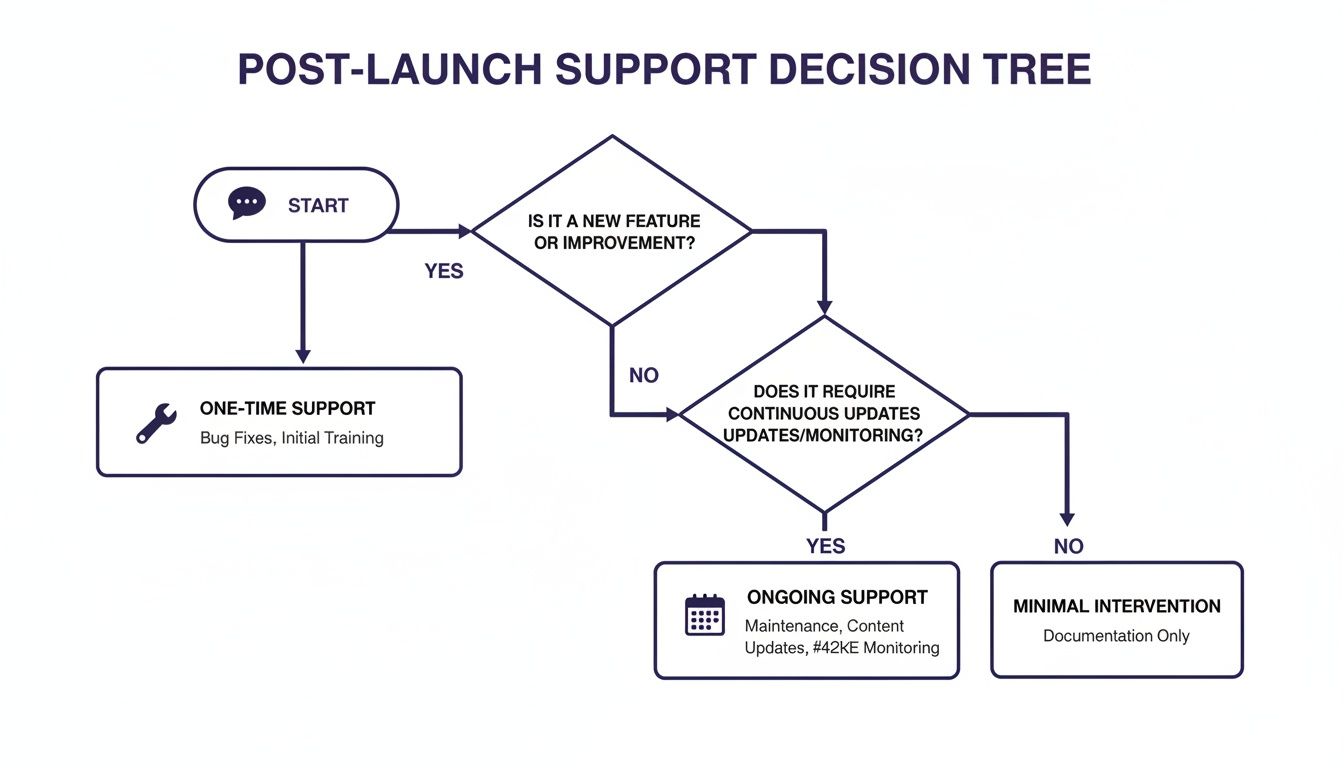
Ultimately, your choice here depends on whether you see your site needing continuous improvements and new features, or just occasional fixes and updates after it goes live.
When you start looking for the right web design partner, a lot of questions pop up. That's totally normal. Getting straight answers is the only way to feel confident you're picking a company that actually gets what you're trying to do.
Let's tackle some of the big ones we hear all the time.
How Much Is This Going to Cost?
This is usually the first question, and for good reason. The honest answer? It depends. Prices can be all over the map based on what you need. A simple, clean informational website might only run a few thousand dollars. On the other hand, if you're building a sophisticated e-commerce platform with a top-tier agency, you could be looking at tens of thousands.
Nationally, the average for a professionally built website is around $6,760.
The key is to shift your thinking from cost to value. A cheap website that doesn't bring in business is an expense. A quality site that generates leads and sales is an investment that pays for itself again and again.
What's the Difference Between Design and Development?
This is another common point of confusion. Think of it this way: web design is all about the look, feel, and user experience (UX). It’s the visual part—how the site guides a visitor, what the buttons look like, and how intuitive it feels to navigate.
Web development is the engine under the hood. It’s the hardcore coding and programming that makes everything actually work. It’s the technical foundation that ensures your site is secure, fast, and functions perfectly.
A truly great web company is a master of both. You need a site that isn't just beautiful but also technically solid.
What Happens After the Site Is Live?
Your website going live isn't the finish line; it's the starting line. Ongoing support is non-negotiable if you want your site to keep working for you long-term. This usually breaks down into a few key areas:
- Website hosting and managing the server.
- Regular security updates to keep hackers and malware out.
- Consistent backups so your data is always safe.
- Software and plugin maintenance to keep things running smoothly.
Most good agencies offer monthly maintenance plans to take care of all this for you. A great partner doesn’t just build your site and disappear—they stick around to help you grow it. For anyone with more questions about hiring a web designer, you might find some further insights into web designers in this helpful resource.
Ready to build a website that drives real business results? The team at Site Igniters combines strategic design with powerful SEO and AI solutions to help Sacramento businesses grow. Contact us today for a free consultation.
Seth Sanders is the founder of Site Igniters, a digital marketing agency in El Dorado Hills, California.