
What Is Search Intent in SEO and How Can You Master It


Search intent is the secret handshake between a searcher and Google. It’s the “why” behind every single search query. It’s not just about the words someone types into the search bar, but the real goal they're trying to achieve. Are they trying to learn something? Find a specific website? Or are they ready to pull out their credit card and buy?
- Search intent is the underlying goal behind every query and determines what type of content Google will rank.
- The four intent types are informational, navigational, commercial, and transactional; matching them correctly is critical for rankings.
- Analyze the current SERP results for your target keyword to reverse-engineer the intent Google rewards.
Nailing this is hands-down the most important factor for ranking on Google today.
The Secret Language of Search Queries
Think of it like this: when a customer walks into your physical store, you don't just listen to the words they say. You read their body language and listen to their tone to figure out what they really want. Are they "just looking," seriously comparing products, or marching to the counter to buy? Search intent is just the digital version of that exact interaction.
Modern search engine optimization (SEO) has evolved way past just jamming keywords onto a page. It's all about becoming the best problem-solver for your audience. Google's entire mission is to give its users the most relevant, helpful, and satisfying answer for whatever they're looking for. The algorithm has gotten scarily good at decoding a user's true goal, and it heavily rewards content that perfectly matches that underlying need.
Understanding and optimizing for user intent isn't just a "nice-to-have" anymore. It's the core principle that separates the content that ranks and converts from the content that gets buried on page ten.
This is exactly why mastering search intent is your ticket to sustainable, high-ranking positions. If you're looking for a more detailed breakdown, this post on what is search intent in SEO is a great place to start.
Why Intent Is the Key to SEO Success
Getting search intent wrong is like showing up to a potluck with a bag of uncooked ingredients. You might have everything needed to make a great dish, but it doesn't solve the immediate problem for the hungry guests. They'll just move on to the next table.
In SEO, that "moving on" is a high bounce rate, which sends a massive signal to Google that your page wasn't a good fit for that query.
But when you get it right? Magic happens.
- You build instant trust. Giving people the right answer at the right time shows you get them, which makes you the authority.
- Your engagement metrics soar. Visitors stick around longer, click through to other pages, and are way less likely to bounce back to the search results.
- Your conversion rates climb. When you meet people exactly where they are in their journey, it's so much easier to guide them toward taking that next step with you.
For example, when someone types ‘best running shoes for flat feet’ into Google, they aren’t looking for the history of Nike. They're deep in research mode, comparing options and getting ready to make a purchase. That's intent in action.
The 4 Main Types of Search Intent
Every search query falls into one of four main categories. Once you learn to spot them, you'll see them everywhere. It completely changes how you approach your content strategy.
1. Informational Intent (“I want to know”)
This is the big one. The vast majority of searches start here. People with informational intent are looking for answers, knowledge, and solutions. They're not ready to buy yet; they're in the learning phase.
They’re asking questions like "how to," "what is," or "why does." Their goal is to get educated.
Keywords often include:
- How to…
- What is…
- Guide
- Tutorial
- Tips
- Best way to…
A great example is the search for "how to fix a leaky faucet." The search results are packed with DIY guides, step-by-step videos, and blog posts—not product pages for new faucets.
2. Navigational Intent (“I want to go”)
Navigational searches are straightforward. The user already knows where they want to go online, and they're just using Google as a shortcut to get there.
Think about it: it's often faster to type "Facebook" into Google than it is to type "www.facebook.com" into the address bar.
Keywords often include:
- Brand names (e.g., "SiteIgniters," "Twitter")
- Specific product names ("iPhone 15 Pro")
- Website names ("YouTube login")
For these queries, the top result is almost always the official website. Trying to rank for another company's navigational query is usually a waste of time.
3. Commercial Investigation (“I want to compare”)
This is where the user has moved past the initial learning phase and is now actively researching their options before making a purchase. They're comparing products, services, and brands to find the best fit for them.
They’re not quite ready to buy, but they’re getting very close. This is a crucial stage where you can win over a potential customer.
Keywords often include:
- Best…
- Top…
- Review
- Comparison
- Vs (e.g., "HubSpot vs Salesforce")
- Alternatives to…
A search for "best email marketing software" brings up listicles, comparison articles, and review sites—all content designed to help the user evaluate their choices.
4. Transactional Intent (“I want to buy”)
This is the money stage. The user has done their research, made a decision, and is ready to take action—buy a product, sign up for a service, or book an appointment.
These keywords are often highly specific and show a clear intent to complete a transaction right now.
Keywords often include:
- Buy
- Discount
- Coupon
- For sale
- Deal
- Pricing
For a query like "buy Nike Air Max 90," Google serves up e-commerce product pages and shopping ads, making it as easy as possible for the user to make a purchase.
To help you keep these straight, here's a quick cheat sheet.
The Four Core Types of Search Intent at a Glance
This table breaks down the four main intent types to give you a quick reference.
| Intent Type | User's Primary Goal | Example Keywords |
|---|---|---|
| Informational | To find information or learn something | "how to tie a tie", "what is SEO", "benefits of green tea" |
| Navigational | To find a specific website or page | "Facebook login", "YouTube", "SiteIgniters blog" |
| Commercial Investigation | To compare products, services, or brands | "best running shoes", "Mailchimp vs ConvertKit", "iPhone review" |
| Transactional | To make a purchase or take a specific action | "buy laptop online", "plumber near me", "Squarespace discount" |
Understanding these categories is the first step. Now, let's talk about how to figure out the intent behind the keywords you actually want to rank for.
Breaking Down the Four Search Intent Types
It's one thing to know what search intent is, but it's another to see it play out on a live Google search results page. That’s where the theory gets real. Think of every search query as a different customer walking through your door with a unique need. To win at SEO, you have to get brilliant at figuring out who you're talking to and giving them exactly what they came for.
Let's unpack the four core types of search intent. We’ll get inside the user’s head for each one and look at what kind of content Google likes to show them.
This concept map helps visualize how the "why" behind every search branches out into these four fundamental motivations.
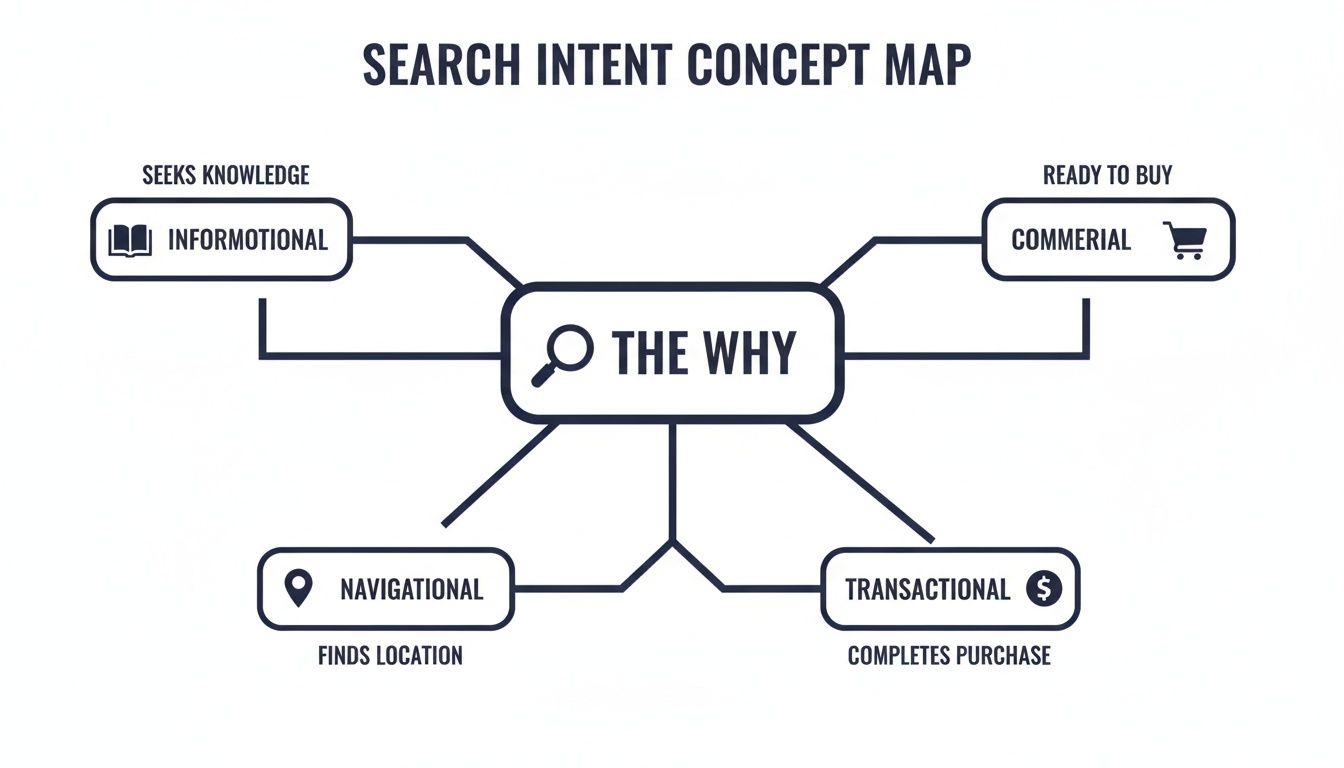
This just reinforces that no matter how different a query seems, one of these core drivers is powering it, which should guide your entire content plan.
Informational Intent: The Knowledge Seeker
Informational intent is, by far, the most common reason people search. The user is in learning mode. They’ve got a question, a curiosity, or a problem, and they’re hunting for an answer, a guide, or just a straight-up explanation. They are nowhere near ready to buy; they just want information.
These queries are full of clue words like "how to," "what is," "guide," "tips," or "tutorial." A search for "how to improve website speed," for instance, is purely informational. That person wants a step-by-step walkthrough, not a sales pitch for a web developer.
Google gets this, so it serves up specific types of content to match.
- Dominant Content Formats: Deep-dive blog posts, ultimate guides, step-by-step tutorials, infographics, and explainer videos crush it here.
- Common SERP Features: You’ll almost always see "People Also Ask" boxes, Featured Snippets, and video results—all designed to give answers fast.
The business play here is to build trust. When you provide the best, most thorough answer, you position your brand as the helpful expert. That makes you the first one they think of when they eventually are ready to buy.
Navigational Intent: The Direct Navigator
Navigational intent is the easiest to spot. The searcher already knows exactly where they want to go online and is just using Google as a shortcut. It’s just faster to type "YouTube" into the search bar than it is to type the full www.youtube.com into the address bar.
These searches almost always contain a specific brand, website, or product name. Think "Site Igniters blog" or "Facebook login." The destination is already decided.
The user isn't looking for options; they're looking for a specific doorway. Trying to rank your page for another company's brand name is almost always a losing battle—Google’s going to put the official site first.
For your own brand's navigational searches, the job is simple: make sure your official pages are easy to find and offer a clear path. Your homepage better be #1 for your brand name, and key pages like your login portal or contact page should pop up as sitelinks right on the results page.
Commercial Investigation: The Smart Shopper
Commercial investigation is that all-important middle ground between learning and buying. The user knows they have a problem and that a product or service is the solution, but they haven't picked one yet. They’re in full-on comparison mode, weighing their options.
These queries are loaded with high-value words that scream "I'm evaluating my choices!"
- Common Keywords: "best," "top," "review," "comparison," "vs," and "alternatives."
- Example Query: A search for "best PPC agencies in El Dorado Hills" is a textbook commercial query. This person is actively building a shortlist of providers to contact.
This content does incredibly well here because it helps the user make a smart, informed decision. They're looking for detailed comparison articles, honest reviews, and well-organized "best of" lists.
Transactional Intent: The Ready Buyer
Finally, we hit transactional intent. This is the moment of truth. The user has done their research, made up their mind, and is ready to pull the trigger. They have their wallet out and are looking for the fastest way to buy, sign up, or book.
Transactional queries are super specific and packed with action words like "buy," "price," "discount," "for sale," or even an exact product model number. A search for "buy Squarespace business plan" leaves zero doubt about what that user wants to do next. They need the page where they can hand over their money.
The competition is fierce, but so are the rewards. Fast-forward to 2026: organic traffic claims 46.98% of all website visits, yet it's dipped 3.65% year-over-year as AI reshapes discovery—making search intent your survival edge. The top SERP position snags a 39.8% click-through rate (CTR), which plummets to 18.7% at #2. This is because Google prioritizes pages that deliver frictionless value for high-intent queries, rewarding those that satisfy the user's goal instantly. You can learn more about these pivotal SEO statistics and trends.
For these searches, Google rolls out the red carpet for pages that make a transaction happen. You’ll see product pages, service pages, and pricing pages with big, obvious calls-to-action. Your only job is to get out of the way and make it as easy as possible for the user to take that final step.
How to Confidently Identify User Intent
Knowing the different types of search intent is one thing, but how do you actually apply that to your keyword research? You need a solid way to figure out the "why" behind any search before you sink hours into creating content. Think of yourself as a detective looking for clues; the proof is always there if you know where to find it.
This process eliminates the guesswork. Instead of just hoping your content aligns with what people want, you'll know for sure. Let's dig into three reliable techniques that will make you an expert at decoding search intent.

Analyze the Language of Keywords
The words people type into the search bar are your most direct clues. Certain words and phrases, often called keyword modifiers, are like little signposts pointing you straight to a specific intent. Getting good at spotting these is the first step.
For instance, the keyword "SEO" is super broad. The intent is anyone's guess. But toss in a simple modifier, and the picture becomes crystal clear.
- "how to do SEO" is obviously informational.
- "best SEO agency" is a commercial investigation.
- "buy SEO software" is clearly transactional.
These words give you a powerful shortcut to understanding a user's mindset. When you pay attention to them, you can start sorting keywords and lining up your content strategy right from the get-go.
Think of keyword modifiers as a user's subconscious telling you exactly where they are in their journey. A word like "review" means they are evaluating options, while "guide" means they are just starting to learn.
To make things even easier, here's a quick cheat sheet connecting common modifiers to their most likely intent. Think of this as your practical guide for mapping keywords to content goals.
Keyword Modifiers and Their Likely Intent
| Keyword Modifier | Likely Search Intent | Content Goal |
|---|---|---|
| How to, what is, guide, tips | Informational | Educate and build authority with comprehensive guides and blog posts. |
| Best, top, review, vs, compare | Commercial Investigation | Help users decide with detailed comparisons and expert reviews. |
| Buy, price, discount, for sale | Transactional | Convert users into customers with clear product or service pages. |
| [Brand name], login, website | Navigational | Provide a direct path to the specific page the user wants to find. |
This table isn't exhaustive, but it covers the big ones you'll see every day. Using it helps turn abstract intent concepts into a concrete plan of action for your content.
Decode the SERP Clues
Honestly, your most trustworthy tool for figuring out search intent is Google itself. The Search Engine Results Page (SERP) is like a living treasure map, showing you exactly what kind of content Google thinks is the best match for a query. You just have to learn how to read it.
Go ahead, type your target keyword into Google and take a hard look at page one. Don't just glance at the top-ranking sites; analyze the SERP features that pop up. These are the special result formats Google uses to answer a searcher's question as fast as possible.
What patterns do you notice? The features are a dead giveaway.
- Informational SERPs: See a "People Also Ask" box? A Featured Snippet at the top? A bunch of video results or in-depth "how-to" guides? These are all classic signs of informational intent. Google knows the user is in learning mode.
- Commercial SERPs: Is the page full of star ratings, product carousels, or results from review sites with "best of" lists? That screams commercial investigation. The searcher is comparing options, and Google is serving up content to help them choose.
- Transactional SERPs: Are you seeing Shopping ads, product pages from e-commerce stores, or a local map pack showing businesses nearby? That's a huge indicator of transactional intent. The user has their wallet out and is ready to act.
By dissecting the SERP, you're not just guessing what Google wants—you're seeing it firsthand. This simple, free research method is without a doubt the most accurate way to confirm what users are really looking for.
Review Your Own Analytics Data
Finally, don't overlook the goldmine of information you're already sitting on: your website's analytics. Tools like Google Search Console and Google Analytics can tell you in no uncertain terms whether your current content is hitting the mark or missing it completely.
Jump into Google Search Console and check out the "Performance" report. This shows you the exact queries people are using to find your pages. Are you ranking for informational keywords but secretly hoping for transactional traffic? That mismatch points to a disconnect between your content and what users actually want.
For example, if your article on "the benefits of SEO" is getting impressions for "Sacramento SEO services cost," that's a blinking neon sign that searchers want pricing info you're not providing. That insight lets you create a new, perfectly aligned page or update the existing one to better meet that commercial intent.
Over in Google Analytics, you can look at user behavior on your most important pages. A high bounce rate on a product page might mean that people landing there actually had informational intent and weren't ready to buy. With that knowledge, you can create a supporting blog post to catch them earlier in their journey. This data-driven approach lets you constantly fine-tune your strategy based on how real people interact with your site.
Creating Content That Perfectly Matches Intent

Pinpointing the search intent is really just the first domino. The real work—and where most strategies fall flat—is creating content that actually satisfies that intent. This is where your SEO moves from a spreadsheet into the real world.
When well-researched content fails to rank, a mismatch here is almost always the culprit. You might have written a fantastic article, but if it's the wrong answer to the user's unspoken question, it's dead in the water.
Think of it this way: you wouldn't use a hammer to drive a screw. In the same way, a detailed product page will only annoy someone looking for a beginner's guide, and a 3,000-word blog post will frustrate a user who's ready to buy right now.
Let's walk through how to build the right content for each of the four main intent types. I'll even give you some actionable checklists to make sure every page you publish is laser-focused on what the user actually wants.
H3: Crafting Content for Informational Intent
When someone searches with informational intent, they’re in learning mode. Your only job is to be the clearest, most helpful teacher you can be. This isn't the moment for a sales pitch; it's your chance to build trust and prove your expertise by providing real value, no strings attached.
Your content needs to directly tackle their question with depth and clarity. Think about formats that educate: comprehensive guides, step-by-step tutorials, detailed "how-to" blog posts, and insightful explainers. To really nail this, looking into advanced strategies like Answer Engine Optimization can help you structure your content to directly feed Google the answers it’s looking for.
For informational queries, your success is measured by how well you educate. The goal is to create a resource so thorough that the user has no reason to hit the back button and look elsewhere.
Informational Content Checklist:
- Structure: Use crystal-clear headings (H2s, H3s) to break down complex topics into bite-sized chunks.
- Format: Weave in visuals like infographics, screenshots, and videos to illustrate your points.
- Tone: Keep it helpful, educational, and objective.
- Depth: Go deep. Cover the topic from all angles and anticipate the next questions they'll have.
A post on "How to Improve Website Speed," for instance, should dive into image compression, browser caching, and minimizing code—not just end with a CTA to hire your agency.
H3: Building Content for Commercial Investigation
Users with commercial intent are in comparison mode. They know they have a problem and that a product or service is the answer, but they haven't picked a winner yet. Your mission is to be their trusted advisor, guiding their decision with honest, detailed content.
This is your prime opportunity to show off your expertise. Formats like "best of" lists, in-depth reviews, and side-by-side comparison articles work wonders here. You're not just selling; you're helping someone make a smart, confident choice.
Commercial Content Checklist:
- Structure: Use tables to cleanly compare features, pricing, pros, and cons.
- Format: Lean on star ratings, user testimonials, and clear callouts for key benefits.
- Tone: Be balanced and credible. If you're reviewing your own product against others, be honest about its strengths and weaknesses.
- Credibility: Back up your claims with trust signals like awards, certifications, or powerful case studies.
A perfect example is an article like "Best SEO Agencies in Sacramento." It would compare different providers on their services, pricing models, and client reviews, helping a local business owner make a truly informed decision.
H3: Optimizing Content for Transactional Intent
With transactional intent, the user’s wallet is out. They've finished their research and are looking for the checkout line. Your content's only job is to create a smooth, frictionless path to that final click. Any confusing language, extra steps, or slow-loading pages can completely derail a sale.
The best format here is a clean, hyper-optimized product or service page. Every single element—from the headline down to the button text—should scream confidence and urge the user to take that final step.
Transactional Content Checklist:
- Structure: Make sure your main call-to-action (CTA) is visible "above the fold" without any scrolling.
- Format: Use high-quality product images or videos alongside concise, benefit-driven bullet points.
- Tone: Use direct, action-oriented language. Think "Buy Now," "Get Your Free Quote," or "Sign Up Today."
- Frictionless Experience: The page must load fast. The checkout or sign-up process needs to be dead simple and feel secure.
For a query like "buy Site Igniters SEO package," the user needs to land on a page that shows exactly that: package details, the price, and a big, obvious button to get started. Anything else is just noise.
H3: Fulfilling Navigational Intent
Navigational intent is the easiest of the bunch. The user already knows you and is just using Google as a shortcut to a specific page on your site. Your goal is simple: get out of their way.
Your main task is to make sure your website ranks #1 for your brand name and that Google displays sitelinks to your key pages right on the SERP. This is less about writing new content and more about solid technical SEO and a logical site structure.
Navigational Content Checklist:
- Homepage: Your homepage must be flawlessly optimized for your brand name.
- Site Structure: Your navigation menu should be clear and logical, making it easy to find pages like "Login," "Contact," or "Pricing."
- Schema Markup: Use
Organizationschema to tell Google, "Hey, this is our official site."
When someone searches for "Site Igniters login," they should immediately see your login page at the very top, ideally with handy sitelinks pointing to other important parts of your website.
Exploring Advanced Search Intent Scenarios
Once you get a feel for the four main types of intent, it’s time to dig into the trickier situations that can throw a wrench in your SEO strategy. The digital world isn't always so neat and tidy, and plenty of search queries don't fit into a single box.
Learning to navigate these gray areas is what separates a good SEO from a great one.
Some of the most competitive—and valuable—keywords have what we call mixed intent. This just means that a single search phrase could have a few different, perfectly valid goals behind it.
Take the keyword "standing desk." Is the person searching for information on health benefits? Are they comparing different brands? Or are they ready to pull out their credit card and buy one right now? The real answer is often "all of the above."
For keywords like these, the winning strategy is usually a comprehensive hub page that speaks to each of these potential needs. You might start with the basics, move into a detailed comparison of top models, and then offer clear links to purchase. This approach lets the user choose their own adventure on your site.
Mastering Local Search Intent
For any business with a physical location, local intent is the name of the game. Think of this as a powerful sub-category of intent where the user’s goal is directly tied to a specific geographic area. These are your classic "near me" searches, or queries that tack on a city name, like "best web design Sacramento."
Google knows these folks want quick solutions close to home. Optimizing for this kind of intent requires more than just standard on-page SEO.
- Google Business Profile (GBP): Your GBP listing is your single most important local SEO tool. It needs to be filled out completely, kept accurate, and loaded with recent, positive reviews.
- Location-Specific Pages: Build out dedicated pages on your website for each city or neighborhood you serve. These pages should be packed with local testimonials, case studies, and answers to common questions for that area.
- Local Citations: Make sure your business name, address, and phone number (NAP) are identical across every online directory, from Yelp to the local chamber of commerce.
Ignoring local intent is like putting a "closed" sign on your digital front door. You're telling Google—and potential customers—that you aren't the most convenient or relevant answer in their community.
The Future of Intent in an AI-Driven World
The way people find information is changing fast, thanks to the explosion of AI chatbots and conversational search. This shift makes understanding intent more important than ever. Users are asking longer, more detailed questions, often mashing multiple intents into a single conversational prompt.
The core of search intent in SEO hasn't changed—it’s still about understanding the user’s goal. But AI is raising the bar, forcing our content to provide direct, deeply satisfying answers to much more sophisticated questions.
We’re barreling toward a future where mastering intent isn’t just an advantage; it’s a requirement. Projections for 2026 show AI chatbots could have hundreds of millions of weekly users, with a huge slice of younger generations skipping traditional search engines altogether. This trend points toward a new era of "Search Everywhere Optimization," where organic clicks might dip, but the value of each high-intent visitor goes through the roof. You can explore the latest AI and SEO statistics to see just how quickly things are moving.
This evolution also pulls in things like voice search, where users speak their queries in a natural, conversational way. If that’s on your radar, you’ll want to check out our guide on how to optimize your website for voice search. Getting ready for this AI-powered future means creating content that is clear, structured logically, and built to directly answer the nuanced goals hidden inside these advanced queries.
Common Questions About Search Intent
As you start putting all this into practice, a few questions are bound to pop up. Let's tackle some of the most common ones that come up when you're working with search intent in the real world.
How Does Search Intent Affect Local SEO?
For local businesses, search intent isn't just important—it's everything. When someone searches for "web design near me" or "Sacramento SEO company," they're sending a crystal-clear signal. They don't want an article; they want a local expert they can call right now.
To show up for these high-value searches, you have to nail your local optimization.
- Google Business Profile: Think of this as your digital front door. It needs to be polished and up-to-date with your correct hours, services, photos, and especially, recent customer reviews.
- Location Pages: If you serve multiple areas, create specific pages for each city or neighborhood. Pack them with local testimonials and details that show you're part of that community.
- Local Signals: Your business name, address, and phone number (NAP) need to be identical everywhere online. Consistency is key.
When you perfectly match local intent, you're telling Google that you're the best, most convenient answer for that user. That's how you earn a spot in the coveted Local Pack and get prime placement on map results.
Can the Search Intent for a Keyword Change?
Absolutely. Search intent is anything but static. It can shift with the seasons, get flipped upside down by a major world event, or just evolve as technology and user habits change.
Take a term like “best video conferencing software.” For years, the intent was almost purely commercial investigation, driven by IT managers and businesses. But when the world suddenly went remote, the intent exploded. It took on a massive informational component as millions of everyday people tried to figure out the technology for the first time.
Because intent can evolve, it's essential to periodically re-evaluate the SERPs for your most important keywords. What worked last year might not align with what users—and Google—are looking for today.
What Are the Best Tools for Analyzing Intent?
While there's no substitute for rolling up your sleeves and analyzing the SERPs yourself, a few tools can definitely speed things up. Big SEO platforms like Semrush and Ahrefs will often tag keywords with a presumed intent (informational, commercial, etc.), which gives you a solid starting point. As you explore related marketing topics, our complete guide to Search Engine Marketing (SEM) can help you see the bigger picture.
Honestly, though, your most powerful tools are completely free:
- Google Search: This is your #1 source of truth. It shows you exactly what content formats and SERP features are winning right now.
- Google Search Console: Here, you can see the actual search queries you're already ranking for. It's a goldmine for spotting where your content might be misaligned with what users really want.
- Google Analytics: This lets you see what people do once they land on your page. A high bounce rate could be a red flag that your content isn't actually satisfying the user's goal.
At Site Igniters, we don't just understand search intent—we build entire digital strategies around it. From local SEO that captures "near me" searches to content that builds authority and drives conversions, our team helps businesses in Sacramento and beyond connect with customers at every stage of their journey. If you're ready to stop guessing and start ranking, contact us today for a personalized strategy session.
Seth Sanders is the founder of Site Igniters, a digital marketing agency in El Dorado Hills, California.