
AI Marketing for Small Business A Practical Guide

Trying to compete with bigger companies can feel like you're constantly playing catch-up. But what if you had a secret weapon to level the playing field? For a small business, AI marketing is that competitive edge.
- AI marketing tools give small businesses enterprise-level capabilities at a fraction of the cost.
- Start with one or two AI tools that automate repetitive tasks like email personalization or ad targeting.
- AI-driven insights help you make smarter marketing decisions and spot growth opportunities faster.
Think of it as a practical, affordable toolkit. It’s like hiring a new digital team member who works 24/7, handling the repetitive stuff, digging up customer insights, and spotting growth opportunities you might have missed otherwise.
Your New Competitive Edge: AI Marketing

A lot of small business owners hear "Artificial Intelligence" and immediately picture something complicated and wildly expensive—something only corporate giants can afford.
That’s just not the case anymore. Today, AI marketing for small business is all about easy-to-use tools that automate the tedious work. This frees you up to focus on the big picture: strategy and growth. It’s not about replacing your human touch; it's about making it more powerful.
This isn't just some passing trend. It's a real shift in how business gets done. Globally, AI is completely changing the game for small and medium-sized businesses (SMBs). In fact, an estimated 75% of SMBs worldwide are expected to invest in AI technologies by 2025.
A deep-dive survey from Salesforce revealed that growing businesses are almost twice as likely to put money into AI compared to those that are struggling. That shows a pretty clear link between using AI and building business momentum. You can get more details on this shift over on the official Salesforce blog.
What This Guide Will Show You
We’re here to pull back the curtain on AI. It’s not a far-off concept; it’s a real-world solution you can use right now to work smarter and drive more sales. This guide is your roadmap, packed with straightforward advice and real examples you can put into action immediately.
You will learn how to:
- Automate Time-Consuming Tasks: Get hours back each week by letting AI handle things like content ideas, social media scheduling, and email campaigns.
- Gain Deeper Customer Insights: Use AI to sift through your data and figure out what your customers really want. This leads to marketing that actually works.
- Personalize at Scale: Send the right message to the right person at the right time. AI makes it possible to deliver tailored recommendations to every customer, something that used to require a huge team.
- Make Smarter Decisions: Lean on predictive analytics to see what’s coming next and get the most out of your marketing budget for a better return.
The goal is simple: to move you from feeling overwhelmed by marketing to feeling empowered by it. AI gives you the tools to not just compete but to actually thrive, making sophisticated marketing accessible to everyone. This guide is your first step.
Understanding Core AI Marketing Concepts
To really get what AI marketing can do for your small business, it helps to peek under the hood. You don’t need a degree in computer science, but getting a handle on a few key ideas will show you how this stuff actually works to find customers and give you your time back.
Let's break down the engine into its main parts. Think of these concepts less like code and more like specialists you're adding to your digital team. Each one has a specific job, and together they create a much smarter marketing strategy.
Machine Learning: The Digital Apprentice
At the heart of most AI marketing is Machine Learning (ML). The easiest way to think about machine learning is to picture a digital apprentice. When you hire an apprentice, they don't know much at first. They watch, learn from what works and what doesn't, and get better over time at figuring out what customers want.
ML does the exact same thing, but with massive amounts of data. It digs through thousands of your customer interactions, sales histories, and website clicks. Over time, it starts to recognize what your best customers look like, which email headlines get opened the most, and the perfect time to post on social media. It isn't just following orders; it's actively learning and adapting.
For instance, an e-commerce store’s ML tool might notice that people who buy hiking boots often come back about two weeks later to browse for waterproof socks. Once it learns that pattern, it can start suggesting those socks right after someone buys the boots, making a second sale that much more likely.
Natural Language Processing: The Helpful Communicator
Next on the team is Natural Language Processing (NLP). This is the technology that basically gives AI a "voice." NLP allows computers to understand, interpret, and generate human language, whether it's typed out or spoken aloud.
Think of it as your super-efficient, always-on-duty customer service rep. When someone types a question into your website's chatbot, NLP is what breaks that sentence down to understand what they really mean. It's not just hunting for keywords; it’s figuring out the context.
A classic example of NLP is a chatbot that can instantly answer questions like, "Are you open on Saturdays?" or "How much is shipping?" It understands the question and gives a helpful, conversational answer, improving the customer's experience without you needing someone glued to a screen 24/7.
To really see the big picture, it’s also important to understand how AI builds on and turbocharges existing marketing automation best practices. AI simply makes that automation smarter and more intuitive.
Predictive Analytics: The Business Forecaster
Last but not least, we have Predictive Analytics. If machine learning is your apprentice, predictive analytics is your business forecaster. It takes all the historical data and what the ML models have learned to make solid, educated guesses about what’s coming next.
This is the tool that helps you answer mission-critical questions before you spend a dime of your marketing budget. Instead of just looking at last month’s sales report, predictive analytics can forecast which customers are likely to churn or which ad campaigns will probably give you the best bang for your buck next quarter.
It lets you be proactive instead of just reactive. When you can spot these trends early, you can make smarter calls on everything from how much inventory to order to where you should put your ad spend. These three concepts work hand-in-hand to create an AI marketing system that learns, communicates, and looks ahead—giving your small business some seriously powerful tools to grow.
Practical AI Tools to Supercharge Your Marketing
Knowing the theory behind AI marketing is great, but putting it into practice is where you'll see real growth. For a small business, adopting new tech can feel like a massive hurdle, especially when you're watching every penny. The good news is the market is now loaded with powerful, affordable AI tools built to solve the exact problems you’re facing every single day.
Don’t think of these as complex, intimidating software packages. Instead, picture them as specialized assistants ready to join your team. Need to get blog posts written faster? There's a tool for that. Want to finally make sense of your website traffic? Yep, there’s a tool for that, too. Let's look at some real-world options that deliver results without needing a dedicated tech team.
AI for Content Creation
Content is the fuel for nearly all your marketing, but churning it out consistently is a massive time-suck. AI content creation tools can be your creative partner, helping you smash through writer's block and pump out quality drafts in a fraction of the time.
These platforms can help you:
- Generate blog post ideas and outlines from just a single keyword.
- Write first drafts of articles, social media posts, and email newsletters.
- Repurpose existing content with different tones or for different platforms.
- Whip up compelling ad copy and product descriptions that actually convert.
Tools like Jasper and Copy.ai are fantastic starting points. They use advanced AI to produce remarkably human-like text based on simple prompts. Many even offer free trials or affordable monthly plans, letting you generate thousands of words without a huge upfront investment. For a small business trying to scale up its content, this is an absolute game-changer.
AI for SEO and Analytics
Search Engine Optimization (SEO) can sometimes feel like a mysterious dark art. AI tools cut through the fog, bringing clarity and data-driven direction to your strategy. Instead of just guessing which keywords to go after, these platforms analyze your competitors and search data to hand you a clear roadmap for climbing the rankings.
AI-powered SEO tools such as SurferSEO or MarketMuse analyze the top-ranking articles for a keyword and give you a detailed checklist. This includes things like word count goals, related phrases to include, and even how to structure your headings. It's like having an SEO pro looking over your shoulder as you write.
For small businesses, this is huge. It means you can create content that's strategically built to attract organic traffic from the get-go, getting the most bang for your buck on every article you publish.
Beyond just creating content, AI helps you understand what happens next. These tools can show you which pages are performing well and where you're losing people, turning a mountain of raw data into simple, actionable insights.
It's also becoming critical that your content is discoverable through voice search, as AI helps analyze the natural, conversational questions people ask. To stay ahead of the curve, you need to optimize your website for voice search and capture this growing audience.
AI for Social Media Management
Juggling multiple social media accounts is another huge time drain for any small business owner. AI-powered social media tools can streamline this entire workflow, from creating content to scheduling posts and analyzing what works.
Platforms like Later and Buffer use AI to help you:
- Schedule posts at the perfect times when your audience is most likely to be online.
- Generate caption ideas and suggest relevant hashtags to boost your reach.
- Analyze post performance so you can double down on what resonates with your followers.
Automating these tasks frees you from the daily grind of posting. This gives you more time to actually engage with your community and build those all-important relationships. You can also explore specialized AI tools for social media content generation that are designed to make these specific tasks even easier.
Adopting AI for marketing is having a massive impact, especially for smaller companies. The data speaks for itself: 67% of small enterprises are expected to be using AI for content marketing and SEO by 2025. Marketing teams are already seeing the benefits, with 93% using AI to generate content faster and 81% gaining insights more quickly.
These numbers aren't just hype; they point to a clear trend. AI isn't some futuristic luxury—it's a practical, present-day tool for efficient growth.
To help you navigate the options, here's a quick comparison of some popular tools designed with small businesses in mind.
AI Marketing Tool Comparison for Small Businesses
A comparative look at popular AI marketing tools across different categories, helping small business owners choose the right solution for their needs and budget.
| Tool Category | Example Tool | Key Feature for SMBs | Typical Starting Price |
|---|---|---|---|
| Content Creation | Jasper | Generates high-quality blog posts and copy from simple prompts. | ~$39/month |
| SEO Optimization | SurferSEO | Provides a data-driven content editor to optimize articles for search. | ~$69/month |
| Social Media Mgmt | Later | AI-powered scheduling and content suggestions. | Free tier available |
| Email Marketing | Klaviyo | Uses AI for audience segmentation and personalized campaigns. | Free tier up to 250 contacts |
By picking the right tools for your specific needs, you can automate tedious workflows, make much smarter decisions, and seriously supercharge your marketing results.
How to Build Your First AI Marketing Strategy
Diving into AI marketing for small business doesn't mean you have to rip up your current playbook and start over. In fact, the smartest way to start is the complete opposite: begin small, zero in on one major pain point, and build momentum from there.
Think of it less like a massive renovation and more like adding a single, highly skilled specialist to your team. The goal is to avoid the overwhelm that comes from trying to do everything at once. Instead, you’re going to find that one area where AI can make the biggest, most immediate difference. This laser-focused approach ensures you see a real return on your time and money, fast. That early win gives you the confidence to expand later on.
This simple flowchart shows you how to go from problem to solution.
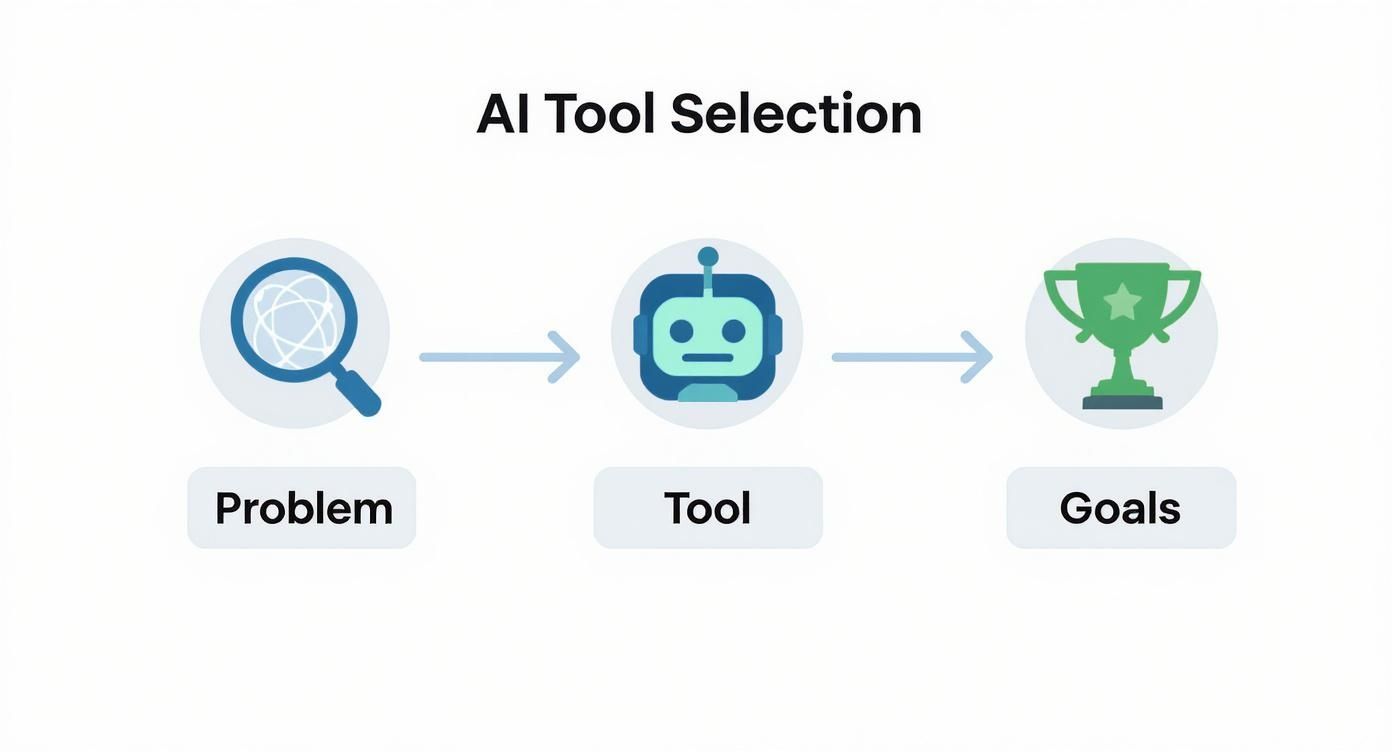
It’s a visual roadmap that takes the guesswork out of the process, making your first step into AI marketing feel clear and totally manageable.
Identify Your Biggest Marketing Bottleneck
Before you even glance at a single AI tool, stop and take a hard look at your marketing workflow. Where are you bleeding the most time? What repetitive task makes you dream of hiring an assistant? The answer to that question is your starting point.
This bottleneck is usually a task that’s critical for growth but is an absolute time-suck. It’s the friction point that’s holding you back.
For most small businesses, these bottlenecks look pretty familiar:
- Content Creation: You know you need to publish blog posts and social media updates, but you can never seem to find the hours to actually write. Producing one good piece of content can eat up half a day.
- Lead Nurturing: New leads are coming in, but many go cold simply because you don't have a solid system to follow up with them consistently and personally.
- Data Analysis: You've got analytics from your website and social media, but it feels like a mountain of numbers you don't have time to climb. You know there are insights in there somewhere, but who has time to find them?
- Social Media Management: You’re spending way too much time manually scheduling posts across different platforms and trying to guess the best times to post to get any engagement.
Just pick one. The most successful AI marketing strategy starts by solving one real, nagging problem.
By focusing on your single biggest challenge, you ensure that your first experience with AI is not just an experiment, but a genuine solution that frees up your most valuable resource: your time.
Select One High-Impact Tool
Once you've nailed down your bottleneck, the next step is finding the right tool for that specific job. Don't get distracted by platforms promising to do everything under the sun. Your mission is to find a specialist, not a jack-of-all-trades.
For example:
- If your bottleneck is content creation, check out an AI writing assistant like Jasper or a tool that helps with search engine optimization (SEO) like SurferSEO. You can build a stronger foundation by reading our in-depth guide on search engine optimization SEO.
- If you're struggling with lead nurturing, an AI-powered email platform like Klaviyo can help you automate personalized follow-up emails that feel human.
- If social media is your time sink, a tool like Later can use AI to suggest the best times to post and help you schedule content weeks in advance.
The key here is to match the tool directly to the problem you identified. Many of these platforms offer free trials or basic free plans, so you can test them out with almost no risk. This focused approach makes picking a tool much less intimidating.
Set a Clear and Measurable Goal
The final step is defining what success actually looks like. Without a clear goal, your new AI tool is just a shiny object. You need to give it a specific job to do with a Key Performance Indicator (KPI) so you can tell if it's really working for you.
Your goal needs to be specific, measurable, achievable, relevant, and time-bound (that’s a SMART goal). Vague ambitions like "improve our content" just won't cut it.
Here are a few examples of strong, measurable goals:
- Reduce Content Creation Time: "Use an AI writing assistant to decrease the time it takes to write one blog post from 4 hours to 2 hours within the first month."
- Increase Lead Engagement: "Implement an AI email tool to achieve a 15% open rate on our automated welcome series for new subscribers this quarter."
- Boost Social Media Consistency: "Use an AI scheduler to post on Instagram 5 times per week, every single week, for the next two months."
By setting a concrete target, you turn aimless experimentation into a focused business strategy. This simple, three-step framework—identify a problem, select a tool, and set a goal—removes the guesswork and lets you build your first AI marketing strategy with total confidence.
Real-World Examples of AI Marketing Success
Theory is one thing, but seeing AI marketing for small business in action really brings its power to life. Abstract ideas suddenly click when you see how businesses just like yours are using this tech to solve everyday problems and actually grow.
These aren't stories about mega-corporations with bottomless budgets. They're about local shops and online stores finding clever, practical ways to get ahead.
Let's walk through a couple of relatable scenarios. I’ve broken them down into a simple "Challenge-Solution-Result" format so you can see the direct impact a single, well-chosen AI tool can have. These are real-world applications you could adapt for your own business tomorrow.

The Local Bakery Boosting Foot Traffic
-
Challenge: A neighborhood bakery was struggling to keep up with social media. The owner was busy baking, so posts were inconsistent. They were missing out on chances to connect with locals and announce daily specials, and their quiet online presence wasn't driving people through the door.
-
Solution: They signed up for an AI-powered social media manager. The tool helped them brainstorm post ideas, write catchy captions, and automatically schedule everything to go out when their local audience was most active online.
-
Result: Within just two months, their online engagement tripled. The steady stream of posts about fresh-baked bread and daily deals led to a 20% jump in weekday foot traffic, with new customers regularly mentioning they saw the posts online.
The Online Apparel Shop Winning Back Customers
-
Challenge: A small e-commerce clothing store had a lot of one-time buyers but couldn't get them to come back. Their generic, mass-email newsletters were getting ignored, with terrible open rates and almost no sales.
-
Solution: They integrated an AI email marketing platform that looked at each customer's purchase history. The AI then automatically sent personalized emails with product recommendations based on what they'd already bought. If someone bought running shorts, they'd get an email a week later showing off matching athletic tops.
-
Result: This personal touch led to a 35% increase in repeat customer sales in the next quarter. Even better, their email open rate shot up from a measly 12% to 28%—proof that sending people what they actually want to see works.
These examples drive home a critical point: AI marketing success isn't about juggling a dozen complicated tools. It's about finding one that solves a specific, nagging business problem. That's how you get clear, measurable results.
This isn't just a niche trend; it's quickly becoming the standard. A 2025 study showed AI adoption among small businesses has surged, with 58% now using generative AI—a huge leap from 40% in 2024.
The impact is impossible to ignore. 77% of these businesses said that limiting their use of AI would hurt their growth. And here's a stat that busts a common myth: a striking 82% of small businesses using AI also increased their number of employees, proving that AI helps companies expand, not replace people. You can dig into the numbers yourself in the U.S. Chamber's report on AI empowering small business.
The data is clear: small businesses are well past the "experimenting" phase. They're actively using AI to build stronger, more successful companies. In that same spirit of using modern tools to grow, our guide on the 10 powerful benefits of video marketing shows how you can supercharge your video efforts with AI-powered creation and editing tools.
Navigating Common AI Marketing Challenges
Jumping into any new tech has its learning curve, and AI marketing for small business is no different. The potential is huge, but it pays to know about the common hurdles you might run into. Getting ahead of these challenges from the start will help you build a strategy that actually works for the long haul.
A lot of business owners worry that using AI will make their brand feel robotic or impersonal. It’s a totally valid concern. Your unique voice and customer relationships are your biggest assets, so the last thing you want is to trade that human touch for a bit of efficiency. This can definitely happen if you treat AI as a replacement for your own creativity instead of a partner to it.
Then, of course, there's the data side of things. Since AI runs on data, questions about privacy and security are bound to pop up. How do you know your customer data is safe? And finally, there’s the simple fact of getting started—learning new tools takes time, and it's easy to feel overwhelmed at first.
Keeping Your Brand’s Human Touch
The number one fear is that AI-generated content will suck the personality right out of your brand, making you sound like everyone else. The trick is to change how you think about these tools. Don't see an AI content generator as the final author; think of it as a super-dedicated assistant who knocks out the first draft for you.
Your role is to be the editor-in-chief. You always need to review and tweak what the AI gives you to:
- Inject Your Unique Voice: Add your own slang, inside jokes, and personal stories.
- Fact-Check for Accuracy: AI isn't perfect and can get things wrong. Make sure every stat and claim is spot-on.
- Share Real Stories: Weave in genuine customer testimonials and case studies that only you have.
By treating AI as the starting line, you get all the speed without sacrificing the authenticity that built your customer base in the first place.
Key Insight: Let AI handle the first 80% of the heavy lifting. That frees you up to add the final 20% of human creativity and strategic polish that makes your marketing truly connect. That’s where the real magic happens.
Addressing Data Privacy Concerns
When you hook AI tools into your systems, you're often giving them access to your customer data. This makes picking the right platforms a really big deal. You wouldn’t hand your company’s financial records to a stranger, and you should be just as careful with your marketing data.
To protect your business and your customers, stick with tools from reputable companies that are upfront about their data policies. Look for platforms that follow privacy rules like GDPR. A trustworthy AI provider will make it easy to understand how your data is used, stored, and kept safe. A little bit of homework here can save you from massive headaches later.
Overcoming the Initial Learning Curve
Feeling a bit lost the first time you open a new AI tool? That’s completely normal. The secret is to not try and master everything all at once.
Pick one simple, high-impact task to start. For example, just focus on using an AI tool to brainstorm five blog post ideas. That's it. Once you're comfortable with that, maybe try using it to create outlines for those ideas.
By taking these small, steady steps, you build confidence and avoid getting burned out. This approach turns what feels like a massive mountain into a manageable—and even fun—climb.
Frequently Asked Questions About AI Marketing
Jumping into any new tech always comes with a few questions, and AI marketing for small businesses is no different. It's totally normal to wonder about the cost, how it'll affect your team, and whether you can still keep your brand's unique flavor. This section gives you straight answers to the most common worries we hear from business owners, so you can move ahead with confidence.
Here's what people ask us the most.
Is AI Marketing Too Expensive for a Small Business?
Not at all. While you hear about giant companies spending a fortune on massive AI platforms, the market is full of affordable—and even free—tools built specifically for businesses like yours. Many of the most popular tools for creating content, managing email lists, or handling social media have generous free plans or low-cost options that pack a serious punch.
The trick is to start small. Pinpoint one specific headache you want to solve, like coming up with blog post ideas or scheduling your social media posts, and find a tool that fits your budget. When you measure the return in time saved and things getting done faster, these tools often pay for themselves almost immediately.
Will AI Replace My Marketing Team?
This is a big one, but the truth is, AI is more of a helpful sidekick than a replacement. AI tools are amazing at the repetitive, data-crunching tasks that eat up so much time—like analyzing keywords, sending personalized emails to hundreds of people, or whipping up a first draft of a social media post. This frees up you and your team to focus on what people do best.
AI handles the grunt work, which lets your team put their brainpower into big-picture strategy, creative ideas, building real relationships with customers, and making the final call. The businesses that really succeed with AI use it to empower their team, letting them get more done without getting burned out.
This kind of partnership lets you scale up your marketing in a way that used to require a huge team and budget.
How Do I Keep My Brand Voice with AI Content?
Keeping your brand's personality is non-negotiable. It's how you build trust and stand out from the crowd. The best way to do this is to think of AI as your assistant, not the final author. It gets the first draft on paper, but you provide the strategic polish and human touch.
Here are a few simple steps to make sure your voice always comes through loud and clear:
- Create Clear Guidelines: Before you even start, have a simple document that outlines your brand’s tone, style, and a list of words you love and words you hate.
- Always Edit and Refine: Never, ever just copy and paste from an AI tool. Read through every single piece of content to inject your personality, add a personal story or two, and double-check everything for accuracy.
- Train Your Tools: Many of the smarter AI content platforms let you feed them your style guide or even "train" them on your past blog posts to get results that sound more like you from the get-go.
By always having a human in the loop, you get the speed of AI without losing the authenticity that your customers actually connect with.
Ready to see how AI can transform your marketing without all the guesswork? The team at Site Igniters specializes in building practical, AI-driven marketing strategies that deliver real results for businesses in Sacramento and beyond. Let us help you automate tasks, find more customers, and grow your brand. Start your journey with us today!
Seth Sanders is the founder of Site Igniters, a digital marketing agency in El Dorado Hills, California.