
generative engine optimization geo: Boost AI search

You've probably heard of SEO, but have you heard of Generative Engine Optimization (GEO)? It’s the next evolution of search, focused on making sure your website’s content is found, understood, and actually used by AI-powered search engines. Think of it as SEO for the age of AI, ensuring your brand's expertise shows up in answers like Google's AI Overviews.
- GEO is the next evolution of SEO, focused on making your content the answer AI search engines deliver to users.
- Practical GEO tactics include structured data, topical authority, and creating content that directly answers user questions.
- Businesses that invest in GEO now will have a significant first-mover advantage as AI search adoption grows.
Understanding the New Search Reality

The way we find information has completely flipped on its head. For years, the game was simple: climb to the top of Google’s search results page. But with AI stepping into the picture, that's no longer the whole story.
Let's break it down with an analogy:
- Traditional SEO is like a librarian pointing you to the right bookshelf. You still have to grab the book, flip through the pages, and find the answer yourself.
- Generative Engine Optimization (GEO) is like that same librarian reading the top three books on your topic and giving you a direct, summarized answer on the spot, telling you exactly which books the information came from.
This isn't some far-off future—it's happening right now. Features like Google’s AI Overviews are already changing how people search, shifting preferences from clicking links to getting instant answers. For brands, this is a whole new challenge.
Why Generative Engine Optimization Is Now Essential
With GEO, your main goal is to make sure your brand's knowledge is accurately represented and cited inside these AI-generated answers. It's not just about ranking anymore; it’s about becoming a trusted, foundational source that the AI leans on to build its responses.
This shift is happening fast. At its I/O conference, Google announced that its AI Overview features now serve 1.5 billion monthly users in over 200 countries. AI-powered search already makes up about 6% of global search traffic, and some experts predict that number could hit 10-14% by 2028.
People are asking longer, more conversational questions and getting what they need without ever clicking a blue link. This is a massive change. You can learn more about how AI Engine Search Optimisation is reshaping web traffic.
The new benchmark for success isn't just ranking #1. It's becoming the source the AI trusts enough to quote directly. This makes your brand an authority not just to users, but to the machines that guide them.
Building Your Foundation for GEO Success
To adapt, you need to focus on strategies that signal undeniable authority and clarity to AI systems. The core idea is to structure your content so it's factual and incredibly easy for a machine to process.
Your website must become the absolute source of truth for your niche. When an AI scours the web to answer a question, you want your content to be the clearest, most reliable, and most authoritative option it finds. That's how you win in this new era of search.
To get a real handle on generative engine optimization geo, you have to peek behind the curtain and see how the machine actually "thinks." These AI models don't just find answers like a traditional search engine. They build them from scratch. They do this by crawling, indexing, and then mashing together information from a mind-boggling number of online sources—including your website.
Think of it like a chef making a gourmet soup. The generative AI is the chef, and the entire internet is their pantry. Your website's content—let's say it's a bundle of fresh, organic carrots—is just one of the ingredients available. The chef might grab your carrots, some celery from another site, and some broth from a third, then simmer it all together to create something entirely new: the soup. Or in our world, the AI-generated answer.
Your job is to be the best-tasting, highest-quality ingredient in that pantry. You want the chef to reach for your carrots every single time because they're crisp, clean, and packed with flavor. That means your content needs to be sharp, authoritative, and structured in a way that's incredibly easy for the AI to digest.
Uncovering the Hidden Prompt
Here’s a crucial piece of the puzzle that most people miss. When a user types something into a search bar, the AI doesn't always take it at face value. It often reworks the query behind the scenes into a much more detailed set of instructions for itself. This rephrased query is the hidden prompt.
Let’s say a user types: "best pizza Sacramento."
The AI's internal hidden prompt might expand that into something far more complex: "Generate a list of the highest-rated pizza places in Sacramento, California. Factor in recent customer reviews, price points, and unique menu items. Include the full address and business hours for each restaurant."
This is the real query the AI is working to answer. Understanding this is a game-changer because you're not just optimizing for what people type; you're optimizing for what the AI is actually trying to find. This is where so many businesses drop the ball on generative engine optimization geo.
From Entities to Knowledge Graphs
Generative AI doesn't just see a sea of text. It organizes information by identifying entities—which are just distinct things, people, places, or concepts—and mapping out the relationships between them. All these connections form a massive digital spiderweb called a knowledge graph.
Your business is an entity. Your location is an entity. The services you offer are entities. The AI's whole job is to figure out how these pieces all fit together.
- Entity: "Site Igniters"
- Relationship: is a
- Entity: "Digital Marketing Agency"
- Relationship: located in
- Entity: "Sacramento"
When you create a clear, consistent digital footprint across the web, you're essentially helping the AI place your business correctly on its map. The more trustworthy and interconnected your information is, the more likely the AI is to use it as a source when building answers about your industry in your location.
This same principle is the bedrock of how you can optimize your website for voice search, since voice assistants rely heavily on these knowledge graphs to spit out quick, factual answers. You can even see this in action by looking at how Google's AI Overview ranks YouTube chapters; it's all about breaking down content into structured, related pieces.
The strength of your online presence isn't just about keywords anymore. It’s about how clearly you define your brand as an entity and build its authority through solid connections in the AI's worldview.
At the end of the day, your website's content becomes a primary source for the AI's synthesis process. When your articles, service pages, and FAQs are packed with clear, factual, and well-organized information, you’re doing more than just writing for customers. You are directly spoon-feeding the AI the premium ingredients it needs to craft reliable, comprehensive answers that put your brand front and center.
The Core Pillars of a Winning GEO Strategy
Okay, so we know how generative AI thinks. The next logical step is figuring out how to influence what it thinks. Building a solid Generative Engine Optimization (GEO) strategy isn’t about trying to trick some new algorithm; it's about making your brand the most reliable and trustworthy source of information in the AI's "mind."
It all boils down to a foundation built on three core pillars. These pillars work together to prove you're the real deal.
To get a picture of what's happening behind the curtain, think about the AI's process like this: it crawls the web for data, indexes it for organization, and then synthesizes everything it finds into a single, cohesive answer.
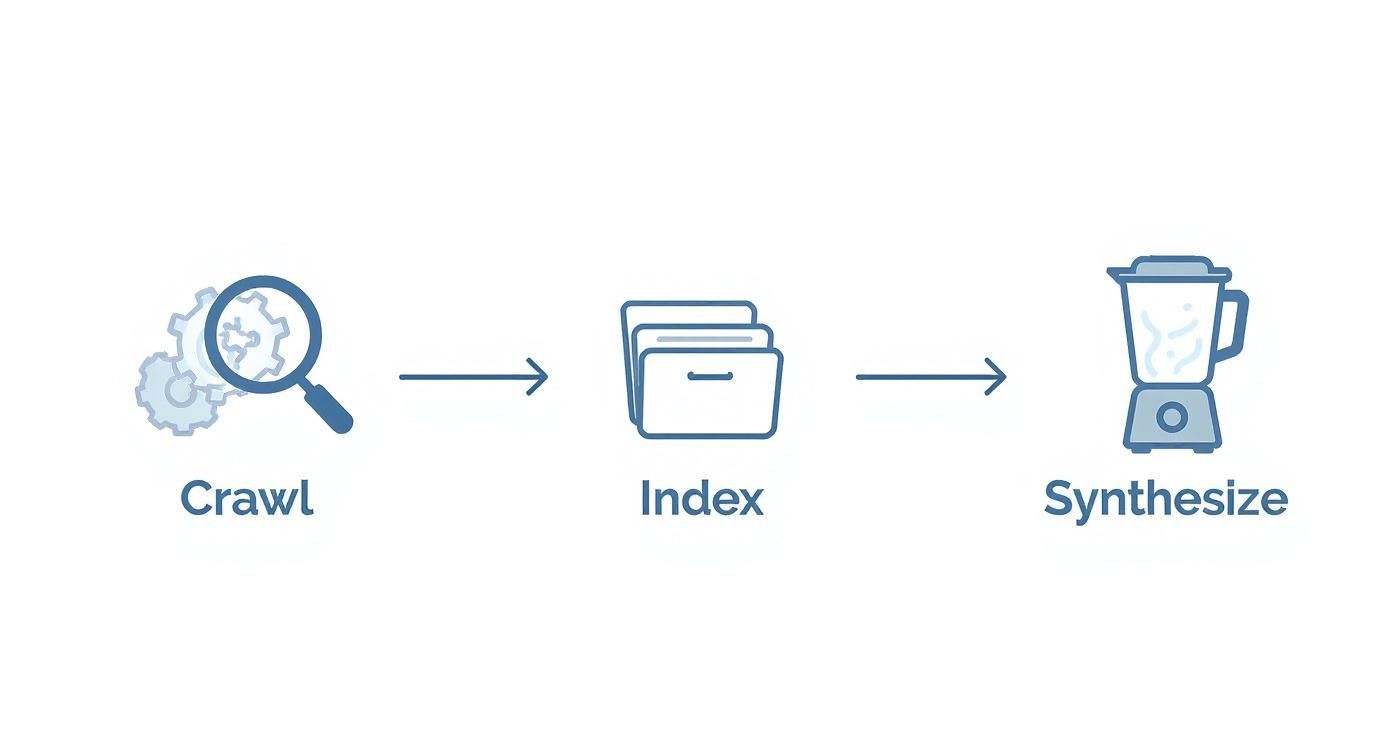
This simple flow shows why just having great content isn't the whole story anymore. That content has to be structured and authoritative enough to make it through the AI's synthesis blender and come out on top.
Pillar One: Unimpeachable Authority
Without a doubt, the single most critical factor in GEO is demonstrating absolute authority. AI models are programmed to favor accuracy and snuff out misinformation, which means they lean heavily on signals of Experience, Expertise, Authoritativeness, and Trustworthiness (E-E-A-T).
For any local business, this starts with a consistent and verifiable digital footprint. Your business name, address, phone number (NAP), and the services you offer have to be identical everywhere—from your website's footer to the most obscure industry directory. Even a small inconsistency plants a seed of doubt for the AI, making it less likely to trust your information.
This isn't a new concept; it's the bedrock of local SEO. In fact, getting this information perfectly aligned is a huge part of how you can optimize your Google Business Profile for better visibility. When an AI cross-references your details and sees the same correct info over and over, it validates you as a legitimate, trustworthy entity.
Pillar Two: Highly Structured and Factual Content
Generative engines don't browse your content for a good read; they strip-mine it for facts. Your content needs to be built for machine readability first and human engagement second. Think of it as creating the ultimate cheat sheet for the AI.
This means using a clear, logical hierarchy with proper heading tags (H1, H2, H3). It means breaking down complex ideas into simple bulleted or numbered lists and using tables to lay out data. An AI can pull a specific data point from a well-organized table in a fraction of a second, but it might completely miss that same fact buried inside a dense paragraph.
Your goal is to make your content the easiest, fastest, and most efficient place for an AI to grab a specific fact. The easier you make its job, the more likely it is to cite you as the source.
Start working these elements into your pages:
- FAQ Sections: Use schema markup to clearly define questions and their corresponding answers, directly targeting common queries.
- Data-Driven Tables: Present comparisons, product specs, or pricing in a structured table that a machine can instantly understand.
- Definitive Statements: Write clear, unambiguous sentences that can be easily lifted and quoted. Something as simple as, "Our agency is located at 123 Main Street in Sacramento, California" is perfect.
Before we move on, let's look at how this new focus changes things. The table below breaks down the shift from older SEO habits to what GEO demands today.
Comparing Traditional SEO and GEO Focus Areas
| Focus Area | Traditional SEO Approach | Generative Engine Optimization (GEO) Approach |
|---|---|---|
| Keyword Strategy | Broad keyword targeting and keyword density. | Focus on conversational queries and long-tail keywords that match user intent. |
| Content Creation | Long-form blog posts aimed at human readers. | Highly structured, fact-based content with clear hierarchies (headings, lists). |
| Authority Signals | Backlinks and domain authority are primary. | Verifiable E-E-A-T signals and consistent NAP data across all platforms. |
| Technical SEO | Focus on site speed, mobile-friendliness, and crawlability. | All of the above, plus heavy emphasis on structured data (Schema markup). |
| Local Signals | Citations and Google My Business optimization. | Deep contextual links connecting services to specific neighborhoods and local entities. |
As you can see, the fundamentals are still there, but the emphasis has shifted dramatically towards clarity, structure, and verifiable facts.
Pillar Three: Semantic Context and Clarity
The final pillar is all about optimizing for semantic context. This goes way beyond just stuffing keywords into a page. It's about showing the AI you understand the meaning behind the words and the relationships between different concepts. You need to create content that doesn't just mention a topic but explains how it connects to everything else around it.
For instance, a plumber in El Dorado Hills shouldn't stop at a page for "emergency plumbing." A GEO-focused strategy would build a web of content connecting that core service to specific local entities ("emergency plumbing for burst pipes in the Serrano neighborhood"), common problems ("what to do when your water heater fails in an El Dorado Hills winter"), and related services ("local water damage restoration services").
This rich, contextual linking helps the AI see that you have deep expertise in your specific domain and your geographic area. By building out this web of interconnected information, you’re proving a comprehensive grasp of your field that an AI can easily recognize and reward.
Practical GEO Tactics You Can Implement Now

Okay, let's move from the high-level theory to the hands-on stuff where you'll actually see some results. Getting GEO to work for you isn't about guesswork. It's about taking specific, concrete steps to make your content easy for machines to read and, more importantly, trust.
Here are some actionable tactics you can start using today. Each one is designed to make your business information simple for an AI to find, verify, and cite in its answers. This is how you go from just having a website to becoming a go-to source for AI.
Structure Your Content for AI Consumption
First things first: you need to rethink how you format your content. AI models aren't browsing your site for a good read; they're scanning it for cold, hard facts and structure. Your job is to make it as easy as possible for them to pull that data out.
Start using question-based headings that sound like something a real person would ask. Instead of a generic title like "Our Services," try something like, "What Types of Lawn Care Do You Offer in Roseville?" This lines up perfectly with how people use conversational search.
You also need to break down complex topics into short paragraphs and easy-to-scan lists. Research shows that AI-powered search loves pulling answers from content structured with clear headings and bullet points. This helps your key points stand out as definitive, quotable snippets.
Embrace Definitive Factual Statements
AI loves clarity. It ignores vague language but latches onto direct, factual statements it can use to build an answer. You need to sprinkle your content with these kinds of verifiable facts.
We're talking about simple, direct sentences like:
- "Our main office is located at 123 Main Street, Sacramento, CA."
- "We have helped over 500 homeowners in the El Dorado Hills area."
- "Our technicians hold certifications in X, Y, and Z."
These unambiguous statements are the perfect ingredients for an AI trying to piece together an answer about local businesses. They're easy to understand and, crucially, easy to cross-reference with other sources to verify their accuracy.
Key Insight: Your website content is no longer just for your human visitors. Think of it as a direct data feed for AI models. Every piece of structured information you provide is a potential citation in a future AI-generated response.
Conduct a Source Consistency Audit
One of the most powerful things you can do for your GEO is a source consistency audit. This is a fancy way of saying you need to meticulously check that your business's core information is exactly the same everywhere it shows up online. AI builds trust through corroboration, and inconsistencies are a major red flag.
Your audit checklist should cover these basics:
- Business Name: Is it written identically on your site, your Google Business Profile, Yelp, and everywhere else?
- Address: Does every single listing show the exact same street address, suite number, and ZIP code? No variations.
- Phone Number: Is the main phone number consistent, right down to the formatting?
- Services Offered: Do your service descriptions match up across all platforms?
Think of your online presence as a pile of evidence. When an AI finds dozens of sources all pointing to the same facts, it considers that information verified. This audit is a fundamental step in building the kind of authority that generative engines reward. If you want to dig deeper into these core principles, our complete guide to search engine optimization covers many best practices that overlap with GEO.
Implement Advanced Schema Markup
The technical side of your site plays a huge role in making it legible to machines. Schema markup is essentially a vocabulary of code you add to your website to help search engines understand what your content is about. For GEO, it's a must-have.
Don't just stop at the basics. You need to implement more advanced types of schema:
- Organization Schema: This clearly tells AI that you're a business entity, spelling out your official name, logo, address, and social media profiles.
- FAQPage Schema: This structures your frequently asked questions in a way that AI can easily grab for direct answers to user queries.
- Person Schema: This helps establish the expertise and credibility of your authors and key team members, which is a direct signal for E-E-A-T (Experience, Expertise, Authoritativeness, and Trustworthiness).
This structured data acts like a set of neatly printed labels for an AI, removing any guesswork about who you are, what you do, and why you're an authority. By connecting these technical dots, you make it dead simple for AI to understand your business and its role in the local information landscape.
The Future of GEO and Its Business Impact
When you look at the horizon, it's pretty clear that generative engine optimization geo isn't just another industry acronym we'll have to memorize. It signals a major pivot in how search works. We’re moving away from the old-school obsession with clicks and rankings. The new game is all about authority, influence, and most importantly, accuracy within AI-powered answers.
This forces us to rethink what website traffic even means. Sure, your overall clicks might dip a bit as more people get their questions answered directly by an AI. But the visitors who do click through? They're going to be incredibly qualified. They’ve already seen your brand featured in a trusted, summarized answer and are coming to you ready for a deeper dive or to make a purchase.
Getting on board with GEO isn’t just another marketing task to check off the list. Think of it as a long-term investment in your brand's digital relevance. It’s about making sure you’re still a trusted voice as search technology barrels forward.
This whole shift is tied to a massive economic wave. The AI sector, which is the engine behind generative search, is becoming a huge piece of the global economy. By 2025, the AI industry is projected to hit a global value of around $391 billion, and some estimates show it could explode nearly ninefold by 2033. This isn't just happening in a vacuum; it’s reshaping the job market, with about 1.8% of new job listings now requiring AI skills and 90% of tech professionals using AI in their daily work. As businesses pour more money into AI-driven marketing, this tech is becoming baked into everything we do, including SEO. You can dig into more of the numbers behind this trend in these compelling AI industry statistics.
Emerging Trends in Generative Search
The world of generative engine optimization is still being built, but we can already see a few key trends popping up that will define what’s next for search. If you want to stay competitive, you need to keep your eye on these.
So, what should you be watching?
-
Hyper-Personalized AI Answers: In the near future, AI engines won’t just give a generic answer. They'll use your past searches, your location, and other real-time clues to give you an answer that's specifically for you. For a local shop, this could mean the AI suggests your store because it knows the user bought something similar last month.
-
Multimodal Search Integration: Search is breaking free from the text box. People will soon be asking questions with images, voice commands, and even videos. The AI will then pull from all these sources to create an answer. Suddenly, optimizing your photos and video content becomes just as critical as writing a good blog post.
-
Proactive AI Assistants: AI is going to stop waiting for you to ask a question. It will start anticipating what you need and offer up information before you even search. Imagine your business being recommended to someone based on their recent activity, before they even realize they need what you offer.
Your Strategic Imperative
At the end of the day, embracing generative engine optimization geo is about making your business future-proof. It’s a call to shift your thinking from chasing quick ranking wins to building a brand presence that is so solid and authoritative that both people and machines can't help but trust it.
When you focus on undeniable authority, clean structured data, and making sure your information is consistent everywhere, you’re not just optimizing for today’s AI. You’re building the foundation to become a go-to source for the smarter, more personalized, and proactive search engines that are right around the corner. The effort you put into GEO today is going to pay off for years, keeping your brand visible, credible, and chosen in a world that’s increasingly powered by AI.
Your Questions About GEO Answered
Jumping into generative engine optimization (GEO) is bound to bring up some questions. It’s a new frontier, and you’re probably wondering how it all fits in with the marketing you’re already doing. The field might seem complex on the surface, but the core ideas are pretty simple once you break them down.
Let's clear up some of the most common questions we hear.
Does GEO Replace Traditional SEO?
Absolutely not. Think of GEO as the next step in the evolution of search, not something that throws out the old rulebook. It builds directly on the foundation you've (hopefully) already laid with traditional SEO.
You still need a website that's technically sound, loaded with quality content, and backed by strong authority signals. Without that solid SEO base, generative engines won't even see you as a credible source to pull from. GEO is the layer you add on top—the specific tweaks that make your great content perfectly formatted for an AI to understand and use.
Generative Engine Optimization doesn't replace SEO; it refines it. Your goal shifts from just ranking for a keyword to becoming a cited, trusted source within the AI's synthesized answer.
What Is the Most Important Factor for GEO Success?
If you had to boil it all down to one thing, it would be verifiable authority. Generative engines are obsessed with accuracy. Their entire model depends on stamping out bad information and delivering trustworthy answers. They’re built to heavily favor sources that are proven experts in their field.
This means you need to be producing deeply researched content that screams expertise. It also means showing your work by citing sources, highlighting author credibility, and making sure your business information is identical everywhere it shows up online. In the world of GEO, your expertise isn't just important—it's everything.
How Can I Measure the ROI of GEO Efforts?
This is where you have to shift your thinking a bit. Measuring the return on GEO isn't about staring at keyword rankings and organic traffic charts anymore. The game has changed, and so have the metrics. Now, it’s all about measuring your influence and authority within the AI’s world.
You’ll want to start tracking a new set of KPIs:
- Brand Mentions: How often is your brand named in AI answers when people ask questions related to your industry?
- Source Citations: Is your website getting directly linked as a source in AI Overviews and other generative platforms?
- Information Accuracy: When an AI does talk about you, is it getting the details right? Is the sentiment positive?
Success here is less about hitting that #1 spot and more about becoming the go-to, frequently cited source that the AI trusts. This is a long-term play that builds incredible authority and sends highly qualified, ready-to-convert users your way.
Ready to make your business the trusted authority for AI? Site Igniters blends expert SEO with forward-thinking GEO strategies to make sure you’re not just found, but cited and chosen in this new era of search. Let's build your future-proof digital presence together. Learn more at https://siteigniters.com.
Seth Sanders is the founder of Site Igniters, a digital marketing agency in El Dorado Hills, California.