
How to Build Backlinks Naturally: A Proven Guide


To really build backlinks naturally, you have to create resources so good that other websites want to link to them. The whole mindset shifts from asking for links to earning them. This comes down to a mix of creating high-quality assets, building genuine relationships, and using smart public relations. It's the only approach that builds sustainable growth and real authority in the eyes of search engines.
- Natural link building focuses on earning links by creating resources so valuable that others want to reference them.
- Genuine outreach and digital PR generate high-authority backlinks without spammy tactics.
- Link reclamation and broken link building offer quick wins with minimal content creation effort.
Why Natural Link Building Is Non-Negotiable

Before you even think about sending an outreach email, you need to get your head around what "natural" link building really means today. It’s not a numbers game about stacking up as many links as possible. It’s about earning the kind of trust and authority that Google actively rewards. Think of a natural backlink profile as a powerful, organic stamp of approval for your site's credibility.
This philosophy pulls you away from risky, short-term tactics that can get you penalized. Instead, you focus on a sustainable, value-first strategy. Rather than chasing metrics, you put all your energy into creating something genuinely worth linking to. This is the fundamental principle that separates a flash-in-the-pan win from long-term success in modern search engine optimization (SEO).
The Foundation of Trust and Authority
Every natural backlink you earn is basically an editorial vote of confidence. When a reputable site links to your content, they’re telling their audience—and just as importantly, search engines—that your page is a trustworthy resource. This is worlds away from artificial links you might get through payment or spammy schemes, which search engines have gotten incredibly good at spotting and devaluing.
A smart natural link building strategy often starts with a solid grasp of how to build a brand strategy. When you have a strong brand identity, it shapes the kind of authoritative content you create and the audience you're trying to reach. This makes all your outreach feel more authentic and, ultimately, more effective.
The real goal isn't just to earn links—it’s to become part of the conversation. Getting cited alongside trusted brands in relevant content carries more weight than obsessing over anchor text alone.
Natural vs. Unnatural Link Building Tactics
It's easy to get confused about what's fair game and what could land you in hot water. Here's a quick breakdown of sustainable, natural methods versus the risky tactics you should absolutely avoid.
| Tactic | Natural Approach (Recommended) | Unnatural Approach (Avoid) |
|---|---|---|
| Content Creation | Creating genuinely useful, original content that attracts links on its own merit. | Spinning articles or creating thin content just to have something to build links to. |
| Outreach | Building real relationships with editors and site owners to share relevant content. | Sending mass, impersonal emails to buy links or ask for placements on irrelevant sites. |
| Guest Posting | Writing high-quality, insightful articles for relevant, authoritative publications. | Publishing low-quality posts on spammy sites purely for the backlink. |
| Directories | Submitting your site to respected, niche-specific, or local business directories. | Paying for inclusion in thousands of low-quality, generic web directories. |
| Comments/Forums | Adding valuable, insightful comments to relevant discussions and including a link where appropriate. | Spamming blog comments and forums with keyword-stuffed, irrelevant links. |
Focusing on the "Natural Approach" column is how you build an asset that grows in value over time, not a liability that you have to clean up later.
Why It's a Competitive Advantage
Let’s be honest: building links naturally is hard. And that's exactly why it's so valuable. The competition is insane; something like 94% of all pages online have zero external links pointing to them. Earning them takes a deliberate strategy focused on producing top-tier content and nurturing real relationships.
All that effort pays off by creating a competitive moat around your website that's tough for others to cross. While your competitors are busy buying temporary links that might disappear tomorrow, your earned links from authoritative sources provide lasting value. Ultimately, this is how you build a resilient digital presence that can weather any storm—including future algorithm updates.
Create Content That Naturally Attracts Links

Let's be honest. The entire game of natural link building comes down to one simple truth: you have to create something genuinely worth linking to. No amount of clever outreach or fancy tools can make up for content that’s just… average.
This is where linkable assets come into play. A linkable asset isn't just another blog post; it's a piece of content so useful, insightful, or unique that other writers and creators want to reference it. Think of it as a strategic investment that acts as a magnet, pulling in high-authority links long after you hit "publish."
This is how you stop chasing links and start earning them on autopilot.
Finding Your Next Big Idea
Before you even think about writing, you have to find a gap in the conversation. Pumping out another "me too" article is a surefire way to be ignored. Instead, a content gap analysis helps you find what your audience is searching for but can't find—or what your competitors have covered poorly.
Start by looking at the top-ranking content for your main keywords. Ask yourself a few critical questions:
- What are they missing? Is there a crucial piece of the puzzle they’ve left out?
- Is their data old or is their advice totally outdated?
- Could I explain this topic more clearly, maybe with better visuals or real-world examples?
- Is there a chance here to build the single most comprehensive resource on this topic?
The answers will point you toward opportunities to create something that doesn't just add to the noise, but becomes the new gold standard.
Your goal isn't just to answer a question. It's to create the go-to resource that other people use to answer that question for their audiences. You want to be the source.
Picking a Format That Gets Results
Got a killer idea? Great. Now you need to package it correctly. Some content formats are just naturally more "linkable" because they provide unique value that’s easy to cite.
Here are a few formats that consistently bring in the links.
Original Data and Research
Journalists, bloggers, and industry experts absolutely love citing fresh statistics. You don't need a massive budget for this. A simple industry survey, an analysis of your own company data, or even just compiling public information into a unique study can create an asset that's almost impossible for others to replicate.
For instance, a local digital marketing agency could survey 200 small businesses in their city about their top marketing hurdles and publish the findings. Suddenly, they've created a hyper-relevant, citable piece of local data that news outlets and business bloggers will jump on.
The Ultimate Guide
A truly exhaustive guide that covers a topic from A to Z can become an evergreen link magnet for years. We're not talking about just a long article. These are meticulously structured resources, packed with actionable advice, visuals, and examples.
Long-form content absolutely crushes it here. In fact, studies show that blog posts over 3,000 words get way more backlinks than shorter ones.
Compelling Visual Assets
Remember, not all assets are text-based. Infographics, custom diagrams, and high-quality videos can be massive link magnets. Infographics are especially great because they're so easy to embed and share, often with a link back to your site.
A well-made video tutorial can be just as powerful. If you want to dive deeper, you can explore the benefits of video marketing in our guide.
Here’s a quick breakdown of how these formats stack up:
| Asset Type | Primary Value | Best For Earning Links From |
|---|---|---|
| Original Research | Provides unique, citable statistics and insights. | News outlets, industry blogs, academic sites. |
| Ultimate Guides | Offers comprehensive, one-stop-shop information. | Niche bloggers, resource pages, educational sites. |
| Visual Assets | Simplifies complex data in a shareable format. | Social media, visual platforms, roundup posts. |
By focusing on developing one or two of these core assets, you build a powerful foundation for all your link building efforts. Every other piece of content you create can point back to these cornerstone pieces, strengthening your internal linking while your asset works 24/7 to pull in valuable external links. That's how you build backlinks the smart way.
Mastering Outreach Without Being Spammy
Having a brilliant, linkable piece of content is a fantastic start, but let's be honest—it’s only half the battle. If you want to build backlinks naturally, you have to get that content in front of the right people. This is where outreach comes in, and unfortunately, it often gets a bad rap for being spammy and transactional.
But modern, effective outreach is the complete opposite of that. It’s all about building real relationships, offering genuine value, and starting conversations. The whole mindset has to shift from "what can you do for me?" to "here's something that can help you."
Identifying and Vetting Your Prospects
Before you even think about writing an email, you need a highly curated list of people who will actually care about what you've made. Blasting a generic list is a complete waste of time and, worse, it can damage your brand's reputation. The goal here is precision, not volume.
Start by looking for authors, editors, and website owners who have recently written about or linked to topics similar to your content. If you just published an ultimate guide on local SEO, your list should be full of bloggers who write about small business marketing or journalists covering digital trends.
As you build this prospect list, you have to ask some critical questions for every single entry:
- Is it relevant? Does this person consistently cover my topic? An out-of-the-blue pitch on something they never talk about is the fastest way to get your email marked as spam.
- Does the audience fit? Would their readers genuinely get value from my resource? If you can't give a clear "yes" to that question, move on.
- Are they active? Is the site actually being updated? Look for recent posts, social media activity, and comments from readers. An abandoned blog isn't going to get you a link.
Tools like Ahrefs or Semrush can definitely speed this up by showing you who links to your competitors. But there's no substitute for manual vetting. This is where you separate the real, high-value opportunities from all the noise.
The Art of the Personalized Pitch
Your email is your first impression, so make it count. A generic, copy-pasted template screams, "I want something from you." A personalized, thoughtful message shows you've done your homework and that you respect their time. The best outreach emails aren't really templates at all; they're conversation starters.
While every email needs to be unique, a successful pitch usually has a few key things going for it.
- A Genuine, Specific Compliment: Show them you're actually familiar with their work. Don't just say, "I love your blog." Reference a specific article, a point they made on a podcast, or something they recently posted on social media. For example, "Your recent article on content marketing frameworks was brilliant—I especially liked your take on the hero-hub-hygiene model."
- The Value Proposition (The "Why"): Get to the point and explain why you're reaching out and what's in it for them. Don't lead by asking for a link. Instead, offer your content as a resource that could add value to a specific article they've already written. Frame it as a way to make their existing content even more helpful for their audience.
- A Soft, No-Pressure Ask: End your email with an easy, low-commitment call to action. Instead of demanding, "Can you add my link?" try something much softer like, "If you think it would be a good fit for your readers, I'd be thrilled if you considered including it." This gives them an easy out and feels more like a helpful suggestion than a demand.
The most successful outreach isn’t about tricking someone into giving you a link. It's about finding a point of mutual benefit and building a real connection. Your goal should be to become a trusted source they'll want to hear from again in the future.
Warming Up Before the Pitch
Often, the best outreach starts long before you ever send that first email. Engaging with your prospects on social media is a powerful way to get on their radar in a natural, non-intrusive way.
Follow them on platforms like X (formerly Twitter) or LinkedIn. Share their content, leave thoughtful comments on their posts, or reply to their stories. This isn't about spamming them with a bunch of "great post!" comments; it's about adding to the conversation in a meaningful way.
When you finally do send that email, you're no longer a complete stranger. A simple opening like, "Hi Jane, I've really been enjoying your recent posts on LinkedIn about AI in marketing…" instantly makes your message warmer and much more likely to be read. This small investment in relationship-building can dramatically increase your response rate and turns a cold ask into a warm introduction.
Use Digital PR to Attract High-Authority Links
Once you've got a handle on creating great content and doing smart outreach, digital PR is the next level. This is how you really start to attract those big, high-authority links that can significantly impact your rankings.
It’s a shift in mindset. Instead of one-to-one requests, you're broadcasting your expertise to a much wider audience. You're not just asking for links; you're earning media coverage that comes with powerful, context-rich backlinks that Google values. If you're new to the concept, it’s worth understanding what is earned media and why it's such a big deal for brand authority.
The game is about creating a newsworthy story, getting it in front of the right people, and then engaging with the communities that care about it.
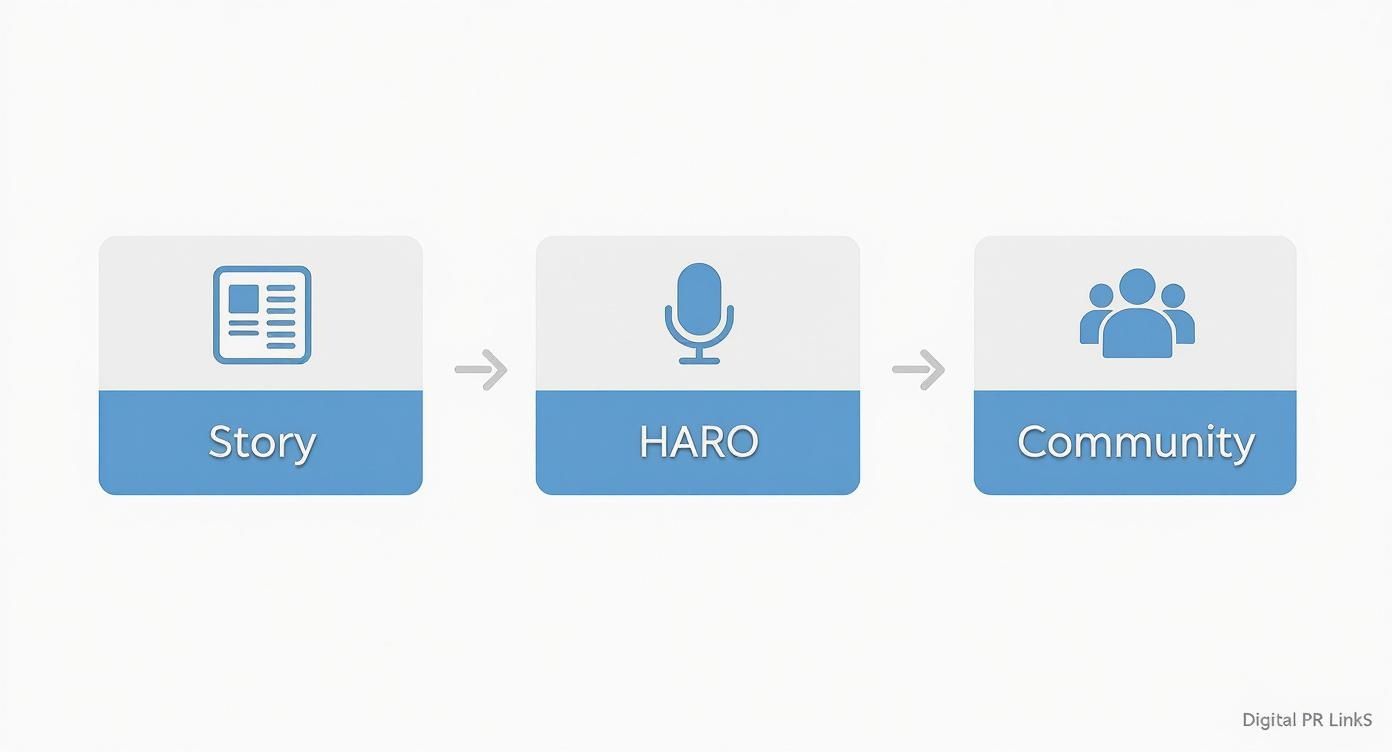
When you combine proactive storytelling with reactive opportunities and genuine community building, you create a powerful engine for natural link acquisition.
Become a Go-To Source for Journalists
One of the most direct ways to land top-tier backlinks is to become a source for reporters who are actively looking for experts. This isn't cold pitching. It's giving journalists exactly what they need, right when they need it.
Services like Help a Reporter Out (HARO) and Qwoted are your best friends here. They send daily emails with queries from journalists who need quotes for their articles. Getting your response chosen is an art form.
Here's how to get it right:
- Be selective. Don't try to answer everything. Only jump on queries where you have a unique, interesting take you can express clearly and quickly.
- Write a killer quote. Journalists are on insane deadlines. Give them a punchy 2-3 sentence quote they can copy and paste directly into their article. Make it memorable.
- Prove your credibility. Briefly state who you are, why you're an expert on this topic, and include a link back to your site.
Do this consistently, and you'll build a reputation as a reliable expert. Eventually, journalists might even start reaching out to you directly.
Don’t just give an answer. Give them a quote they can’t resist. A fresh perspective or a catchy soundbite will beat a generic, textbook response every single time.
Build Links Through Community Engagement
Your industry's online communities are a goldmine for relevant, natural links. Think about platforms like Reddit, Quora, and niche forums where your ideal customers are asking questions every day. Your job is to show up with the best answers.
But this has to be about providing value, not spamming your links. Nobody likes a self-promoter.
- On Quora and Reddit, look for questions you can genuinely answer in detail. Write a comprehensive, helpful response. Only drop a link to your content if it adds real, follow-up value to your answer.
- In niche forums, spend time participating in discussions first. Build a reputation as a helpful member of the community before you ever share a link.
- In local community groups, engaging can be huge for local businesses. Sharing a helpful resource could not only earn a link but also indirectly support your local SEO. It's a key part of the puzzle for anyone trying to figure out how to master their Google Business Profile presence.
Think of it this way: every helpful answer you post is a micro-piece of content marketing. It builds your authority, sends referral traffic your way, and earns you backlinks that signal to search engines that you're a trusted voice in your space.
Find Quick Wins with Link Reclamation and Recovery

Not every link building campaign has to start with a massive, brand-new piece of content. In fact, some of the fastest and most effective strategies involve capitalizing on opportunities that are already out there.
Two of my favorite tactics are link reclamation and recovery. Think of these as picking up the low-hanging fruit—links you've basically already earned.
What makes these methods so powerful is how they completely change the outreach dynamic. You're not just another person asking for a favor. You're showing up with a solution, either by helping a site owner fix a broken part of their website or pointing out a way to make their content even better. This value-first approach is the secret sauce to building links that feel truly natural.
The Power of Broken Link Building
The internet is littered with dead ends. Websites go down, pages get moved, and content gets deleted, leaving behind a massive trail of broken links. The whole idea behind broken link building is to find these dead links on other sites and offer your own relevant content as the perfect replacement.
You're not just begging for a link; you’re actually doing the webmaster a service by finding a 404 error that’s hurting their site's user experience. It's a true win-win. They get to patch up their website with a quality resource, and you get a contextual backlink from a relevant page.
Here’s a simple workflow to get you started:
- Hunt for Target Sites: Look for authoritative blogs, news sites, or big resource pages in your niche. Older, more established sites are goldmines because they've had more time to accumulate broken links.
- Find the Broken Links: SEO tools like Ahrefs or Semrush can scan these sites for broken external links in minutes. You can also use handy browser extensions that highlight dead links while you browse.
- Find or Create a Replacement: Once you find a broken link, use a tool like the Wayback Machine to see what content used to be there. If you already have a similar piece of content that fits, fantastic. If not, this is your cue to create a new resource specifically designed to fill that void.
- Reach Out and Be Helpful: Your email needs to be genuinely helpful, not demanding. Start with a quick compliment about their content, then politely point out the broken link you found. Only then should you casually suggest your resource as a potential replacement.
The real secret to making broken link building work is the outreach. Your email should feel like a helpful heads-up. A subject line like "A broken link on your [Topic] page" cuts right to the chase and immediately shows you’re there to help, not just take.
Reclaiming Your Unlinked Brand Mentions
Right now, someone out there on the internet is probably talking about your brand, your products, or a piece of your content. More often than not, they don't actually link back to your website. We call these unlinked brand mentions, and every single one is a golden opportunity for an easy backlink.
You’ve already done the hard part—earning the mention. Now you just have to claim the link.
The process is surprisingly simple. You can set up free tools like Google Alerts to get an email whenever your brand name pops up online. For more firepower, paid tools can dig deeper and track mentions across forums, social media, and news sites.
When you find an unlinked mention, the outreach is a breeze. Just send a polite email to the author or site owner. Thank them for mentioning you and gently ask if they'd be willing to add a link so their readers can learn more. It's that simple.
This tactic works so well because they've already shown they value your brand enough to write about it. Personalized link building outreach has an average response rate of around 8.5%, and this kind of warm pitch can push that number even higher. Given that over half of all websites have zero backlinks, these targeted, high-success tactics are a powerful way to pull ahead of the competition. You can discover more insights about these link building statistics at Meetanshi.com. By turning existing recognition into tangible SEO value, you build backlinks naturally and efficiently.
Your Top Questions About Natural Link Building, Answered
Jumping into natural link building always brings up a ton of questions. I get it. From wondering about timelines to picking the right tools, getting a clear picture is the first step to setting realistic expectations and making sure your hard work pays off.
Let's walk through some of the most common questions that pop up when you decide to earn links the right way. Getting these answers straight is huge, because a winning strategy isn't just about going through the motions—it's about understanding why you're doing what you're doing.
How Long Does Natural Link Building Take to Show Results?
This is always the first question, and the honest answer is: it’s a marathon, not a sprint. Natural link building is a long-game SEO strategy. You might land your first few solid links within a couple of months of steady work, but seeing a real, noticeable bump in your organic rankings usually takes anywhere from 6 to 12 months.
A few things can speed that up or slow it down:
- Your Industry: Trying to make a dent in a super competitive space with big, established players? That’s going to take more time than carving out a spot in a smaller niche.
- Your Content: If your linkable assets are genuinely amazing and valuable, people will find and link to them much faster. Great content accelerates everything.
- Your Outreach: A consistent, personalized outreach effort will always get results faster than shooting out a few emails whenever you have a spare moment.
The whole point is to focus on sustainable growth. The authoritative links you earn through this patient process will deliver value for years, unlike the quick, risky gains from shady tactics.
What’s the Difference Between Natural and Unnatural Links?
Nailing this difference is crucial for your site's long-term health. Natural link building is all about earning links on merit. You create something awesome—like original research, a killer guide, or a useful tool—and other site owners link to it because it helps their audience. It's the foundation of a rock-solid SEO strategy.
Unnatural link building, on the other hand, is all about trying to manipulate search rankings. These tactics are a direct violation of Google's webmaster guidelines and carry a huge risk of getting a manual penalty, which can literally wipe your site off of Google.
| Tactic Comparison | Natural (Earned) Approach | Unnatural (Manipulative) Approach |
|---|---|---|
| Origin | An editorial choice made by another site owner. | A direct attempt to trick search engines. |
| Examples | A blogger citing your data study; a journalist quoting you as an expert. | Buying links; using private blog networks (PBNs); excessive link exchanges. |
| Risk Level | Low; builds lasting authority. | High; can lead to severe penalties. |
A natural link is a genuine vote of confidence from one site to another. An unnatural link is an attempt to game the system. And trust me, search engines have gotten incredibly good at spotting the difference.
What Are the Best Tools for Natural Link Building?
While the heart of natural link building is all about human connection and creating value, the right tools can make you way more efficient and effective. A good toolkit helps you spot opportunities, manage your outreach, and track progress without drowning in spreadsheets.
Here are a few tools I can't live without, broken down by category:
- Competitor and Opportunity Analysis: Tools like Ahrefs, Semrush, and Moz Pro are non-negotiable. They let you peek at your competitors' backlink profiles, find broken link opportunities, and identify the most authoritative sites in your niche.
- Outreach and Prospecting: When it comes to finding email addresses, Hunter.io or Snov.io are fantastic. To actually manage and scale your outreach campaigns, platforms like BuzzStream or Pitchbox are a lifesaver for keeping track of all your conversations.
- Mention Tracking: For link reclamation, you can't beat the simplicity of Google Alerts. It's a surprisingly powerful—and free—way to find unlinked mentions of your brand.
Should I Focus on Link Quantity or Quality?
Let me be crystal clear: always, always prioritize quality over quantity. This might be the single most important lesson in learning how to build backlinks naturally.
One backlink from a highly authoritative, relevant website in your industry is worth more than hundreds of low-quality links from spammy or irrelevant sites. Chasing some arbitrary number of "links per month" is a broken strategy that almost always leads to cutting corners on quality.
Focus instead on consistent, thoughtful execution. A healthy "link velocity"—the rate you acquire links—should be the natural outcome of creating great content and doing smart outreach. It shouldn't be a metric you force at all costs. Earning one or two truly high-quality links each month is a much better goal than getting 50 links that do nothing for you.
At Site Igniters, we build strategies that focus on earning high-quality, authoritative backlinks that stand the test of time. If you're ready to move beyond chasing metrics and start building real digital authority, we can help. Learn more about our SEO services and how we drive measurable growth.
Seth Sanders is the founder of Site Igniters, a digital marketing agency in El Dorado Hills, California.