
How to Choose Website Hosting for Your Business


Picking the right website hosting isn't just a technical chore; it's the foundation of your entire online presence. It has a direct impact on your site speed, security, and the experience visitors have, so you've got to get this right. Before you even start looking at providers, the first move is to figure out what you actually need.
- Your hosting choice directly impacts site speed, security, and uptime, which all affect SEO and user experience.
- Shared hosting works for starter sites, but growing businesses should upgrade to managed or VPS hosting for reliability.
- Prioritize hosts with built-in SSL, daily backups, strong support, and data centers close to your target audience.
Matching Your Hosting to Your Business Goals
Forget about features and prices for a minute. The absolute most important step is defining what a "win" looks like for your website. Think of hosting as a business investment, not just a line item on your tech budget. The right choice will help you hit your goals, while the wrong one can throw up roadblocks you didn't even know existed. This isn't about finding the cheapest plan—it’s about finding the best value for what you're trying to accomplish.
For example, a local service business here in Sacramento needs a host that’s lightning-fast for people in the area. That speed helps with local search rankings. An e-commerce store, on the other hand, needs rock-solid security and the horsepower to handle a flood of orders during the holidays. Different goals, different hosting needs.
Assess Your Core Needs
To get started, let's get real about three foundational questions:
- How much traffic are you really expecting? Be honest. If you're launching a brand new blog, you might only get a few hundred visitors a month. A simple shared plan is probably fine. But if you’re about to run a big ad campaign or you've got a PR feature coming out, you need a plan that won't buckle under a sudden traffic spike.
- How tech-savvy are you? If the idea of running server updates or patching security holes makes you break out in a cold sweat, a "managed" hosting plan is worth every penny. It lets you focus on running your business instead of becoming an accidental IT manager.
- What does the future look like? Think a year or two down the road. If you're planning to add an online store, launch a serious SEO campaign, or expand your services, pick a host that makes it easy to scale up. Planning for that growth now saves you from a massive headache (and a costly migration) later.
Taking the time to really map out your needs is a huge part of the process. If you want to dig deeper into this discovery phase, we have a guide on crafting a comprehensive https://siteigniters.com/website-discovery-page/ that will set your project up for success from day one.
Think of your hosting provider as a long-term partner. They shouldn't just meet your needs today; they should offer a clear and affordable path to upgrade as your business takes off.
This kind of strategic thinking makes sure your hosting is an asset that helps you grow, not a technical problem you constantly have to solve. For a great overview that pulls this all together, check out this guide on How to Choose Web Hosting.
Decoding the Different Types of Web Hosting
Choosing a web host can feel like learning a new language. You're hit with terms like Shared, VPS, Dedicated, and Cloud, and it's easy to get lost in the jargon.
Let’s break these down with some real-world analogies so you can see exactly which option aligns with where your business is today—and where it’s headed. Think of it like finding a place for your business to operate. Your website needs a physical location (a server) to store its files and make them accessible to visitors online. The type of hosting you pick determines how much space, power, and autonomy you get.
This flowchart can help you visualize the decision-making process based on your site's traffic, your technical comfort level, and your budget.
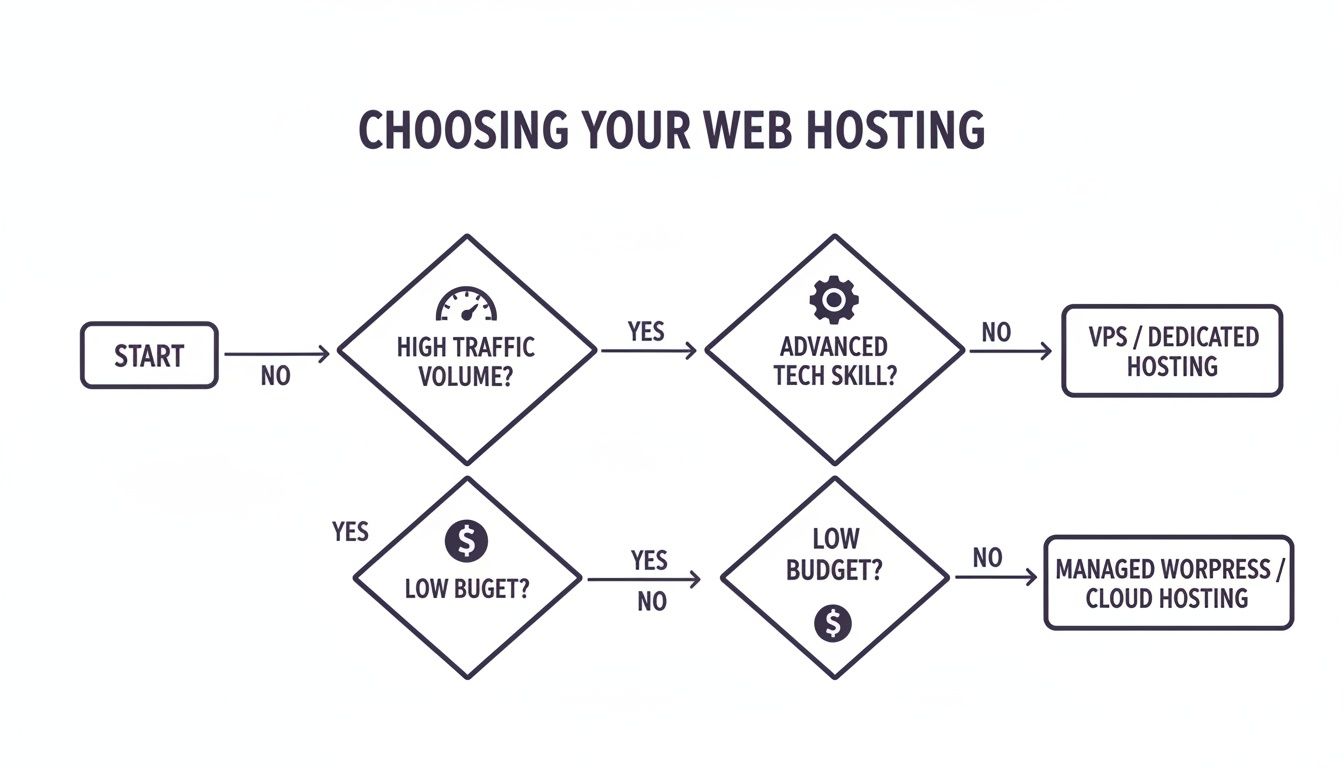
As you can see, the path becomes clearer once you define your priorities. A brand-new site can start lean, but a high-traffic e-commerce store needs more muscle from day one.
Hosting Type Comparison at a Glance
This side-by-side comparison is a great way to quickly see which hosting type might be the best fit for your business's cost, performance needs, and technical requirements.
| Hosting Type | Best For | Typical Cost | Performance | Technical Skill Needed |
|---|---|---|---|---|
| Shared | New sites, blogs, portfolios | $ | Low-Moderate | Low |
| VPS | Growing businesses, small e-commerce | $$ | Moderate-High | Medium |
| Dedicated | High-traffic sites, large businesses | $$$$ | Highest | High |
| Cloud | Sites with fluctuating traffic, apps | $$-$$$ | Scalable | Medium-High |
| Managed WordPress | Any business using WordPress | $$-$$$ | Optimized | Low |
Each option offers a different balance of resources and control. The key is to match the solution to your specific business goals, not just your current traffic numbers.
Shared Hosting: The Starter Apartment
Shared hosting is far and away the most popular and affordable option out there. It's the perfect starting point for new businesses, bloggers, and small portfolio sites just getting off the ground.
Think of it like renting an apartment in a large building. You get your own private space, but you share the building’s resources—like utilities, parking, and the gym—with all the other tenants. This keeps costs incredibly low, but a noisy neighbor (a website on your server getting a huge traffic spike) can sometimes slow things down for everyone else.
Shared hosting is ideal for:
- Brand new websites with low to moderate traffic.
- Small local businesses establishing their first online presence.
- Business owners working with a tight budget.
VPS Hosting: The Flexible Duplex
When you start outgrowing your shared plan, a Virtual Private Server (VPS) is the next logical step up. This is like owning a duplex. You still share the same physical property (the server hardware) with a few others, but your resources are completely walled off and guaranteed.
This means you have your own dedicated portion of the server’s processing power, memory, and storage. Your neighbor’s traffic surge won’t impact your site’s performance one bit. A VPS gives you a serious boost in control and performance without the massive price jump to a dedicated server.
Dedicated Hosting: The Private Estate
When you absolutely need maximum power, security, and control, nothing beats a dedicated server. This is the hosting equivalent of owning your own private house on its own land. The entire server is yours and yours alone.
You get to call all the shots, from the security settings to the operating system. This is the go-to solution for high-traffic e-commerce stores, large businesses, or any website that handles sensitive data and simply cannot afford to share resources. It’s incredibly powerful but comes with a much higher price tag and usually requires more technical expertise to manage.
Cloud Hosting: The Modern Skyscraper
Cloud hosting works a bit differently. Instead of relying on a single physical server, your website is hosted on a vast network of connected virtual and physical cloud servers that work together.
If one server has an issue, another one instantly picks up the slack, which makes your site incredibly resilient and stable. It's also amazingly scalable. Think of it like a modern skyscraper with on-demand utilities; you can instantly get more power or space during a massive traffic event (like a Black Friday sale) and then scale back down when things quiet down, only paying for what you use.
Key Takeaway: The market reflects these choices. Shared hosting dominates with 37.64% of the market for its affordability, while VPS (25.38%) and Dedicated (17.98%) serve growing and high-demand sites. As a WordPress user—part of the 43.4% of all websites—choosing a host optimized for your platform is crucial. You can learn more about these web hosting trends and statistics on DiviFlash.
Ultimately, the best choice depends on where your business is today and where you plan to go tomorrow. For those running on WordPress, our Missing WordPress Manual eBook can provide deeper insights into getting the most from your setup.
Evaluating Hosting Performance: Speed and Uptime
Let's be blunt: your website's performance isn't just a techy detail—it's a core business asset that directly hits your bottom line. A slow site frustrates visitors, kills conversion rates, and can torpedo your search rankings before you even get off the ground. When you're figuring out how to choose website hosting, performance is absolutely non-negotiable.
Think of it this way: every extra second your site takes to load is another chance for a potential customer to give up and click away. That's why digging into a host's speed and reliability is one of the most important things you'll do.

What Uptime Guarantees Really Mean
You'll see hosting companies throw around uptime guarantees like "99.9%" or "99.99%." They look almost identical, right? But the difference in the real world is huge.
A 99.9% uptime guarantee actually allows for almost nine hours of downtime per year. For an e-commerce store or a local service business, that’s nine hours of lost sales and broken trust. In contrast, 99.99% uptime means less than an hour of downtime annually. Anything less than 99.9% should be an immediate red flag.
The good news is that the industry's move to cloud infrastructure has made rock-solid reliability more common. Gartner predicts that 80% of enterprises will ditch traditional data centers by 2025, and modern hosts are using that tech to ensure your site stays online.
Key Performance Technologies to Look For
Beyond uptime, a few key pieces of tech make a massive difference in how fast your site feels to a user. You don't need to be a server admin to know what to look for when you're comparing plans.
- Solid State Drives (SSDs): This is a must-have, no exceptions. SSDs are lightyears faster than old-school hard disk drives (HDDs). This means your website files, databases, and images get delivered to visitors much, much faster.
- Server Location: Proximity matters. If your customers are primarily in the United States, choose a host with data centers in the US. The physical distance data has to travel directly impacts load times.
- Content Delivery Network (CDN): A CDN is a game-changer. It works by storing copies of your website on servers all over the world. When someone visits your site, the content is loaded from the server closest to them, which can dramatically speed things up, especially for a national or global audience.
Your hosting provider’s technology stack is the engine that powers your website. Choosing a host that invests in modern infrastructure like SSDs and offers CDN integration gives your business an immediate competitive advantage.
A fast, reliable host is also foundational for getting found in the first place. For more on this, check out our guide on how your site's performance impacts search engine optimization (SEO).
Essential Security Features and Backups
Website security isn't just a feature on a checklist; it's a core requirement for doing business online. Think of your hosting provider as the first line of defense for your digital storefront. A single security breach can shatter the trust you've spent years building, leading to serious financial and even legal consequences.
Even a simple brochure website can be a prime target for automated attacks. Bots are constantly crawling the web, sniffing out vulnerabilities. Without the right protections in place from your host, your site could be compromised, and you might not even realize it until it's too late.

Core Security Protections
Any hosting plan you consider must include a few non-negotiable security layers. These are the absolute basics that shield your business and your customers from the most common online threats.
Here's the minimum of what to look for:
- Free SSL Certificate: An SSL is what gives you the little padlock icon in the browser's address bar. It encrypts the connection between your site and its visitors, protecting sensitive info like contact forms and payment details. Honestly, there's no excuse for a host not to provide a free Let's Encrypt SSL today.
- Web Application Firewall (WAF): A WAF is like a bouncer for your website. It inspects incoming traffic and blocks common hacking attempts and malicious requests before they ever get a chance to reach your site's files.
- Malware Scanning and Removal: A good host doesn't just wait for something to go wrong; they proactively scan for malware. The real question to ask a potential host is about their removal policy. If something nasty is found, will they help you clean it up, or are you on your own?
It's not enough for a host to just have these tools. They need to be actively managed. Proactive, 24/7 threat monitoring is what separates a decent host from a great one.
The Lifeline of Automated Backups
Even with top-notch security, things can still go sideways. A rogue plugin update, a simple human error, or a particularly persistent hacker could knock your site offline. This is where automated backups become your ultimate safety net.
Just imagine losing every blog post, every product, and all of your customer data in an instant. It’s a complete nightmare, but it's also completely preventable.
Your hosting provider absolutely must offer automated daily backups. These backups should be stored "off-server" in a totally separate location, and you should be able to restore them with just a few clicks. Don't even consider settling for weekly backups or manual options that put the responsibility on you. A reliable, one-click restore feature is the gold standard here—it’s what gets you back online fast when disaster strikes.
Finding Long-Term Value in Support and Scalability
That cheap introductory price you see splashed across a hosting provider's homepage is designed to do one thing: get you in the door. But it almost never reflects the true cost of the plan.
Real, long-term value isn’t found in a first-year discount. You discover it in reliable support, fair renewal rates, and the freedom to grow without hitting a technical brick wall. When you're trying to figure out how to choose a website host, you have to learn to look right past those flashy "90% off!" banners.
The real price tag usually shows up a year later when the renewal invoice hits your inbox. It's not uncommon to see prices jump by 300% or more. A trustworthy hosting partner is upfront and transparent about these costs from the get-go.
Your hosting provider is more than just a utility bill. They're a partner in your business's success. Their support team effectively becomes your IT department, and their infrastructure is what allows you to scale.
Don't ever underestimate the value of expert, responsive support. When your site goes down at 2 AM on a Saturday, the last thing you want is an unhelpful chatbot or a support ticket that won't get a reply for hours. Quality support is the difference between a minor hiccup and a major business disruption that costs you sales and damages your reputation.
Is Your Host Ready to Grow with You?
Scalability might just be the most critical factor for your long-term success online. Your business will grow, and your website traffic will increase right along with it. A provider that can’t accommodate that growth will eventually force you into a complicated, stressful, and costly migration down the road.
It's a crowded market out there. The global web hosting industry was valued at $94.64 billion in 2022 and is projected to skyrocket, which just shows how much explosive growth is happening online. With over 330,000 hosting companies worldwide, it's absolutely essential to pick a provider with proven, scalable infrastructure. If you don't, you risk outgrowing your plan way too quickly. You can dig into more data on the web hosting industry's expansion on Bluehost's blog.
A great host makes the growth process simple. You should be able to upgrade your plan—say, from a shared server to a VPS—with minimal friction and little to no downtime. Before you even think about signing up, ask a potential provider what their upgrade path actually looks like.
Questions to Ask About Support and Scalability
Before you commit, it's time to get clear answers to a few key questions. These will reveal a lot about whether a company is focused on long-term partnerships or just churning through short-term sales.
- What are your renewal rates for this specific plan? Don't accept a vague answer. Get the exact number, preferably in writing.
- What support channels do you offer (phone, live chat, email)? And just as important, are they all available 24/7?
- Is your support team in-house or outsourced? In-house teams almost always have deeper, more practical knowledge of the platform.
- What does the process of upgrading my plan look like? Ask specifically about potential downtime and any associated costs.
Finding a provider that excels in these areas ensures your hosting is a stable foundation you can build on for years. It's the difference between a solid partner and a temporary solution you'll quickly outgrow. This is the final and, frankly, most important step in choosing a website hosting provider that truly works for your business.
Got Questions About Web Hosting? Here Are the Answers.
As you get closer to picking a web host, a few practical, last-minute questions always seem to pop up. Getting straight answers to these common concerns is the final step to feeling confident you're making the right call for your business and your budget.
Let's dive into the questions that business owners always ask right before they pull the trigger.
How Much Should I Expect to Pay for Good Hosting?
For a solid small business hosting plan, a realistic budget is somewhere between $10 to $30 per month. That price range usually gets you a top-notch shared or managed WordPress plan with all the essentials baked in.
You'll definitely see flashy offers for as low as $3 to $5 per month, but be careful. Those plans often have serious performance issues and come with massive price hikes after the first year. A slightly bigger investment upfront almost always pays off with better long-term value, ensuring you get things like daily backups, a free SSL certificate, and support you can actually count on.
Once your website starts picking up steam and needs more muscle, you might look at a Virtual Private Server (VPS), which can run anywhere from $20 to $80 a month. The real trick is to look past the tempting intro price and focus on what the plan will deliver for your business over time.
Can I Switch Hosting Providers Later?
Yes, absolutely. If you're not happy with your host, you can always move. The process is called a website migration, and it's basically just moving your website's files, databases, and everything else from the old server to a new one.
Many of the best hosting companies offer free or cheap migration services to win your business. They have teams of experts who handle the whole thing for you, making the switch feel almost effortless.
Keep in mind, though, that if it's not handled by pros, a migration can get technical and might lead to some downtime. This is exactly why it pays to spend a little extra time choosing the right host from the start—it can save you the headache and cost of a move down the road.
Key Insight: When a host offers a free, professional migration, it's a huge vote of confidence in their own service. They're betting you'll be so happy with them that you'll stick around for a long time.
Does My Web Host Affect My SEO?
It has a massive impact. Your web host directly influences your site's search engine optimization (SEO) in three really important ways:
- Speed: Google loves fast websites because users love fast websites. A slow host leads to a higher bounce rate, which tells search engines people aren't having a good experience, and that can tank your rankings.
- Uptime: If your site is constantly down, it's invisible to both visitors and search engine crawlers. Too much downtime will send your rankings into a nosedive, fast.
- Security: A host with weak security makes your site an easy target for hackers or malware. If your site gets compromised, you could face penalties from Google or even get removed from search results entirely.
A fast, reliable, and secure host isn't just a nice-to-have; it's a foundational piece of any good SEO strategy. For a deeper look into making the right choice, this guide on how to choose a hosting provider is a great resource.
What Is Managed Hosting and Is It Worth It?
Managed hosting is basically a white-glove service where the hosting provider handles all the technical server management for you. They take care of security updates, software patches, backups, and performance tuning. It's an incredibly popular option, especially for WordPress sites.
So, is it worth the extra cash? For business owners who aren't tech experts—or who would rather spend their time running their business instead of babysitting a server—it is 100% worth it.
Think of it like having an expert IT team on standby 24/7. It frees up your time and gives you incredible peace of mind, knowing your site is in good hands and being proactively kept fast, secure, and online.
At Site Igniters, we build high-performance websites backed by SEO strategies that get you seen. If you're ready to establish a powerful online presence that drives real growth, let's talk. Visit us at https://siteigniters.com to learn how we can help your business thrive.
Seth Sanders is the founder of Site Igniters, a digital marketing agency in El Dorado Hills, California.