
SEO Is Dead and AI Killed It: Why Ranking #1 Means Nothing in 2026
I watched it happen in real time.A client's average search position climbed two spots. Their rankings dashboard looked beautiful. Green arrows everywhere. The team celebrated.Their traffic dropped...

I watched it happen in real time.
- Traditional SEO rankings are losing value as AI overviews and zero-click searches dominate search results in 2026.
- Businesses must shift from chasing rankings to building brand authority and direct audience relationships.
- The future of search visibility requires optimizing for AI answer engines, not just Google’s blue links.
A client’s average search position climbed two spots. Their rankings dashboard looked beautiful. Green arrows everywhere. The team celebrated.
Their traffic dropped 50%.
This wasn’t a technical glitch or a penalty. This was the infrastructure collapsing beneath us while we stared at metrics that no longer mattered.
The game changed. Most people are still playing by the old rules.
The Visibility Illusion: When Volume Hides the Truth
Here’s what’s actually happening in search right now.
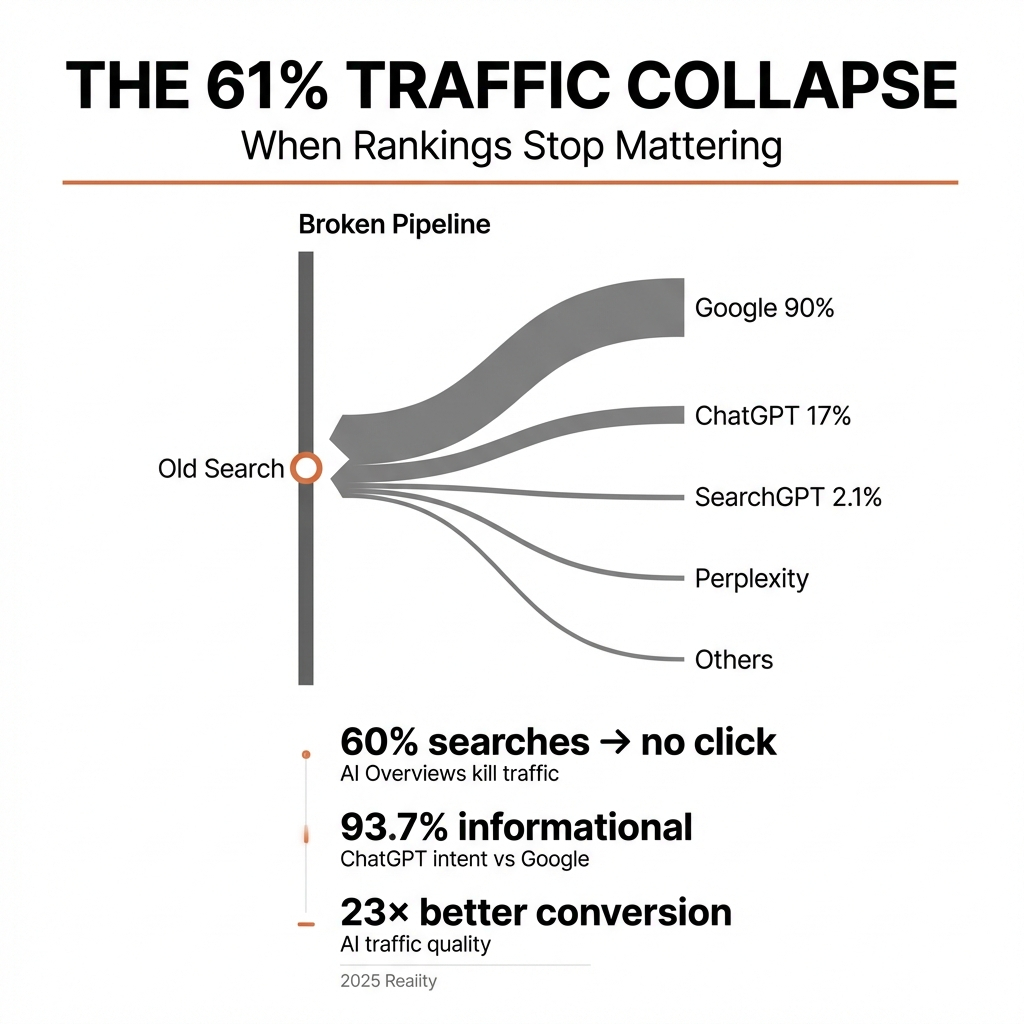
Roughly 60% of searches end without a click. When AI summaries appear at the top of Google, fewer than 1 in 10 users click a traditional result. The organic click-through rate collapsed from 1.76% to 0.61% when AI Overviews show up.
That’s a 61% decline in traffic potential.
Your ranking didn’t get worse. The destination just stopped mattering.
I’ve spent two decades watching search evolve through multiple paradigm shifts. This one is different. Previous changes modified the rules. This change is replacing the playing field entirely.
The measurement systems we built assume a world where visibility equals opportunity. That assumption broke.
The Fragmentation Reality: Search Isn’t Singular Anymore
Google still commands 90% market share. That number makes people feel safe.
Look closer.
ChatGPT now handles 17% of queries. SearchGPT’s market share exploded by 740% in just 12 months, jumping from 0.25% to 2.1% of total search traffic. Perplexity, Claude, and a dozen other AI platforms are carving out territory.
User behavior fragmented across platforms. Search is no longer a single destination. It’s a distributed conversation happening across multiple intelligent systems.
Each platform interprets relevance differently. Each one surfaces different results. Each one connects users to information through different mechanisms.
The old playbook optimized for one system. The new reality requires understanding behavioral patterns across fragmented discovery modalities.
You can’t rank your way out of this.
The Intent Stratification Problem: Not All Visibility Equals Readiness
This is where most analysis falls apart.
People treat AI search traffic the same as Google traffic. The behavioral data tells a completely different story.
93.7% of ChatGPT searches are informational. Only 0.1% are transactional. Google balances research behavior with buying behavior. About half its users seek information. A meaningful portion are actively shopping or ready to engage commercially.
Same search query. Completely different intent signals depending on platform.
I’ve watched companies chase AI visibility without understanding this distinction. They celebrate being cited in AI responses while their conversion rates crater.
Presence without intent is noise. It consumes resources without yielding proportional return.
The bottleneck isn’t observation anymore. It’s interpretation. You need infrastructure that distinguishes between indicators of presence and indicators of commercial readiness.
The Citation Economy: When Being Found Means Something New
Here’s the shift most people miss.
Traditional SEO optimized for position. You wanted spot one, two, or three. The logic was simple: higher position equals more clicks equals more opportunity.
AI search introduced a different currency.
Citation.
When an AI system cites your content in its response, the behavioral outcomes change dramatically. Average organic click-through rate on AI Overview queries sits at 0.61%. Cited brands achieve 0.82% click-through rate. That’s a 35% boost.
More striking: paid click-through rate crashed to 6.34% on these queries. Cited brands see 12.1% click-through rate. A 91% advantage.
Being cited becomes the new readiness signal. It filters volume through a layer of algorithmic validation that users trust.
You’re not competing for position anymore. You’re competing for interpretive authority within intelligent systems that synthesize information before presenting it.
Different game. Different rules. Different success metrics.
The Expansion Velocity: How Fast Is This Actually Happening?
People ask me if this is really the future or just hype.
Look at the acceleration.
In January 2025, AI Overviews appeared for 6.49% of queries. By March 2025, that number hit 13.14%. A 102% increase in eight weeks.
If current growth rates continue, AI Overviews could appear for 20-25% of queries by end of 2025.
This isn’t a distant future scenario. This is happening right now while most optimization efforts remain focused on deprecated systems.
I’ve lived through enough technological transitions to recognize the pattern. Early adopters gain temporal advantage during disequilibrium periods. By the time consensus forms around new best practices, the advantage evaporates.
The companies winning in 2026 are the ones reorienting their infrastructure today.
The Conversion Quality Paradox: Lower Volume, Higher Value
Here’s where the data gets interesting.
AI search visitors convert 23 times better than traditional organic traffic. According to Ahrefs, AI-referred traffic carries 4.4 times higher economic value.
One study found AI search platforms generated 12.1% of signups despite accounting for only 0.5% of overall traffic.
Quality supersedes quantity.
When you optimize for visibility without stratifying for readiness, you generate volume that looks impressive in dashboards but doesn’t move revenue. When you filter for behavioral intent signals, volume drops but conversion probability skyrockets.
This inverts the traditional SEO logic entirely.
More traffic isn’t better if conversion rates decline. Narrow accuracy beats broad approximation when resources are constrained.
Revenue change serves as the ultimate validity check. If revenue stays flat despite traffic increases, you’re optimizing noise.
The Infrastructure Realignment: What Actually Needs to Change
Most responses to this shift focus on tactical adjustments.
Add schema markup. Optimize for featured snippets. Create FAQ content. Write in a way AI systems prefer.
These tactics treat AI search as an incremental channel. They miss the structural transformation.
The mechanics that defined SEO—keywords, rankings, links, traditional SERPs—aren’t disappearing. They’re becoming one layer in a multi-layer discovery ecosystem.
AI-driven discovery created a parallel system where answers get generated rather than retrieved. Visibility depends on whether intelligent systems understand, trust, and cite your expertise.
You need infrastructure that operates across both layers.
That means behavioral intelligence systems that capture signals across fragmented platforms. It means readiness detection that distinguishes research behavior from buying behavior. It means contact coordination mechanisms that route opportunities based on intent probability rather than traffic volume.
The companies I work with that adapted fastest didn’t add AI optimization to their existing SEO workflow. They rebuilt their workflow around behavioral synthesis as the foundational layer.
The 2026 Reality: What Winning Actually Looks Like
I can tell you what doesn’t work anymore.
Chasing rankings in isolation. Optimizing for traffic volume. Treating all visibility as equally valuable. Measuring success through intermediate metrics divorced from commercial outcomes.
Here’s what I’m seeing work.
Audience construction precedes content construction. You identify behavioral clusters that exhibit readiness signals before you deploy resources toward reaching them.
Multi-platform behavioral triangulation. You correlate weak signals across different discovery systems to build strong intent inference. A search pattern on Google combined with an AI query on ChatGPT combined with direct site behavior tells you more than any single signal.
Citation architecture over ranking architecture. You structure content and authority signals to maximize the probability that AI systems cite you when synthesizing responses in your domain.
Conversion rate improvement with constant volume beats volume improvement with declining conversion rates. Always.
The measurement systems need to change. The success definitions need to change. The resource allocation logic needs to change.
The Uncomfortable Truth: Your Expertise Might Be Obsolete
I learned this the hard way.
When environmental shifts invalidate existing success patterns, accumulated expertise becomes a liability if you apply it to the wrong problem.
The people who built careers optimizing for Google’s algorithm face a psychological barrier. Admitting the game changed means admitting their expertise depreciated. That’s painful.
New entrants don’t have pattern libraries from previous paradigm shifts. They lack the longitudinal observation that reveals which patterns persist across substrate changes and which patterns are substrate-dependent.
The advantage belongs to people who can distinguish between the two.
I’ve watched multiple technological regime changes. Each time, the practitioners who succeeded were the ones willing to declare their own methods obsolete before the market forced them to.
That’s where we are right now.
What You Should Actually Do
Stop optimizing for rankings as your primary success metric.
Start building behavioral intelligence infrastructure that captures intent signals across fragmented discovery platforms.
Implement readiness stratification. Not all traffic deserves equal resource allocation. Filter volume through conversion probability.
Audit your measurement systems. If intermediate metrics trend positive while revenue stays flat, you’re measuring the wrong things.
Reorient content strategy around citation architecture. Structure your domain authority and content depth to maximize AI system trust and reference likelihood.
Accept that audience clarity precedes message deployment. You can’t optimize your way to success if you’re reaching the wrong people.
The infrastructure exists. The behavioral data is already being generated. The coordination mechanisms are available.
What’s missing is the interpretive layer that transforms observation into actionable intelligence.
That’s the gap. That’s the opportunity.
And that’s what separates organizations that adapt from organizations that optimize deprecated systems until they stop working entirely.
The choice is yours. But the clock is running.
Seth Sanders is the founder of Site Igniters, a digital marketing agency in El Dorado Hills, California.