
Unlock how to improve local seo rankings with proven local SEO tactics

If you want to climb the local search rankings, you need to get three things right: your Google Business Profile, your website's on-page signals, and your overall online reputation. When you nail these pillars, you're sending powerful trust signals to Google, making it crystal clear that your business is the best local answer for whatever a user is searching for.
- Optimize your Google Business Profile completely to dominate the local map pack.
- Build trust through consistent online reviews and accurate local citations.
- Strengthen on-page and technical local SEO signals to reinforce your geographic relevance.
Dominate the Map with Your Google Business Profile
Let's be clear: your Google Business Profile (GBP) is the undisputed heavyweight champion of local search. It's not just another listing. It’s your digital storefront, welcome mat, and first handshake all rolled into one.
For a huge chunk of your potential customers, your GBP is your business online. It's often the first and only thing they see before deciding whether to call you, ask for directions, or click through to your website.
This free tool is your command center for managing how you show up on Google Search and Maps. Honestly, mastering it is the single most impactful step you can take for your local SEO.
Choose Your Categories Wisely
The first thing you have to get right is your primary category. This one choice tells Google exactly what your business is. You have to think like a customer here—what term would they type into Google to find a business like yours?
If you're a plumber who also dabbles in HVAC, "Plumber" should almost certainly be your primary category if that's where most of your revenue comes from. Get specific.
Then, you can flesh things out with relevant secondary categories. Use all that apply, but don't go crazy. These help you show up for related searches that aren't your main service. That same "Plumber" could add secondary categories like:
- Water Heater Installation & Repair
- Drain Cleaning Service
- Gas Line Installation
This level of detail helps you cast a much wider, more relevant net in local search results. For a deeper dive, check out our other guides on https://siteigniters.com/category/google-my-business/.
Craft a Compelling Business Description
You get 750 characters for your business description—make them count. This is your elevator pitch. Don't just list what you do; explain what makes you the best choice.
This is the perfect spot to naturally work in your core services and the specific neighborhoods or towns you serve. For instance, a Sacramento bakery could write: "Artisan bakery in East Sacramento specializing in handcrafted sourdough and custom cakes for all occasions. We've proudly served the community for over 10 years." That's worlds better than a flat "We sell bread and cakes."
Use Google Posts to Stay Active
Think of Google Posts as mini-updates that appear right on your profile. They are perfect for shouting out promotions, announcing events, or showcasing new products. More importantly, they signal to Google that your business is active and engaged.
A consistently updated Google Business Profile is a massive trust signal. Industry analyses estimate that GBP signals account for roughly 20–25% of local ranking influence. This includes everything from having a complete profile and the correct primary category to regular photo uploads and frequent posts.
To make this a habit, you can use tools like a GMB Post Generator to help create and schedule content. The key is to make sure your profile never looks abandoned.
Proactively Manage Photos and Q&A
High-quality photos make your business look real and inviting. Post pictures of your storefront, your team in action, your products, and even before-and-after shots of your work. Businesses with more photos simply get more clicks and direction requests. It's that simple.
The Q&A section is another goldmine that most businesses ignore. Don't wait for customers to ask questions. You can—and should—proactively ask and answer your own FAQs. Think about it: what do people always ask about parking, services, or pricing? Answer it here to control the narrative and remove any friction for potential customers.
To help you keep track of all the moving parts, here’s a quick checklist of the essential GBP optimizations.
Google Business Profile Optimization Checklist
This table breaks down the key features of your Google Business Profile, the specific actions you need to take, and why it matters for your local search performance.
| GBP Feature | Optimization Action | Impact on Local SEO |
|---|---|---|
| Business Name | Ensure it's your exact, real-world business name. No keyword stuffing. | Builds trust and avoids penalties. |
| Categories | Select a highly specific primary category and relevant secondary categories. | The most critical factor for ranking in relevant searches. |
| Address & Service Areas | Use a consistent, accurate physical address and define your service areas. | Crucial for "near me" searches and Map Pack visibility. |
| Phone Number | Use a consistent, local phone number across all platforms. | Key for direct customer contact and local trust signals. |
| Website | Link to the most relevant page on your site (often the homepage or location page). | Drives traffic and connects your GBP to your on-page SEO. |
| Business Description | Write a compelling, keyword-rich description within the 750-character limit. | Helps customers and Google understand your business's value. |
| Photos & Videos | Regularly upload high-quality, geotagged images of your business. | Increases engagement, clicks, and signals an active business. |
| Google Posts | Publish weekly posts with updates, offers, or events. | Signals to Google that your business is active and relevant. |
| Q&A | Proactively seed your own frequently asked questions and answer them. | Controls the narrative and provides helpful info to users. |
| Reviews | Actively request reviews and respond to every single one (good and bad). | A massive ranking factor that builds social proof and trust. |
Following this checklist is a surefire way to build a powerful foundation for your local SEO strategy. Don't just set it and forget it—your GBP needs consistent attention to deliver real results.
Build Local Trust Through Online Reviews
Think of online reviews as the modern-day version of a neighbor leaning over the fence to give a recommendation. For local businesses, a steady stream of positive feedback is one of the most powerful trust signals you can send to both potential customers and Google.

It’s just human nature. When you're searching for a new restaurant or need a plumber you can rely on, what’s the first thing you check? The star rating and what other people are saying. Your potential customers are doing the exact same thing.
Create a Frictionless Review Process
The biggest reason customers don't leave reviews is simple: it's a hassle. If they have to jump through a bunch of hoops, they'll just give up. Your mission is to make leaving feedback as easy as a single tap on their phone.
First, grab the direct link to your Google Business Profile review section. Then, put that link everywhere.
- Email Signatures: Add a simple "Leave us a review!" call-to-action in every email.
- Text Message Follow-ups: Send a quick, polite text with the link right after a job is done.
- On Receipts: A QR code printed on a receipt that goes straight to the review page works wonders.
The trick is to ask when they're happiest—right after a fantastic meal, a successful service call, or a great experience in your shop.
Turn Every Review into an Opportunity
Responding to reviews isn't just a nice thing to do; it's a non-negotiable part of managing your online reputation. A thoughtful response shows you're an engaged business owner who actually listens to feedback. This is a huge factor in how you improve your local SEO rankings.
Responding to reviews—both good and bad—is a public display of your customer service. It shows potential customers that you're attentive, and if something does go wrong, you’re committed to making it right. That kind of accountability builds incredible trust.
Always try to personalize your responses. Mention a specific detail from their review to prove you’re not a robot. For negative reviews, the formula is simple: acknowledge their frustration, apologize sincerely, and offer to take the conversation offline to fix it. This flips a public complaint into a showcase of your commitment to customer satisfaction. We dive deep into this with our guide on review management strategies.
The Hidden SEO Power of Review Content
The impact of reviews goes way beyond just the star rating. The actual words your customers use are powerful semantic signals for Google. When customers naturally drop keywords about your services and location into their feedback, it reinforces your relevance for those exact searches.
For example, imagine a review for a Sacramento plumber that says, "They did a fantastic job with our water heater installation in East Sac." That's pure SEO gold. It directly connects your business name to a specific service in a specific neighborhood, boosting your visibility for anyone searching for that.
The sheer volume and frequency of your reviews also matter—a lot. Studies consistently show that review signals make up a huge piece of the local ranking puzzle. Some analyses attribute anywhere from ~17% to ~26% of ranking influence to review signals alone. This data makes one thing clear: a proactive plan to get more reviews isn't just good for business, it's essential for competing in local search.
Fine-Tune Your Website with On-Page Local Signals
Your Google Business Profile is the digital handshake that gets customers in the door, but your website is where you actually convince them to hire you. Think of it as the real conversation after the initial introduction. Powerful on-page signals are how you prove to Google—and to your customers—that you are the undisputed local authority in your field.
This goes way beyond just sprinkling your city's name across your homepage. It’s about strategically weaving your geographic relevance into the very fabric of your site. Getting these on-page tweaks right is fundamental to showing up when and where it matters.
Infuse Your Content with Local Keywords
First things first, you need to get your location-based keywords into the most important spots on your webpages. This is how you tell search engines exactly where you operate and what you do, leaving no room for interpretation.
Start with the low-hanging fruit: your title tags and headers. A title tag for a roofer in Sacramento shouldn't just be "Roofing Services." It has to be something like "Expert Roof Repair in Sacramento | Your Company Name." That title tag is prime real estate; don't waste it.
From there, work your local keywords naturally into your body content. Mention specific neighborhoods, well-known landmarks, and the different service areas you cover. This isn't just great for SEO; it also builds a genuine connection with local readers who recognize these places. For a deeper dive into making your content work for search engines, these SEO content writing best practices are an invaluable resource.
Build Dedicated Service and Location Pages
One of the most common mistakes I see is businesses cramming every single service they offer onto one generic page. A much, much better strategy is to create dedicated pages for each of your core offerings. This lets you go deep on each topic and target very specific search terms.
For example, a plumber shouldn't have one "Services" page. They should have separate, detailed pages for:
- Emergency Drain Cleaning
- Water Heater Installation
- Trenchless Sewer Repair
Each of these pages can then be optimized with its own unique keywords, customer testimonials, and calls-to-action, massively increasing their odds of ranking for those specific queries.
Want to take it a step further? Create hyper-local landing pages. If your plumbing business serves the entire Sacramento area, build out separate pages targeting specific suburbs or neighborhoods like "Plumber in Folsom" or "Drain Cleaning in El Dorado Hills." This shows you're truly committed to serving those individual communities.
These hyper-local pages are incredibly powerful. They allow you to rank for long-tail keywords like "emergency plumber in North Natomas," which have significantly higher conversion intent than broader searches. A user searching with that level of specificity is ready to make a call.
Just make sure these pages feature unique content, including testimonials from that area and details relevant to those local customers.
Demystify Local Business Schema Markup
Schema markup sounds technical, but it’s basically a snippet of code you add to your website that acts as a translator for search engines. It structures your key business information in a way that Google can instantly understand, removing any and all guesswork.
Specifically, LocalBusiness schema lets you clearly define your:
- Business Name: Your official business name.
- Address: Your physical street address.
- Phone Number: Your primary local phone number.
- Hours of Operation: Your daily business hours.
- Geocoordinates: Your precise latitude and longitude.
Implementing this code makes your business eligible for rich results in search, like showing your star rating or hours directly in the search listings. And while it might sound like a job for a developer, tools like Google’s Structured Data Markup Helper can generate the code for you.
This structured data is a powerful confirmation signal. It backs up the NAP (Name, Address, Phone) information you have on your GBP and across the web, creating a consistent and trustworthy digital footprint. For anyone wondering how to improve local SEO rankings, this is a foundational piece of on-page optimization that a surprising number of competitors completely overlook.
Establish Authority with Citations and Local Links
Outside of your own website and Google Business Profile, search engines are constantly scanning the web for clues about your business. They’re trying to verify that you’re legitimate, active, and a real part of the local community.
The name of the game here is consistency. Every time your business is mentioned online, it’s like a small vote of confidence. When all those votes line up perfectly, they send a powerful signal to Google that you’re a business it can trust. This is where citations and local links come in—they’re the digital breadcrumbs that prove you are who and where you say you are.
Master Your NAP Consistency
At the heart of any local SEO effort is a simple little acronym: NAP. This stands for your business Name, Address, and Phone Number. For Google to take you seriously, this core data needs to be absolutely identical everywhere it shows up online.
Even the tiniest variations can throw things off. Think "Suite 100" vs. "Ste. 100" or "Main Street" vs. "Main St." To a search engine, those can look like two different businesses, which dilutes your authority. Your goal is to create an unwavering, consistent footprint across the web.
Start by getting your NAP perfect on the big data aggregators and top-tier directories that search engines already trust.
- The Big Guys: Make sure you’re flawless on Yelp, Apple Maps, and Bing Places. These are non-negotiable.
- Industry-Specific Sites: Are you a contractor? You need to be on Angi or Houzz. A restaurant? Get listed on TripAdvisor or DoorDash.
- Hyper-Local Directories: Don’t forget about your local Chamber of Commerce or a neighborhood business association website.
And this isn't a one-and-done task. You need to audit your citations every so often to find and fix old or incorrect listings that might be quietly hurting your rankings.
The Power of True Local Link Building
If citations are all about consistency, then local links are all about authority. Getting a backlink from another well-regarded local website is one of the strongest signals you can send to Google. It’s a direct endorsement, basically telling search engines, "Hey, this business is a real, trusted part of our community."
Not all links are created equal. The real power here comes from local relevance. A single link from your local newspaper’s website is worth way more for local SEO than a dozen links from random blogs with no connection to your area.
Think of it this way: a citation is like having your business listed in the phone book—it confirms you exist. A local link is like getting a glowing recommendation from a respected community leader—it confirms you matter.
So, how do you get these valuable local shout-outs? It has less to do with technical wizardry and more to do with actual, real-world community engagement.
Actionable Strategies for Earning Local Links
You can forget about complicated outreach campaigns. The best local links usually grow out of genuine relationships and getting involved in your community.
-
Sponsor a Local Event: Putting your name on a local charity 5K, a little league team, or a community festival almost always gets you a link from the event's website. It's a true win-win: you support a good cause and get a powerful backlink at the same time.
-
Partner with Neighboring Businesses: Team up with non-competing businesses nearby. For instance, a wedding planner could work with a local photographer and florist to create a "Local Wedding Guide," where each business links to the others as trusted partners.
-
Host a Workshop or Event: If you host a free workshop or even a simple open house, local event calendars and community blogs are often more than happy to list it and link back to your site for details.
-
Join Your Chamber of Commerce: This is often the easiest and most authoritative local link you can get. Most Chambers have an online directory where they list and link to all their members.
Building these connections takes time, but every local link you earn strengthens your digital roots in the community. This process is absolutely fundamental to proving your local relevance and is a key driver in how to improve local SEO rankings for the long haul.
Gain an Edge With Technical Local SEO
While your on-page content and Google Business Profile get a lot of attention, what happens behind the scenes is just as critical for local search. A technically sound website isn't just a bonus—it's the foundation for everything else. Without it, you're trying to build a house on sand.
Think about it this way: the best content and glowing reviews won't do much good if your site is slow, clunky, or impossible for search engines to crawl. Getting the technical details right ensures your hard work pays off and gives local customers a smooth experience.
Prioritize The Mobile Experience
Local search is, for the most part, a mobile game. An incredible 60% of smartphone users have contacted a business right from the search results, using handy features like the "click to call" button. That means your website absolutely has to work flawlessly on a small screen.
This is about more than your site just shrinking to fit. A truly mobile-friendly experience means:
- Large, tappable buttons: Nobody wants to pinch and zoom just to hit a link.
- Simple navigation: Menus need to be clean and easy for a thumb to navigate.
- Speedy load times: Mobile users are even less patient than those on a desktop.
A poor mobile experience is a direct signal to Google that your site isn't user-friendly, and that can tank your local rankings fast.
The modern customer journey starts on a smartphone. If your website frustrates a mobile user, they won't wait for it to load or struggle to find information. They'll just hit the back button and give their business to your competitor with a better mobile site.
Make Your Website Fast and Secure
Site speed is a confirmed ranking factor, and it's easy to see why. A slow-loading page is the digital version of a locked door—it turns people away before they even get a chance to look around. Every extra second it takes to load increases the odds a potential customer will leave.
Security is also non-negotiable these days. Using HTTPS (the 'S' stands for secure) encrypts the data shared between your site and its users, which is crucial for protecting their information. Browsers like Chrome now slap a "Not Secure" warning on non-HTTPS sites, which is a massive red flag for visitors and a negative signal for search engines.
The chart below shows how these foundational elements come together to build your online authority.
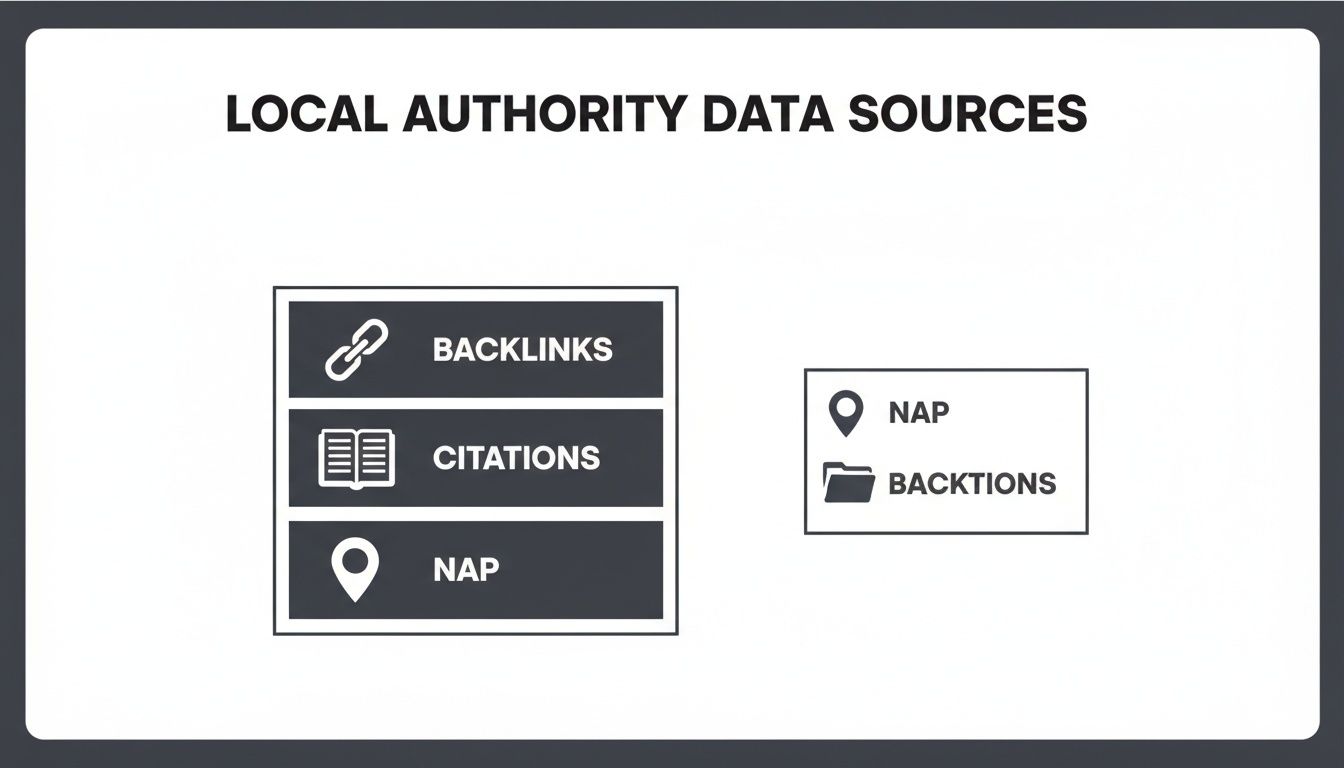
It really illustrates how a consistent NAP, strong citations, and quality backlinks are the core pillars of building trust with Google.
To help you decide where to focus your time, this table breaks down the impact and effort for key local SEO signals.
Local SEO Signal Impact Comparison
| Local SEO Factor | Estimated Ranking Impact | Optimization Effort |
|---|---|---|
| Google Business Profile Optimization | High | Low to Medium |
| Localized On-Page Content | High | Medium |
| Online Reviews (Quality & Quantity) | High | Medium (Ongoing) |
| Local Citations & NAP Consistency | Medium | Medium to High |
| Local Link Building | Medium | High |
| Technical SEO (Mobile, Speed, Schema) | Medium | Medium |
| Behavioral Signals (CTR, Dwell Time) | Low to Medium | High (Indirect) |
This comparison makes it clear that while some tasks require more upfront work, others offer a high return for a relatively low time investment. A balanced approach is usually best.
Create a Logical Site Structure
A clear, logical site structure is like a good map—it helps both users and search engines find what they’re looking for quickly. Your homepage should link out to your main service pages, which can then link to more specific offerings or hyper-local landing pages for different towns or neighborhoods.
This kind of logical hierarchy makes your site intuitive for visitors. It also lets Google's crawlers efficiently index your important content and understand how all your pages relate to each other.
With voice search on the rise, a well-structured site also makes it easier for assistants like Alexa and Siri to pull answers directly from your pages. To learn more about this trend, check out our in-depth guide to optimize your website for voice search.
By nailing these technical essentials, you turn your website into a powerful asset, not a liability. This solid foundation is what allows all your other local SEO efforts to truly shine.
Answering Your Top Local SEO Questions
When you start digging into local search, a lot of questions pop up. It's totally normal to wonder about how long it takes, what really matters most, and whether you should just hire someone to handle it all. Let's tackle some of the most common questions business owners ask when they're trying to climb the local rankings.
How Long Does It Take to See Local SEO Results?
This is always the first question, and the honest answer is: it’s a marathon, not a sprint. Local SEO is a long-term play for your business's visibility.
You can often feel some early momentum in the first 30 to 90 days, especially after you've really dialed in your Google Business Profile. That initial traction usually looks like more phone calls, clicks to your website, or people asking for directions right from your listing.
But if you're trying to rank for a really competitive term—something like "plumber in Sacramento"—you're looking at 3 to 6 months of consistent work. Things like building a solid base of reviews, earning quality local links, and creating content that establishes you as a local authority simply take time. These efforts build on each other, creating a strong foundation that your competitors can't just copy overnight.
Is My GMB More Important Than My Website SEO?
That's a bit like asking if your storefront sign is more important than what's inside the store. They're two parts of the same whole, and they work best when they're in sync.
Here’s how to think about it:
- Your Google Business Profile (GBP) is your digital storefront in the search results. It’s what gets you seen in the map pack and prompts those quick actions, like a phone call or a request for directions. A great GBP is what gets a customer to notice you in the first place.
- Your website is where you tell your full story. It's where you dive deep into your services, show off your expertise, build trust, and turn that initial click into a paying customer. A great website is what makes them decide to hire you.
A winning strategy needs both. A strong GBP listing sends traffic to your site, and a well-optimized website full of great local signals tells Google that your GBP is the real deal. If you ignore one, you'll always be holding the other back.
Your Google Business Profile gets them in the door; your website convinces them to stay. You simply can't dominate local search by focusing on just one. They make each other stronger.
Can I Do Local SEO Myself or Should I Hire Someone?
Plenty of business owners can absolutely get the ball rolling with foundational local SEO. Claiming your Google Business Profile, encouraging customers to leave reviews (and responding to them!), and making regular Google Posts are all high-impact tasks you can manage yourself with a little dedication. For any business, that's a fantastic place to start.
Things get trickier, though, when you get into technical SEO, schema markup, strategic local link building, and serious citation cleanup. These tasks usually demand specialized tools, a deep understanding of how search engines work, and a lot of time to do right.
The best choice for you really comes down to a few things:
- Your Time: Do you realistically have several hours a week to dedicate to this?
- Your Technical Skill: Are you comfortable poking around in your website's backend or looking at performance data?
- Your Goals: How fast do you want to grow and become the go-to business in your area?
Bringing in an agency means you get expertise and dedicated resources to speed things up and handle all the complicated, time-sucking parts of local SEO. That frees you up to do what you do best: run your business.
At Site Igniters, we specialize in turning local businesses into market leaders. From dominating the map pack to building a technically flawless website, we create comprehensive strategies that deliver measurable growth. If you're ready to take your local presence to the next level, let's talk.
Seth Sanders is the founder of Site Igniters, a digital marketing agency in El Dorado Hills, California.