
What Is Programmatic SEO And How Does It Scale Traffic

Let's be honest: Programmatic SEO is just a fancy term for using data to automatically create hundreds—or even thousands—of web pages that are laser-focused on specific search terms. It’s a strategy where you stop creating content one by one and instead build a system that publishes at scale to capture all those super-specific search queries.
- Programmatic SEO uses data and templates to automatically generate hundreds or thousands of targeted landing pages at scale.
- It works best for businesses with large datasets and repeatable content patterns, like directories, location pages, or product comparisons.
- Quality control is critical; thin or duplicate programmatic pages can trigger Google penalties rather than rankings.
Defining Programmatic SEO In Simple Terms
At its core, programmatic SEO is all about building a machine that turns raw data into useful content.
Think of it like a mail merge, but for your website. You need two key things: a flexible page template (the blueprint) and a structured database of information (the ingredients). The programmatic SEO process is the engine that mashes them together, automatically spitting out a unique, optimized page for every single row in your database.
This is a world away from traditional content marketing. A typical blog post can take hours, or even days, to write and usually targets a single, broad keyword. This automated method, on the other hand, can publish thousands of pages in minutes. It targets a massive web of specific, long-tail keywords that you could never dream of covering by hand.
The Core Idea: Scalable Page Creation
The goal isn't just to crank out more pages; it's to create real value at a scale that was once impossible.
Picture a local plumbing company. Trying to manually create a unique page for every single service they offer in every neighborhood they cover would be an absolute nightmare. With programmatic SEO, they can generate all these pages in a flash:
- "Emergency plumbing in East Sacramento"
- "Tankless water heater installation in Folsom"
- "Drain cleaning services in Roseville"
Each page is perfectly tailored to what a user is looking for, creating a highly relevant experience that search engines love to reward. This is where the magic really happens—matching specific user intent with hyper-relevant content, multiplied across thousands of variations. For a refresher on the basics, our guide on search engine optimization (SEO) is a great place to start.
This method transforms your website from a collection of handcrafted articles into a dynamic, data-driven resource that can answer thousands of specific customer questions automatically.
Programmatic SEO vs Traditional SEO
Understanding the key differences between these two approaches makes it clear when and why this strategy is so powerful. While both are trying to get you more traffic from search engines, their methods and results are completely different. For a deeper dive, check out this practical guide on what is programmatic SEO from Sight AI.
Let's break down the comparison.
Programmatic SEO vs Traditional SEO
| Attribute | Traditional SEO | Programmatic SEO |
|---|---|---|
| Approach | Manual, one-by-one page creation (e.g., blog posts, guides). | Automated, bulk page generation from a database. |
| Scale | Low to moderate. Limited by human resources and time. | High. Can generate thousands or millions of pages. |
| Speed | Slow. Content creation can take days or weeks per asset. | Fast. New pages can be published almost instantly. |
| Ideal Use Cases | In-depth articles, thought leadership, brand storytelling. | Product catalogs, service locators, data directories, marketplaces. |
As you can see, it's not about one being "better" than the other. They are different tools for different jobs. Traditional SEO is perfect for building brand authority and deep engagement, while programmatic SEO is the go-to for capturing massive amounts of long-tail search traffic at scale.
How Programmatic SEO Actually Works
At first glance, programmatic SEO sounds complicated, but the engine driving it is a surprisingly straightforward four-step process. Think of it like a high-tech assembly line for web pages. Instead of building one car at a time by hand, you design a master blueprint and then use a massive, organized inventory of parts to automatically assemble thousands of unique vehicles.
That's the heart of programmatic SEO: switching from slow, manual content creation to a scalable system you can repeat over and over. This process breaks down into four clear stages, each one building on the last to turn a simple concept into a major traffic-generating asset.
This diagram shows how the two core pieces—your data and your design—come together to create web pages on a massive scale.
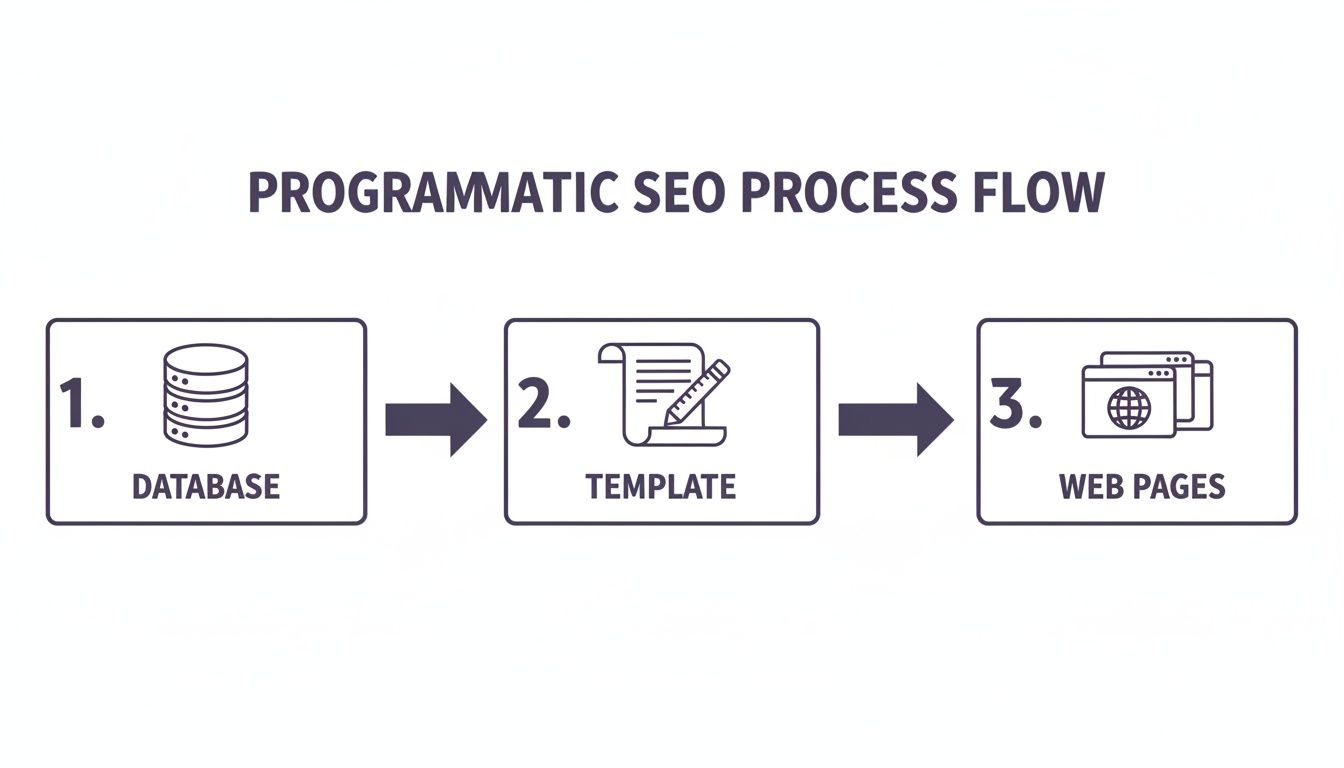
As you can see, the engine is simple but powerful. A structured database feeds information into a flexible template, which then pumps out a huge number of unique, optimized web pages.
Step 1: Find Scalable Keywords
The whole strategy kicks off by finding a user search pattern you can scale. This isn't about finding one perfect keyword; it's about finding a formula. You need to uncover a core "head term" that people consistently pair with different variables, or "modifiers."
This formula usually looks something like this:
- [Core Service] in [Location]
- [Product A] vs [Product B]
- Best [Tool Type] for [Industry]
Take a real estate agency, for example. They might see users searching for "homes for sale" (the head term) plus modifiers like different neighborhoods, zip codes, or even features like "with a pool." This repeatable pattern is the bedrock of any solid programmatic project. The goal is to find a query structure that can spin off hundreds or thousands of logical, high-intent variations.
Step 2: Build a Structured Database
Once you've got your keyword formula, it’s time to gather the "ingredients"—the unique data that will make each page valuable. This is arguably the most important stage because your data is your competitive advantage. Without unique, quality data, you’ll just end up with "thin" pages that don't help anyone.
This database can be a simple Google Sheet or a more complex SQL database. The key is structure. Each row will become a webpage, and each column is a unique piece of information that gets dropped into your template.
The quality of your programmatic SEO project is a direct reflection of the quality of your underlying dataset. Generic, scraped data leads to generic pages, while proprietary, unique data creates a valuable resource that is difficult for competitors to replicate.
For our real estate example, that database would need columns for:
- Neighborhood Name
- Average Home Price
- Number of Active Listings
- Local School Ratings
- A unique description of the neighborhood
This organized data is the fuel for your content engine.
Step 3: Design a Flexible Page Template
With your keywords figured out and your data collected, you can now build the master blueprint for your pages. This isn’t just a basic layout. It’s a dynamic template with specific spots designed to be filled by the information from your database.
You'll create a single page design that includes placeholders for each column in your spreadsheet. For instance, the page title might be <h1>[Neighborhood Name] Homes for Sale</h1>, and the content on the page would pull in the [Average Home Price] and [Local School Ratings]. This makes sure every single generated page is not only unique in its content but also perfectly optimized for SEO with the right headings, structured data, and a great user experience.
Step 4: Generate and Publish Pages at Scale
This is the final, most automated part. Using scripts or special tools, you merge your structured database (Step 2) with your flexible template (Step 3). The system zips through your database row by row, creating and publishing a brand new, fully-formed webpage for each entry.
In just minutes, you can launch hundreds or even thousands of highly specific, optimized pages. Instead of having one generic "Sacramento Homes for Sale" page, you now have dedicated pages for every single neighborhood. Each one is packed with relevant, specific data that perfectly matches what a user is looking for with their long-tail search. This is how you achieve true scale and start dominating those niche search results.
Real-World Examples Of Programmatic SEO
Knowing the theory is one thing, but seeing programmatic SEO in the wild really shows you what it's capable of. Some of the biggest sites on the internet were built on this very strategy. They turned huge piles of data into millions of laser-focused pages that pull in massive amounts of traffic. These examples prove just how powerful a simple, repeatable formula can be.
One of the best-known examples is Zapier, the tool that connects all your different web apps. They had a huge challenge: how could they possibly create a unique landing page for every single app integration they offered? The solution, of course, was programmatic SEO.
They built a simple, repeatable page template around one core search query: "Connect [App X] to [App Y]."
This screenshot of Zapier's app directory is a perfect look at the raw ingredients for their strategy—a massive, well-organized database of apps. Every app you see is a variable they can plug into that template, instantly creating pages for "Connect Google Sheets to Slack" or "Connect Mailchimp to Salesforce."
With this approach, Zapier has spun up over 25,000 pages that perfectly match what their users are searching for. Each page feels like it was custom-made for that specific integration, but they all come from the same template and data. It's how they completely dominate the search results for a staggering number of long-tail keywords.
From Global Giants To Local Businesses
But this isn't just a strategy for Silicon Valley giants. The same thinking works across just about any industry or business size, from worldwide travel sites to your local service pro.
-
TripAdvisor: This travel titan uses programmatic SEO to create pages for searches like "Best [Activity] in [City]." They just combine their database of activities (restaurants, tours, museums) with a list of every city on earth to generate millions of pages targeting travelers. That's why they seem to pop up for almost any travel search you can think of.
-
Real Estate Agencies: A local real estate firm in Sacramento can use the exact same logic. Instead of one bland page for "homes for sale," they can create hundreds of pages targeting queries like "homes for sale in [Neighborhood] with a [Feature]." The result? Hyper-specific pages like "homes for sale in East Sacramento with a pool" or "condos for sale in Midtown Sacramento under $500k."
The core principle remains the same whether you have a database of ten thousand products or fifty local services. Programmatic SEO works by matching a specific user need with a precisely tailored page, multiplied at scale.
This strategy really hit its stride in the mid-2010s. Research from enterprise SEO platforms showed that successful projects could deliver a mind-blowing 300-700% increase in organic traffic within the first year. We saw it happen with travel aggregators and product directories that went from small players to traffic juggernauts by turning their data into content. You can explore more data on programmatic SEO's impact and get a complete master guide to learn more about its history.
Hyper-Local Service Applications
Even small, local businesses can get incredible results. A law firm that serves the Sacramento suburbs can go way beyond a single "personal injury lawyer" page. They can automatically generate pages for the specific, high-intent searches that bring in clients.
Imagine creating pages for every variation a potential client might search for:
- "[Accident Type] lawyer in [Suburb]"
- "Car accident lawyer in Folsom"
- "Slip and fall attorney in Roseville"
- "Truck accident lawyer near El Dorado Hills"
Each one of these pages can be populated with unique local details like case results from that area, office information for that specific suburb, and relevant client testimonials. This allows the firm to compete and win in local search, capturing clients who are looking for help right now, right around the corner. These examples prove that programmatic SEO isn't just a big-brand tactic—it's a scalable system for turning data into real business opportunity.
Capturing High-Intent Long-Tail Keywords
One of the biggest wins with programmatic SEO is its uncanny ability to target and capture long-tail keywords by the thousands. These are the longer, super-specific search phrases—usually three or more words—that tell you exactly what a user wants. While the big, broad terms like "dentist in Sacramento" are a constant battleground, long-tail queries come from people who are much further down the buying path.
It’s like this: someone searching for "shoes" is just window shopping. But a person searching for "women's waterproof trail running shoes size 8" knows precisely what they need and probably has their credit card ready. Programmatic SEO lets you automatically create dedicated, perfectly optimized pages for thousands of these high-value searches.
This strategy helps you sidestep the brutal competition for generic keywords. Instead of dumping your budget into a fight you might not win, you can dominate thousands of less crowded search results where your ideal customers are actively looking for answers.
The Power of Specificity
Traditional SEO really struggles with the sheer volume of long-tail variations. Manually building a unique page for every possible mix of service, feature, and location just isn't realistic. Programmatic SEO flips the script by turning your data into a page-building machine, generating hyper-relevant pages for queries most competitors completely ignore.
For a local Sacramento business, this could mean creating pages like:
- 'Emergency root canal dentist in East Sacramento'
- 'Pediatric dentist that accepts Aetna in Folsom'
- 'Family dentist offering payment plans near Roseville'
Each page answers a very specific need, which naturally leads to higher engagement and much better conversion rates. This approach quickly establishes your website as a deep authority on countless niche topics.
Sidestepping Competition and Driving Conversions
The numbers behind this strategy are hard to argue with. A massive 70-80% of all search queries are long-tail keywords. While they don't have the huge search volume of head terms, their specificity means they convert like crazy and face far less competition. For a Sacramento agency like Site Igniters, programmatic SEO makes it possible to target hyper-specific phrases like 'ADA Title III compliant web design in El Dorado Hills' or 'AI-driven PPC remarketing for local healthcare providers,' generating tailored pages that rank much faster. You can find more details on how programmatic SEO works with long-tail keywords to see the full potential.
By focusing on high-intent, long-tail keywords, you're not just attracting more traffic—you're attracting the right traffic. These are visitors who have clearly defined their problem and are actively searching for the solution you provide.
This targeted approach is also becoming more critical as people increasingly use voice assistants. Voice searches are naturally longer and more conversational, fitting the long-tail model perfectly. As you build out these specific pages, you're also positioning your site for success in this growing search space. If you want to dive deeper, check out our guide on how to optimize your website for voice search.
Ultimately, by systematically answering thousands of specific questions, you create a powerful, scalable engine for attracting qualified leads and driving real, sustainable business growth.
The Essential Technology Stack You Need

When you hear "programmatic SEO," it's easy to picture a massive enterprise budget and an army of engineers. But the reality is much more accessible. The technology you need can be surprisingly lean, and it all boils down to three core functions: collecting your data, managing it, and generating the pages.
You really don't need to be a coding wizard to get started. Plenty of modern tools make this powerful strategy available even to small businesses and solopreneurs ready to scale their content in a smarter way.
Tools For Data Collection
First things first, you need the raw materials for your pages. This data is what makes every page unique and valuable. Picking the right tool just depends on where that information lives and how you can get to it.
There are two main ways to go about this:
- Web Scrapers: Tools like Scrapy or Beautiful Soup are what developers use to pull publicly available info from websites. This is super useful for building out datasets for directories or comparison sites.
- APIs (Application Programming Interfaces): Lots of platforms offer APIs that let you pull structured data directly from their systems. This is the clean, organized way to access things like product information, user reviews, or inventory levels.
For most businesses, though, the best data is the stuff you already have—like product specs, service details, or location information. The key is just getting it organized for the next step.
Managing Your Information Database
Once you've gathered your data, it needs a home. This database is the central nervous system for your entire project, holding all the variables that will eventually fill your page templates. The good news? You can start small and scale up whenever you need to.
Think of your database as a well-organized warehouse for your content. A tidy warehouse makes it easy for your page-building machine to find the right parts quickly and efficiently.
For small to medium-sized projects, you can get a lot done with tools you probably already know:
- Google Sheets: This is the ultimate starter tool. It's free, everyone knows how to use it, and it's perfect for organizing a few hundred or even a few thousand rows of data without any technical headaches.
- Airtable: Think of Airtable as a spreadsheet on steroids. It acts like a user-friendly database, giving you much better data structuring, relationships between tables, and handy integrations that simplify everything.
When projects get bigger—we're talking tens of thousands of pages or the need for lightning-fast performance—then a more robust database like MySQL or PostgreSQL becomes the standard choice. We often help clients figure out the best fit, frequently starting simple and scaling up from there. A solid discovery process is crucial for planning a project that succeeds, and you can learn more about how we handle that on the Site Igniters SEO discovery page.
Platforms For Page Generation
Finally, you need a system to merge your data with your template and actually publish the pages. This is where your website's content management system (CMS) or a development framework comes into play. If you're serious about programmatic SEO, picking from the best AI SEO software tools can also be a game-changer for scaling your operations.
- CMS Plugins: If you aren't a developer, platforms like WordPress have plugins that can connect directly to a Google Sheet or CSV file and automatically spin up pages from your data.
- Modern Frameworks: Developers often prefer frameworks like Next.js, Hugo, or Gatsby. These tools can pull data from any source and generate thousands of super-fast, static HTML pages, which is fantastic for performance and SEO.
To make things clearer, here's a quick breakdown of the tools you might consider, depending on the scale of your project.
Programmatic SEO Tool Stack
| Project Stage | Example Tools for SMBs | Example Tools for Enterprise |
|---|---|---|
| Data Collection | Manual Entry (Sheets), Zapier, Low-Code Scrapers | Custom Scripts (Python), APIs, Fivetran |
| Database | Google Sheets, Airtable | PostgreSQL, MySQL, BigQuery, Snowflake |
| Page Generation | WordPress + Plugins (e.g., WP All Import) | Next.js, Gatsby, Hugo, Custom Frameworks |
Choosing your stack doesn't have to be complicated. The best approach is to start with the simplest tools that get the job done and only upgrade when your project's needs outgrow them.
Common Mistakes In Programmatic SEO

While programmatic SEO has the power to massively scale your digital footprint, that speed comes with some serious risks. A poorly planned project won't just fail to rank—it can actually get you penalized by search engines.
Knowing the common pitfalls is the first step to building something that lasts. The absolute worst mistake is launching a project that just rehashes information without adding anything new. That's a surefire way to get your pages flagged and kicked out of the index.
Creating Thin Or Duplicate Content
The biggest danger you’ll face is creating thousands of pages that Google considers "thin content." This is what happens when your pages are basically carbon copies of each other, with only a small detail like a city name swapped out. Search engines are smart enough to see this as a cheap trick, not a genuine effort to help users.
To stay out of trouble, every single page you generate needs a good reason to exist. This means building each page around unique data points that make it genuinely useful. Don't just change the headline; populate each page with specific details, user-generated content, or your own data that competitors can't just scrape and copy.
The rule of thumb is simple: if a user wouldn't find your page meaningfully different from another, it probably shouldn't exist. Always aim for value, not just volume.
Neglecting Internal Linking
Another all-too-common mistake is treating your new pages like they're on a deserted island. If you publish thousands of pages without a smart internal linking strategy, you’re leaving them disconnected from your site's authority. This makes it a nightmare for search engines to crawl them, figure out how they're related, and pass any link equity around.
A good programmatic project needs a well-thought-out site architecture from day one. Your main pages should link down to category pages, which then link to the individual programmatic pages. This creates a logical hierarchy that guides both users and search engines, signaling to Google that these pages are an integral part of your site.
Ignoring The User Experience
Finally, never let automation get in the way of a good user experience (UX). It’s easy to get so wrapped up in data and scale that you forget an actual human has to land on these pages. Every page you generate still needs to be fast, easy to navigate, and look great on a phone.
A page that's slow, hard to read, or looks broken will have a sky-high bounce rate. That’s a massive red flag to Google that tells them your content is low-quality.
The most successful projects see incredible results, with some reporting organic traffic jumps of 300-700% in the first year. That kind of success only happens when the technical execution is matched with a people-first approach. For a closer look at the numbers, check out this in-depth analysis of programmatic SEO. By steering clear of these three critical mistakes, you can build a programmatic strategy that’s set up for long-term growth.
Frequently Asked Questions
As you start thinking about how programmatic SEO could work for you, a few common questions always pop up. Here are some straightforward answers to clear up the details and reinforce what we've covered.
Is Programmatic SEO Considered Black Hat?
Nope. When it’s done right, programmatic SEO is a completely white-hat strategy. The entire point is to provide real value by creating pages that answer very specific user questions, not to trick Google.
It only wanders into "black hat" territory if you're just churning out thin, spammy pages with no unique information. Quality data, a deep understanding of user intent, and a commitment to being genuinely helpful are what keep this strategy powerful and penalty-free.
How Much Data Do I Need to Get Started?
There’s no magic number here, but a solid project usually needs a dataset with at least a few hundred unique entries to get going. The key thing to remember is that the quality and uniqueness of your data matter way more than the sheer volume.
For instance, a local business might start with a list of 50 services they offer across 20 different towns. That alone gives them a foundation for 1,000 unique pages. The goal is simply to have enough distinct data points so that every page you generate offers something valuable and different from the next.
Can Programmatic SEO Work For A Small Business?
Absolutely. While it’s famous for fueling giants like Zapier and TripAdvisor, the strategy is incredibly effective for local businesses. It can actually become a massive competitive advantage in a smaller market.
A local plumber, for example, can use programmatic SEO to create a dedicated, optimized page for every single service in every single neighborhood they serve. This helps them show up for hyper-local searches that their bigger, more generalized competitors completely miss.
This approach is a powerful tool for driving targeted, local growth. By zeroing in on those community-level keywords, small businesses can attract high-intent customers who are literally right around the corner.
How Is The ROI Of Programmatic SEO Measured?
The return on a programmatic SEO project is all about tracking the metrics that actually impact your bottom line—not just vanity numbers like website traffic. The focus has to be on real-world outcomes.
We measure success by looking at key performance indicators (KPIs) like:
- Organic Traffic Growth: A steady increase in visitors landing on the new pages.
- Keyword Rankings: Watching how many new long-tail keywords your pages start ranking for.
- Lead and Conversion Growth: Measuring the uptick in form submissions, phone calls, or sales that come directly from these programmatic pages.
By tracking these conversions, we can draw a straight line from the strategy to your business results and prove a clear, positive ROI. At the end of the day, it's not about getting more visitors; it's about getting more customers.
Ready to unlock scalable growth for your business? The team at Site Igniters specializes in building powerful programmatic SEO strategies that drive targeted traffic and measurable results. Schedule a consultation with us today to learn how we can build a content engine for your brand.
Seth Sanders is the founder of Site Igniters, a digital marketing agency in El Dorado Hills, California.