
6 Transformative Agentic AI Use Cases for 2025


While conversational AI has captured the public’s imagination, a more significant technological shift is quietly taking shape: the operational deployment of agentic AI. These systems are not simply reactive chatbots. They are autonomous, goal-directed agents engineered to plan, execute complex multi-step tasks, and self-correct based on real-time feedback. This capability moves AI from a passive tool to an active digital collaborator.
- Agentic AI goes beyond chatbots by autonomously planning and executing complex, multi-step tasks across business functions.
- Top use cases include customer service automation, sales lead qualification, software development, and supply chain optimization.
- Early adopters of agentic AI gain a significant operational and competitive advantage as the technology matures.
Understanding the practical applications of this technology is now a strategic necessity for businesses aiming to gain a competitive advantage. The difference between a simple AI and an agent lies in its autonomy to pursue an objective. For marketing leaders, this means agents that can independently manage and optimize entire PPC campaigns. For e-commerce brands, it translates to systems that autonomously handle supply chain logistics from procurement to final delivery.
This article moves past abstract theory to provide a detailed breakdown of six transformative agentic AI use cases. We will dissect real-world implementations across key industries, from customer service and software development to healthcare and finance. Each example includes a strategic analysis of its operational impact, a breakdown of the tactics involved, and actionable takeaways your business can adapt. Our goal is to equip you with a clear, replicable framework for identifying and leveraging opportunities for autonomous AI within your own operations. Forget the hype; this is your guide to the practical, high-impact applications remaking industries today.
1. Customer Service and Support Automation
One of the most impactful and rapidly adopted agentic AI use cases is in the complete transformation of customer service. These are not the basic, script-following chatbots of the past. Agentic AI systems autonomously manage customer inquiries from start to finish, acting as true digital employees capable of complex problem-solving.
Unlike traditional bots that hit a dead end with any non-standard query, agentic AI can access multiple backend systems, interpret customer intent with high accuracy, and execute multi-step actions. This includes processing refunds, updating account details, scheduling appointments, or troubleshooting technical issues by cross-referencing knowledge bases, customer history, and real-time inventory data.
The core differentiator is autonomous action. An agentic system doesn't just provide information; it acts on it.
Strategic Analysis: The Klarna Case Study
A prime example is Klarna's AI assistant, which now manages two-thirds of all customer service chats. This AI, co-developed with OpenAI, performs the work equivalent to 700 full-time human agents. It handles a wide range of tasks, from managing refunds and returns to resolving disputes over payments, operating 24/7 in 23 markets.
Key Strategic Insight: Klarna didn't just automate responses. They empowered their AI agent with the authority and system access to resolve issues completely, leading to a 25% drop in repeat inquiries and an equivalent customer satisfaction score to its human counterparts.
This success demonstrates a clear strategy: delegate high-volume, resolution-oriented tasks to an AI agent, freeing human teams to focus on complex, high-empathy scenarios.
The following infographic highlights the core benefits driving this widespread adoption.
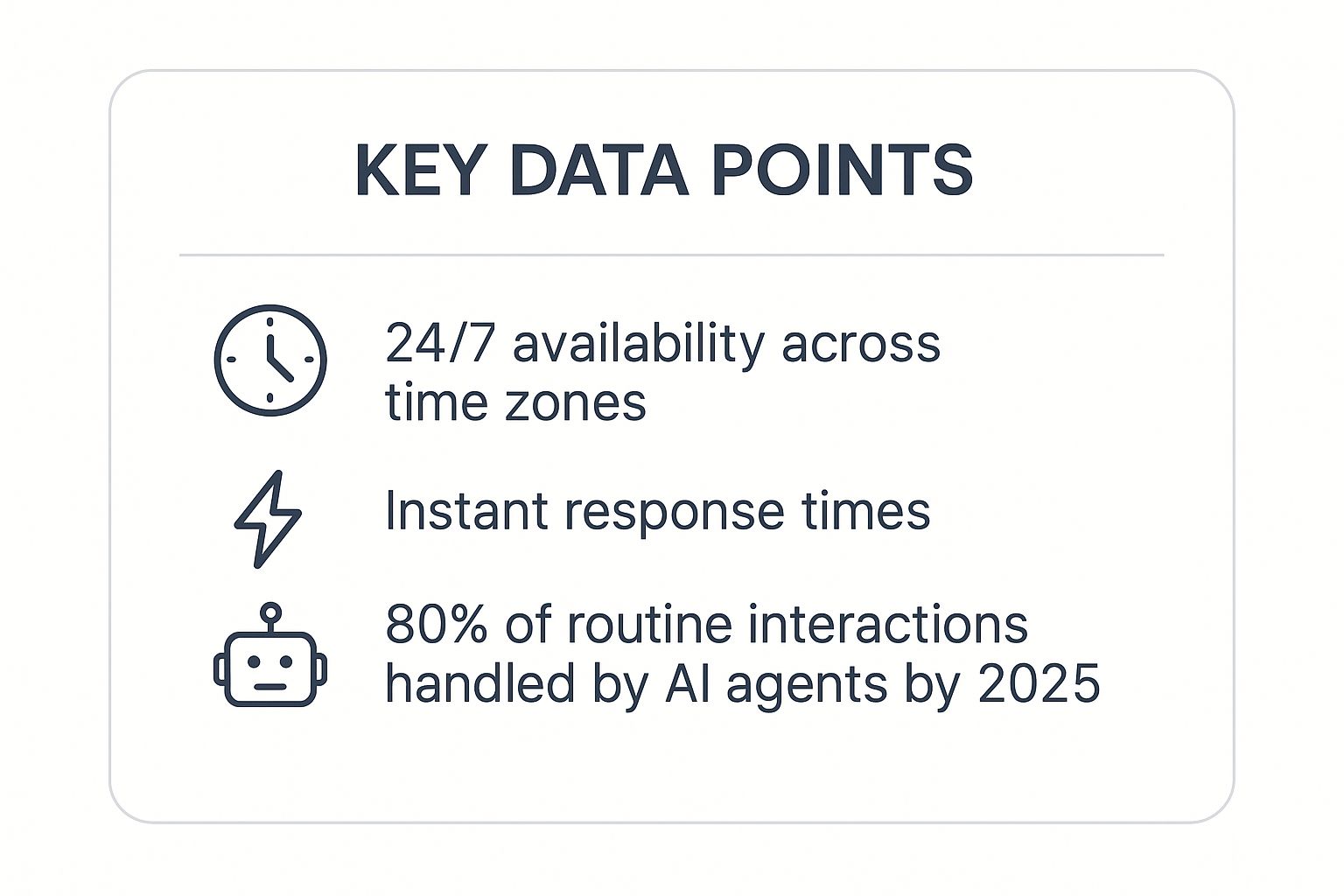
This data underscores the triple advantage of agentic AI in support: constant availability, immediate engagement, and massive efficiency gains, with a clear trend toward automating the majority of routine customer interactions.
Actionable Takeaways for Implementation
For businesses in Sacramento or El Dorado Hills considering this technology, the path to implementation is tactical and phased.
- Start Small, Scale Smart: Begin by identifying your top 3-5 most frequent, low-complexity customer queries. Train your agent to handle these flawlessly before expanding its responsibilities. This builds a reliable foundation and demonstrates ROI quickly.
- Establish Clear Guardrails: Define the agent's scope of authority. For instance, set a maximum refund amount it can process autonomously or specify which account changes require human verification.
- Create a Seamless Human Handoff: The system must be able to recognize its limitations and escalate complex or emotionally charged conversations to a human agent without friction. The goal is resolution, not frustration.
- Monitor and Train Continuously: Use analytics to track customer satisfaction (CSAT) scores, resolution rates, and escalation triggers. Feed transcripts of both successful and failed interactions back into the model to continuously improve its performance and understanding of nuance. This is a crucial step in refining your agentic AI use cases for maximum impact.
2. Sales Development and Lead Qualification
Beyond support, the next frontier for agentic AI is radically transforming the sales pipeline. Autonomous agents are now being deployed as AI-powered Sales Development Representatives (SDRs), capable of managing the entire top-of-funnel process from initial outreach to qualified meeting handoff. These are not simple email automation tools; they are intelligent systems that engage in dynamic, two-way conversations.
Agentic AI in sales can identify ideal customer profiles, personalize outreach messaging at a massive scale, and interpret nuanced prospect responses. It autonomously follows up, answers product questions by accessing a knowledge base, and nurtures leads over time. The system's ability to analyze engagement patterns allows it to determine the precise moment a lead is sales-ready and then schedule a meeting directly on a human sales representative's calendar.
The key distinction is autonomous conversation management. An agentic sales AI doesn't just send emails; it builds relationships and qualifies intent through persistent, intelligent dialogue.
Strategic Analysis: The Conversica Case Study
Conversica provides a compelling example of this technology in action. Their AI assistants engage leads in natural, human-like email conversations to qualify them for sales teams. One of their clients, a technology company, deployed a Conversica AI assistant to re-engage a database of over 50,000 cold leads that the human team had no capacity to contact.
The AI assistant methodically reached out, identified interested prospects, and successfully booked dozens of qualified meetings, generating millions in new pipeline value from a list that was previously considered inactive. The rise of autonomous systems is particularly evident in sales, where a dedicated AI sales agent can automate outreach and qualify leads with remarkable efficiency.
Key Strategic Insight: The company didn't just automate outreach; it delegated the entire qualification process for a low-priority segment. This allowed the AI to work at a scale impossible for humans, extracting significant value from dormant assets and freeing the senior sales team to focus exclusively on closing high-value, pre-vetted opportunities.
This strategy showcases how agentic AI can serve as a force multiplier, ensuring no lead is left behind while amplifying the productivity of the human sales force. This is one of the most powerful agentic AI use cases for driving direct revenue growth.
Actionable Takeaways for Implementation
For Sacramento businesses aiming to boost their sales pipeline, adopting this technology requires a strategic approach.
- Define Your Ideal Customer Profile (ICP) First: The agent’s effectiveness depends on precision. Start with a tightly defined ICP so the AI knows exactly who to target and can tailor its conversational style accordingly.
- Establish Clear Handoff Triggers: Determine the exact criteria for when the AI should pass a lead to a human. This could be after a prospect asks a complex technical question, expresses explicit purchase intent, or agrees to a meeting.
- Integrate with Existing Sales Workflows: Ensure the agent seamlessly integrates with your CRM (like Salesforce or HubSpot). It should be able to log all activities, update lead statuses, and schedule meetings without manual data entry.
- Monitor and Refine Brand Voice: Regularly audit the AI's conversations to ensure the tone, language, and messaging align perfectly with your brand. The goal is to create a positive and consistent customer experience, and incorporating engaging elements like video can further enhance this. To learn more, check out the 10 powerful benefits of video marketing.
3. Autonomous Software Development and Coding
One of the most profound and rapidly evolving agentic AI use cases is in the field of software engineering. AI agents are no longer just code completion tools; they are becoming autonomous developers capable of understanding project goals, writing new features, debugging existing code, and even deploying applications with minimal human intervention.
These agents can interpret natural language prompts, access entire codebases for context, and execute a complete plan from a simple idea to a functional piece of software. This includes setting up the development environment, writing the necessary code, creating test suites to validate functionality, and fixing errors that arise during the process. They function as tireless, collaborative junior developers on a human engineering team.
The core differentiator is end-to-end task completion. An agentic coding assistant doesn't just suggest a line of code; it builds, tests, and refines an entire feature.

Strategic Analysis: The Devin by Cognition AI Case Study
A groundbreaking example is Devin, introduced by Cognition AI as the "first AI software engineer." In demonstrations, Devin successfully completed real-world engineering jobs from the freelancing platform Upwork, autonomously navigating unfamiliar codebases, learning new technologies, and resolving complex bugs along the way.
Unlike tools like GitHub Copilot which assist developers, Devin operates as an independent agent. It plans complex tasks, uses a shell, a code editor, and a web browser, and reports on its progress in real-time, effectively mirroring the workflow of a human engineer.
Key Strategic Insight: Cognition AI's strategy wasn't to build a better code assistant but to create an autonomous agent that could handle the entire development lifecycle for a given task. This shifts the developer's role from a "doer" to a "reviewer" or "architect," massively increasing their leverage and productivity.
This breakthrough showcases the strategic advantage of agentic AI in development: delegating well-defined but complex engineering tasks to an AI, allowing human engineers to focus on system architecture, creative problem-solving, and high-level product strategy.
The following infographic highlights the core benefits driving this widespread adoption.
This data underscores the triple advantage of agentic AI in development: accelerated project timelines, improved code quality through automated testing, and a dramatic increase in developer productivity by offloading routine coding and debugging tasks.
Actionable Takeaways for Implementation
For businesses in Sacramento or El Dorado Hills looking to integrate this technology, a strategic approach is essential.
- Start with Well-Defined Tasks: Begin by assigning the AI agent to small, isolated tasks like writing unit tests for a specific function, fixing a documented bug, or creating a simple API endpoint. This minimizes risk and provides a clear measure of its capabilities.
- Establish Strict Coding Standards: Ensure your project has clear coding standards and linting rules. The AI agent should be configured to adhere to these guidelines to maintain code consistency and quality across the entire codebase.
- Implement Robust Testing and CI/CD: Never allow AI-generated code to be merged directly into production. A robust Continuous Integration/Continuous Deployment (CI/CD) pipeline with automated testing is a critical safeguard to catch any errors or regressions introduced by the agent.
- Keep a Human in the Loop: The most effective model is a human-machine partnership. Use AI agents to generate the initial code, but always have a human developer review, approve, and merge the changes. This maintains quality control and is crucial for major architectural decisions. This approach is key to successfully leveraging agentic AI use cases in software development.
4. Healthcare Diagnostics and Treatment Planning
Agentic AI is making profound inroads in healthcare by augmenting the diagnostic and treatment planning process. These are not simple analytical tools; they are sophisticated agents that can autonomously synthesize vast amounts of patient data, including medical imaging, lab results, genomic sequences, and electronic health records, to support clinical decisions.
Unlike traditional diagnostic software that flags anomalies for review, agentic AI takes the next step. It can cross-reference a patient's unique data against millions of case studies and the latest medical research to propose differential diagnoses, recommend personalized treatment protocols, and even predict potential adverse drug reactions. A central application of agentic AI in healthcare is its role in AI for Medical Diagnosis, where it significantly transforms diagnostic processes.
The key distinction is proactive synthesis and recommendation. The agent doesn't just present data; it interprets it in context and proposes a clear, evidence-backed course of action.
Strategic Analysis: The Viz.ai Case Study
A compelling example of agentic AI in action is Viz.ai, an AI-powered care coordination platform. Its system autonomously analyzes CT scans for suspected strokes in real-time. When it detects a large vessel occlusion, it doesn't just flag the scan; it automatically alerts the entire stroke care team, including specialists who may be off-site, via a secure mobile application.
The agent's task is to close the time gap between diagnosis and treatment, a critical factor in stroke outcomes. It coordinates communication and shares vital imaging data, effectively activating the necessary clinical workflow without human intervention.
Key Strategic Insight: Viz.ai's success stems from automating the coordination and communication workflow, not just the image analysis. By empowering the agent to act on its findings and alert the right people at the right time, they have demonstrated a reduction in treatment times by an average of 52 minutes, drastically improving patient outcomes.
This illustrates a powerful strategy: use agentic AI not only for analysis but to autonomously execute the critical, time-sensitive steps that follow a diagnosis.
Actionable Takeaways for Implementation
For healthcare organizations and medical tech companies, especially those dealing with sensitive patient information and needing to stay up-to-date with privacy policy compliance, implementing these agentic AI use cases requires careful planning.
- Establish a Physician-in-the-Loop Model: The AI should always augment, not replace, clinical expertise. Implement a workflow where every AI-generated recommendation or diagnosis is subject to final validation by a qualified healthcare professional. This ensures safety and accountability.
- Prioritize Data Diversity and Integrity: Train models on diverse and representative patient datasets to avoid biases that could lead to health inequities. Ensure data quality and adherence to standards like HIPAA and GDPR from the outset.
- Define Clear Operational Protocols: What happens if the AI is uncertain? What is the escalation path? Establish clear, documented protocols for how clinical staff should interact with the AI, especially in cases of conflicting opinions or ambiguous findings.
- Monitor for Performance Degradation: AI models can experience "drift" as patient populations, equipment, or medical practices change. Implement continuous monitoring to track the agent's diagnostic accuracy and overall performance, and retrain the model periodically to maintain its effectiveness.
5. Financial Trading and Investment Management
The high-stakes, data-intensive world of finance is a natural proving ground for agentic AI. Here, AI systems operate as autonomous quantitative analysts and traders, ingesting and interpreting colossal datasets in real-time to execute trades faster and more accurately than any human team could.
These agents go far beyond simple algorithmic trading. They independently analyze a diverse spectrum of inputs, including market prices, economic reports, geopolitical news, and even social media sentiment, to build and continuously refine predictive models. They are empowered to manage entire portfolios, execute complex multi-leg trades, and dynamically adjust strategies based on evolving market conditions, all without direct human intervention.
The key distinction is proactive, goal-driven strategy execution. An agent doesn't just follow a pre-programmed "if-then" rule; it learns, adapts, and pursues a defined objective, such as maximizing alpha or minimizing portfolio volatility.
Strategic Analysis: The Renaissance Technologies Case Study
Renaissance Technologies' legendary Medallion Fund is perhaps the most prominent, albeit secretive, example of agentic AI in finance. While specifics are closely guarded, the fund's strategy relies on autonomous agents that identify and exploit fleeting, non-random patterns in chaotic market data. These agents build their own predictive models from petabytes of information, including historical data points others might discard.
The agents at Renaissance don't just trade; they are tasked with the entire lifecycle of a strategy. They find signals, build models, manage risk, and execute trades, learning from every outcome to continuously self-improve. The fund's consistent, market-beating returns for decades are a testament to the power of this agentic approach.
Key Strategic Insight: Renaissance Technologies' success isn't just about speed; it's about complexity. They delegated the entire process of signal discovery and strategy execution to AI agents, allowing them to operate at a scale and sophistication that is impossible to replicate with human-led teams.
This model demonstrates that the most advanced agentic AI use cases in finance involve trusting the AI not just with execution, but with the core intellectual work of investment strategy itself.
Actionable Takeaways for Implementation
For firms exploring this technology, from hedge funds to proprietary trading desks, the approach must be built on a foundation of rigorous control and oversight.
- Implement Robust Risk Guardrails: The first and most critical step is to define strict, non-negotiable risk parameters. This includes setting hard limits on position sizes, maximum daily loss (circuit breakers), and sector exposure that the agent cannot override.
- Backtest with Extreme Scrutiny: Before deploying any capital, an agent's strategy must be backtested against a wide range of historical market conditions, especially "black swan" events like the 2008 financial crisis or the 2020 COVID-19 crash. This helps uncover hidden vulnerabilities.
- Maintain Human-in-the-Loop Oversight: While the agent operates autonomously, a human team must always be in place to monitor its behavior and intervene in catastrophic or unforeseen market scenarios. The goal is autonomous operation, not abdication of responsibility.
- Ensure Regulatory Compliance: The agent’s activities must be fully compliant with all relevant financial regulations from bodies like the SEC and FINRA. This includes maintaining meticulous records of all trades and ensuring the strategies do not constitute market manipulation.
6. Supply Chain Optimization and Logistics
Beyond customer-facing roles, agentic AI is fundamentally reshaping the operational backbone of global commerce: the supply chain. Instead of relying on static models and human-led analysis, businesses are deploying AI agents that autonomously manage logistics networks in real-time. These agents can dynamically forecast demand, manage inventory levels, optimize shipping routes, and coordinate with suppliers without human intervention.
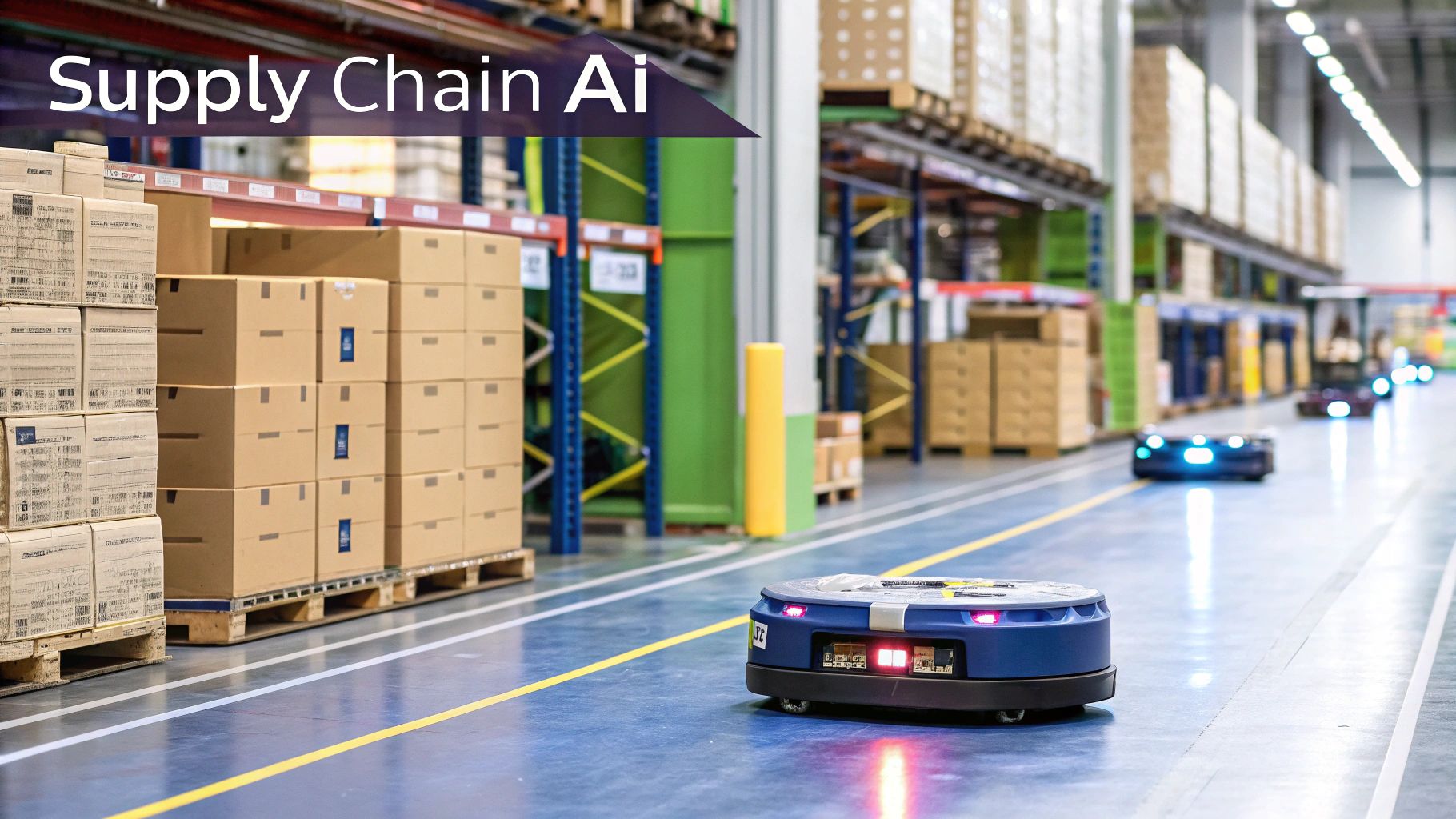
These systems process vast datasets, including weather patterns, shipping lane congestion, and geopolitical events, to make proactive decisions. They can reroute shipments to avoid delays, automatically reorder stock to prevent shortages, and adjust production schedules based on fluctuating consumer demand, ensuring resilience and efficiency on a scale previously unattainable.
The core differentiator is predictive and adaptive execution. An agentic AI doesn't just report a potential disruption; it autonomously executes a multi-faceted plan to mitigate it across the entire network.
Strategic Analysis: The Amazon Case Study
Amazon’s fulfillment network is a masterclass in agentic AI at scale. Its system employs a fleet of AI agents to manage nearly every aspect of the supply chain, from inventory placement in warehouses to final-mile delivery routing. These agents predict regional demand for millions of products and pre-emptively position inventory in fulfillment centers closest to anticipated customers before they even place an order.
Once an order is placed, another set of agents orchestrates warehouse robots, optimizes packing, and determines the most cost-effective and rapid shipping route. This is a continuous, self-optimizing loop that adapts to millions of new data points every second.
Key Strategic Insight: Amazon's strategy is built on decentralized, autonomous optimization. Instead of a single central system making all decisions, thousands of specialized AI agents collaborate, each optimizing a small piece of the puzzle. This creates a highly resilient and scalable network that can absorb shocks and adapt to changes far faster than a centralized, human-managed system.
This approach demonstrates that the true power of agentic AI use cases in logistics lies in empowering agents to control specific operational domains while working toward a collective goal of speed and efficiency.
Actionable Takeaways for Implementation
For businesses in Sacramento or El Dorado Hills looking to improve their logistics, implementing agentic AI is a powerful next step.
- Start with a Single Domain: Begin by deploying an AI agent to solve one specific problem, such as demand forecasting for your top-selling products or optimizing delivery routes for a single vehicle fleet. This focused approach provides clear metrics for success.
- Prioritize Data Integration: Ensure your AI agent has clean, real-time access to crucial data sources like inventory levels, sales data from your POS system, and supplier lead times. The quality of its decisions depends entirely on the quality of its data.
- Establish Human-in-the-Loop Protocols: Define clear rules for when the AI must seek human approval. For example, any procurement order over a certain dollar amount or a major change in a supplier relationship might require manual sign-off.
- Set Clear KPIs and Monitor Performance: Track key metrics like inventory turnover, order fulfillment time, shipping costs, and forecast accuracy. Use this data to continuously refine the agent's models and decision-making parameters. Gaining visibility into these metrics is as crucial as improving your digital presence through effective search engine optimization.
Agentic AI Use Cases Comparison
| Use Case | Implementation Complexity 🔄 | Resource Requirements 💡 | Expected Outcomes 📊 | Ideal Use Cases 💡 | Key Advantages ⭐⚡ |
|---|---|---|---|---|---|
| Customer Service and Support Automation | High: integration with multiple systems, ongoing refinement needed | Significant investment in setup, training, and monitoring | 24/7 availability, instant responses, handles 80% routine interactions by 2025 | High-volume, low-complexity customer queries; scalability needs | ⭐ Consistent quality; ⚡ Instant response; 📊 Cost reduction |
| Sales Development and Lead Qualification | Moderate: requires CRM integration, campaign management setup | Requires quality training data and multi-channel tools | 3-5x increase in qualified leads; 50-70% cost reduction per lead | Lead scoring, nurturing, multi-channel outreach at scale | ⭐ Increased sales productivity; ⚡ Efficient lead handling |
| Autonomous Software Development and Coding | High: complex AI code understanding and testing pipelines | Needs training on codebases, robust testing infrastructure | 30-50% productivity increase; faster prototyping and deployment | Repetitive coding, bug fixing, code review assistance | ⭐ Accelerated development; ⚡ Reduces boilerplate code |
| Healthcare Diagnostics and Treatment Planning | Very high: requires regulatory compliance and validated medical data | Extensive validated datasets, multi-modal inputs, ongoing monitoring | Improved diagnostic accuracy, personalized treatments, 24/7 monitoring | Medical diagnosis, treatment recommendation, patient monitoring | ⭐ Improved accuracy; 📊 Reduced errors; 💡 Specialist insights |
| Financial Trading and Investment Management | Very high: real-time data streams, strict compliance, risk controls | Intensive data processing, backtesting, regulatory adherence | Operates 24/7, manages thousands of positions, eliminates emotional bias | High-frequency trading, portfolio management, risk optimization | ⭐ Fast decisions; 📊 Consistent risk management; ⚡ 24/7 operation |
| Supply Chain Optimization and Logistics | High: integration across legacy systems, dynamic multi-objective optimization | High initial cost, requires cross-organization coordination | 20-30% inventory cost reduction; 15-25% improved delivery performance | Demand forecasting, route planning, warehouse automation | ⭐ Cost savings; 📊 Improved delivery; ⚡ Real-time optimization |
From Automation to Autonomy: Your Next Strategic Move
We've journeyed through a landscape of transformative agentic AI use cases, moving far beyond simple automation. From revolutionizing customer support with proactive problem-solving to optimizing complex supply chains with self-governing logistics, the message is clear. Agentic AI is not a futuristic concept; it is a present-day strategic asset that redefines operational efficiency and competitive advantage.
The examples discussed, spanning sales, software development, healthcare, finance, and logistics, share a powerful common thread. They represent a fundamental shift from tools that execute pre-programmed tasks to intelligent systems that pursue complex goals with autonomy. This transition liberates your most valuable resource, your human team, from repetitive, process-driven work. It empowers them to focus on what they do best: strategic thinking, creative innovation, and building meaningful customer relationships.
Synthesizing the Strategic Imperative
The core takeaway from these diverse applications is that successful implementation hinges on a strategic, not just a technological, mindset. The most successful deployments of agentic AI are not about replacing humans but augmenting them. They are about creating a symbiotic relationship where AI handles the complexity of data analysis and process execution, while humans provide oversight, context, and strategic direction.
Consider the autonomous coding agents. They don't eliminate the need for senior developers. Instead, they act as tireless junior partners, handling routine code generation and debugging, which allows senior talent to focus on system architecture and innovation. Likewise, in financial trading, agents execute trades based on intricate models, but human experts set the risk parameters and overarching investment strategy.
Key Insight: The true power of agentic AI is unlocked when it is viewed as a force multiplier for human expertise, not a replacement for it. The goal is to build systems where autonomous agents and human strategists work in concert to achieve outcomes neither could accomplish alone.
Your Actionable Roadmap to Agentic Integration
Embarking on this journey requires a methodical approach. The path from concept to successful implementation is paved with careful planning and incremental steps. For businesses in Sacramento, El Dorado Hills, and beyond, the initial steps are crucial for building momentum and ensuring a positive return on investment.
Here is a practical, three-step framework to begin your integration of agentic AI:
- Identify High-Impact, Low-Complexity Starting Points: Don't try to overhaul your entire operation at once. Look for a process that is repetitive, data-heavy, and has clear, definable goals. Lead qualification for your sales team or initial ticket triage for customer support are excellent candidates. Success here builds the business case for more ambitious projects.
- Prioritize Data Integrity and Governance: Agentic AI is only as good as the data it learns from and the rules it operates within. Before deployment, ensure your data is clean, accessible, and structured. Establish clear governance protocols, defining the agent's scope of authority, escalation paths, and the essential "human-in-the-loop" checkpoints for critical decisions. This is non-negotiable for mitigating risk and ensuring reliable performance.
- Adopt a Pilot-and-Scale Methodology: Start with a controlled pilot program. Define specific key performance indicators (KPIs) to measure the agent's impact, such as reduced response times, increased lead conversion rates, or lower operational costs. Use the insights from this pilot to refine the system before scaling it across the department or organization.
The era of autonomous operations is here, and the strategic deployment of agentic AI use cases is quickly becoming the dividing line between market leaders and followers. The question is no longer if you should adopt this technology, but how you will harness its power to build a more intelligent, resilient, and efficient organization. Your next strategic move is to step from the world of simple automation into the future of true autonomy.
Ready to move from theory to implementation? The team at Site Igniters specializes in developing custom agentic AI solutions and LLMs tailored to your unique business challenges. We build the intelligent systems that turn your complex workflows into autonomous, revenue-driving assets, helping you navigate the transition to an agent-powered future. Visit Site Igniters to schedule a consultation and discover how we can build your next strategic advantage.
Seth Sanders is the founder of Site Igniters, a digital marketing agency in El Dorado Hills, California.