
AI Solutions for Small Businesses A Practical Guide

Think of AI tools for small businesses as your new secret weapon—a smart co-pilot helping you go toe-to-toe with the big players. These solutions aren't just for tech giants anymore; they level the playing field by making powerful technology surprisingly affordable and easy to use.
- AI solutions are now affordable and accessible enough for small businesses to compete with larger companies.
- Start with AI tools that automate repetitive tasks like customer service, marketing, and data analysis.
- Choosing the right AI tools based on your specific business needs is more important than adopting the latest trends.
Why AI Is Your New Competitive Edge
If you’re running a small business, you know the grind. You're constantly switching hats. One minute you're crafting social media posts, the next you're chasing down leads, and by the afternoon, you're buried in inventory or scheduling appointments. It’s a relentless juggling act, and time is always in short supply.
This is exactly where AI tools come in. Forget the complicated, sci-fi stuff—think of AI as a practical, ready-to-use solution for growth. It’s the behind-the-scenes assistant that takes over your most demanding tasks so you can finally breathe.
Making High-Powered Tech Accessible to Everyone
For a long time, the best technology felt locked away, reserved for corporations with huge budgets and entire IT departments. AI completely flips that script. It’s making sophisticated tools available to everyone, allowing smaller companies to punch way above their weight class.
This newfound access gives you the power to:
- Automate the Annoying Stuff: Get yourself and your team away from tedious work like data entry, sending follow-up emails, and scheduling meetings.
- Create Wow-Worthy Experiences: Use AI to really understand what your customers want, offering them personalized recommendations and support that keeps them coming back.
- Find Game-Changing Insights: Dig into your sales data and market trends to make smarter decisions, all without needing a dedicated team of analysts.
The real magic of AI for a small business isn't just about speed. It's about freeing you up to focus on what actually grows your business: connecting with customers, improving your offerings, and planning your next big move.
A Practical Fix for Common Headaches
At the end of the day, AI tackles the two biggest challenges for any small business: not enough time and a tight budget. Instead of hiring another person to handle a growing workload, you can bring in an AI tool to manage it for a fraction of the cost.
It's not just a theory, either. A recent survey found that 95% of US companies are already using AI to operate more efficiently. They’re proving its value every single day.
When you start using these tools, you’re doing more than just adding new software. You’re fundamentally changing how your business runs, making it faster, smarter, and ready to compete with anyone. This guide will show you exactly how to do it.
Understanding AI in Simple Terms

When you hear "Artificial Intelligence," it's easy to picture robots from a sci-fi movie. For your business, the reality is a lot less complicated and way more practical. The best way to think about AI solutions for small businesses is to imagine hiring a team of virtual assistants, each one a specialist in a single task.
Each of these digital helpers has a very focused talent. They don't get tired, they don't need coffee breaks, and they're experts from day one. This lets you hand off specific, time-sucking tasks so you can get back to focusing on the bigger picture.
For example, one assistant could be a master wordsmith, ready to draft your marketing emails or social media posts. Another might be a customer service guru who’s available 24/7 to answer common questions on your website. You could even have a data whiz who organizes your sales numbers into clear reports you can actually use.
The AI You Can Use Today
It’s important to separate the AI available right now from the all-knowing superintelligence you see in movies. Today's AI is what experts call Narrow AI or Task-Specific AI. All this means is that it's designed to do one job—and do it exceptionally well.
Here are a few examples of these specialized assistants in action:
- Generative AI: Think of this as your creative assistant. It generates brand new content, like writing a blog post with a tool like Jasper or creating unique images for your ads.
- Chatbots: This is your frontline support. It talks with website visitors, answers FAQs, and can even book appointments, giving your customers instant help.
- Predictive AI: This one is your strategic analyst. It digs through your data to forecast sales trends, spot your most valuable customers, or predict when you'll need to reorder inventory.
These tools aren't trying to "think" like people in a general sense. They are powerful pattern-recognition machines built for a specific business goal. They give you targeted support exactly where you need it most.
Think of it like this: You wouldn't ask your accountant to design your company logo. In the same way, you use a specific AI tool for a specific job. This focus is what makes these solutions so powerful and easy to plug into your workflow.
How These Tools Get Smarter
So, how do these AI assistants get so good at what they do? The short answer is data. AI models learn by analyzing massive amounts of information. An AI writing tool, for instance, has been trained on billions of articles and books to get a deep understanding of grammar, tone, and style.
The more data an AI chews through, the better its skills become. When you use an AI-powered CRM, it learns from every single customer interaction. Over time, it starts to recognize which leads are most likely to buy and which customers might need a little extra attention. This "learning" process is what allows AI solutions for small businesses to adapt and improve as you use them.
Understanding this foundation is key. Once you see AI as a team of specialized assistants that learn from data, you can start to spot exactly where they fit into your own business. You can pinpoint the repetitive, data-heavy, or time-intensive tasks and find the right AI tool ready to take them on.
How to Put AI to Work in Your Business
Knowing what AI can do is interesting, but seeing it actively change how you run your business day-to-day is where the magic happens. The real power of AI solutions for small businesses is in their ability to handle the repetitive stuff, sharpen your decision-making, and most importantly, give you back your time.
Let's look at how you can actually deploy AI across the three main pillars of your business.
This infographic breaks down the first steps for bringing AI on board, from figuring out what you need to picking the right tools and getting your team comfortable.
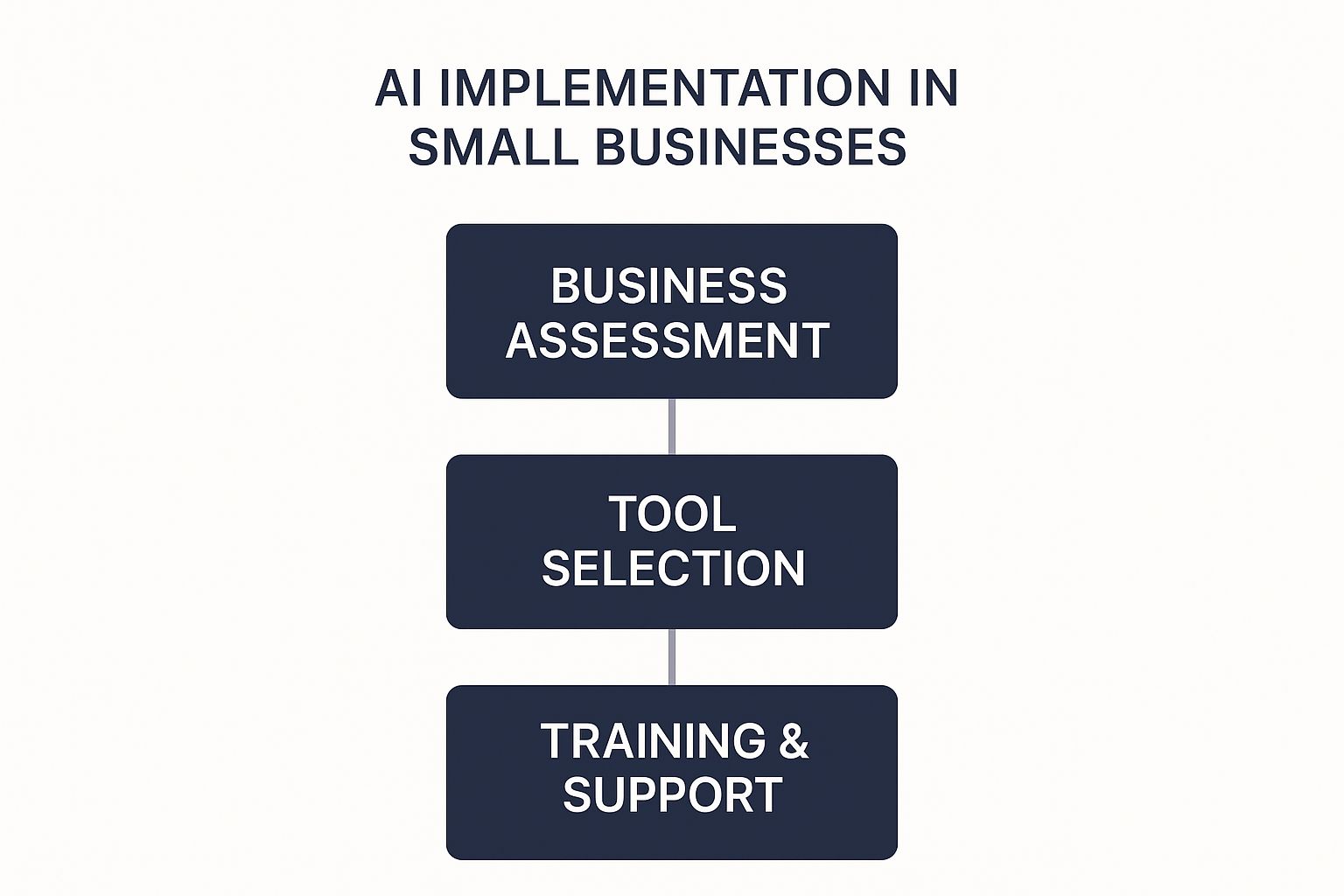
As you can see, a smart AI strategy always starts with a hard look at your business needs—before you even think about signing up for a tool.
Supercharge Your Marketing and Sales
Marketing and sales are all about connecting with people, but they get bogged down by so many manual tasks. AI slides right in as a tireless assistant, taking care of the grunt work so you can focus on big-picture strategy and building real customer relationships.
For instance, an AI tool can watch your ad campaigns, automatically shifting your budget and targeting to the people most likely to buy. That alone saves you countless hours of staring at spreadsheets and guessing what works.
- Content Creation: Need social media captions, blog post ideas, or email newsletters? AI can generate drafts in minutes, helping you stay consistent and finally beat writer's block.
- Ad Optimization: Let an algorithm manage your pay-per-click (PPC) ads. It can pinpoint the best keywords and ad designs to make sure you're getting the most bang for your buck.
- Email Personalization: Stop sending generic email blasts. AI can sort your audience based on their past actions and send perfectly timed, personalized messages that actually get opened.
Elevate Your Customer Service
In a world of instant gratification, customers expect fast answers. AI helps small businesses deliver top-tier service without needing a massive call center budget.
The simplest and most effective example is an AI-powered chatbot on your website. This little helper works 24/7, answering common questions like "What are your hours?" or "Where's my package?" This frees up your team to tackle the trickier problems that need a human brain.
An AI chatbot does more than just answer questions. It's a gatekeeper for your time, filtering out the simple stuff so you only have to deal with the most important customer issues.
But it goes beyond chatbots. Other AI tools can scan customer emails and online reviews to gauge how people are feeling. This is called sentiment analysis, and it gives you a real-time pulse on customer happiness. You can spot problems before they blow up and find out what people truly love about what you do. For instance, if you notice more people are asking questions through their smart speakers, you'll know it's time to optimize your website for voice search.
Streamline Your Daily Operations
The engine room of any good business is its daily operations. This is also where most small business owners get stuck, drowning in administrative work. AI is here to automate the boring stuff.
A great example is using tools for AI-powered invoice data extraction, which can completely eliminate hours of mind-numbing data entry.
Here’s how AI can clear up other common bottlenecks:
- Smart Inventory Management: Ditch the spreadsheets. AI can look at your sales history to predict what you'll need next, sending you alerts when stock is low or even placing reorders for you. No more surprise stockouts.
- Automated Scheduling: Stop the endless email chain trying to find a meeting time. AI scheduling tools connect to your calendar and let clients book a slot that works for everyone, automatically.
- Simplified Financial Forecasting: You don't have to be a financial wizard. AI tools can plug into your accounting software to spot spending trends, analyze cash flow, and give you a clear, simple forecast of your business's health.
The numbers back this up. The majority of business owners using AI (80%) say it's essential for finding new customers, and 78% believe it’s necessary for meeting today's customer expectations for speed. By bringing these tools into your workflow, you're not just getting more efficient—you're building a smarter, stronger business ready for whatever comes next.
The Real-World Benefits of Adopting AI
Knowing what AI can do is one thing, but seeing the real, tangible results it brings to the table is what really counts. Bringing these tools into your business isn't just about installing some new software. It's about changing how you operate from the ground up.
The payoff goes way beyond a little extra convenience. We're talking about a direct impact on your bottom line and, most importantly, on your time. By taking over repetitive tasks and simplifying complicated processes, AI literally gives you back hours in your day. This lets you finally step back from working in your business to start working on it—focusing on the big picture, building real relationships with customers, and chasing down those big ideas.
Reclaim Your Time With Smart Automation
Just think about all the hours you lose every week to administrative busywork. A simple AI scheduling tool, for instance, can wipe out those endless back-and-forth emails just to book one meeting. It checks your calendar, lets the client pick a time that works for everyone, and then handles all the confirmations and reminders on its own.
That’s a small win, but when you start applying that same thinking across your entire business, the time you save adds up incredibly fast.
- Automated Email Responses: Let AI handle those first-touch customer questions or send out lead follow-ups. You won't miss an opportunity, even when you're focused on something else.
- Content Creation Assistance: Ditch the blank page forever. Use AI to whip up first drafts for your social media posts, blog outlines, or product descriptions in minutes, not hours.
- Data Organization: AI tools can instantly sort through messy sales data, customer feedback, or financial records, turning a chaotic spreadsheet into a report you can actually use.
Cut Operational Costs Where It Counts
When you're running a small business, every single dollar counts. AI brings in efficiencies that trim your operational costs, letting you do more with less. Instead of hiring another person to keep up with a growing workload, you can often deploy an AI tool to manage it for a tiny fraction of the cost.
Take an AI-powered marketing platform, for example. It can automatically figure out the best audience for your ads, making sure your budget isn't wasted on clicks that go nowhere. This pushes down your customer acquisition cost and makes every marketing dollar work harder for you.
AI isn't here to replace people. It's here to make them better. It takes on the soul-crushing, monotonous work so your team can focus on what humans do best: creativity, strategic thinking, and connecting with other people.
This actually has a surprising effect on your team. You might think automation leads to downsizing, but the data shows the opposite. A whopping 82% of small businesses using AI actually grew their workforce over the past year. This proves AI is a catalyst for growth, creating the capacity and the need for more human talent. You can dig into more of this data in a report on empowering small businesses with technology from the U.S. Chamber of Commerce.
Drive Sustainable and Smarter Growth
At the end of the day, the biggest benefit of AI is how it fuels smarter, more sustainable growth. It gives you the kind of data-driven insights that used to be reserved for giant corporations with entire analytics departments.
AI can spot hidden patterns in your sales data, showing you which customer groups are most profitable or helping you predict what products are about to take off. This lets you get ahead of the market instead of just reacting to it, grabbing opportunities before your competitors even know they exist.
You can also use AI to create truly personal experiences for your customers, building deeper and more loyal relationships. An AI system can recommend products based on a customer's shopping history or send them content that speaks directly to their needs. This kind of personal touch fosters incredible loyalty, drives repeat business, and turns casual shoppers into your biggest fans. AI doesn't just help you compete; it gives you the tools to lead.
How to Choose the Right AI Tools

Stepping into the world of AI can feel like walking into a massive store with endless aisles. With so many AI solutions for small businesses out there, the key is to shop with a clear purpose, not just wander aimlessly. The right tool can completely change your workflow, while the wrong one just adds another subscription to your monthly bill.
Your journey should always start with a simple question: "Where does it hurt the most?" Pinpoint your biggest bottleneck. Are you drowning in administrative tasks? Struggling to keep up with customer support tickets? Don't start by looking at tools; start by looking at your problems.
Once you’ve nailed down the core challenge, you can start hunting for a solution with a clear goal in mind.
Define Your Needs and Research Smart
Before you get dazzled by flashy features, make a simple checklist of what you actually need. A tool might offer twenty functions, but if you only need two of them, the rest is just noise. Focus your research on solutions built to solve your specific problem.
Think about these critical factors:
- Ease of Use: You don't have time for a steep learning curve. The best tools are intuitive and can be picked up quickly by you and your team. Look for clean interfaces and simple dashboards.
- Integration Power: Does the tool play well with the software you already use? A new AI solution should plug right into your existing world—your CRM, email platform, or accounting software—without causing headaches.
- Scalability: Pick a tool that can grow with you. It might solve your problem today, but will it still work when your business doubles in size next year?
The goal isn't to find the most powerful AI tool on the market. It's to find the one that fits most seamlessly into your current business operations and solves a real, immediate problem.
Ask the Right Questions Before You Commit
When you've narrowed your options down to a few contenders, it's time to dig deeper. Treat this like a job interview for a new virtual team member. Don't be shy about asking providers direct questions to make sure they're the right fit.
A few essential questions include:
- What does your pricing model really look like? Look beyond the introductory offer. Are there hidden fees, user limits, or steep price hikes after the first year?
- What kind of customer support do you offer? When you hit a snag, you'll want fast, reliable help. Is support available through live chat, email, or phone?
- How do you handle data security and privacy? This is non-negotiable. Make sure the provider has solid security measures to protect your business and customer information.
Speaking of security, it remains a top concern for many. While small businesses are using AI heavily for marketing (39.4%) and data analysis (32.6%), security vulnerabilities (23.3%) are a significant barrier to wider adoption.
When you're looking at AI tools, it's also smart to understand the bigger picture of workflow automation. For a great guide on this, check out this resource on choosing the right workflow automation platforms. These platforms can often support or integrate with many AI functions. For example, solid marketing automation is a huge part of any effective search engine optimization (SEO) strategy.
Finally, always start small. Pick one tool and run a pilot project. Test it with a small team or on a limited task to prove its value before committing to a company-wide rollout. This approach minimizes risk and helps you build momentum one successful step at a time.
Future-Proofing Your Business with AI
Bringing AI solutions for small businesses into your world isn’t a one-and-done tech upgrade. Think of it as bringing on a new strategic partner that gets smarter and more capable over time. The tools you set up today are just the beginning. To really get ahead, you have to build a culture of continuous learning and make innovation a part of your daily rhythm.
This is all about getting your team curious and giving them the green light to experiment with new tech. Frame it less like a mandatory training session and more like an in-house lab for finding smarter ways to work. When your team sees AI as a tool that makes their jobs better—not as a threat—they become your biggest advantage.
Staying Ahead of AI Innovation
The speed of AI development can feel like trying to drink from a firehose, but keeping up doesn't require a crystal ball. All it really takes is a commitment to learning and a few smart habits. Just carving out a small amount of time to explore can keep your business from falling behind.
Here are a few practical ways to stay in the loop:
- Follow Key Industry Voices: Find a handful of AI experts or tech journalists you trust on platforms like LinkedIn or X (formerly Twitter). Let them curate the important stuff for you.
- Join Relevant Communities: Jump into online forums or local business groups where other owners are talking about how they're using AI. Hearing about someone else's real-world experience is often the best teacher.
- Schedule Experimentation Time: Block off just a few hours each month for you and your team to play with a new AI tool. This kind of hands-on practice is what builds confidence and sparks killer ideas.
As you start integrating these powerful systems, always remember that handling data comes with a ton of responsibility. To get a handle on protecting your company and your customers, check out our guide on how to stay up to date with privacy policy compliance.
AI is not a destination you arrive at; it's a dynamic path you travel. The small businesses that thrive will be those that learn to walk it with confidence, adapting and growing with the technology every step of the way.
By making smart moves with AI now, you’re doing more than just fixing today's problems with slick software. You're building a business that’s fundamentally more agile, resilient, and competitive. You're future-proofing your operations so you're ready not just for next quarter, but for whatever comes next.
Your AI Questions, Answered
Even after seeing all the ways AI can help, it's natural to have a few lingering questions before you jump in. Let's clear up some of the most common worries so you can get started with confidence.
Is AI Too Expensive for a Small Business Budget?
Not at all. When people think of AI, they often picture massive, custom systems that cost corporations a fortune. The reality for small businesses is completely different. Today’s market is full of affordable—and even free—tools built specifically for entrepreneurs.
Most of these solutions work on a subscription basis, so you’re looking at a small monthly fee instead of a crippling upfront cost. You can find free plans for AI writing assistants, basic website chatbots, and social media tools. The key is to find one specific problem you're facing and grab a targeted, low-cost tool to fix it. The time you save usually means the tool pays for itself almost immediately.
Do I Need to Be a Tech Whiz to Use These Tools?
The short answer is a definite no. You don't need a degree in data science or a background in coding to make AI work for you. The vast majority of AI solutions for small businesses are designed with regular, non-technical people in mind.
They almost always have clean dashboards, simple drag-and-drop features, and plenty of helpful guides to get you started.
Think about it this way: if you can handle modern accounting software or an email marketing platform, you've got this. These tools are designed to be "plug-and-play," and the companies behind them offer tons of tutorials and customer support to help you out.
Which AI Tool Should My Business Start With?
There’s no single right answer here—it all comes down to your biggest headache. To find your perfect starting point, just ask yourself where the most pressure is coming from.
- Struggling with marketing? If you’re constantly running out of content ideas, an AI writing assistant or a social media scheduler with AI features could be a game-changer.
- Overwhelmed by customer questions? A simple chatbot on your website can provide instant answers around the clock, taking a huge load off your shoulders.
- Drowning in admin work? Check out an AI-powered scheduling tool. It can eliminate all the back-and-forth emails that come with booking appointments.
The best approach is to aim for a quick, obvious win. Pick one area where a tool can make an immediate difference. That first success will build your confidence and show your team just how valuable AI can be, making it that much easier to bring it into other parts of your business down the road.
Ready to see how custom AI and smart digital marketing can really move the needle for your business? The team at Site Igniters specializes in building practical, powerful solutions that drive real growth. Explore our AI services and get in touch today.
Seth Sanders is the founder of Site Igniters, a digital marketing agency in El Dorado Hills, California.