
AI Agents for Enterprise A Practical Implementation Guide


Think about the best teammate you've ever had. Now, what if you could create a digital version of that person? That's essentially what an enterprise AI agent is: an autonomous digital teammate. These aren't just bits of code; they're designed to understand your goals, map out the necessary steps, and then execute complex tasks across all the different software your business uses.
- Enterprise AI agents go beyond basic automation by reasoning, planning, and executing complex multi-step workflows autonomously.
- Successful implementation starts with identifying high-value, repetitive processes and deploying agents with clear guardrails.
- Data security, governance frameworks, and human-in-the-loop oversight are critical for enterprise-scale AI agent deployments.
They're a massive leap beyond simple bots. Instead of just automating a single click or a basic response, AI agents can handle entire workflows from start to finish, driving some serious efficiency and opening the door for real innovation.
What Are AI Agents and Why Should You Care?

Imagine hiring someone who works 24/7, never gets tired of repetitive tasks, and has instant access to every piece of software in your company. That’s the kind of power we're talking about with an AI agent. This isn't just another chatbot or a clunky automation script. It’s a completely different way of getting work done.
These agents are built from the ground up to be proactive problem-solvers. A traditional chatbot is stuck on a rigid script, like a call center agent who can't go off-book. An AI agent, on the other hand, operates with a clear goal. It can reason, create a plan, and then use all the tools at its disposal—your CRM, your email, your analytics software—to get the job done all on its own.
The Shift From Simple Tools to Autonomous Teammates
This whole space is exploding right now, and it's happening for two main reasons. First, the incredible power of new large language models (LLMs) has given these agents advanced reasoning skills. Second, businesses are hungry for true end-to-end automation. Companies are done with tools that only fix one tiny piece of a broken workflow.
And this shift is already making waves. As of 2026, 89% of business teams are now using AI agents somewhere in their operations. The average company isn't just experimenting anymore; they're running about 12 AI agents and plan to bump that number up by 67% to 20 within the next couple of years. It’s a clear sign that we've moved from pilot projects to full-blown production. You can dig into more of this data in the 2026 Connectivity Benchmark Report.
An AI agent is less like a calculator that just gives you an answer, and more like an accountant who understands your financial goals, gathers the right documents, prepares your taxes, and files them for you.
To really get what makes these agents different, it helps to put them side-by-side with the automation we're all used to.
AI Agents vs Traditional Automation
| Capability | Traditional Automation (e.g., Chatbot, RPA) | AI Agent |
|---|---|---|
| Thinking | Follows a strict, predefined script or rule set. | Reasons through problems, forms plans, and makes decisions. |
| Scope | Handles single, repetitive tasks within one system. | Manages complex, end-to-end workflows across many systems. |
| Interaction | Needs specific, structured commands to work. | Understands natural language and broad, goal-oriented requests. |
| Adaptability | Fails or stops when it hits an unexpected problem. | Can adapt to new information and find creative solutions. |
| Learning | Static; requires a developer to update its logic. | Learns from outcomes and improves its performance over time. |
| Business Impact | Incremental efficiency gains on isolated tasks. | Drives major productivity boosts across entire business functions. |
The takeaway is simple: older automation was about making a single task faster. AI agents are about making an entire business process smarter.
Core Capabilities That Define an Enterprise AI Agent
So, what really separates a true AI agent from the tech that came before it? It boils down to a few key abilities that let them act more like reliable digital employees and less like passive tools.
- Autonomous Reasoning: They can take a complex request, break it down into logical steps, and figure out the best way forward without a human holding their hand.
- Multi-System Integration: An agent can jump between your apps seamlessly. Think pulling customer data from Salesforce, creating a support ticket in Zendesk, and then sending a follow-up email in Outlook—all as part of one fluid task.
- Goal-Oriented Action: You don't give an agent a list of instructions; you give it an objective. For example, instead of telling it what to click, you tell it why: "Increase ad conversions for our new product launch." The agent then figures out the how.
- Adaptability and Learning: The best agents don't just execute; they learn. They analyze their own performance, see what worked, and get better and more efficient over time.
This powerful combination is what lets enterprise AI agents finally tackle the messy, cross-departmental work that has always been a manual, time-sucking nightmare. They unlock a level of operational agility that just wasn't possible before.
Calculating the Real ROI of AI Agents

Once the initial excitement wears off, decision-makers want to see the numbers. How do enterprise AI agents actually translate into real, measurable value? The answer isn’t just about automating a few tasks; it’s about making a direct impact on the things that matter most: operational efficiency, revenue growth, and customer loyalty.
To calculate the return on your investment, you have to look beyond simple cost-cutting. While efficiency gains are a huge part of the picture, the real financial home run comes from an agent’s ability to find new opportunities and speed up key parts of your business.
Think of it like this: you can keep using a manual screwdriver, and it'll get the job done. Or, you can upgrade to a high-powered drill. The drill is faster, takes less effort, and suddenly lets you tackle much bigger projects. AI agents offer that same kind of leap, changing the very scope of what your teams can accomplish.
Pinpointing Operational Efficiency Gains
The most straightforward way to measure ROI is by looking at operational efficiency. This is where agents step in to handle the repetitive, time-sucking tasks that tie up your best people, freeing them to focus on high-value, strategic work. The financial impact here is usually clear and almost immediate.
A classic example is in customer service. An AI agent can field initial questions, walk customers through common troubleshooting steps, and process returns—all without a human ever touching it. This directly shrinks the number of tickets your support team has to handle, which lowers operational costs and makes response times way faster.
The economic impact of enterprise AI agents is no longer a "someday" promise; it's happening right now. A striking 80% of organizations are already seeing measurable financial benefits, and 88% expect those gains to get even bigger.
This is especially true in customer service, where agents are now autonomously resolving 50-65% of all inquiries. That translates to slashing resolution times by up to 40% and cutting operating costs by a solid 20-30%. You can dig into more data on these agentic AI adoption and ROI trends.
Accelerating Revenue and Growth
Beyond saving money, AI agents are serious money-makers. By automating and fine-tuning sales and marketing workflows, they can shorten sales cycles, serve up better-quality leads, and give conversion rates a healthy boost. This ability to accelerate revenue is a huge piece of their total ROI.
Imagine an agent working 24/7 to nurture leads, sending personalized follow-ups based on exactly what a prospect does on your site. Or one that analyzes ad campaign performance in real time, automatically moving budget to the channels that are actually working to maximize conversions and stop wasting spend.
Here are just a few ways agents can drive revenue:
- Automated Lead Qualification: An agent can chat with new leads the second they come in, ask the right qualifying questions, and even book meetings for your sales team. No more missed opportunities.
- Personalized E-commerce Experiences: For an online store, an agent can be a personal shopper, suggesting products based on browsing history and answering tricky questions to get customers across the finish line.
- Dynamic Pricing Optimization: Agents can watch the market, check competitor pricing, and monitor inventory to make smart, real-time pricing adjustments that maximize your profit margins.
Enhancing Strategic Decision-Making
Finally, there’s a less obvious but incredibly valuable return: better decision-making. AI agents can pull, process, and analyze massive amounts of data from all your business systems, delivering insights you could never get before. That clarity helps leaders make smarter, faster strategic moves.
For instance, you could task an agent with keeping an eye on customer sentiment across social media, support tickets, and product reviews. It could then bundle all that info into a simple weekly report, flagging emerging trends or potential issues before they blow up into major problems.
This turns an agent from a simple task-doer into a strategic advisor. The ROI here is measured in lower risk, better use of resources, and the ability to jump on market opportunities faster than the competition. When you connect these capabilities directly to financial outcomes, the business case for AI agents becomes impossible to ignore.
Understanding How AI Agents Actually Work
To really get what enterprise AI agents can do for you, it helps to peek under the hood. While the tech is definitely advanced, the main idea is pretty straightforward. Just think of an agent as a digital team member with three key parts: a brain that thinks, a planner that creates a strategy, and hands that do the work.
These pieces don't work in isolation; they're in a constant loop. This allows the agent to take a big, high-level goal, chop it up into smaller, concrete actions, and then use the software you already have to get it all done. It’s a huge leap beyond the simple, rigid automation we're used to.
The Core Components of an AI Agent
At the very center of every agent is a Large Language Model (LLM), which is its brain. This is the reasoning engine that understands what you mean when you type a request in plain English, figures out the context, and makes sense of complex instructions. It's the part that lets you say, "Find our top ten customers in the Midwest and draft a personalized outreach email for them," and have it know exactly what you're asking for.
Next up is the planning module. If the LLM is the brain, the planner is the strategic mind. It takes the big goal from the LLM and maps out a step-by-step action plan. For that customer outreach example, the plan might look something like this:
- Log into the CRM.
- Filter all customer data by purchase history and location.
- Isolate the top ten accounts based on the filters.
- Write a personalized email template.
- Queue up the drafts for a human to approve.
Finally, the agent needs tools, which are basically its hands. These tools are the connections—usually APIs—that let the agent actually interact with your other software. One tool might plug into Salesforce to pull customer data, another into Outlook to handle emails, and a third into Slack to send a notification when the job is done. The planner tells the agent which tool to grab for each step in its plan.
An AI agent operates in a continuous cycle: observe, think, and act. It looks at the current state of a system, thinks about the next logical step to get closer to its goal, and then takes action with its tools. This loop just keeps repeating until the objective is officially checked off the list.
This whole setup is what gives an agent its autonomy. It can size up a situation, create a game plan, and carry it out across your entire tech stack—all without needing a person to guide every single click.
Choosing Your Deployment Path
When you're ready to bring AI agents into your business, you've generally got three main paths to consider. The best one for you will come down to your company's in-house tech skills, budget, and just how unique your business problems are. Each route offers a different mix of speed, cost, and customization.
- Embed in Existing Platforms: Many of the big software players, like Salesforce and Zendesk, are building agent features right into their products. This is often the quickest and easiest way to get started since all the integration work is already done for you.
- Use Pre-built SaaS Agents: There's a growing market of companies offering specialized, ready-to-use AI agents for specific departments like marketing, sales, or HR. This approach gets you a solution for common business problems fast, without needing a big technical team.
- Build Custom Agents: For companies with one-of-a-kind workflows or those looking for a serious competitive advantage, building a custom agent is the most powerful choice. This path gives you total control and can be molded to your exact operational needs, but it does require more resources and expertise.
Comparing Your Options
Picking the right deployment model is a big strategic decision. If you get it wrong, you could end up with wasted resources or a tool that doesn't really solve your problem.
| Deployment Model | Best For | Pros | Cons |
|---|---|---|---|
| Embedded Agents | Companies already heavily invested in a specific software ecosystem. | Fast to get going; works seamlessly with the main platform. | Limited to what that one platform can do; risk of vendor lock-in. |
| SaaS Agents | Teams that need to solve a common problem quickly with minimal fuss. | Quick to deploy; lower upfront cost; already specialized. | Less customizable; might not connect with all your niche tools. |
| Custom Agents | Enterprises with unique processes and the resources to build their own. | Perfectly tailored to your needs; can create a real competitive edge. | Higher cost and complexity; needs specialized technical skills. |
At the end of the day, the goal is to find the path that lines up with your business strategy. Whether you start small with an embedded agent to automate a few simple tasks or go all-in on a custom build to reinvent a core process, understanding these models will make sure your AI agent project starts on the right foot.
Practical AI Agent Use Cases You Can Implement
It's one thing to talk about AI agents for enterprise in theory, but seeing them in action is what really makes the lightbulb go on. These aren't just abstract concepts for a future business world; they're practical, problem-solving digital teammates you can deploy today to fix specific, high-impact challenges.
The real key is shifting your mindset from a vague idea of "automation" to pinpointing concrete tasks where an agent can deliver obvious, measurable results. Let's walk through a few real-world scenarios where AI agents are already making a difference in core business functions.
Each of these examples is straightforward: you find a common business headache, give an AI agent a clear goal, and let it deliver tangible improvements. These are actionable strategies you can start planning for right now.
This is a simplified look at how the core components of an AI agent work together.
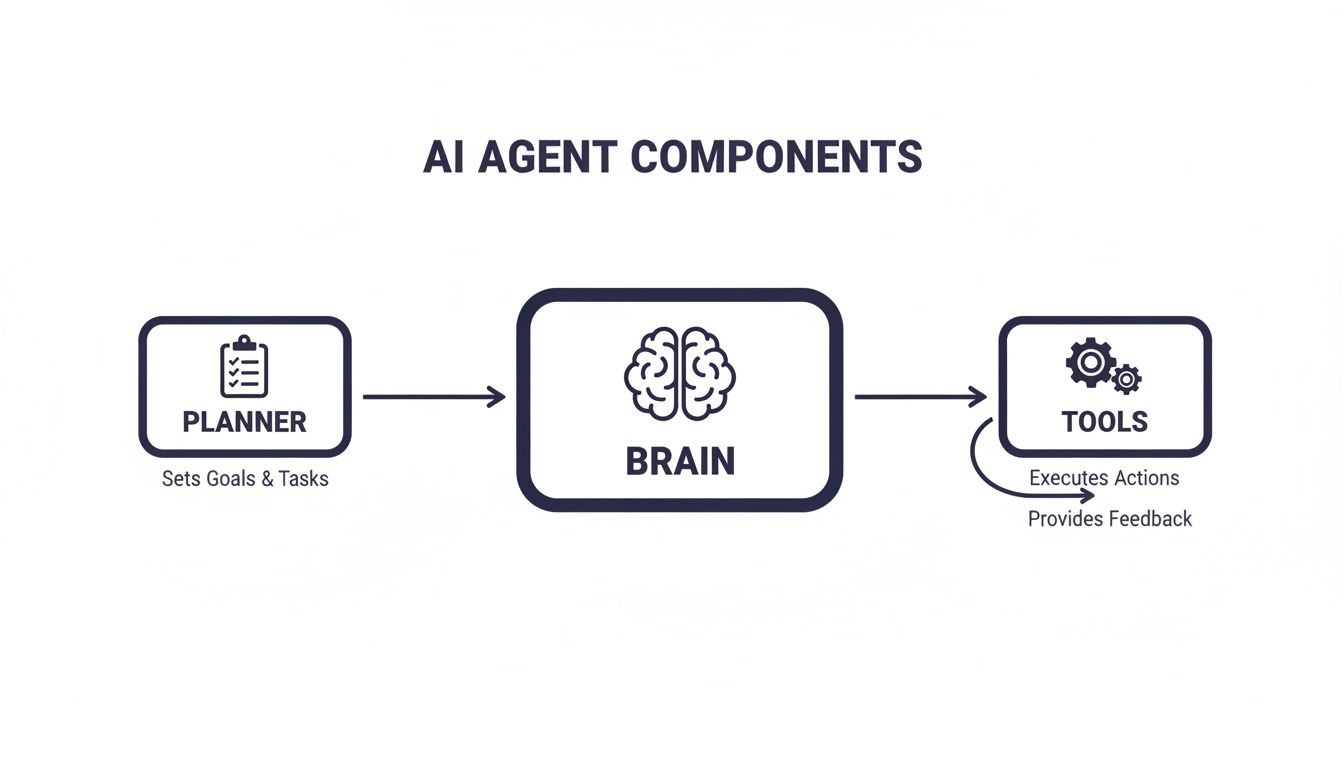
As the diagram shows, the planner, brain, and tools operate in a constant loop, allowing the agent to tackle complex, multi-step tasks all on its own.
Automating Marketing and Ad Campaigns
Marketing teams are drowning in a sea of data, trying to manage budgets, creatives, and performance metrics across way too many platforms. This chaos is the perfect environment for an AI agent to step in and run a paid ad campaign from start to finish.
The Problem: A marketing manager burns hours every week manually tweaking ad bids, killing creatives that aren’t working, and shifting budget between Google Ads and social media. It's an inefficient, reactive process that always feels like you're one step behind.
The AI Agent Solution:
- The Goal: You give the agent a simple, direct objective: "Get the highest possible conversion rate for our new product launch, but don't spend more than $10,000 this month."
- Autonomous Action: The agent plugs directly into your ad platforms (Google, Meta, etc.) and your analytics tools. It then starts watching performance metrics—click-through rates, cost per acquisition, you name it—in real time.
- Optimization on the Fly: Using that live data, the agent makes decisions instantly. It might pump more budget into a Facebook ad set that's crushing it, pause a Google keyword that's burning cash, or even suggest A/B testing a new headline for a lazy ad.
The Outcome: The human marketing manager is freed up to think about big-picture strategy and creative ideas. The campaign itself runs leaner and meaner, driving down the cost per acquisition and boosting ROI because optimizations happen 24/7, not just when someone has time to check the dashboard.
Enhancing the E-commerce Customer Journey
For any online store, turning a casual browser into a loyal customer comes down to creating a seamless, personal shopping experience. An AI agent can serve as a super-intelligent shopping concierge, guiding customers from the moment they land on your site to checkout.
The Problem: Shoppers bail on their carts all the time because they can't get a quick answer to a specific product question or the returns process is a nightmare to figure out. Old-school chatbots just hit them with a list of FAQs, which only creates more frustration.
The AI Agent Solution:
An e-commerce concierge agent is tasked with a dual mission: slash cart abandonment rates and boost customer satisfaction. To do this, it connects to your product catalog, inventory system, and entire knowledge base.
- Personalized Recommendations: By looking at a customer's browsing history, the agent can suggest other products they might actually like, acting like a skilled personal shopper.
- Deep Product Knowledge: When a customer asks, "Is this jacket really waterproof enough for a downpour?" the agent digs into tech specs and customer reviews to give a detailed, confident answer, not just a generic "yes."
- Effortless Returns: If a customer needs to make a return, the agent can find their order, generate a shipping label, and even schedule a pickup. It transforms a major point of friction into a simple, guided conversation.
This same principle of deep, contextual understanding applies in many B2B contexts, too. For example, agents are becoming essential for specialized tasks like AI brand tracking for SaaS companies, where they can provide incredibly detailed market insights.
Streamlining Professional Services Operations
Firms in law, healthcare, and consulting are swamped with complex client onboarding, scheduling, and mountains of paperwork. These administrative burdens are perfect candidates for an AI agent to take over.
The Problem: A law firm's paralegals are spending way too much of their expensive time on admin work. They're chasing down new clients for initial information, hounding them for signed documents, and getting stuck in endless email chains just to schedule a single meeting.
The AI Agent Solution:
- Client Onboarding: You can deploy an agent to manage the entire client intake process. It sends the forms, follows up automatically if information is missing, and ensures every signed document is correctly filed in the firm's system.
- Intelligent Scheduling: The agent gets access to every attorney's calendar. It can then cross-reference availability and coordinate directly with the client to book appointments, killing the back-and-forth email volley for good.
- Initial Report Drafting: Once it has all the preliminary data, the agent can even draft an initial case summary using a predefined template. This gives the legal team a huge head start on the real, substantive work.
By handing off these repetitive, multi-step processes to an AI agent, professional firms can unlock a massive efficiency gain. This lets their highly skilled people focus on what they were actually hired to do: provide expert advice and world-class service to clients.
The table below summarizes just a few high-impact applications, showing how versatile these agents can be across different business environments.
AI Agent Applications Across Industries
| Industry | Example Use Case | Key Business Outcome |
|---|---|---|
| Marketing | Autonomous management of multi-platform paid ad campaigns. | Increased ROAS (Return on Ad Spend) and reduced manual oversight. |
| E-commerce | Intelligent shopping concierge for personalized recommendations and support. | Lower cart abandonment rates and higher customer lifetime value (CLV). |
| Healthcare | Automated patient appointment scheduling and pre-visit intake form completion. | Reduced administrative overhead and improved patient experience. |
| Legal Services | New client onboarding, document collection, and initial case brief drafting. | Increased paralegal/attorney productivity and faster case-to-close times. |
| Local Service Business | Automated lead qualification and appointment booking via website chat or SMS. | Higher lead conversion rates and a more efficient sales pipeline. |
As you can see, the applications aren't limited to one type of company. The core idea is to identify a bottleneck filled with repetitive tasks and deploy an agent to handle it with speed and precision.
Implementing a Framework for Governance and Security
Bringing powerful ai agents for enterprise operations into your business is a game-changer for efficiency, but it also creates brand new risks. You wouldn’t hand a new hire the keys to every company system on day one, right? The same logic applies here. You can’t just let an autonomous agent loose without a clear set of rules.
Setting up a solid framework for governance and security isn't just a "nice-to-have"—it's an absolute must for using this technology responsibly and successfully.
Think of it as creating a digital employee handbook for your AI agents. This handbook needs to define who's accountable for the agent's actions, how much freedom it has, and how its performance is monitored and audited. Without these guardrails, you’re exposing your business to data breaches, compliance nightmares, and operational chaos.
Establishing Clear Governance Protocols
Good governance kicks off by defining who owns what and where the boundaries are. You need to figure out who in the company is responsible for watching over these agents. Is it the IT department? A specific team lead? Or maybe a dedicated AI governance committee? Getting this clear from the start means someone is always accountable.
Next, you have to draw hard lines on what decisions an agent can make by itself. For instance, you might let an agent automatically shift ad spend up to $500, but anything over that requires a human to sign off. These kinds of thresholds prevent expensive errors and keep a person in charge of the big decisions.
To get a handle on the risks and complexities of AI, solid governance is key. The Three Lines of Defense framework for AI Governance and Risk Management offers a structured way to think about this and provides great guidance for creating these vital controls.
Fortifying Security and Data Protection
Security and governance are two sides of the same coin. The moment an AI agent plugs into your CRM, accounting software, and internal wikis, it becomes a juicy target for attackers. Protecting the sensitive data it can touch is job number one. The guiding principle here is simple: least privilege.
This just means an agent should only have access to the bare minimum data and permissions it needs to do its job. An agent built to schedule meetings has no business looking at your company’s financial records. By keeping its access strictly limited, you drastically shrink the potential damage if something goes wrong, whether that’s a security breach or just an agent bug.
A few key security measures are non-negotiable:
- Access Control: Use strict, role-based access so agents can only touch approved apps and data.
- Data Encryption: Make sure any data the agent works with—whether it's being sent or just sitting on a server—is fully encrypted.
- Audit Trails: Keep detailed logs of every single thing an agent does. This paper trail is critical for fixing mistakes and investigating any security incidents.
A well-governed AI agent operates in a digital "sandbox" you've built with your security and compliance rules. It has the freedom to do its job well, but it's physically prevented from coloring outside the lines, which keeps your whole company safe.
Embedding Compliance into Workflows
If you’re in a regulated industry like healthcare or finance, compliance is the law. The great thing about AI agents is that you can build the compliance rules right into how they operate. This flips compliance on its head—instead of being a manual checklist after the fact, it becomes an automated, preventative part of the process.
For example, an agent working in healthcare could be programmed to automatically verify patient consent before it ever touches personal health information. Along the same lines, you can learn how to stay up-to-date with privacy policy compliance to ensure your agents are always handling data the right way.
By building these rules directly into the agent’s programming, you make sure you’re following regulations like HIPAA or GDPR by default. What used to be a major liability becomes a secure, managed, and fully compliant automated workflow.
Your Step-by-Step AI Agent Deployment Roadmap
Successfully rolling out AI agents for enterprise operations isn't something that happens by accident. It takes a deliberate, thoughtful plan that starts with a small, focused experiment and grows into a wider, more impactful launch. A phased approach is your best bet—it lets you prove the value, learn fast, and build momentum without taking on too much risk all at once.
This roadmap breaks that journey into five clear, manageable phases. Think of it less as a rigid set of rules and more as a flexible guide. The real goal is to create an agile process that empowers your team to move confidently from a simple concept to a major enterprise-wide impact.
Phase 1: Identify a High-Impact Business Problem
Before you even think about technology, you need to start with a real business pain point. Look for workflows that are repetitive, suck up a lot of time, and are prone to human error. A great place to start is often a process that nobody on the team wants to do but is absolutely critical for the business.
Pick a problem where the return on investment will be obvious to everyone. For instance, focus on cutting down customer service ticket resolution times or speeding up how you qualify new leads. When you choose a clear, measurable problem, you can easily demonstrate success and get the buy-in you'll need for future projects.
Phase 2: Launch a Small-Scale Pilot Project
Once you've zeroed in on the problem, your next move is to launch a small pilot. The goal here isn't perfection; it's about learning. A pilot lets you test your assumptions, see how an agent actually interacts with your live systems, and get real-world feedback from your team in a low-risk setting.
A successful pilot acts as your internal case study. It proves the technology works within your unique environment and creates a story you can use to get other departments excited about what's possible.
Keep the scope of your pilot project laser-focused. Define what success looks like from day one—whether that’s a 15% reduction in manual data entry or a 20% faster response to new leads. This keeps the project on track and makes it simple to measure the outcome.
Phase 3: Select the Right Tools and Partners
After your pilot proves the concept is a winner, it's time to think about the right long-term tools. As we talked about earlier, you can go with embedded agents in platforms you already use, grab pre-built SaaS agents for common tasks, or build a custom solution from the ground up for a unique competitive edge.
Your decision should line up with your company's technical skills, budget, and strategic goals. Don't just pick a vendor based on a flashy feature list; look for a true partner who understands your industry and can actually support you as you scale.
Phase 4: Design a Smart Integration Strategy
An AI agent is only as good as the systems it can talk to. A smart integration strategy is absolutely essential for unlocking its full potential. You need to map out exactly which applications the agent needs to access, from your CRM and email platform to internal knowledge bases and databases.
Start with the most critical connections for your pilot use case and then plan to add more integrations in phases over time. This approach ensures a much smoother, more stable rollout. And remember, ensuring accessibility is a key part of any modern digital strategy. You can learn more about making your digital assets accessible by exploring our guide on ADA website compliance.
Phase 5: Plan for Adoption and Scale
Here's a hard truth: technology is only half the battle. The other half is people. You need a clear change management plan to get your team on board. You have to show them how the AI agent is going to make their jobs easier, not replace them.
Provide solid training, share the fantastic results from your pilot, and make a big deal out of early wins. Once you have a proven model and an enthusiastic team behind you, you can start hunting for other high-impact problems across the organization and replicate your success, scaling the benefits of AI agents for enterprise operations.
Frequently Asked Questions About AI Agents
Diving into the world of enterprise AI agents always brings up a few questions. Let's tackle some of the most common ones that business leaders ask when they're getting started with this technology.
What Is the Main Difference Between an AI Agent and a Chatbot?
It’s helpful to think of it this way: a chatbot is like a friendly cashier working from a script. It’s great for answering common questions and handling simple, predictable tasks.
An AI agent, on the other hand, is like an experienced store manager. It can understand a complex goal, figure out the multiple steps needed to achieve it, and coordinate with different departments to solve a unique customer problem. The real difference-maker here is autonomy and reasoning.
How Much Technical Skill Is Needed to Implement AI Agents?
This really depends on the path you take.
If you’re using pre-built agents inside a platform like Salesforce or adopting a specialized SaaS tool, there’s very little heavy lifting on your end. But if you decide to build a custom agent from the ground up, that’s a different story. That approach requires serious in-house talent in AI, data science, and software integration.
Are AI Agents Secure for Handling Sensitive Business Data?
Security isn't an add-on; it has to be baked in from the very beginning. Well-designed AI agents operate under strict governance frameworks built on the principle of least privilege. This just means they only get access to the absolute minimum amount of data needed to do their job.
Every action is logged in a detailed audit trail, and all data is encrypted. To get a better sense of these practices, it helps to understand how to keep your own privacy policy and data standards current.
The best way to think about it is to treat an AI agent like any employee. You grant access based on their role, monitor their actions, and put clear boundaries in place to prevent mistakes or unauthorized access. With the right controls, they can be incredibly secure.
When you establish solid protocols from day one, you ensure your AI agents operate safely within your organization's rules. This protects your valuable business information while they get to work making your processes better.
Ready to deploy AI that solves real business problems? Site Igniters builds custom AI agents and LLM solutions that drive efficiency and growth. Contact us today to get started.
Seth Sanders is the founder of Site Igniters, a digital marketing agency in El Dorado Hills, California.