
Innovative Picks: best ppc management software for 2026 – Compare Top Tools

The best PPC management software is whichever one fixes your biggest headache. It might be a tool that automates mind-numbing tasks, one that serves up deep competitive insights, or one that helps you scale complex campaigns without losing your shirt. We see platforms like WordStream, Optmyzr, and Adzooma as top dogs because they turn paid search from a reactive, time-sucking chore into a proactive, data-smart growth machine.
- The best PPC software depends on your biggest pain point: automation, analytics, competitive intelligence, or campaign scaling.
- AI-powered bidding and budget optimization tools can dramatically reduce wasted ad spend in 2026.
- Look for platforms that integrate with your existing ad networks and provide actionable, not just decorative, reporting.
Why Smart PPC Software Is a Must-Have for Growth
Trying to manage modern PPC campaigns by hand is like showing up to a Formula 1 race on a bicycle. You might be moving, but your competition is in a different league entirely. Sticking only to native platforms like Google Ads works for a bit, but it quickly becomes a mess as you scale up your ad spend and campaign complexity. This old-school approach is a recipe for disaster.
You end up with budget leaks from keywords you didn't even know you were bidding on. You miss out on optimization opportunities that happen overnight or on a Saturday. Before you know it, you're drowning in spreadsheets, just trying to plug holes in the ship instead of steering it toward profitable new waters.
This is exactly why dedicated software is a strategic investment, not just another monthly expense. It takes over the repetitive, rule-based jobs that eat up your day, freeing your team to think about big-picture strategy, creative testing, and building client relationships. The right tool is your central command center for all things paid advertising.
The Shift from Manual Effort to Automated Intelligence
Today's PPC tools are built to crunch numbers on a scale that's impossible for a human. They’re packed with features designed to squeeze every last drop of value from your ad spend by making smarter, faster decisions on your behalf.
Here’s what that looks like in the real world:
- Automated Bid Management: Smart algorithms adjust your bids 24/7 based on performance, time of day, device, and even a user's location, ensuring you’re always paying the right price for the most valuable clicks.
- Intelligent Budget Pacing: These tools keep you from accidentally blowing your whole month's budget in the first week. They make sure your money goes to the campaigns that are actually delivering results.
- Actionable Reporting: Instead of a dozen different reports, you get one clean dashboard that pulls data from all your platforms. It tells you exactly what’s working and what’s not, without the fluff.
To really get why this software is so critical for growth, you have to understand the power of AI-driven marketing in today's ad world. That tech is the engine running under the hood of all the best optimization features.
The Google Ads interface itself is powerful, but it only shows you what's happening within its own walls.

Think of the native platform as the foundation. Third-party software builds on top of it, adding layers of automation, cross-channel management, and competitive analysis that you just can't get otherwise.
A Market Driven by Efficiency and Scale
The move toward these tools isn’t just a hunch; it’s a massive industry trend. The global PPC software market is on track to hit USD 28.62 billion by 2027, growing at a steady clip of 11.2% year over year.
What’s fueling this? It's small and medium-sized businesses scrambling for a competitive edge. They're using cloud-based tools with automated bidding and real-time analytics to punch above their weight.
At the end of the day, the right PPC management software lets you break free from the limits of the native platforms. It empowers you to build a paid advertising machine that is more scalable, more profitable, and a whole lot more efficient.
The Core Pillars for Evaluating PPC Platforms
Picking the right PPC management software isn't just about grabbing the one with the most bells and whistles. It’s about finding a platform that truly aligns with your business goals, whether you're a local shop or a sprawling e-commerce brand. To cut through the marketing fluff, you need a solid framework built on four essential pillars.
Think of these pillars as your personal scorecard. They'll help you judge how any potential software will actually hold up when you put it to work, day in and day out.
Automation and AI Capabilities
Let's be honest, the whole point of a PPC platform is to save you time by automating the tedious stuff. This pillar is all about how well a tool can handle tasks like bid adjustments, budget pacing, and keyword management without you having to constantly babysit it. Basic automation is table stakes, but the real magic is in the intelligence driving it.
Today’s best tools are powered by AI and machine learning that go way beyond simple "if this, then that" rules. They crunch thousands of data points in real-time to make predictive bids, spot weak ad creative, or even surface new keywords based on what people are searching for right now. For small businesses, which are slated to hold the highest market share, AI-driven features are a game-changer for running optimized campaigns without a huge team. You can dive deeper into the market trends driving PPC software adoption to see why this is so critical.
A Practical Example: Imagine an e-commerce store in the middle of a holiday sale. An AI-powered tool could automatically push more budget toward the products and audiences converting best throughout the day, maximizing sales during peak hours—all without someone having to manually pull levers.
Reporting and Insight Delivery
Raw data is just noise; actionable insight is where the money is. This pillar measures a platform's knack for turning complex campaign numbers into clean, easy-to-digest reports that actually help you make decisions. A great tool doesn’t just tell you what happened—it helps you understand why and what to do next.
Look for a few key things here:
- Customizable Dashboards: Can you build a single screen showing the KPIs that matter most to your business or your client?
- White-Label Reporting: If you're an agency, being able to slap your own logo on reports isn't a luxury; it's a necessity.
- Cross-Channel Views: How easily can you pull data from Google Ads, Microsoft Ads, and social platforms into one unified report?
The goal is to get answers, not spend your afternoon wrestling with spreadsheets. The best software makes opportunities and problems jump right off the page, which is a core part of any strong search engine marketing strategy.
Integration Power
Your PPC software doesn't live on an island. It has to play nice with the other tools in your marketing stack to create a smooth, data-driven workflow. This pillar is all about how well a platform connects with other systems.
You’ll want to see integrations with your CRM (like Salesforce or HubSpot), analytics platforms (like Google Analytics), and call tracking software. When the integrations are solid, data flows automatically. For instance, linking your CRM lets the PPC platform see which keywords are driving actual sales—not just clicks—which allows for much smarter bidding based on real business impact.
Usability and Scalability
At the end of the day, even the most powerful tool is useless if your team hates using it. This final pillar looks at the user experience and whether the platform can grow with you. Is the interface intuitive? How long will it take to get a new team member up to speed?
Scalability is just as crucial. A tool that handles a $5,000 monthly ad spend needs to perform just as well when you’re managing $50,000. That means it has to efficiently manage more campaigns, keywords, and data as your business gets bigger. Look for features like bulk editing, multi-account management, and user permissions that will support you down the road.
A Head-to-Head Comparison of Top PPC Software
Jumping into the crowded market for PPC management software demands a clear, real-world analysis. Instead of just rattling off features, let’s compare how the leading platforms—WordStream, Adzooma, Optmyzr, and the free Google Ads Editor—actually handle the daily grind.
Each tool is built on a different philosophy, serving everyone from time-strapped business owners to data-obsessed agency professionals. This comparison will focus on how they perform in real scenarios. How does each platform tackle critical jobs like managing budgets, expanding keywords, and creating reports that clients will actually understand? Getting these differences is the key to finding the right fit.
The Baseline: Google Ads Editor
Before we even look at paid tools, we have to talk about the workhorse in every PPC manager’s toolkit: Google Ads Editor. This free desktop app is built for one thing—making bulk changes to Google Ads campaigns, fast.
Think of it as a supercharged spreadsheet for your campaigns. Need to update ad copy across 50 ad groups or tweak thousands of keyword bids at once? The Editor lets you do it all offline, review everything, and then push it live. It's quick, reliable, and completely free, making it the undisputed champ for heavy-lifting tasks.
But its strengths are also its weaknesses. It gives you zero strategic guidance, no automated optimizations, and no support for other ad platforms. It’s a powerful tool for execution, not strategy.
WordStream Advisor: The Guided Path to Optimization
WordStream Advisor is built for the small business owner or marketing generalist who has to wear a dozen different hats. Its entire approach is about making PPC accessible and providing guided improvements, which is perfectly captured by its "20-Minute Work Week" feature. This isn't just another dashboard; it's your prioritized to-do list for PPC.
Instead of throwing raw data at you, WordStream analyzes your account and serves up specific, actionable recommendations. For example, it might flag a costly, irrelevant search term and let you add it as a negative keyword with a single click. It breaks down complex jobs into simple, manageable steps, taking the guesswork out of PPC.
WordStream's real value is in translating complex PPC data into a simple, guided workflow. It's less about granular control and more about making sure the most critical optimizations get done, even by non-experts.
This approach is perfect for teams that don't have deep PPC expertise but still need to drive consistent results. However, seasoned pros might find the hand-holding a bit restrictive, as it doesn't have the deep, script-based customization you'd find in more advanced platforms.
Adzooma: Simplicity and Accessibility
Adzooma carves out its niche with a clean, intuitive platform that’s surprisingly powerful for its price—especially since it includes a solid free plan. Much like WordStream, it aims to simplify campaign management, but with its own unique flavor. Its "Opportunities" feature is the star of the show, using AI to scan your Google, Microsoft, and Facebook accounts for suggestions to boost performance.
Where Adzooma really shines is its user-friendly reporting and multi-channel view. You can quickly generate a clear performance report that pulls data from multiple ad networks into one place. This is a huge time-saver for freelancers and small agencies who need to show clients what's working without spending hours building reports from scratch.
While it offers great one-click optimizations and automation rules, it doesn’t provide the same deep, custom script capabilities as an enterprise-level tool like Optmyzr. It’s the perfect choice for those who have outgrown the native ad platforms but don't need—or want to pay for—the highest level of complexity.
Optmyzr: The Powerhouse for PPC Professionals
If WordStream is your helpful guide, Optmyzr is the sophisticated command center for seasoned PPC experts and agencies. The entire platform is built around providing granular control, deep data analysis, and powerful, script-based automation. This is the best PPC management software for pros who want to build their own custom optimization strategies from the ground up.
For instance, an Optmyzr user could write a complex "bid to position" script that automatically adjusts bids to keep their most profitable keywords in a specific ad rank. Or they could build an "A/B Ad Test Winner Alerter" that sends a Slack notification the moment an ad variation hits statistical significance.
This level of customization is its greatest strength. It gives agencies the power to create unique, high-impact optimization workflows for every single client. But all that power comes with a steeper learning curve and a higher price tag, making it a tough sell for beginners or small businesses with simple campaign structures.
PPC Software Feature Comparison Matrix
To make sense of it all, here's a quick look at how these platforms stack up against each other on the core features that matter most.
| Feature | WordStream | Adzooma | Optmyzr | Google Ads Editor |
|---|---|---|---|---|
| Primary User | SMBs, Marketing Generalists | SMBs, Freelancers, Small Agencies | PPC Experts, Agencies | All PPC Practitioners |
| Pricing Model | Subscription (Tiered) | Freemium, Subscription | Subscription (Tiered) | Free |
| Automation | Guided Recommendations | AI-based Opportunities, Rules | Custom Scripts, Advanced Rules | None (Manual Bulk Edits) |
| Reporting | Pre-built Templates | Multi-channel, Customizable | Highly Customizable, White-label | Basic Performance Data |
| Supported Platforms | Google, Microsoft, Facebook, Insta | Google, Microsoft, Facebook | Google, Microsoft, Amazon, Facebook | Google Ads Only |
| Key Differentiator | 20-Minute Work Week | Free Tier, Multi-channel Simplicity | Deep Customization & Scripting | Offline Bulk Editing Speed |
This table highlights the core philosophy of each tool. Your choice really comes down to your team's expertise, budget, and how much control you truly need.
With search advertising leading the charge in digital marketing, tools that masterfully handle platforms like Google Ads—which holds 69.04% of the global market—are incredibly valuable. You can learn more about the market drivers behind PPC software and its projected growth to see just how critical these platforms have become.
Beyond core campaign management, don't forget to look into specialized software. Using the best ad spy tools, for example, can give you a serious competitive edge. Ultimately, the choice between these platforms boils down to your team's skill level, goals, and budget. Each one offers a distinct path to better PPC performance.
Matching the Right Software to Your Business Needs
Picking the best PPC management software isn't about finding the one with the longest feature list. It's about finding the one with the right features for your business. A tool that's perfect for a global e-commerce brand will be a complicated, expensive mess for a local service business. You have to match the software’s core strengths to what you actually do day-to-day.
This is a critical decision, especially as more and more ad dollars move online. With digital ad spend booming in North America, managing it well is non-negotiable. For the industries we serve at Site Igniters—like healthcare, legal, and retail—the right software can be a genuine game-changer. The market is projected to grow at a sustained 11.4% CAGR from 2025 to 2031, which tells you just how much demand there is for these tools. You can read the full research on the PPC software market's growth to get the whole picture.
To help you get beyond a generic list of options, let's look at a few common business types and the kind of software that makes sense for them.
For the Local Service Business Owner with Limited Time
Imagine you own a local plumbing company or run a dental practice. Your main goal is getting the phone to ring with local leads, but you don't have a marketing department or endless hours to poke around in Google Ads. Your biggest headache is complexity and a serious lack of time.
In this case, a platform like WordStream Advisor is a fantastic fit. Its whole "20-Minute Work Week" concept was built for this exact person. It cuts through all the noise and gives you a simple, prioritized to-do list of high-impact tasks. Things like adding negative keywords or shutting down bad ads can be done in just a few minutes.
For a time-crunched business owner, the real win isn't having access to every bell and whistle. It's having a tool that gives clear, actionable advice to stop wasting money and drive local business—without needing a PhD in PPC.
WordStream’s guided approach makes sure the basics are always covered. It turns PPC management from a daunting project into a quick weekly task.
For the E-commerce Retailer Scaling Globally
Now, picture an online retailer selling products in multiple countries. They're not just on Google Shopping; they're on Amazon and Facebook, too. This business is juggling massive product catalogs, complicated bidding strategies, and needs to see reporting from every channel in one place. Simplicity isn't the goal here—power and control are.
This is where a powerhouse tool like Optmyzr shines. Its biggest advantage is deep customization and automation using scripts. An e-commerce manager could use Optmyzr to build custom rules that automatically change bids based on stock levels or profit margins. That's a level of control you just won't find in simpler tools.
They can also create detailed, white-label reports that pull in data from Google, Microsoft, and Amazon for a complete performance overview. That kind of granular control is essential when you're managing a huge ad spend where tiny, data-backed tweaks can lead to huge ROI gains.
This decision tree gives you a simple starting point based on ad spend, which is a major factor in choosing between a guided tool and a power tool.
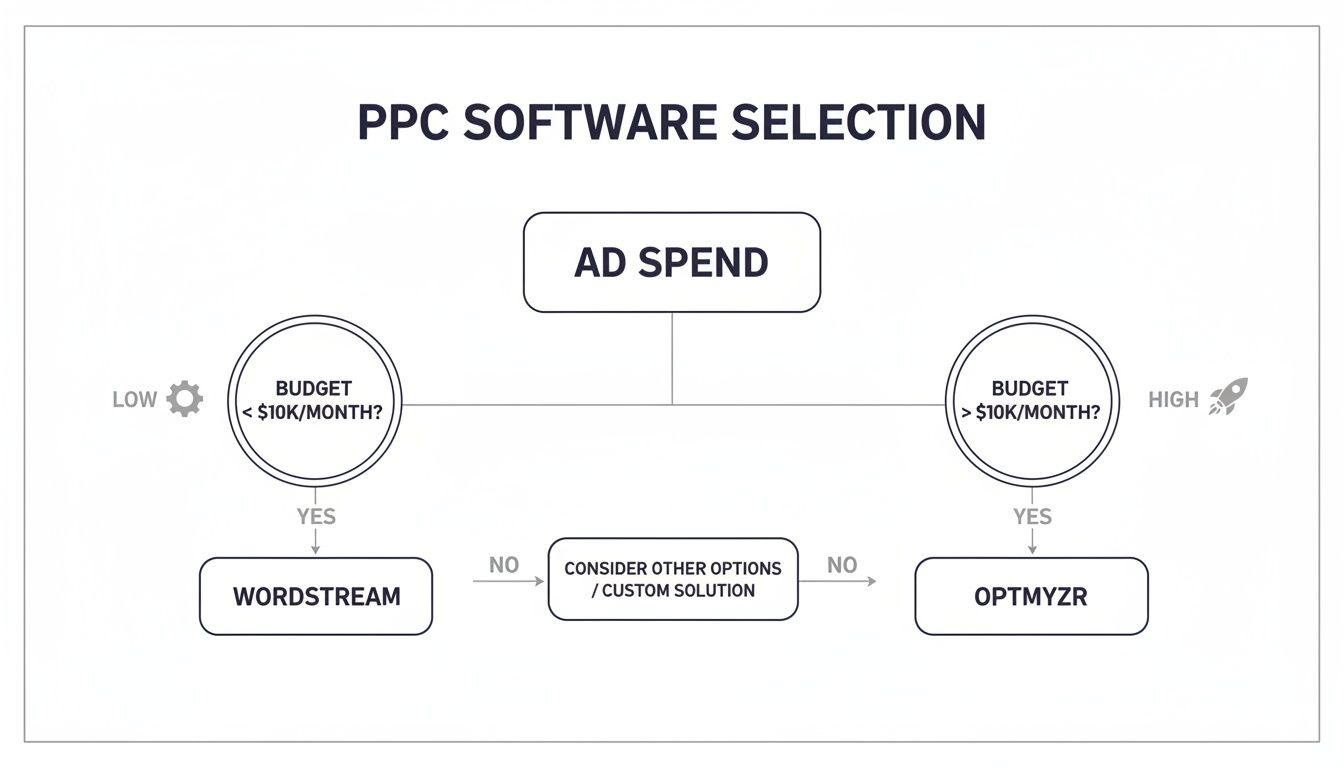
As the flowchart shows, businesses with smaller ad spends usually do best with simple, guided workflows. Those with bigger budgets need more advanced, hands-on control.
For the Marketing Agency Juggling Multiple Clients
Finally, let's think about a digital marketing agency handling a dozen or more client accounts. Their needs are completely different. They're looking for efficiency to manage all those accounts, slick white-label reporting to show clients their value, and collaboration tools for their team.
An agency is going to thrive with a platform that combines a multi-client dashboard with serious optimization tools. While Optmyzr is a top choice for its raw power, an agency might also consider a solution like Adzooma for its blend of simplicity and strong reporting, especially if they manage clients with a wide range of budgets.
Here are the non-negotiables for an agency:
- Multi-Account Dashboards: A single screen to see what's happening across all client accounts is a must for spotting problems or opportunities quickly.
- White-Label Reporting: The ability to generate professional reports with your own branding is crucial for client communication and retention.
- Team Collaboration Tools: You need features that let multiple team members work on accounts, with clear user roles and permissions to avoid stepping on each other's toes.
When you look at software through the lens of your own business model—whether you're a local shop, a growing retailer, or a busy agency—you can confidently pick a tool that will solve today's problems and grow with you tomorrow.
Navigating Implementation and Hidden Costs
Picking the best PPC management software is just the starting line. Getting it adopted successfully by your team? That’s where the real race is won. It’s easy to get fixated on the sticker price, but that’s rarely the final cost. To get a real sense of what you're investing, you have to look past the monthly subscription and factor in the time and resources needed to actually weave the tool into your daily workflow.

So many businesses get tripped up by the "soft costs." These are the sneaky expenses that can blow up your budget and hamstring your team’s efficiency if you don't see them coming.
Uncovering the True Cost of Ownership
The total investment is way more than just a monthly fee. You've got to budget for a few things that are all too easy to forget when you’re just looking at a features list.
Here are the most common hidden costs to watch out for:
- Team Training and Onboarding: Every new tool has a learning curve. You need to account for the billable hours your team will burn in training sessions and just fumbling around the new interface instead of actually managing campaigns.
- Premium Integration Fees: A platform might brag about its long list of integrations, but the ones you really need often cost extra. Connecting to your specific CRM or that advanced analytics tool you love might require another subscription or a one-off setup fee.
- Data Migration and Setup: This one’s a biggie. Moving years of historical campaign data, user permissions, and all your reporting templates from an old system to a new one can be a massive project. It often requires technical help, which adds another line item to your initial spend.
- Opportunity Cost of Underutilized Features: Paying for an enterprise-level platform when your team only uses 20% of its features is just throwing money away. The most expensive tool is always the one you don't use to its full potential.
A smooth implementation hinges on budgeting for time as much as money. A tool that saves ten hours a week is a poor investment if it takes a hundred hours of confusing setup and training to get running.
Your Essential Implementation Checklist
Jumping in without a plan is a recipe for chaos. A structured approach ensures your team actually adopts the new software and doesn't just resent it. A clear plan helps everyone know what their role is and sets the right expectations for the transition.
Here's a straightforward checklist to guide your rollout:
- Assign a Project Lead: Pick one person to own the entire implementation. They'll be the main point of contact for the software provider and the one responsible for keeping your team on track.
- Migrate Data Systematically: Don't try to move everything at once. Start by migrating one or two smaller client accounts as a pilot test. This lets you find and squash any bugs with the data transfer before you’re in too deep.
- Configure User Roles and Permissions: Set up access levels for every team member right away. Make sure managers have the oversight they need, while your campaign specialists have the specific tools for their day-to-day grind.
- Establish Initial Automation Rules: Start small and build from there. Create a few simple automation rules first—things like alerts for budget overspending or pausing ads with terrible performance. Don't try to automate everything on day one. Let your team build complexity as they get more comfortable. For more advanced tracking, you can layer in tools like the Site Igniters OmniPixel to really complement your core PPC efforts.
Deciding Between In-House Tools and Agency Expertise
Choosing the right PPC management software is a huge step, but a tool is only as good as the person running it. The software is the engine, but you still need a skilled driver to handle the tricky world of paid search. The real decision isn't just about which platform to buy; it's about who should be behind the wheel.
This brings up a big question for a lot of businesses: do you manage your campaigns in-house with a powerful tool, or do you bring in a specialized agency? The answer really comes down to your team’s time, expertise, and what you’re trying to achieve. Software can automate your bids and spit out reports, but it can't come up with a growth strategy that spans multiple channels or pivot when the market suddenly shifts.
When to Consider an Agency Partnership
Running PPC in-house with great software works well until it doesn't. There are some clear signs you’ve hit a wall and could use some expert help. Spotting these signs can save you from months of wasted ad spend and missed chances.
Think about partnering with an agency if any of this sounds familiar:
- Performance Plateaus: Your results have gone flat, and you’re not sure how to kickstart the next phase of growth.
- Lack of Strategic Bandwidth: Your team is buried in day-to-day tasks, leaving no time for big-picture strategy, creative testing, or keeping an eye on the competition.
- Increasing Complexity: Your campaigns have spread across multiple platforms like Google, social media, and retail sites, and they need a more connected approach than your team can handle.
An agency doesn't replace good software; they are a strategic partner who uses best-in-class tools to add a layer of expertise and proactive management that software alone can't replicate. It’s about pairing the artisan with the right tool.
Without that combination, advertisers face real financial risks. For example, costs per click (CPC) shot up by an average of 10% across 87% of industries in 2025. For local small businesses, working with an agency that masters top-tier tools ensures campaigns are fine-tuned to fight rising costs and deliver real growth. You can get more details about the rising costs in digital advertising to see what's at stake.
Ultimately, an agency like Site Igniters uses the best PPC management software to execute a strategy built on deep expertise. This kind of partnership makes sure your tools are pushed to their full potential, driving conversions and maximizing your return on investment. If you're based in our local area, our guide on how to hire an SEO company in Sacramento offers more tips for finding the right expert partner.
Frequently Asked Questions About PPC Software
Working through the world of PPC tools always kicks up a few questions. We've put together some clear, straightforward answers to the ones we hear most often to help you sort out any final details before you make a decision.
How Much Should I Budget for a PPC Tool?
The budget for a good PPC management software can really swing one way or the other. If you're a small business with an ad spend under $5,000 a month, platforms like WordStream or the free version of Adzooma are fantastic starting points. They guide you through the process without a huge price tag.
For agencies or larger businesses running more complex campaigns, you'll need to invest more. Heavy-hitters like Optmyzr typically start around $500 per month and can climb into the thousands, with pricing usually tied to your total ad spend.
Don't forget to look beyond the subscription price. Factor in the hidden costs, like the hours your team will spend getting trained or extra fees for those premium integrations. The sticker price is really just the start.
Can This Software Completely Replace a Human Manager?
Nope, and it's not even close. PPC software is a seriously powerful tool, but it's not a substitute for a savvy strategist. Its real strength is automating the grind—adjusting bids, churning out reports, and flagging keywords that aren't pulling their weight. That's what frees up a human manager's time.
But software can't replicate the strategic vision, creative spark, or gut-feeling decisions of an experienced professional. You still need a person to set the high-level strategy, read the subtle shifts in the market, and manage client relationships. Think of the software as a co-pilot; it handles the mechanics so the pilot can focus on where you're going.
What Is the Most Important Feature for a Small Business?
For almost any small business, the number one feature to look for is actionable recommendations. Most SMB owners are stretched thin on time and don't have years of deep PPC expertise to fall back on.
Platforms that can analyze your account data and spit out a simple, prioritized to-do list of improvements are worth their weight in gold. Features like WordStream's "20-Minute Work Week" or Adzooma's "Opportunities" slice right through the complexity and point you toward the changes that will actually make a difference, without a massive learning curve.
Ready to pair powerful software with expert strategy? The team at Site Igniters leverages best-in-class tools to drive measurable growth for businesses like yours. Let's build a winning PPC strategy together.
Seth Sanders is the founder of Site Igniters, a digital marketing agency in El Dorado Hills, California.