
The 12 Best AI Marketing Tools for Growth in 2025

Artificial intelligence is no longer a futuristic concept; it's a core component of modern marketing stacks, automating everything from content creation to customer analytics. But with hundreds of options, finding the best AI marketing tools that deliver tangible results without adding complexity can feel overwhelming, especially for local small and medium-sized businesses. This guide cuts through the noise.
- The best AI marketing tools in 2025 automate content creation, analytics, and campaign optimization at scale.
- Choose tools that integrate with your existing stack and solve specific bottlenecks, not just the trendiest options.
- Agentic AI and custom LLMs are emerging as the most impactful category for growth-focused businesses.
We've compiled a comprehensive roundup of 12 powerful AI-driven platforms, breaking each down by category, practical use case, and its specific value for SMBs. This isn't just a list; it's a strategic resource designed to help you make informed decisions. We provide direct links and screenshots for each tool, so you can see them in action.
You'll get a clear framework for choosing the right solutions, with detailed implementation scenarios and an honest assessment of each platform's pros and cons. We also offer clear guidance on when a do-it-yourself approach makes sense versus when partnering with a specialist agency like Site Igniters can unlock true, scalable growth. If your focus is primarily on e-commerce, it's also helpful to inform your decision-making on the best solutions for real growth, consider this overview of the top AI tools for ecommerce in 2025 as a supplementary resource.
This article moves beyond generic feature lists to give you actionable insights, whether you're looking to enhance your SEO, automate ad campaigns, or implement advanced agentic AI solutions. Let's find the tools that will actually drive your business forward.
1. Agentic AI Solutions & Custom LLMs — Site Igniters AI Studio
For businesses seeking a comprehensive, production-ready AI solution rather than a collection of DIY tools, the Site Igniters AI Studio represents a significant step forward. It moves beyond generic chatbots and content spinners to offer a turnkey growth engine built on agentic AI and custom Large Language Models (LLMs). This approach is designed for organizations that want to integrate AI deeply into their marketing stack for measurable, scalable results.
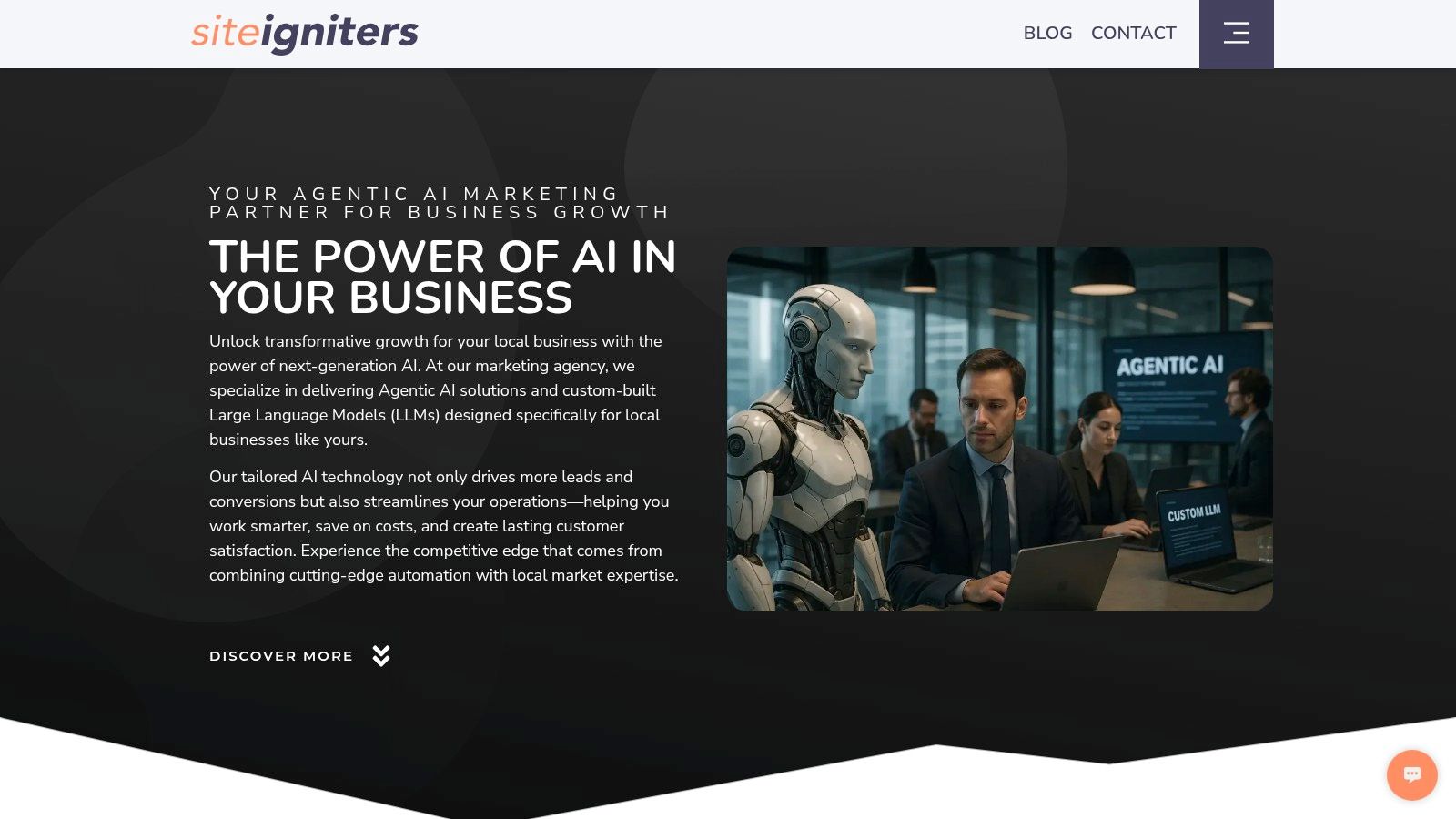
The core differentiator is the focus on building and deploying AI models trained specifically on your company's proprietary data, brand guidelines, and performance metrics. This ensures every automated interaction, from lead generation and customer support to content creation, remains perfectly on-brand and optimized for conversion. Unlike off-the-shelf tools, this service isn't an isolated experiment; it’s an integrated part of a broader, expert-led digital marketing strategy.
Key Strengths & Use Cases
Site Igniters combines its AI offering with its established expertise in SEO, PPC, and analytics. This holistic approach grounds the AI in proven marketing principles, making it one of the best AI marketing tools for businesses that prioritize ROI and compliance.
- Brand-Aligned Automation: Deploy AI agents that understand your unique value proposition to manage customer support queries, qualify local leads, and execute personalized marketing campaigns at scale.
- Integrated Growth Stack: The custom LLMs are not standalone. They are woven into a complete marketing framework that includes SEO optimization, PPC management, remarketing via OmniPixel, and press amplification.
- Compliance and Accessibility: A standout feature is the built-in consideration for ADA/WCAG compliance. The AI is designed to operate within legal and accessibility best practices, a critical safeguard many tools overlook.
- Agency-Level Implementation: This is a fully managed service, not a self-serve platform. It's ideal for organizations that want to leverage advanced AI without the overhead of building an in-house data science team.
Pros & Cons
| Pros | Cons |
|---|---|
| Turnkey Solution: Deploys production-ready, agentic AI as an integrated part of your marketing stack, not just a prototype. | Requires Quality Data: Not a plug-and-play fix. Success depends on having clear business data for training and agency setup. |
| Hyper-Personalization: Models are custom-trained on your data, ensuring all automated messaging stays consistent and on-brand. | Higher Initial Investment: Custom deployment and compliance focus can be costlier than off-the-shelf software subscriptions. |
| Multi-Channel Impact: Automates campaigns, local lead generation, customer support, and large-scale SEO/content creation. | Ongoing Oversight: May require continued agency oversight to maintain peak performance and strategic alignment. |
| Expert Safeguards: Combines AI with proven SEO, PPC, analytics, and critical ADA/WCAG compliance to reduce risk and maximize results. |
Best For: Small to medium-sized businesses, healthcare providers, and legal firms that need a practical, measurable, and compliant AI-driven growth strategy without the complexity of DIY tool management.
Learn More: Site Igniters AI Studio
2. HubSpot – Marketing Hub
HubSpot’s Marketing Hub has evolved into a formidable player among the best AI marketing tools, primarily because its AI features are natively integrated with a powerful CRM. This isn't a standalone AI gadget; it's a comprehensive system where every AI-driven action is informed by rich customer data, making it ideal for SMBs and mid-market companies seeking a unified platform. Instead of stitching together disparate tools for email, social media, and content, HubSpot centralizes these functions, leveraging AI to streamline campaign creation and automation.
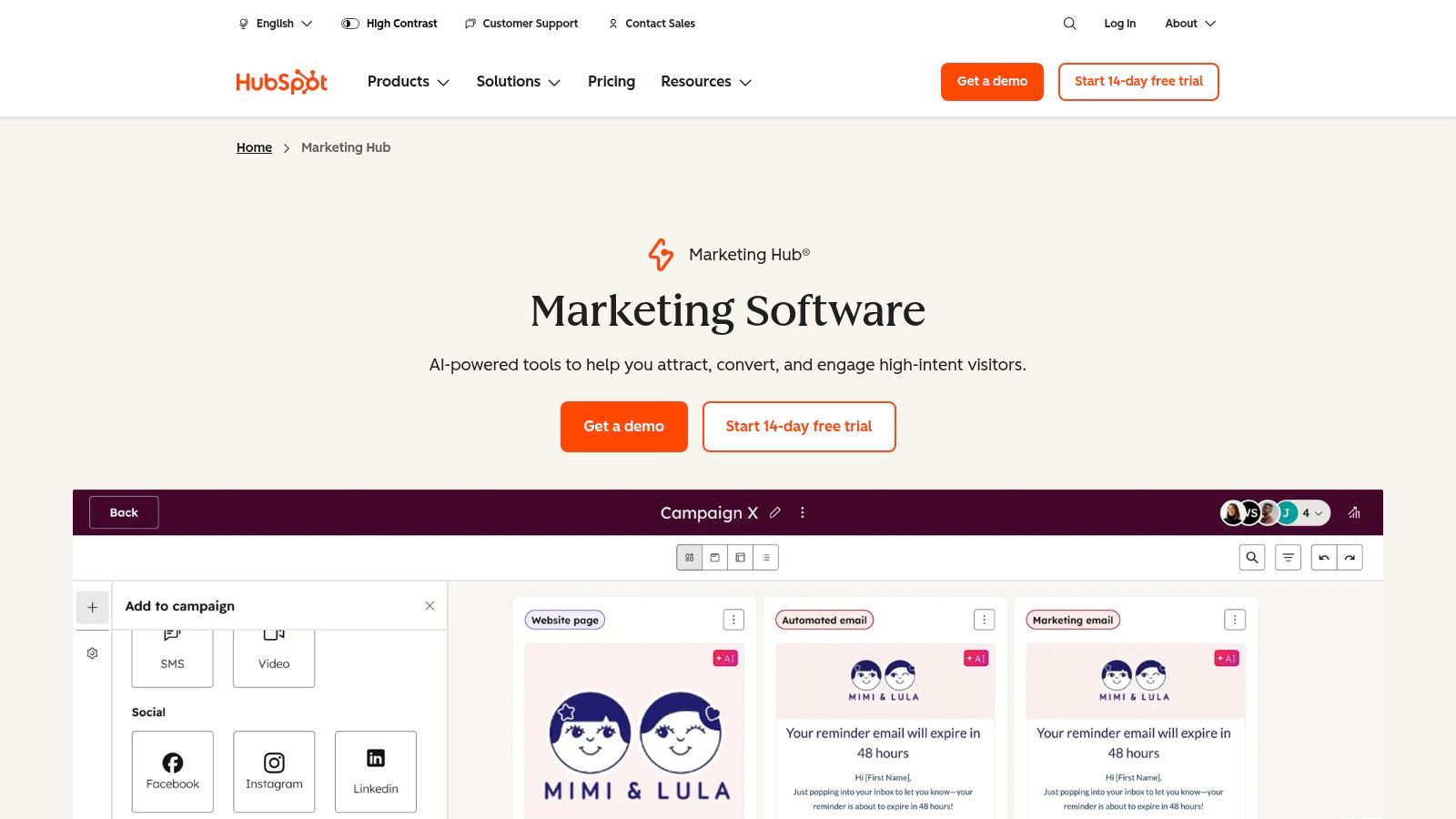
The platform's strength lies in its ability to connect marketing activities directly to revenue. For instance, you can use its AI to draft an email campaign, then build a workflow that automatically scores leads based on their interaction with that email, and finally track their journey to a sale all within one dashboard. This tight integration provides clear, multi-touch revenue attribution that isolated point solutions simply can't offer.
Key Features & Implementation
- AI-Assisted Campaigns: Generate copy for landing pages, social posts, and ad campaigns directly within the platform.
- CRM-Powered Automation: Create intelligent workflows that adapt based on customer behavior and lead scores.
- Integrated Analytics: Use AI to surface insights from your marketing data and build custom reports without needing a data scientist.
| Feature | Pros | Cons |
|---|---|---|
| Unified Platform | Reduces data silos and integration complexity. | Can feel overwhelming for very small teams. |
| Pricing Model | Scales from free tools to enterprise plans. | Contact-based pricing can escalate costs quickly. |
| Onboarding | Extensive support and a massive resource library. | Professional/Enterprise tiers have mandatory fees. |
Website: https://www.hubspot.com/products/marketing
3. Salesforce Marketing Cloud
Salesforce Marketing Cloud stands as an enterprise-grade powerhouse among the best AI marketing tools, engineered for large organizations that demand sophisticated, multi-brand orchestration and deep governance. Its core AI, Einstein, is deeply embedded within the platform, moving beyond simple content generation to power complex customer journeys, predictive analytics, and hyper-personalization at a massive scale. This isn't a tool for casual use; it's a strategic platform for businesses already invested in the Salesforce ecosystem or those needing to manage intricate cross-channel campaigns across email, mobile, and social platforms.
The platform’s key differentiator is its native alignment with Salesforce Data Cloud and CRM. This integration allows Einstein AI to leverage a rich, unified customer profile to make decisions, such as optimizing email send times for individual subscribers or recommending the next best product in a customer journey. This creates a deeply connected experience that is difficult to replicate with separate tools, providing a single source of truth for customer interaction and marketing performance.
Key Features & Implementation
- Einstein AI: Powers campaign creation, send-time optimization, and predictive analytics across the platform.
- Journey Orchestration: Build and automate complex, multi-channel customer journeys that adapt in real time.
- Advanced Personalization: Deliver highly tailored content and product recommendations at scale using rich CRM data.
| Feature | Pros | Cons |
|---|---|---|
| Enterprise Controls | Deep segmentation, governance, and scale for large teams. | Premium pricing is billed annually and is significant. |
| Salesforce Integration | Native alignment with Salesforce CRM and Data Cloud. | Complexity can lead to a long implementation time. |
| Partner Ecosystem | Robust ecosystem of integrations and certified implementation partners. | Often requires specialized consultants for setup. |
Website: https://www.salesforce.com/marketing/pricing/
4. Semrush
Semrush solidifies its position among the best AI marketing tools by integrating artificial intelligence into its already robust SEO and competitive intelligence suite. It's not just a keyword research tool; it's an all-in-one visibility management platform where AI enhances everything from content creation to paid advertising strategy. This makes it an indispensable asset for agencies and in-house teams who base their growth on search performance and need deep, data-driven insights into their market landscape.
The platform’s strength is its comprehensive nature, allowing users to move seamlessly from uncovering competitor ad copy to optimizing their own landing page content within the same ecosystem. For example, its Advertising Toolkit uses AI to generate effective ad copy and suggest PPC keywords, while the Local SEO add-on can automate Google Business Profile updates. This level of integration ensures that insights from one channel inform actions in another, a critical component for any effective search engine optimization strategy.
Key Features & Implementation
- AI-Powered Ad Copy: Leverage the Advertising Toolkit to generate and refine PPC ad copy based on competitor analysis and performance data.
- Content Marketing Toolkit: Utilize AI writing assistants and SEO suggestions to create content that ranks for target keywords.
- Local SEO Automation: Use the Local SEO add-on for AI-driven management of Google Business Profile listings and local visibility.
| Feature | Pros | Cons |
|---|---|---|
| Comprehensive Toolkit | Spans SEO, PPC, content, and competitive intelligence. | Learning curve can be steep for new users. |
| Scalability | Add-ons for local, ads, and competitive intelligence. | Costs escalate quickly with multiple users and add-ons. |
| Data & Resources | Extensive data, learning resources, and templates. | Plan limits can be restrictive for heavy use. |
Website: https://www.semrush.com/
5. Mailchimp
Mailchimp has cemented its place as a go-to email marketing platform, especially for small businesses, and its integration of AI features makes it a strong contender among the best AI marketing tools. Rather than offering a complex, all-in-one system, Mailchimp focuses on simplifying email and SMS marketing with accessible AI. Its tools are designed to help users quickly generate effective subject lines, email body copy, and even predict audience segments most likely to engage, lowering the barrier to entry for data-driven marketing.
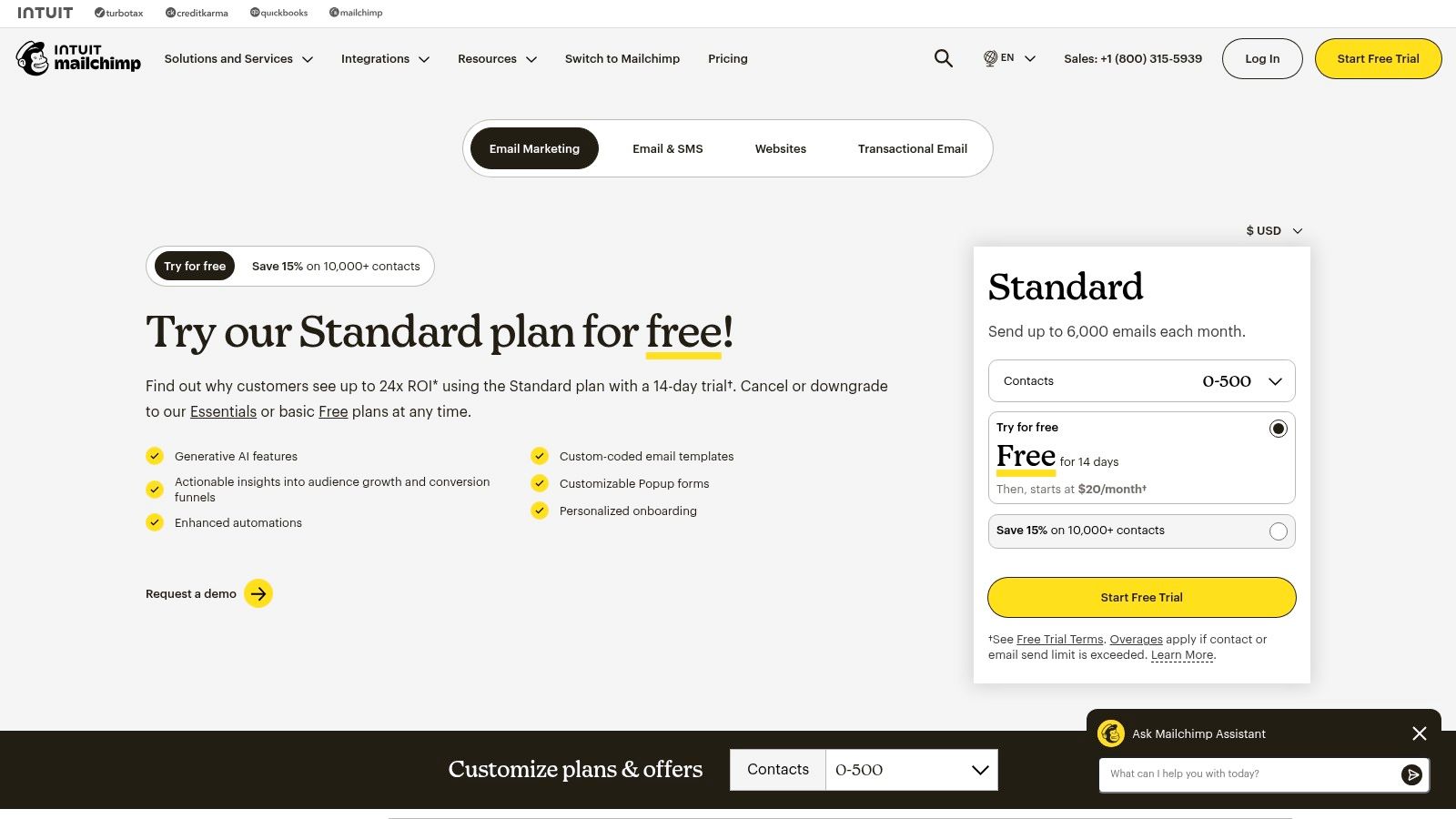
The platform's core advantage is its user-friendly interface combined with powerful, yet straightforward, automation. A small business owner can use the AI Content Optimizer to refine an email's tone and structure, then build a simple automated welcome series for new subscribers in the same session. This practicality, along with its reputation for high deliverability, makes it an ideal choice for businesses focused on building and nurturing an email list without a steep learning curve or significant technical overhead.
Key Features & Implementation
- AI Content Optimizer: Get AI-driven suggestions for subject lines, headers, and body copy to improve engagement.
- Predictive Segmentation: Automatically identifies customer groups with high or low predicted lifetime value to target campaigns more effectively.
- Creative Assistant: Generates on-brand designs for multi-channel campaigns using your website's colors, fonts, and logos.
| Feature | Pros | Cons |
|---|---|---|
| Ease of Use | Low-friction onboarding and an extensive template library. | Feature depth lags behind more complex enterprise suites. |
| Pricing Structure | Offers clear upgrade paths and a pay-as-you-go option. | Contact-based billing can increase costs as lists grow. |
| Deliverability | Strong reputation for ensuring emails reach the inbox. | Advanced analytics and reporting are limited on lower tiers. |
Website: https://www.mailchimp.com/pricing/
6. Klaviyo
Klaviyo stands out as a premier AI marketing tool specifically engineered for ecommerce. Its power comes from its deep, native integrations with platforms like Shopify, which allows its AI to leverage a wealth of customer data-purchase history, browsing behavior, and past interactions-to drive revenue. This isn't a general-purpose marketing platform; it's a finely tuned engine for online retailers looking to convert customer lifecycle moments into sales, from abandoned carts to post-purchase upsells.
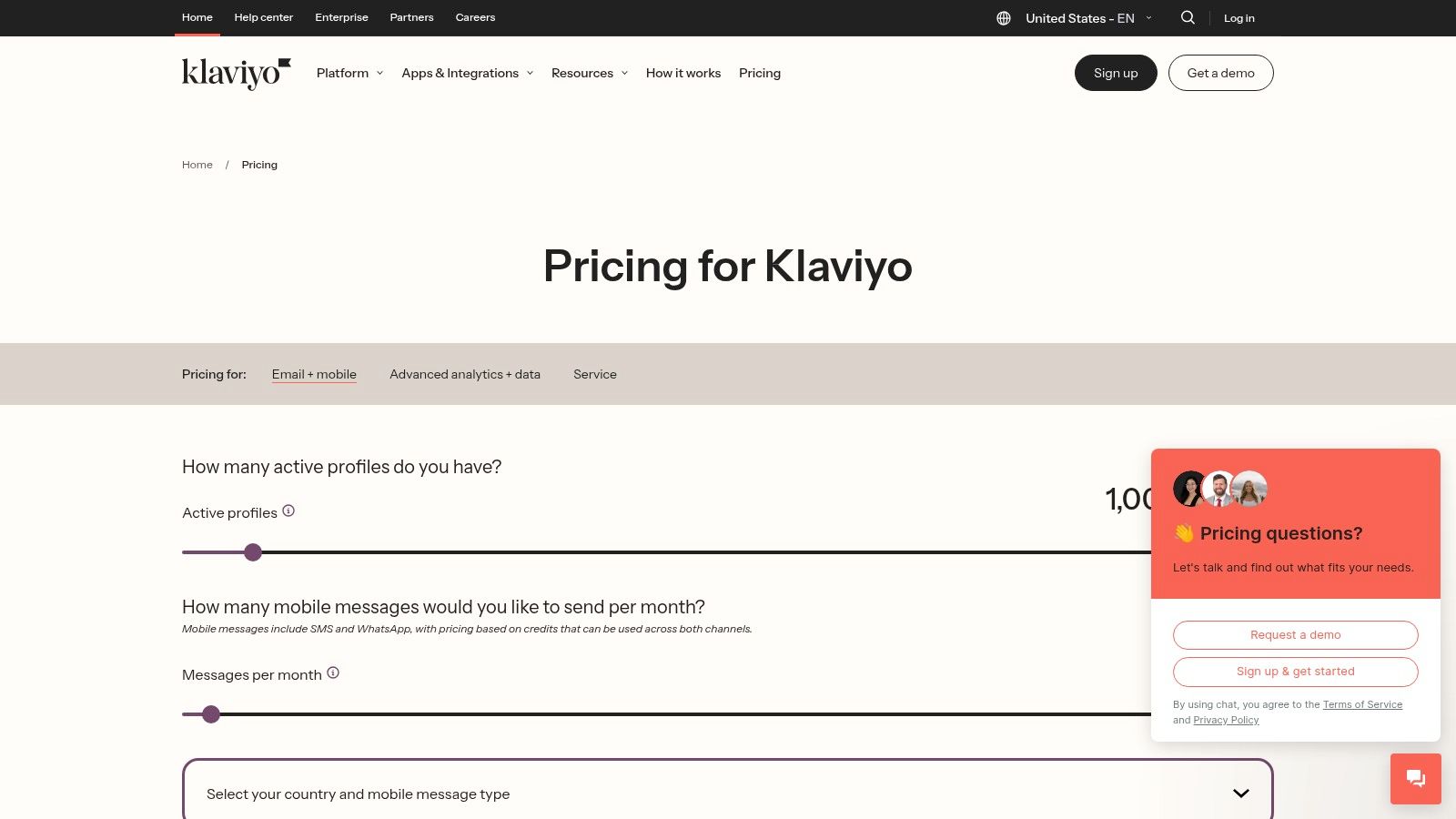
The platform’s unique advantage lies in its recent expansion into AI-powered customer service. By integrating tools like an AI Customer Agent and Helpdesk directly with its marketing automation, Klaviyo creates a powerful feedback loop. For instance, a support interaction can trigger a personalized marketing flow, turning a customer query into a targeted sales opportunity. This synergy between support and marketing provides a holistic view of the customer journey that few other platforms can match.
Key Features & Implementation
- AI Product Recommendations: Automatically personalize emails and SMS messages with product suggestions based on individual customer data.
- Deep Ecommerce Integrations: Utilize predictive analytics and segmentation powered by real-time data from platforms like Shopify and Magento.
- AI Customer Service Suite: Deploy an AI Customer Agent to handle queries 24/7 and use the Helpdesk to turn support tickets into revenue opportunities.
| Feature | Pros | Cons |
|---|---|---|
| Ecommerce-First Focus | Purpose-built to maximize revenue for online stores. | Less suited for B2B or non-retail businesses. |
| Data & Segmentation | Tight Shopify synergy provides powerful, granular targeting. | Pricing is profile-based and can become costly as your list grows. |
| Integrated Service & Marketing | Creates new revenue channels from support interactions. | AI service tool pricing and promotions can change; verify current rates. |
Website: https://www.klaviyo.com/pricing
7. Jasper
Jasper has established itself as a premier AI marketing content copilot, specifically designed for teams that prioritize brand consistency and governance. It moves beyond simple text generation by offering a suite of tools that embed your brand's unique voice, product knowledge, and target audience profiles directly into the AI. This makes it an exceptional choice for marketing teams needing to produce high-volume, on-brand content across various channels without constant manual oversight.
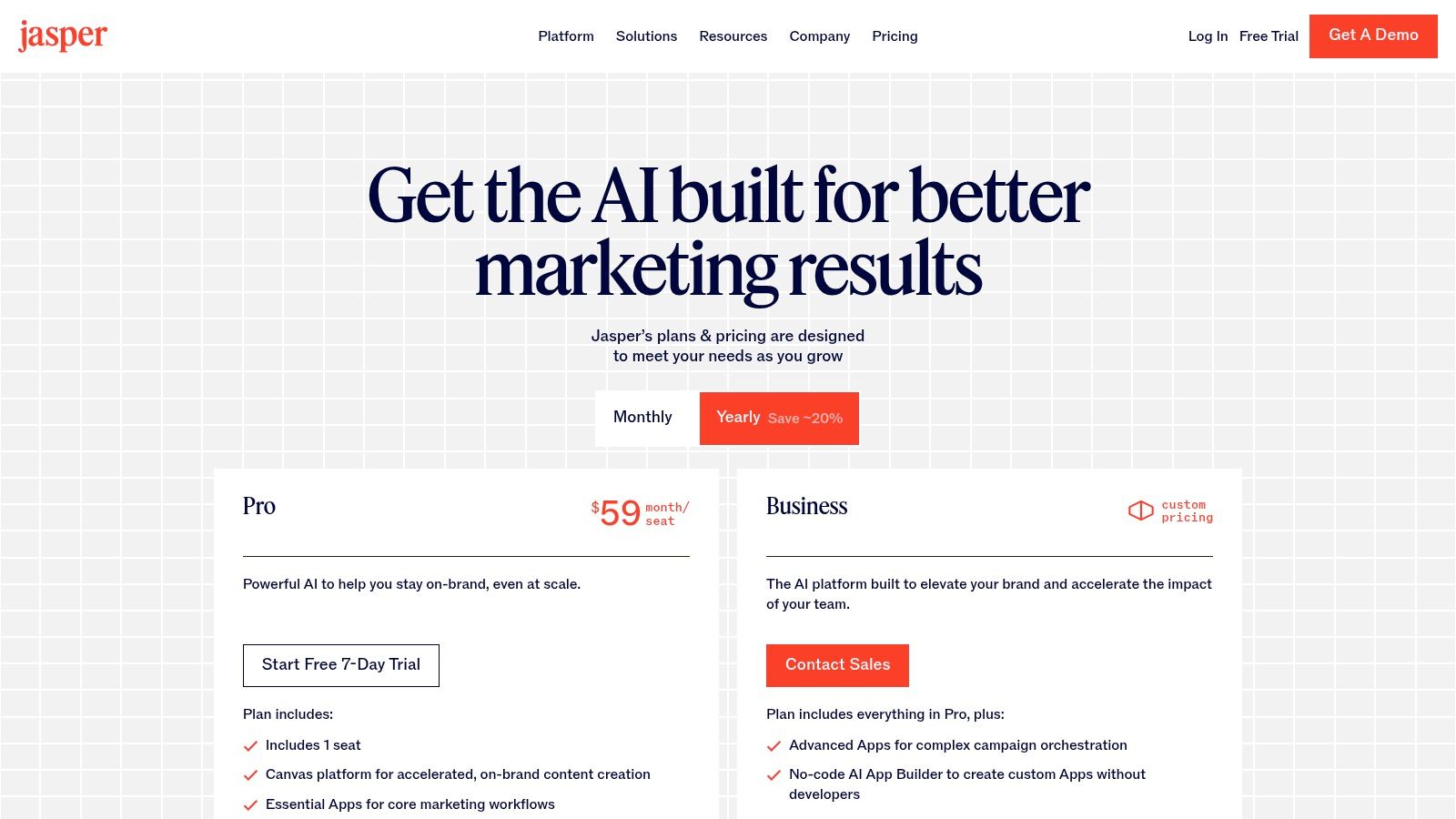
The platform’s real power lies in its campaign-level orchestration and custom workflow capabilities. Instead of generating one-off pieces, teams can use Jasper's Canvas and AI App Builder to create and execute entire multi-asset campaigns from a single brief. This cohesive approach ensures that every ad, social post, and blog article is aligned. For teams looking to scale content production without sacrificing quality, leveraging a specialized service can provide the necessary framework. For more on this, you can learn more about SiteIgniters' Done-For-You content solutions.
Key Features & Implementation
- Brand Voice & Knowledge: Upload brand guidelines, product catalogs, and audience personas to ensure all AI-generated content is consistently on-brand.
- Campaign Canvas & Apps: Orchestrate entire marketing campaigns across different formats and channels from a single collaborative space.
- No-Code AI App Builder: Create custom, repeatable marketing workflows and internal tools tailored to your team's specific needs without writing any code.
| Feature | Pros | Cons |
|---|---|---|
| Brand Governance | Strong collaboration features ensure brand safety and consistency. | Best value is realized at team scale; may be pricey for solo users. |
| Templates & Workflows | Broad library of marketing templates reduces time-to-value. | Advanced features like the App Builder are gated to higher tiers. |
| Security & Flexibility | Enterprise-grade security options and flexible deployment. | Can have a steeper learning curve than simpler writing tools. |
Website: https://www.jasper.ai/pricing
8. Copy.ai
Copy.ai positions itself as one of the best AI marketing tools for teams aiming to automate content production at scale, rather than just generating one-off pieces. Its primary differentiator is the Content Agent Studio, which allows users to train autonomous agents on their brand voice, product information, and target personas. This transforms the tool from a simple AI writer into a system for creating consistent, on-brand content workflows for everything from sales outreach to blog post creation. It strikes a balance between advanced automation and user-friendly operation, making it suitable for lean marketing and sales teams needing to scale output without a massive budget.
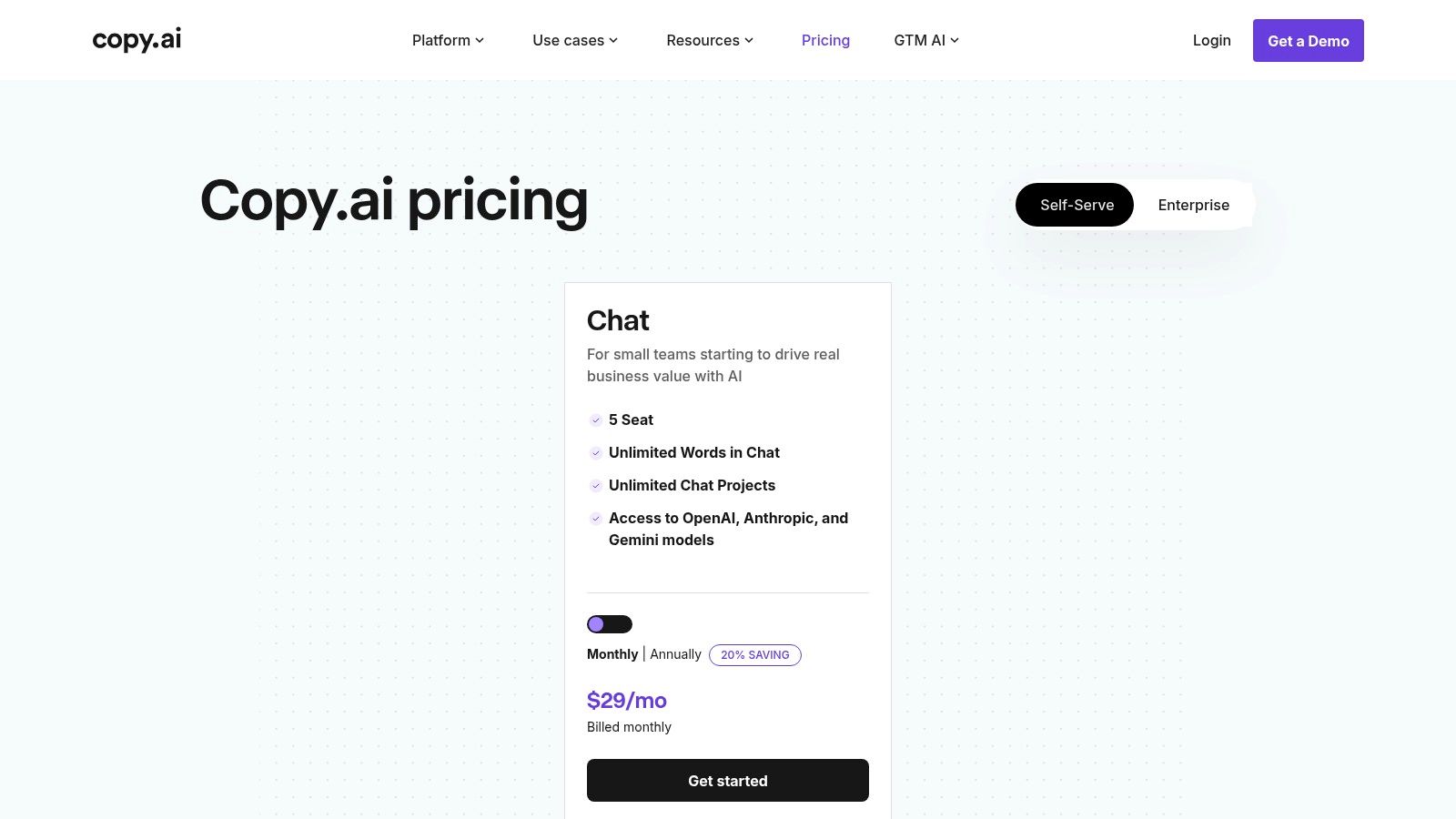
The platform’s strength is its focus on repeatable, automated processes. Instead of just using a chat interface for ad-hoc requests, a team can build a workflow that ingests a product spec sheet and automatically generates a full suite of marketing assets: social media posts, email announcements, and a landing page draft. This workflow-centric approach, combined with access to multiple LLMs (like models from OpenAI, Anthropic, and Google), ensures teams can leverage the best model for each specific task, all within a unified project management interface.
Key Features & Implementation
- Content Agent Studio: Train custom AI agents on your brand guidelines and data to automate content creation.
- Multi-LLM Chat: Access leading language models within a single chat interface for flexible and powerful text generation.
- Workflow Automation: Build and run repeatable content processes, managed with team-based project controls and workflow credits.
| Feature | Pros | Cons |
|---|---|---|
| Workflow Automation | Helps scale content output beyond simple, ad hoc copy generation. | Workflow credit system requires monitoring to manage costs. |
| Pricing Model | Competitive entry-level pricing and multi-model access. | Lacks some of the deep enterprise controls of larger suites. |
| Onboarding | Fast to implement with guided setups available for new teams. | Advanced workflow creation has a slight learning curve. |
Website: https://www.copy.ai/prices
9. Hootsuite
Hootsuite has solidified its position as a central hub for social media management, and its integration of AI tools like OwlyWriter makes it one of the best AI marketing tools for businesses focused on a strong social presence. Rather than treating AI as a separate feature, Hootsuite embeds it directly into core workflows, from content creation to audience engagement. This allows marketing teams and small business owners to generate high-performing social copy, get trend insights, and find the perfect time to post without leaving the platform.
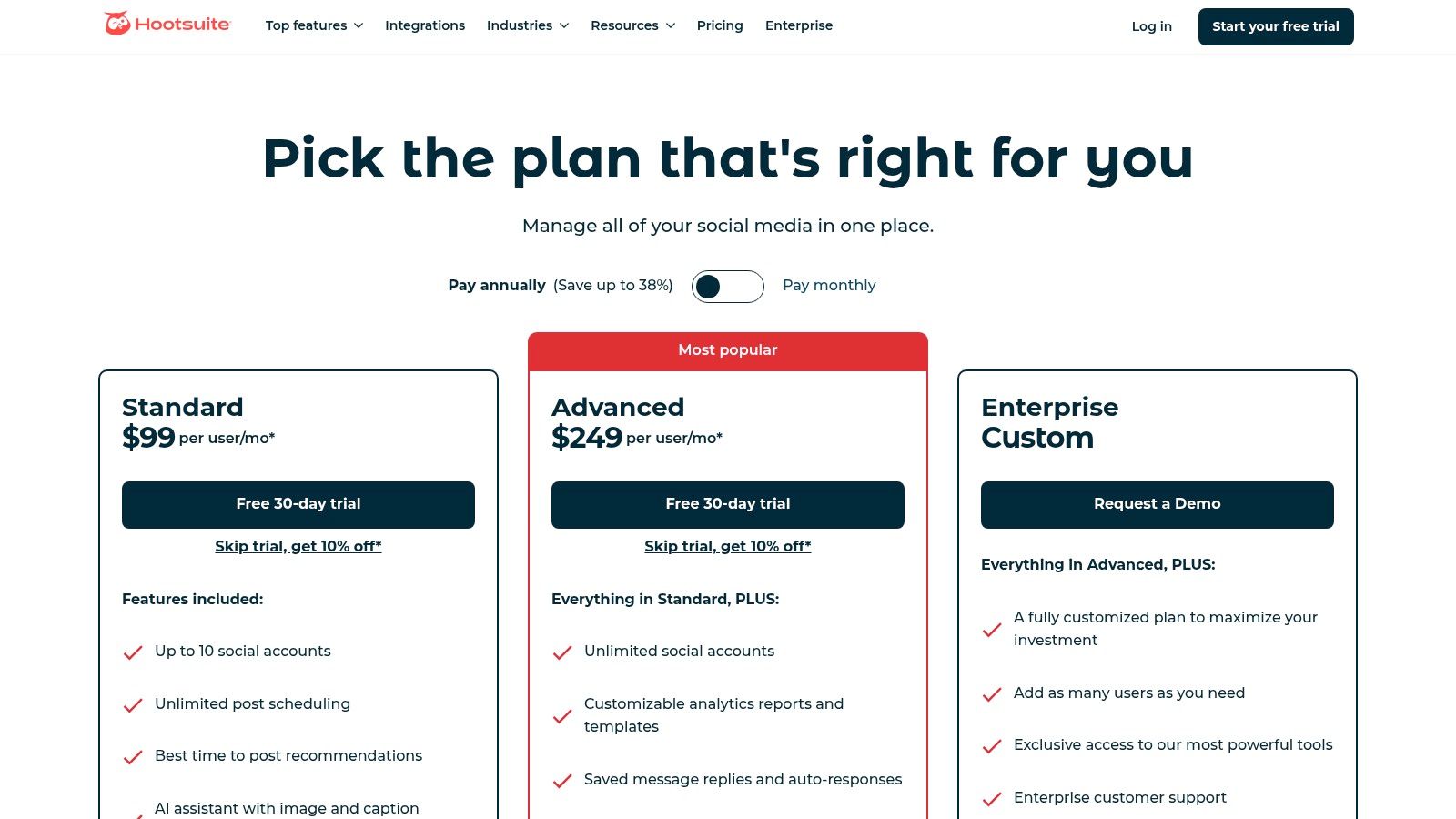
The platform’s strength is its all-in-one nature. A user can draft a month's worth of content using OwlyWriter AI, schedule it with the "Best Time to Post" feature, monitor brand mentions and industry conversations through AI-powered social listening, and analyze campaign performance in a single dashboard. This streamlined process saves significant time and provides a cohesive view of social media ROI, a critical advantage for teams needing to prove the value of their social efforts. For a deeper dive, learn more about getting started with Hootsuite for your business.
Key Features & Implementation
- OwlyWriter AI / OwlyGPT: Instantly generate captions, post ideas, and hashtag suggestions based on simple prompts.
- AI-Powered Scheduling: The platform suggests optimal posting times based on your audience’s activity patterns to maximize reach.
- Social Listening & Analytics: Use AI to summarize trends and sentiment from conversations, and create automated performance reports.
| Feature | Pros | Cons |
|---|---|---|
| All-in-One Workflow | Centralizes all social media tasks, reducing tool-switching. | Pricing can become high for larger teams or brands. |
| AI Integration | AI is natively built into publishing and listening features. | Token limits apply to AI features and reset monthly. |
| Platform Support | Extensive integrations and a generous 30-day free trial. | The interface can feel busy for first-time users. |
Website: https://www.hootsuite.com/plans
10. Shopify App Store – AI Marketing Apps
For e-commerce businesses running on Shopify, the App Store is a critical resource, functioning as a specialized marketplace for the best AI marketing tools designed for seamless integration. Instead of seeking standalone solutions, merchants can access a curated ecosystem of apps that plug directly into their store's data, from customer profiles to product catalogs. This native connection allows AI tools to automate everything from SEO content for product pages to personalized email campaigns and targeted ad creation with minimal setup.
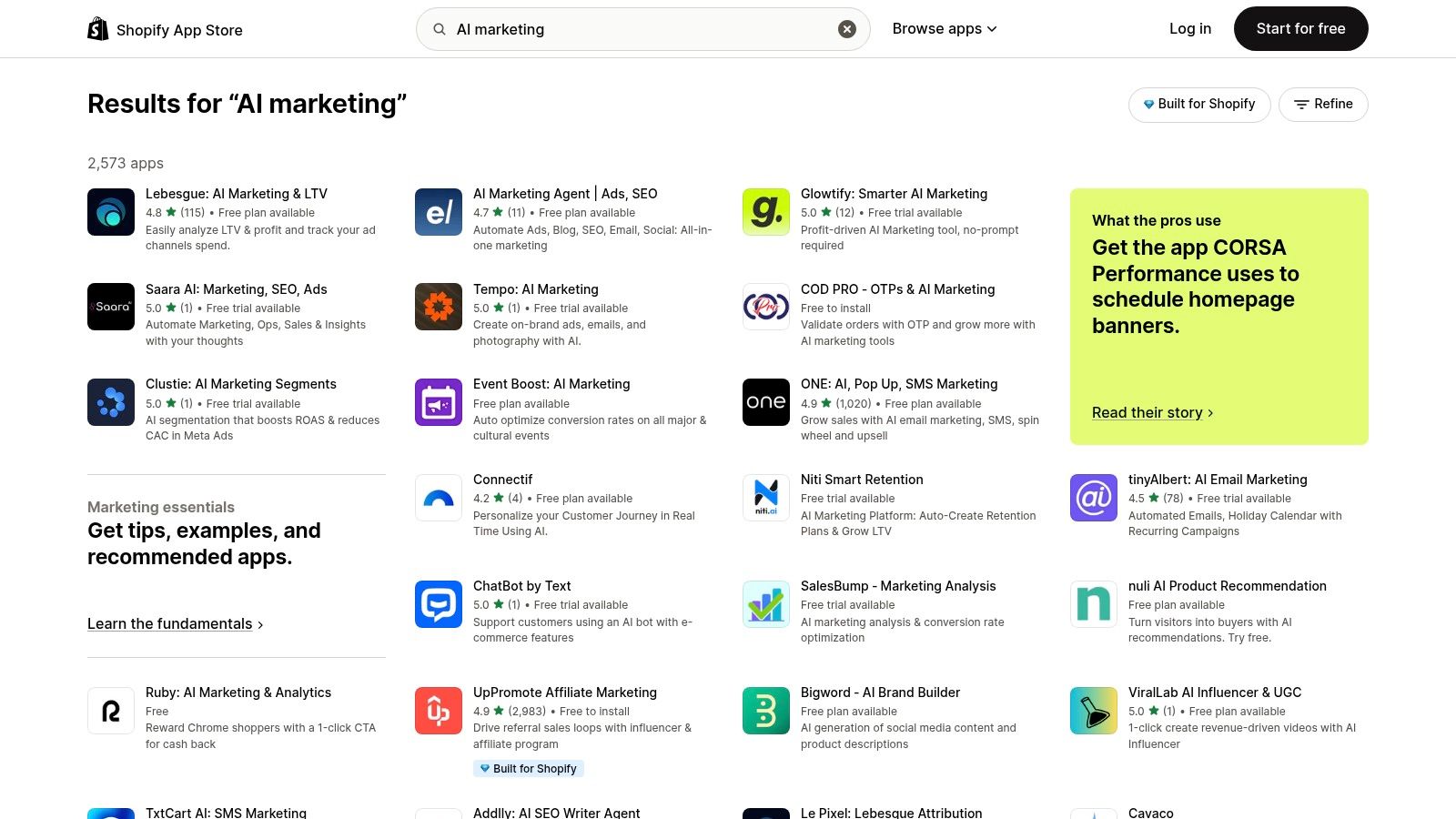
The primary advantage is the immediate access to store data, enabling many apps to offer "no-prompt" campaign creation and rapid deployment. An AI ad tool, for example, can automatically pull product images, descriptions, and pricing to generate social media ads in minutes. This model is perfect for e-commerce brands that need efficient, plug-and-play solutions to scale their marketing efforts without complex technical integrations or data migrations.
Key Features & Implementation
- Direct E-commerce Integration: Apps use live product, customer, and order data for highly relevant marketing automation.
- Wide Range of Solutions: Find AI-powered tools for SEO, content generation, email marketing, ad management, and customer support chatbots.
- Verified Reviews & Trials: User ratings and free trial periods help merchants vet app quality and fit before committing financially.
| Feature | Pros | Cons |
|---|---|---|
| Native Integration | Apps install directly into the Shopify admin. | Quality varies by vendor; requires careful vetting. |
| App Selection | Wide choice for different budgets and needs. | Can lead to app bloat and overlapping functionalities. |
| Shopify Ecosystem | Growing first-party AI features from Shopify itself. | Some advanced apps can have high subscription costs. |
Website: https://apps.shopify.com/search?q=AI%20marketing
11. G2
While not an AI tool itself, G2 is an indispensable resource for anyone looking to find the best AI marketing tools. It's a comprehensive software review marketplace where you can compare platforms based on verified user feedback, not just vendor claims. This makes it a crucial first step in the research phase, allowing you to create a shortlist of potential solutions and understand how they perform in real-world scenarios for businesses similar to your own. G2 helps you cut through the marketing noise to see what peers are actually saying.
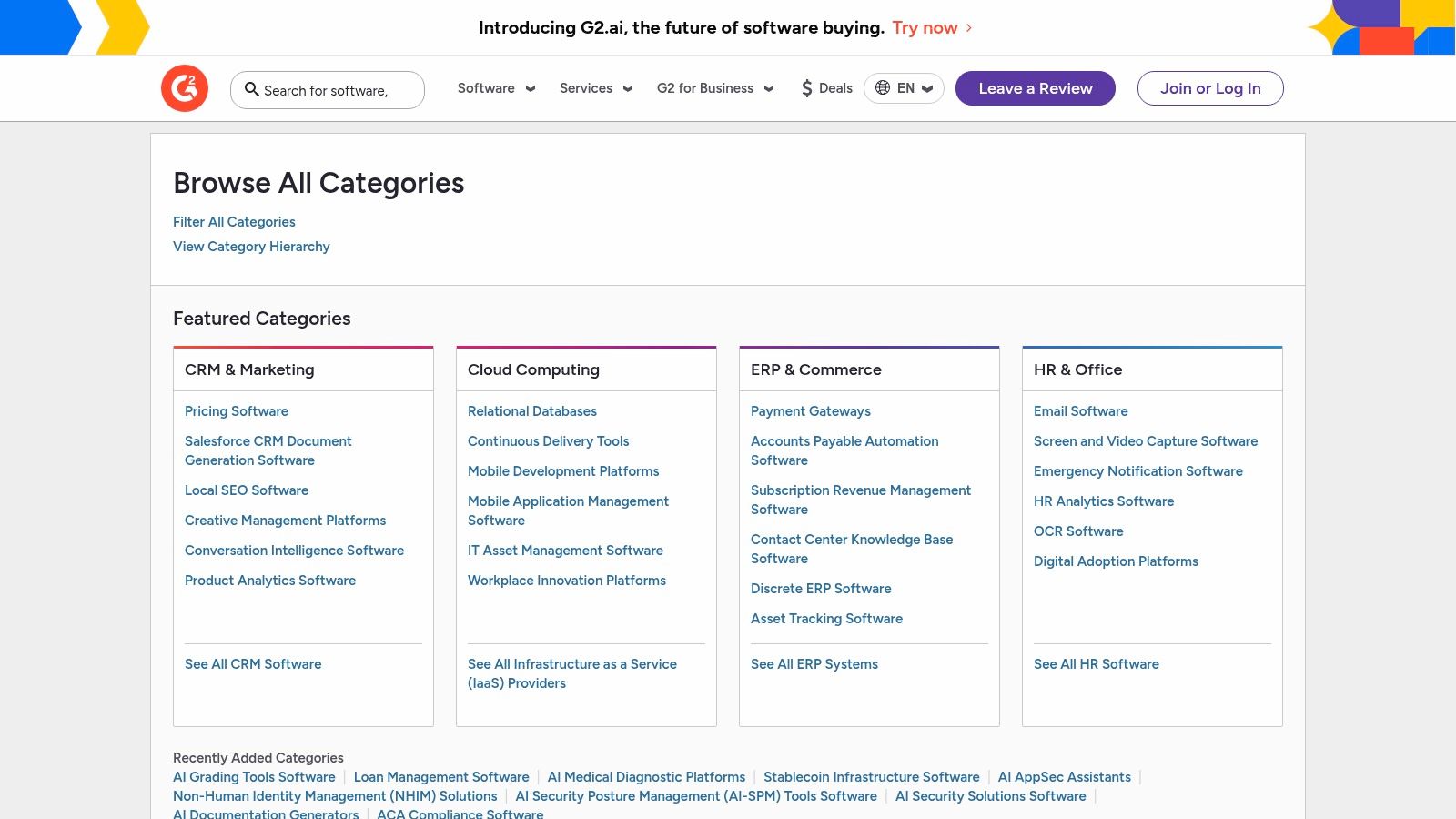
The platform’s power comes from its structured data and filtering capabilities. You can drill down into specific categories, compare tools side-by-side using the G2 Grid Reports, and filter results by company size, user satisfaction, and specific features. This methodical approach ensures you're not just choosing a popular tool, but the right tool for your specific marketing stack, budget, and team size. It effectively serves as a meta-tool for building your ideal AI-powered marketing toolkit.
Key Features & Implementation
- Grid Reports: Visualize the market landscape for categories like "AI Writing Assistants" or "Marketing Automation" to identify leaders and niche players.
- Verified User Reviews: Access detailed feedback from real users, providing authentic insights into a tool’s performance and support.
- Advanced Filtering: Narrow down options by pricing, company size, user satisfaction scores, and must-have features to find a perfect match.
| Feature | Pros | Cons |
|---|---|---|
| Comparative Grids | Independent user reviews offer an unbiased perspective. | G2 is a research platform; purchases are made directly from vendors. |
| Broad Coverage | Helps with shortlisting and assessing peer sentiment. | Rankings can change frequently; always check report dates. |
| Filtering | Excellent for discovering new and emerging AI tools. | The sheer volume of options can sometimes be overwhelming. |
Website: https://www.g2.com/categories
12. AppSumo
AppSumo isn't a single tool but a dynamic marketplace that secures its spot among the best AI marketing tools by offering heavily discounted deals on emerging software. It's a goldmine for budget-conscious marketers and SMBs who want to experiment with cutting-edge AI without committing to expensive annual subscriptions. The platform excels at curating lifetime deals on a wide array of tools for content creation, SEO, video generation, and chatbots, allowing businesses to build a diverse AI toolkit at a fraction of the usual cost.
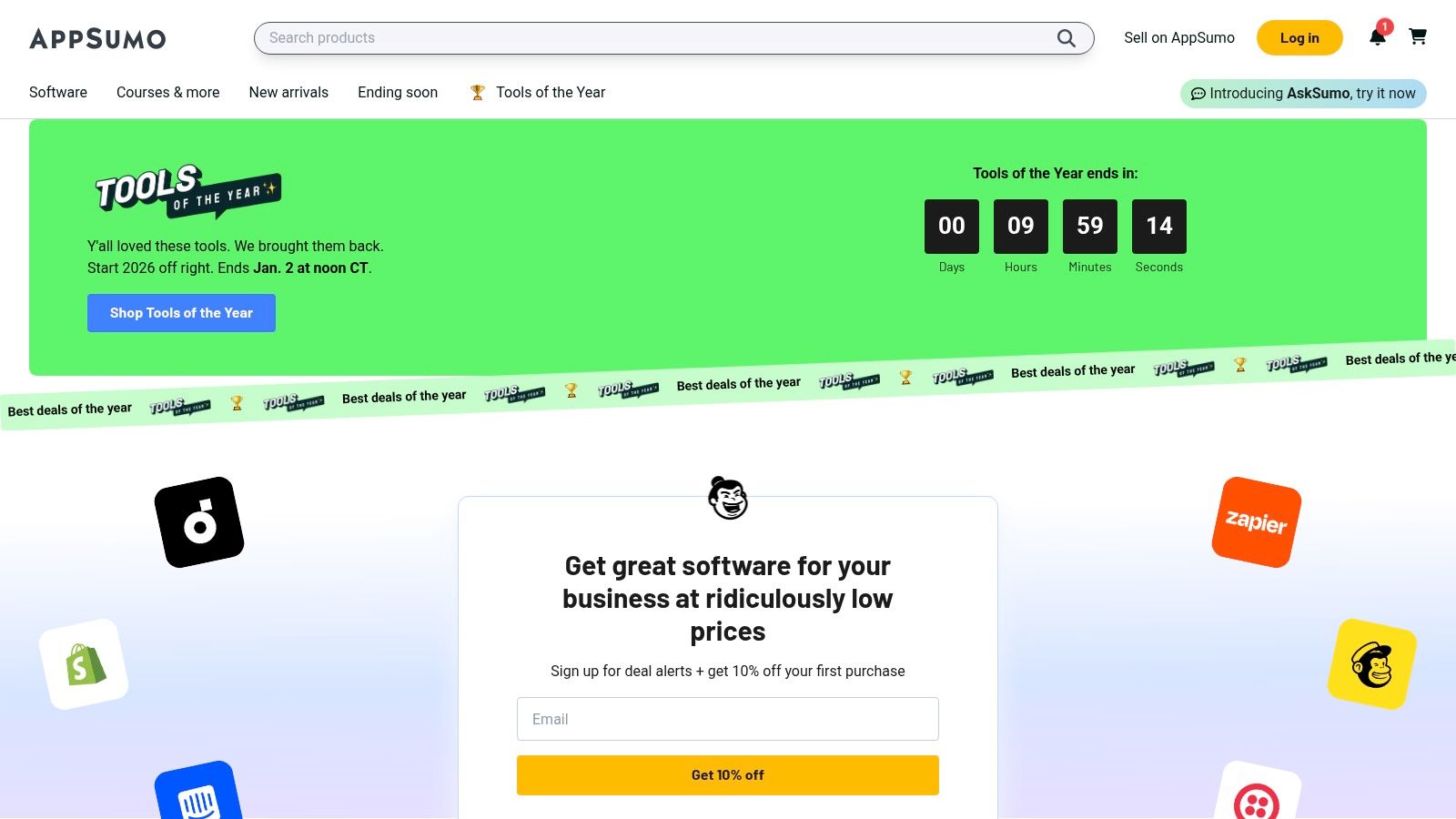
The primary value of AppSumo lies in risk reduction and discovery. Instead of betting your entire marketing budget on one established but costly platform, you can acquire lifetime access to several promising startups. This approach lets you test which AI applications best fit your workflow before scaling up. The vibrant community reviews and Q&A sections provide unfiltered insights, helping you gauge a tool's viability and support quality directly from other users, a feature that's invaluable when assessing new technology.
Key Features & Implementation
- Curated AI Tool Deals: Access a rotating selection of lifetime or deeply discounted deals on tools for SEO, content, lead generation, and more.
- Community Reviews & Discussion: Leverage honest feedback from other marketers to vet tools before purchasing.
- Low-Cost Experimentation: Test and implement new AI solutions into your marketing stack with minimal financial risk.
| Feature | Pros | Cons |
|---|---|---|
| Pricing Model | Low-cost entry point for testing new AI tools. | Vendor longevity can be uncertain; due diligence is crucial. |
| Tool Variety | Constant rotation of new and innovative products. | Support and feature roadmaps vary widely between tools. |
| Community Insight | Third-party reviews offer valuable, unfiltered feedback. | Lifetime deal terms can sometimes be restrictive. |
Website: https://appsumo.com/
Top 12 AI Marketing Tools Comparison
| Offering | Core features ✨ | Quality ★ | Price / Value 💰 | Target audience 👥 | USP / Notes 🏆 |
|---|---|---|---|---|---|
| Agentic AI Solutions & Custom LLMs — Site Igniters AI Studio 🏆 | Turnkey agentic AI + custom LLMs; integrated with SEO, PPC, OmniPixel/OmniFire, analytics & ADA/WCAG compliance | ★★★★★ | 💰 Custom pricing — ROI-focused, ongoing oversight | 👥 Mid‑market → enterprise brands seeking measurable AI growth | ✨ Brand-aligned automation + accessibility safeguards; agency-backed production deployment |
| HubSpot – Marketing Hub | CRM-native AI content, automation, ads, landing pages & analytics | ★★★★ | 💰 Free → Enterprise; onboarding fees on higher tiers | 👥 SMBs → mid‑market teams wanting unified CRM + marketing | ✨ All‑in‑one CRM + marketing stack; strong templates & ecosystem |
| Salesforce Marketing Cloud | Einstein AI, journey orchestration, personalization & analytics | ★★★★ | 💰 Premium, enterprise pricing; annual billing | 👥 Enterprises & Salesforce customers | ✨ Deep governance, multi‑brand orchestration, Data Cloud alignment |
| Semrush | Keyword/backlink analytics, site audits, content toolkit & local SEO | ★★★★ | 💰 Subscription + add‑ons; costs scale with features/users | 👥 Agencies & search‑led in‑house teams | ✨ Broad, proven SEO toolkit with white‑label reporting |
| Mailchimp | Email & SMS, AI copy assist, automation flows, multivariate testing | ★★★ | 💰 Tiered plans + pay‑as‑you‑go credits | 👥 Small → mid‑sized businesses | ✨ Low‑friction onboarding, strong deliverability & templates |
| Klaviyo | Ecommerce flows, AI product recommendations, deep Shopify integrations | ★★★★ | 💰 Pricing by active profiles; scales with list size | 👥 Ecommerce brands (Shopify-first) | ✨ Revenue-focused lifecycle marketing + AI customer agent |
| Jasper | Brand voices, Canvas content editor, apps/agents & no‑code AI App Builder | ★★★★ | 💰 Team/enterprise tiers; higher for governance features | 👥 Content teams, agencies & enterprises | ✨ Strong brand governance and custom AI workflow builder |
| Copy.ai | Multi‑LLM chat, Content Agent Studio, workflow credits & project tools | ★★★ | 💰 Competitive entry tiers; workflow credit quotas | 👥 Lean marketing & sales teams | ✨ Multi‑model access + automation for repeatable content |
| Hootsuite | Scheduling, OwlyWriter/OwlyGPT, listening, inbox & analytics | ★★★★ | 💰 Tiered plans; trial & nonprofit discounts | 👥 Social managers, agencies | ✨ Centralized social hub with AI captions, scheduling & listening |
| Shopify App Store – AI Marketing Apps | Marketplace of AI apps (SEO, ads, email, chat) with Shopify data integration | ★★★ | 💰 Varies by app — many trials; pay per app | 👥 Ecommerce merchants using Shopify | ✨ Rapid, plug‑and‑play Shopify integrations with choice of vendors |
| G2 | Verified user reviews, Grid Reports, filters and vendor profiles | ★★★★ | 💰 Free to browse; report downloads may require signup | 👥 Buyers shortlisting marketing/AI software | ✨ Independent reviews & comparative grids for vendor selection |
| AppSumo | Curated deals and lifetime discounts on emerging AI marketing tools | ★★★ | 💰 Heavily discounted / lifetime offers — deal dependent | 👥 Budget-conscious teams, SMEs, experimenters | ✨ Low‑cost way to test tools; check vendor longevity and terms |
Building Your AI-Powered Future, One Tool at a Time
Navigating the landscape of AI marketing tools can feel overwhelming, but the journey from traditional methods to an AI-powered strategy is an incremental process. We've explored a wide spectrum of solutions, from comprehensive CRM platforms like HubSpot and Salesforce to specialized content generators like Jasper and Copy.ai. We've also seen how marketplaces like Shopify's App Store and AppSumo offer accessible entry points for e-commerce brands, and how analytical powerhouses like Semrush provide the data needed to make intelligent decisions. The central theme is clear: there is no single "best" tool, only the right tool for your specific business challenge.
The key takeaway is that strategic implementation trumps mass adoption. Chasing every new, shiny AI object is a recipe for wasted resources and fragmented efforts. Instead, the path to success lies in a methodical approach. Start by auditing your current marketing workflows, identifying the most significant bottlenecks, and pinpointing the areas where automation and intelligence can deliver the greatest impact. This focused strategy ensures that you're not just adopting technology, but solving real business problems.
Your Action Plan for AI Integration
To move from theory to practice, consider these actionable next steps. Your goal is to build a "tech stack" that aligns perfectly with your business model, team capacity, and growth objectives. Don't be afraid to start small with a single tool or a pilot project to prove ROI before scaling up.
Here’s a simple framework to guide your selection process:
- For Content Creation & SEO: If your primary need is scaling content production while maintaining quality and optimizing for search, tools like Jasper, Copy.ai, and Semrush are your go-to trio. They form a powerful combination for creating, refining, and ranking your content.
- For Email & Personalization: E-commerce and service businesses focused on nurturing leads and driving repeat sales should look closely at Klaviyo and Mailchimp. Their AI features help you segment audiences and personalize messaging at a scale that's impossible to achieve manually. The AI's ability to analyze customer behavior can also inform other parts of your business, such as product selection. To illustrate practical AI applications beyond marketing content, you might also be interested in How AI can help find winning products for your dropshipping store.
- For All-in-One Management & Scale: If your organization is ready for an integrated platform that connects sales, marketing, and customer service, HubSpot and Salesforce Marketing Cloud offer robust, enterprise-level solutions. They centralize data and provide a holistic view of the customer journey.
- For Advanced, Custom Solutions: For businesses in Sacramento or El Dorado Hills needing more than off-the-shelf tools, especially those concerned with WCAG compliance, local media exposure, or building a true competitive advantage, a custom approach is necessary. This is where platforms like the Site Igniters AI Studio shine, enabling you to build proprietary agentic AI solutions and custom LLMs tailored precisely to your operational needs.
Ultimately, the most effective AI marketing strategy is one that grows with you. It starts with identifying your most pressing needs today and selecting the best AI marketing tools to solve them, while keeping an eye on the future. The technologies we've discussed are not just tools; they are strategic partners in building a more intelligent, efficient, and customer-centric business. The future of marketing is here, and it's time to start building yours.
Ready to move beyond basic automation and build a truly intelligent marketing engine? Site Igniters specializes in developing custom AI solutions, from agentic AI workflows to bespoke LLMs, designed to solve your unique business challenges and ensure your digital presence is both powerful and compliant. Schedule a consultation with Site Igniters today to discover how a tailored AI strategy can unlock your next level of growth.
Seth Sanders is the founder of Site Igniters, a digital marketing agency in El Dorado Hills, California.