
Digital Marketing for Healthcare Providers: A Proven Growth Playbook


Your website is the first handshake, the first "hello," the first interaction most patients will have with your practice. Think of it as your digital front door. It’s so much more than a brochure; it's the engine for attracting, educating, and connecting with patients. For any modern healthcare provider, an optimized, compliant, and easy-to-use website isn't just nice to have—it's the absolute cornerstone of a solid digital marketing plan.
- Your website is the digital front door for patients and must be HIPAA-compliant, fast, and mobile-friendly.
- Local SEO and Google Business Profile optimization are critical for attracting nearby patients.
- AI-powered automation can streamline patient communication while staying compliant with healthcare regulations.
Building Your Digital Front Door: A Compliance-First Website

In the crowded healthcare space, your website is often the one thing that convinces a potential patient to choose you over the clinic down the street. It’s the central hub of your entire digital presence. Honestly, the proof is in where providers are putting their money and effort.
An overwhelming 79% of healthcare providers say website optimization and SEO are their top tactics for attracting new patients. It's not a surprise, really. Your website is the one digital property you completely own and control.
Prioritizing Accessibility and Compliance
Before you even think about colors, fonts, or flashy graphics, you have to nail down compliance. It’s the bedrock of a healthcare website. Getting this wrong opens your practice up to serious legal trouble and, just as importantly, shuts the door on a huge group of potential patients.
- ADA and WCAG 2.1 Compliance: The Americans with Disabilities Act (ADA) isn't just for physical ramps; it applies to your digital front door, too. Following the Web Content Accessibility Guidelines (WCAG) 2.1 is your roadmap. This means making sure your site works with screen readers, images have text descriptions, and colors have enough contrast for everyone to read.
- HIPAA and Patient Privacy: Patient privacy is non-negotiable. Any form that asks for patient information must be secure and HIPAA-compliant. This requirement also trickles down to your analytics and tracking tools. The best approach is what’s known as privacy by design, which means you build data protection into the very fabric of your site from day one.
A non-compliant website is like having a beautiful new office with a broken front door—it looks good, but it prevents people from getting the care they need and exposes you to unnecessary liability.
If you want to get into the nitty-gritty of these rules, our guide on https://siteigniters.com/ada-website-compliance/ is a must-read for any practice owner.
Mastering Foundational SEO for Patient Acquisition
Once your compliance house is in order, the next job is making sure patients can actually find you online. This is where search engine optimization (SEO) comes into play. It's how you tell Google what your practice does and who you help, so you show up right when a local patient needs you.
Good healthcare SEO starts with getting inside the head of your patient. They aren't searching with clinical jargon; they're using everyday language. Think "emergency dentist near me" or "pediatrician in Austin who takes Aetna."
Your mission is to line up your website's content with these real-world searches. That means tweaking a few key things on every page:
- Page Titles: This is the big blue link in Google's search results. Make it count. It should clearly state the page's purpose and include your main service and location (e.g., "Top-Rated Dermatologist in Sacramento, CA | Your Practice Name").
- Meta Descriptions: This is the short paragraph of text under the title. It's your 155-character sales pitch to get someone to click, so make it compelling and focus on the patient's needs.
- Content and Headings: The words on your page should naturally weave in your keywords while answering common patient questions. Use clear headings (like the ones here) to break up the text and make it easy to scan.
To really get this right, you have to think holistically. I’ve put together a quick table outlining the core pillars every healthcare website needs to focus on.
Core SEO Pillars for Healthcare Websites
This table breaks down the essential SEO components your website must address to become visible to the patients actively searching for your services.
| SEO Pillar | Key Action | Why It Matters for Patients |
|---|---|---|
| Technical SEO | Ensure fast load times, mobile-friendliness, and a secure (HTTPS) connection. | A slow or broken site is frustrating. Patients want a smooth, trustworthy experience, especially on their phones. |
| Local SEO | Optimize your Google Business Profile and create location-specific pages. | Most patients search for care "near me." This helps you appear in local map results when they need you most. |
| On-Page SEO | Align page titles, content, and headings with patient search terms. | This tells Google exactly what you offer, connecting you with patients searching for those specific services. |
| Content Strategy | Create helpful blog posts and service pages that answer common health questions. | Patients are looking for answers. Providing value builds trust and positions your practice as a credible authority. |
Getting these four pillars right is the difference between a website that just sits there and one that actively brings new patients through your door.
Focusing on Technical Health and User Experience
Ever landed on a website that was painfully slow or impossible to use on your phone? You probably left immediately. Your patients will, too. A clunky website experience will send potential patients running and tell Google that your site isn't worth showing.
Keep a close eye on site speed. If your pages take more than three seconds to load, you've likely already lost a good chunk of your visitors. And since most patients are searching from their phones while on the go, a mobile-first design is mandatory. Your website must look great and work flawlessly on a small screen, with buttons that are easy to tap and text that's easy to read. These aren't just cosmetic details; they directly signal the quality and professionalism of your practice to both patients and search engines.
Winning the Local Search Battle to Attract Nearby Patients
For most healthcare practices, your next patient isn't searching from across the country. They're right around the corner, probably looking for care on their phone at this very moment. Winning in local search means being the first name they see when that need pops up. This isn't about some complex global SEO strategy; it’s about absolutely dominating your immediate service area.
The cornerstone of this entire effort is your Google Business Profile (GBP). Think of it as your digital front door for anyone searching locally. When a potential patient types "cardiologist near me" into Google, the profiles that appear in that map pack are often their first and only point of reference. An unclaimed or incomplete profile isn't just a small mistake—it's a massive missed opportunity.
Of course, just claiming your profile is the bare minimum. The real magic happens when you meticulously optimize it, turning a simple listing into a powerful patient acquisition machine.
Mastering Your Google Business Profile
A fully optimized GBP profile gives patients everything they need to choose you in a single glance. It's that perfect blend of accurate data and compelling content that builds instant trust before they even visit your website.
Start with the basics, but don't stop there. Make sure your practice name, address, and phone number (NAP) are perfectly consistent everywhere online. Once that's locked down, you can dive into the richer features Google offers:
- Services and Categories: Don't just list "Medical Clinic." Get specific. Add detailed services like "Annual Physicals," "Vaccinations," and "Sports Injury Consultation." This is how you help Google match you to highly specific patient searches.
- High-Quality Photos: Upload clear, professional shots of your office exterior, waiting room, treatment areas, and your friendly staff. This helps demystify the experience and makes your practice feel much more approachable.
- Q&A Section: Get ahead of the game by answering common questions. You can even add your own FAQs like "Do you accept new patients?" or "What are your hours on Saturdays?" to provide instant value and control the conversation.
Your Google Business Profile is more than a listing; it's a dynamic mini-website that Google prioritizes for local queries. Treating it with the same care as your main site is critical for attracting nearby patients.
For a deeper dive into all the nuts and bolts, our guide on how to optimize a Google Business Profile provides a step-by-step framework that's still essential for any healthcare provider today.
Building a Reputation That Attracts Patients
After finding you, a patient's next move is almost always checking your reviews. A steady stream of positive, recent feedback is one of the most powerful trust signals you can send. In fact, reviews are a known ranking factor for the local map pack.
Actively managing your online reputation isn't just a nice-to-have anymore. It means getting new reviews and making sure you respond to the ones you have.
- Systematize Your Requests: Don't leave reviews to chance. Use an automated, HIPAA-compliant system to send a review request via text or email shortly after an appointment. The timing here is key—you want to ask while the positive experience is still fresh in their mind.
- Respond to Every Review: Thank patients for their positive feedback. For negative reviews, respond professionally and with empathy, then take the conversation offline to resolve their issue. A thoughtful response can often show other potential patients how much you care.
- Expand Beyond Google: While Google is king, patients also check out platforms like Healthgrades, Vitals, and Zocdoc. Make sure your profiles are claimed and monitored on these key healthcare review sites to keep your reputation consistent everywhere people are looking.
Signaling Local Relevance with Content and Citations
Beyond your GBP and reviews, you need to show Google that your practice is an active, authoritative part of the local community. This is done through two key things: local citations and location-specific content.
Local citations are simply mentions of your practice's name, address, and phone number (NAP) on other websites. Think directories like Yelp, industry-specific sites, or local business associations. Consistency is absolutely crucial; every single citation should perfectly match the information on your Google Business Profile.
You should also create content that speaks directly to the needs of your local community. Instead of a generic post about allergies, write a blog titled "A Guide to Managing Spring Allergies in Sacramento." This kind of geo-targeted content does two things at once:
- It directly answers the questions your local patient base is actually asking.
- It sends powerful relevance signals to search engines, reinforcing that you are the go-to expert for healthcare in your specific city or neighborhood.
Running HIPAA-Compliant Paid Ad Campaigns That Convert
Paid advertising can feel like a cheat code for getting in front of potential patients. While SEO is the long game, a smart paid campaign puts your practice at the very top of the search results the second someone needs care. But in healthcare, that power comes with a huge responsibility: protecting patient privacy is everything.
It's no secret that the industry is leaning heavily into paid channels. A whopping 88% of U.S. healthcare marketers are upping their digital ad spend. When you see that paid search ads deliver the highest conversion rate at 2.6%, it's easy to understand why. For practices that get this right, the opportunity is massive. You can dig into more of these numbers in this insightful report on healthcare marketing statistics.
The key to unlocking this potential safely is to master the art of targeting intent, not individuals. That's the foundation of every compliant campaign.
Structuring Your Campaigns Around Patient Intent
HIPAA is non-negotiable: You absolutely cannot use Protected Health Information (PHI) for ad targeting. That means uploading a list of patients with diabetes or targeting ads based on a known diagnosis is off the table—and a serious violation.
Instead, your whole strategy needs to pivot around high-intent keywords. These are the phrases people actually type into Google when they're actively looking for a doctor or a specific treatment.
Think of your campaign structure as a digital reflection of your practice's services.
- Service-Specific Ad Groups: Don't lump everything together. Create distinct ad groups for each key service, like "Dental Implants," "Pediatric Checkups," or "Sports Physicals."
- Location-Based Targeting: This is a must. Use geo-targeting to show your ads only to people within a realistic travel distance to your office. It saves you money and keeps your leads relevant.
- Keyword Precision: Get specific. Instead of a broad term like "dentist," you want to bid on long-tail keywords that signal real urgency, like "emergency root canal Sacramento" or "cost of dental implants near me."
The golden rule of healthcare PPC is simple: Target the search, not the searcher. By focusing on what people are looking for, you connect with them at their moment of need without ever touching their private health data.
Writing Ad Copy That Builds Instant Trust
You've got about three seconds to make an impression once your ad appears. Healthcare decisions are personal and often stressful, so your ad copy needs to be reassuring, professional, and crystal clear. This isn't the place for aggressive sales tactics; focus on empathy and expertise.
Here’s a simple but effective example for a local dermatology clinic:
Headline: Board-Certified Dermatologists in Austin
Description: Compassionate care for all skin concerns. Same-day appointments may be available. Book online securely.
This ad works. It establishes credibility ("Board-Certified"), shows empathy ("Compassionate care"), and offers a simple, low-risk call to action ("Book online securely"). That last word, "securely," is a small touch that does a lot of heavy lifting to build trust.
Paid ads don't exist in a vacuum. They're supercharged by a strong local foundation, as the image below illustrates.
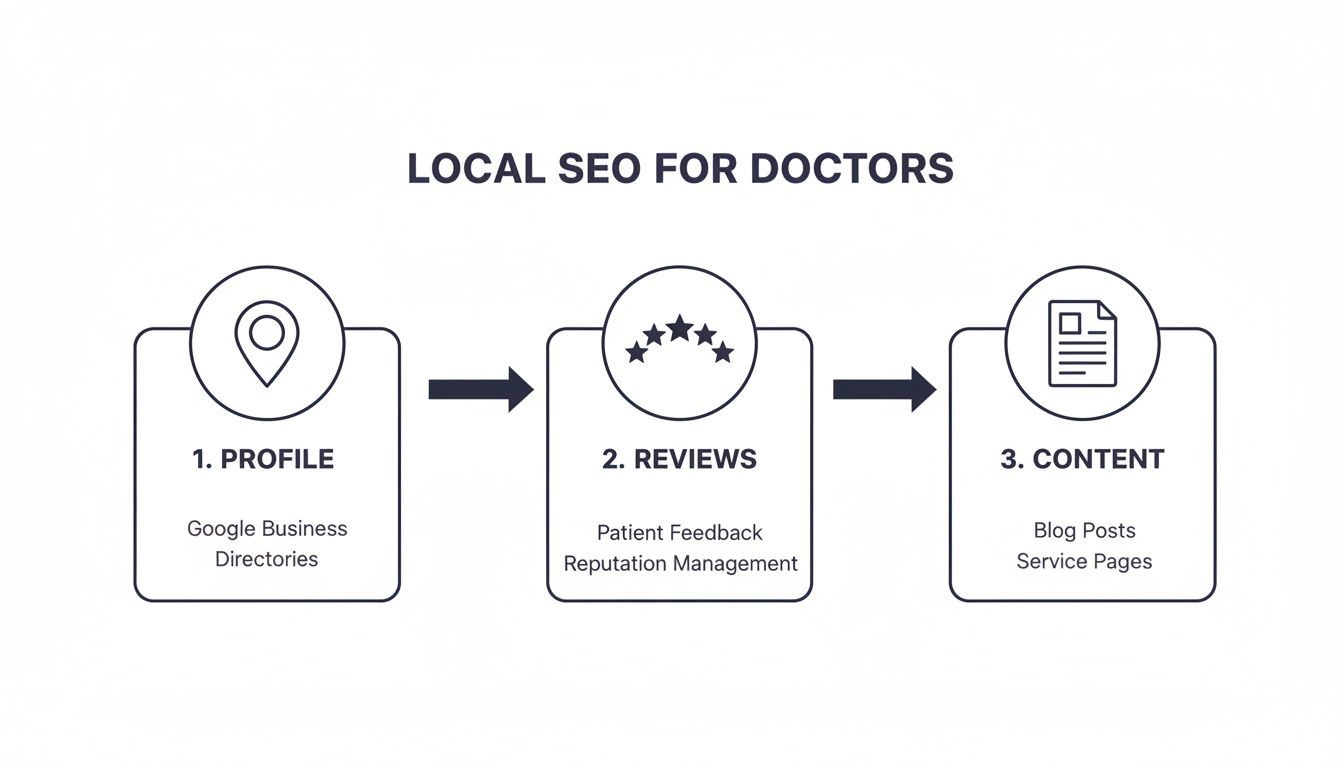
When your profiles are optimized and you have great reviews, your ads become that much more believable and effective.
Deciding where to spend your ad budget is just as important as the ads themselves. Different platforms serve different purposes, especially under the watchful eye of HIPAA.
Paid Channel Comparison for Healthcare Marketing
Here's a quick breakdown of the most common paid channels to help you decide where to focus your efforts.
| Channel | Best For | Key Compliance Note | Average Performance |
|---|---|---|---|
| Google Ads | Capturing high-intent searches for specific services (e.g., "orthodontist near me"). | Excellent. Keyword-based targeting is inherently compliant as it targets intent, not user profiles. | High ROI, typically delivers the most qualified new patient leads. |
| Facebook/Instagram Ads | Top-of-funnel brand awareness, promoting wellness content, events, or new services. | High risk. Avoid targeting based on health interests. Stick to broad demographics and location. | Lower direct ROI for patient acquisition, better for community building. |
| Local Services Ads | Generating direct phone calls and bookings for service-based practices (e.g., dentists, chiropractors). | Compliant. Operates on a pay-per-lead basis for verified providers in eligible categories. | Excellent ROI, as you only pay for legitimate leads. Highly effective. |
| LinkedIn Ads | B2B marketing, recruiting medical staff, or promoting professional medical education. | Very safe. Targeting is based on professional titles and industries, not personal health data. | Not intended for patient acquisition, but very effective for its niche. |
While Google Ads is the undisputed king for direct patient acquisition, a balanced strategy might use Facebook for brand awareness and LinkedIn for recruiting—just be sure you understand the compliance guardrails for each.
The Critical Role of Compliant Landing Pages
Getting someone to click your ad is just the start. Where they land next is arguably more important. Sending paid traffic to your generic homepage is a recipe for wasted ad spend. You need a dedicated landing page for each campaign.
A high-converting, compliant landing page absolutely must:
- Match the Ad's Promise: If your ad was for "emergency dental care," the page better talk all about emergency dental care. Any disconnect will cause people to bounce immediately.
- Feature a Clear Call to Action (CTA): Guide the user with obvious buttons like "Book Your Appointment" or "Call Us Now." Don't make them hunt for what to do next.
- Use HIPAA-Compliant Forms: This is the big one. Any web form that collects name, email, or phone number must be on a secure, encrypted platform. Tools like Jotform or Paubox offer compliant solutions. This is not the place to cut corners.
Navigating Remarketing Without Crossing Privacy Lines
Remarketing—showing ads to people who have visited your website—is a standard tactic in most industries. In healthcare, it’s a minefield. You cannot, under any circumstances, create remarketing lists based on visits to pages about sensitive health topics (like "cancer treatment" or "STD testing").
So, is it completely off-limits? Not quite. You can run remarketing campaigns ethically. For example, you could build an audience of people who visited general pages, like your "About Us" page, your main blog feed, or a post about healthy eating.
This strategy keeps your practice top-of-mind with a broadly interested audience without ever making an assumption about their specific health needs. It's a safe way to keep your digital marketing for healthcare providers both effective and fully compliant.
Building Trust With a Patient-First Content and Email Strategy
Great digital marketing in healthcare is built on a foundation of trust. While SEO and paid ads can get patients to your website, it's your content that convinces them to stay and, ultimately, book an appointment. This is your chance to showcase your expertise and compassion long before they ever walk through your doors.
A true patient-first content strategy goes way beyond just listing services. It's about generously answering the real, pressing questions your community is asking online. This simple shift positions your practice as a reliable, expert resource, not just another clinic down the street.
Creating Content That Answers Real Patient Questions
The best content marketing starts with empathy. You have to put yourself in your patients' shoes. What are they worried about? What symptoms are they Googling late at night? What are the questions they might be too embarrassed to ask during a visit?
Your content needs to tackle these concerns head-on. This isn't about chasing clicks; it's about providing genuine value that calms fears and empowers people with knowledge they can trust.
Here are a few practical formats that work wonders:
- Detailed Blog Posts: Go deep on a specific condition, treatment, or wellness topic. A post titled "What to Expect During Your First Cardiology Visit" can demystify the entire process and ease a lot of anxiety.
- Educational Videos: Short, simple videos can be incredibly powerful. Think about a two-minute clip explaining the difference between two types of flu shots or demonstrating a physical therapy exercise. The benefits of video marketing are huge, making complex topics easier to digest and showing the human side of your practice.
- Authentic Patient Testimonials: Whether written or on video, these provide powerful social proof. Hearing a real person share their positive experience is often far more persuasive than anything you could say about your own practice.
The secret to great healthcare content is to stop selling and start helping. When you consistently provide answers and support, you earn the credibility that makes patients choose your practice when they need care.
Connecting Content to a Smart Email Workflow
Creating great content is only half the job. You also need a solid way to share it and nurture those relationships over time. That's where a HIPAA-compliant email strategy comes in, giving you a direct and personal line of communication with your patients.
Your first move is to grow your email list—ethically, of course. You can do this by offering valuable resources on your website, like a downloadable guide to managing seasonal allergies or access to an informative webinar, in exchange for an email address.
Once someone has opted in, you can start using targeted email campaigns to build a real, lasting connection.
Nurturing Patient Relationships Through Email
Email is so much more than a promotional tool. For a healthcare provider, it's a way to extend care beyond the walls of your clinic and keep patients engaged in their own well-being. A well-planned email workflow can serve several vital functions.
It's the perfect channel for sharing important practice news, like new services, holiday hours, or the addition of a new provider to your team. This keeps patients in the loop and makes your practice feel more connected to their lives.
Even more importantly, email is ideal for preventative care reminders that can genuinely improve patient outcomes.
- Appointment Reminders: Automated emails are fantastic for reducing no-shows and helping patients stick to their treatment plans.
- Preventative Care Nudges: A timely email about annual check-ups, flu shots, or seasonal health tips shows you're proactively invested in their long-term health.
- Content Newsletters: Bundle your latest blog posts or videos into a monthly newsletter. This reinforces your expertise and keeps your practice top-of-mind.
This kind of consistent, helpful communication reinforces trust and can dramatically improve patient retention. When you combine a patient-first content plan with a thoughtful email strategy, you create a powerful system for attracting, educating, and retaining patients who see you as a true partner in their health.
Using AI and Automation to Elevate the Patient Experience

Let's be clear: the goal of digital marketing for healthcare isn't just about getting more patients through the door. It's about creating a smoother, more supportive experience for every single person you treat. This is where AI and automation become your practice's secret weapon, helping your team work smarter, not harder.
The idea isn't to replace the human touch—it's to amplify it. Automation tools can take over the repetitive, time-sucking tasks that bog down your front office, freeing up your staff for what really matters: handling complex patient questions or just offering a reassuring smile.
Streamlining Patient Communication with Smart Tools
One of the quickest wins with automation is in patient communication. Just think about all the routine questions your team answers every single day about office hours, accepted insurance, or how to prep for an appointment. An AI-powered chatbot on your website can field these inquiries 24/7, giving people instant answers and a great first impression.
Picture this: it's 10 PM and a parent is researching pediatricians. They land on your site with one simple question: "Do you offer same-day sick visits?" Instead of leaving and maybe forgetting about you, a chatbot instantly answers, links to your scheduling policy, and even offers to take their info for a follow-up call. That’s a potential new patient you just secured while your office was closed.
These tools do much more than just answer basic questions. Here are a few ways practices are putting them to work:
- Automated Appointment Reminders: These are game-changers for reducing no-shows. Sending automated text and email reminders—especially those that let patients confirm or reschedule with one click—is incredibly effective.
- Post-Visit Follow-Ups: Automatically send out emails with post-procedure care instructions or a link to a helpful blog post on your site. It shows you’re still thinking about them even after they’ve left.
- Review Requests: A day after a visit, an automated email or text can ask for a review. This is the perfect time to ask, while the positive experience is still fresh in their mind. It’s one of the best ways to build your online reputation.
The real power of automation in healthcare is its ability to deliver the right information to the right patient at the right time, without manual intervention. This consistency builds trust and makes patients feel cared for at every step.
Leveraging AI for Deeper Insights and Personalization
Going beyond simple automation, AI gives you the power to analyze data and personalize the patient journey in ways that just weren't possible before. The potential impact is huge; AI-powered platforms are expected to slash marketing costs by 30% by 2025 through better targeting. We already know that data-driven marketing can lift conversions by 40%, so the opportunity for practices to use their own data is massive. Find out more about the growing role of AI in healthcare marketing.
And you don't need a team of data scientists to do it. Many modern marketing platforms have these AI features built right in.
For instance, you can use AI to look at your website traffic and spot trends. It might reveal that a blog post you wrote about managing diabetes is getting tons of visitors from a specific zip code. That's a clear signal to run a targeted local awareness campaign in that area.
The Future AI-Assisted Practice
Looking down the road, the possibilities get even more interesting. Imagine custom AI models trained on your practice's own educational materials. You could generate highly personalized patient education plans on the fly. A patient could receive a custom guide on preparing for their specific procedure, complete with dietary tips and pre-op instructions, all created in an instant.
Ultimately, the goal is to create a seamless experience where technology handles the logistics. This frees up your team to do what they do best: provide compassionate, expert care. By thoughtfully bringing AI and automation into your practice, you'll not only improve patient outcomes but also build a more efficient, future-ready organization.
Your Top Healthcare Marketing Questions, Answered
Jumping into digital marketing can feel like a minefield, especially in healthcare where the stakes are so high. I get it. Over the years, I've seen providers grapple with the same core questions about staying compliant, figuring out a budget, and actually knowing if any of it is working. Let's clear the air on some of the most common concerns.
How Can I Market My Practice Online and Stay HIPAA Compliant?
This is, without a doubt, the number one question, and the answer is less complicated than it seems. At its core, HIPAA compliance in marketing comes down to a single, critical rule: never use Protected Health Information (PHI) for ad targeting or in any unsecured communication. You're marketing to the general public, not your patient list.
Think in terms of search intent and geography, not personal health conditions. For instance, running an ad targeting people who search for "orthopedic surgeon in Austin" is perfectly fine. What you absolutely cannot do is upload a list of your knee replacement patients to target them with ads. That's a serious violation.
Make sure any vendor you work with—from your web developer to your marketing agency—signs a Business Associate Agreement (BAA). And any tool that could possibly touch patient data, like a contact form or an email newsletter platform, needs to be a HIPAA-compliant solution. No exceptions.
What Is a Realistic Marketing Budget for a Private Practice?
There's no single magic number, but a good rule of thumb for an established practice is to set aside 5-10% of your annual revenue for marketing. If you're just starting out or breaking into a tough market, you'll likely need to push that closer to 10-12% to get your name out there and build that initial momentum.
The most important thing isn't the exact percentage; it's consistency. You'll get far better results by investing a steady, reasonable amount into one or two key channels than by sprinkling a tiny budget across ten different platforms. Start focused, master a channel, and then build from there.
How Do I Measure the ROI of My Digital Marketing?
Knowing your return on investment (ROI) is the only way to separate what’s working from what’s wasting money. The ultimate goal is to draw a straight line from your marketing dollars to new patients coming through your door. To do that, you have to track a few key numbers:
- Cost Per Lead (CPL): How much does it cost you to get one person to call your office or submit a web form?
- Patient Acquisition Cost (PAC): This is the metric that matters most. Just divide your total marketing spend for the month by the number of new patients you acquired in that same month.
- Lead Source: This is the most valuable piece of data you can collect. Your front desk staff should make it a non-negotiable habit to ask every single new caller, "How did you hear about us?" and log that answer religiously.
Sure, you can get fancy with unique call-tracking numbers for your ad campaigns or specific landing page forms, and those are great. But nothing replaces that simple, direct question. It tells you exactly which channels are delivering real patients. As technology evolves, so do measurement methods; you can explore resources on AI's impact on the healthcare industry to see how new tech is creating more advanced ways to track marketing effectiveness.
Which Digital Marketing Channel Should I Start With First?
For almost every healthcare provider I've ever worked with, the starting point is the same. Before you spend a dime on social media or PPC ads, you absolutely must nail these two foundational pieces:
- Your Website: It's your digital front door. It has to look professional, load quickly, work perfectly on a phone, and be fully compliant.
- Your Google Business Profile: This is what shows up in the local map pack. For many potential patients, it’s the very first impression they'll ever have of your practice.
These are the assets that capture patients who are actively looking for your services right now. Get these two things locked down and fully optimized first. Once that foundation is solid, your next move should be to build a steady stream of new patient reviews to create trust and social proof. Only then should you start thinking about expanding into things like content marketing or paid ads.
At Site Igniters, we build the compliant, high-performance digital foundations that healthcare providers need to grow. From SEO and web design to HIPAA-safe advertising, we help you connect with the patients who need you most. Learn more at https://siteigniters.com.
Seth Sanders is the founder of Site Igniters, a digital marketing agency in El Dorado Hills, California.