
What Is Multivariate Testing and How Does It Drive Growth


Ever heard of multivariate testing? It's a way to test a bunch of changes on a webpage all at once to figure out the absolute best combination for getting results.
- Multivariate testing lets you test multiple page elements simultaneously to find the highest-converting combination.
- It differs from A/B testing by evaluating interactions between variables, not just single changes.
- Avoid common pitfalls like insufficient traffic and testing too many variables at once.
Think of it like baking the perfect muffin. Instead of just testing butter versus oil (that's more like a simple A/B test), you're testing different flour types, sugar levels, and baking times all in one go. The goal is to discover the ultimate recipe that makes your website visitors happy.
What Is Multivariate Testing in Simple Terms?

At its heart, multivariate testing is all about understanding how different page elements work together. This is often called the "interaction effect." A simple test might tell you that a red button gets more clicks than a green one. Easy enough.
But multivariate testing goes deeper. It shows you how that red button performs when it's paired with a specific headline, a particular image, and a certain call-to-action phrase. It's a seriously powerful way to make incremental improvements to your most important pages without having to do a massive, expensive redesign.
This approach really shines when you've got a handful of good ideas for a page and you want to know which specific changes are actually moving the needle. Instead of setting up dozens of separate, time-consuming tests, multivariate testing rolls them all into one efficient experiment.
To really get why this matters, it helps to see it as part of a bigger picture. If you're new to this, checking out a comprehensive guide to Website Conversion Rate Optimization can provide some great context on how all these pieces fit together.
The Core Components of a Test
Before you jump into running your own experiments, it helps to get a handle on the basic building blocks. A multivariate test really just comes down to a few key ideas.
- Elements: These are the specific things on the page you want to tweak. Think headlines, hero images, button text, or even the form fields.
- Variations: These are just the different versions for each element. So, for your headline "element," you might have two "variations": "Get Started Today" and "Request a Free Demo."
- Combinations: This is where the magic happens. The testing software automatically mixes and matches all your variations to create every possible combination. If you have two headline variations and two image variations, you've got four unique combinations to test against each other.
To make this crystal clear, here’s a quick breakdown of how these concepts apply in the real world.
Multivariate Testing Core Concepts at a Glance
| Concept | Simple Explanation | Website Example |
|---|---|---|
| Element | The specific thing on your page you want to change. | The main call-to-action button on your homepage. |
| Variation | A different version of that thing. | Button text that says "Buy Now" vs. "Add to Cart." |
| Combination | A unique page version created by mixing variations. | Headline A with Button Text A, vs. Headline A with Button Text B. |
This table shows just how straightforward the underlying structure is. You pick what to change, create different options for it, and then let the test run to see which mix your audience responds to best.
The real power of what is multivariate testing lies in its ability to pinpoint which individual changes have the greatest influence on user behavior, providing deep insights that drive meaningful improvements.
Ultimately, this whole process is about ditching the guesswork and making smart, data-backed decisions that actually resonate with your customers. It's a crucial tool for aligning your website's performance with your broader marketing goals, including your search engine optimization (SEO) efforts.
The Surprising Origins of Modern Website Testing

It’s easy to think of multivariate testing as a modern invention, something cooked up in a Silicon Valley lab to optimize landing pages and ad campaigns. The truth is, its roots are much older and far more dramatic.
The core idea wasn’t born from a need to increase clicks, but to solve a life-or-death crisis on the high seas. We have to go all the way back to the 18th century to find the real origin story.
Long before it became a marketer’s best friend, the concept behind multivariate testing was used to fight scurvy, a horrific disease that killed thousands of sailors on long voyages. With no cure in sight, it was one of the biggest threats to naval exploration.
That is, until 1747. A surgeon in the British Royal Navy, James Lind, got fed up with the endless unproven "cures" and decided to try something radical: a structured, comparative test. What he did next is now seen as the first real clinical trial and a perfect ancestor to modern MVT. His famous experiment on scurvy laid the groundwork for how we test today.
Lind's Groundbreaking Experiment
Lind's approach was stunningly simple and effective. He took 12 sailors, all suffering from scurvy, and split them into six pairs. While every man received the same basic meals, each pair was given a different potential remedy to test at the same time.
This allowed him to compare multiple variables under the exact same conditions.
The treatments varied wildly:
- Cider
- Diluted sulfuric acid
- Vinegar
- Seawater
- A spicy paste
- Two oranges and one lemon
The results were immediate and undeniable. The pair given citrus fruits experienced a miraculous recovery; one was fit for duty again in just six days. None of the other groups showed any real improvement.
By testing multiple solutions at once, Lind quickly found the winning "combination" and proved the power of what we now know is vitamin C—long before the vitamin itself was ever identified.
"Lind's experiment was a masterclass in efficiency. Instead of testing one remedy at a time over many voyages, he tested multiple variables simultaneously, getting a clear, actionable answer in a fraction of the time."
This isn't just a fun history lesson. It proves that the logic behind multivariate testing isn't some fleeting digital trend. The fundamental principle—testing multiple combinations to find the best possible outcome—is a problem-solving method that’s been proven effective for centuries. It worked on the high seas, and it works on your website today.
Multivariate Testing vs A/B Testing Explained
One of the first questions people ask is when to use multivariate testing over its more famous cousin, A/B testing. While they both help you improve your website, they tackle different problems and work on completely different scales. Getting this distinction right is the key to picking the right tool for the job.
Think of it like this: A/B testing is like choosing between two completely different car models. You might test a zippy sports car (Version A) against a rugged SUV (Version B) to see which one performs better for your family's needs. The comparison is direct, simple, and tests one big, significant change.
Multivariate testing, on the other hand, is like custom-building one of those cars. Instead of just picking between the sports car and the SUV, you’re testing every possible combination of engine, interior, paint color, and wheel style to create the single most perfect vehicle. It doesn't just ask "which page is better?" but instead, "which specific combination of features drives the best results?"
Core Strategic Differences
The real gap between these two methods boils down to their purpose. An A/B test is your go-to for making a bold, singular change. For instance, testing a completely redesigned homepage against your current one is a perfect job for an A/B test. You get a clear winner for a major decision.
Multivariate testing really shines when you want to refine an existing page by tweaking multiple smaller elements at once. It helps you understand how a headline, a hero image, and a call-to-action button all interact with each other to influence a visitor's decision. For a much deeper dive into the specific scenarios for each, check out this guide on multivariate testing vs. A/B testing.
A/B testing finds the best page. Multivariate testing finds the best combination of elements on a page. This subtle difference dictates when and why you should use each method.
A/B Testing vs. Multivariate Testing Head-to-Head
So, how do you decide which testing method is right for your marketing goals and traffic volume? The biggest factors are usually how much traffic you have to work with and how complex your idea is. This table offers a direct comparison to help you decide.
| Feature | A/B Testing | Multivariate Testing |
|---|---|---|
| Primary Goal | Compares two or more distinct versions of a page to find a clear winner. | Tests multiple element variations at once to find the highest-performing combination. |
| Traffic Needs | Lower traffic requirements, making it perfect for smaller sites and new campaigns. | High traffic is essential to get statistically significant results across many combinations. |
| Complexity | Simple to set up and analyze; the winner is usually obvious. | More complex to design and run; requires careful planning and deeper analysis. |
| Best Use Case | Testing radical redesigns, major layout changes, or a single critical element like a headline. | Optimizing key landing pages by refining multiple existing elements like headlines, images, and CTAs. |
Ultimately, your choice comes down to your resources and what you're trying to achieve. If you're a local business wanting to test a new service description on your homepage, an A/B test is perfect. But if you’re a high-traffic e-commerce store trying to squeeze every last drop of performance from your product page, multivariate testing is the way to go.
How to Run Your First Multivariate Test
Moving from theory to practice can feel daunting, but launching your first multivariate test is more of a structured process than you might think. It's really less about guesswork and more about following a clear roadmap. The whole idea is to build a logical experiment that hands you clean, actionable data on a silver platter.
The journey usually kicks off with a simple question you find in your user data, something like, "Why aren't more people converting on this page?" From that one question, you can build a solid hypothesis, pick which elements to tweak, and define what a "win" actually looks like for your business.
This step-by-step process makes sure your testing efforts are focused and that the results you get are solid enough to base important business decisions on.
1. Formulate a Strong Hypothesis
Every successful test starts with a strong hypothesis. This isn't just a random guess; it's an educated statement you build from data you already have, maybe from Google Analytics, heatmaps, or direct user feedback. A good hypothesis has to be clear and, most importantly, testable.
For instance, a weak hypothesis is something vague like: "Changing the button will improve conversions."
A strong hypothesis gets specific: "By changing the CTA button text from 'Learn More' to 'Get Your Free Quote' and making the button color a high-contrast orange, we will increase form submissions because the new version creates more urgency and is more visible." See the difference? This version names the elements, describes the variations, and predicts the outcome.
2. Identify Elements and Create Variations
With a solid hypothesis in hand, you can zero in on the specific page elements you want to test. On a landing page, the usual suspects include:
- Headline: Try out different value propositions or play with the tone.
- Hero Image: Pit a product shot against a lifestyle image.
- Call-to-Action (CTA) Button: Experiment with different text, colors, or even sizes.
- Form Length: See what happens when you simplify the form by axing a few non-essential fields.
For each element you choose, you'll need to create at least one variation. Let's say you test two headline variations, two image variations, and two CTA variations. Your testing tool will automatically create 8 unique combinations (2 x 2 x 2) to show your visitors.
This infographic gives you a great visual breakdown of how a simple A/B test stacks up against the more complex combinations of a multivariate test.
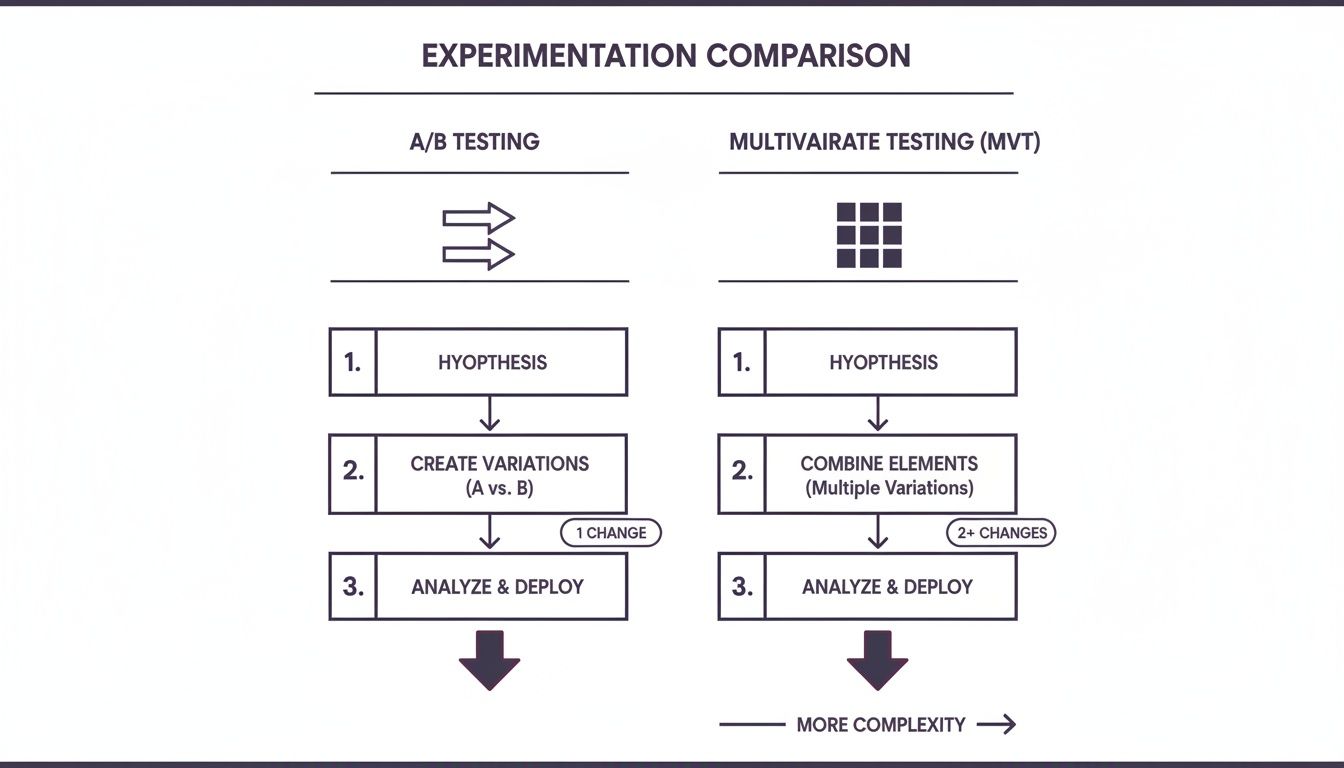
As you can tell, MVT creates a whole grid of possibilities. It's all about helping you find that perfect recipe of ingredients for your page.
3. Calculate Sample Size and Launch
Before you hit the "go" button, it's absolutely critical to make sure you have enough website traffic. Multivariate tests slice your audience into a bunch of small groups, so high traffic is non-negotiable if you want to achieve statistical significance—which is just a fancy way of saying you're confident your results aren't a random fluke.
Most testing tools have built-in calculators to help you figure out the sample size you'll need. One of the biggest mistakes people make is running a test without enough traffic, which almost always leads to results you can't trust.
Once you know your traffic is up to the task, you need to define your main conversion goal. Is it a button click? A form submission? A completed purchase? Then, you can pop into your chosen platform, set up the test, and push it live. Accurately tracking these goals is everything, which is why many businesses use advanced tools like the omni-pixel for cross-platform analytics to keep their data clean and reliable.
Finally, you have to let the test run. Fight the urge to peek at the results every day. You need to wait until you hit your pre-determined sample size to make sure the data is sound. Once the test wraps up, you can dive in, analyze the results, crown the winning combination, and roll it out to all of your users.
Why Top Companies Rely on Multivariate Testing
Ever wonder how the big players seem to have their websites dialed in perfectly? It’s not a guessing game. While the basics of multivariate testing are simple enough, its real power shows when you see how industry giants use it to carve out a massive competitive edge.
For these companies, MVT isn't just another optimization trick. It's the core engine that drives their growth, keeps users coming back, and squeezes every last drop of revenue from each visitor. They operate at a scale where even a tiny improvement—a fraction of a percent—can translate into millions of dollars. It’s about moving beyond assumptions and making high-stakes decisions with cold, hard data.
Lessons from Industry Leaders
Amazon is famous for using multivariate testing to refine its product pages. By testing countless combinations of images, product descriptions, and call-to-action buttons across millions of shoppers, they’ve pinpointed the exact formulas that get people to click "buy." Some of their tests have even found combinations that boosted conversions by up to 30% in specific categories.
You can learn more about these case studies and see how companies using MVT get a 23% average lift in key metrics by reading this complete guide on Convert.com.
This isn't just an e-commerce strategy, either. Think about Netflix. They are constantly running multivariate tests on their content recommendation interface. They'll experiment with different thumbnail images, summary text, and layouts to see what keeps you watching. That directly improves user retention—and their bottom line.
The real takeaway here is that MVT gives you an incredible window into customer psychology. It shows how different elements work together to turn a decent user experience into an amazing one.
Translating Success to Your Business
You don’t need Amazon's budget to get the same kinds of rewards. The same principles that drive growth for the big guys can be applied to any business, even small and local companies. All it takes is a systematic approach to testing combinations of elements on your most important pages.
Think about how you could apply this to your own site:
- Service Pages: Test different headlines, testimonial placements, and contact form designs. See what combination generates the most qualified leads.
- Homepage: Experiment with your main value proposition, hero image, and primary call-to-action to grab attention and guide visitors where you want them to go.
- E-commerce Product Pages: Try out different product image styles, descriptions, and "Add to Cart" button variations to boost sales and cut down on abandoned carts.
When you apply these strategies, you get real results that you can see in your bank account. We’ve seen firsthand how a data-driven approach to web design can completely change a business's trajectory, as you can see in some of our most successful client projects.
Ultimately, multivariate testing lets you stop guessing and start building a website that truly connects with your customers. It turns your site from a simple online brochure into your most effective sales tool.
Common Mistakes and How to Avoid Them
Running a multivariate test can feel like you’ve unlocked a marketing superpower, but a few common missteps can easily send your efforts off the rails and hand you a pile of misleading results. Knowing what these pitfalls are before you start is the best way to make sure your data is solid and your conclusions actually mean something.
The single biggest mistake people make is testing with insufficient traffic. It’s an easy trap to fall into. Because MVT has to split your audience into so many different groups to test every combination, it's a very thirsty process—it needs a lot of visitors to work. Without enough data flowing in, you’ll never reach statistical significance, which is a fancy way of saying your results are probably just random noise.
Another major temptation is ending the test too soon. You see one combination shoot ahead and you get excited to call a winner. Don't do it. User behavior changes day-to-day, even hour-to-hour. A test needs to run long enough to smooth out those bumps—usually at least a full business cycle or one entire week—to get a real, honest picture of how people are behaving.
Protecting Your Test Integrity
Beyond getting the traffic and timing right, a few other things can mess with the validity of your test. It’s absolutely critical to be aware of these outside influences and your own internal biases before you even think about hitting "launch."
To keep your results clean and trustworthy, you should always:
- Avoid Testing During Abnormal Periods: Thinking of running a test during your Black Friday blowout or right after a blog post goes viral? Bad idea. That’s not your normal audience, and the data will be skewed. Stick to your typical, everyday traffic patterns to get results you can actually rely on.
- Test a Clear Hypothesis: Don’t just throw random elements at the wall to see what sticks. Start with a smart, data-informed idea. Have a reason to believe that changing this specific thing will impact user behavior in this specific way.
- Don't Change the Test Mid-Stream: This one is non-negotiable. Adding a new variation or yanking one out after a test has started completely invalidates the whole experiment. You have to commit to your plan from the very beginning and see it through.
A successful multivariate test is a disciplined one. Patience and a strict adherence to statistical principles are just as important as the creative ideas you're testing.
This disciplined approach can also be used to tackle other business challenges, like making your website more accessible. For instance, you could test different color contrasts or button sizes right alongside your calls-to-action. This way, you can find a combination that both improves engagement and ensures you're compliant with accessibility standards. You turn a legal box-ticking exercise into a powerful opportunity to connect with more people—all while staying out of legal trouble.
If you want to dive deeper into the statistical theory behind all of this, you can find more information about the principles of multivariate statistics here.
Answering Your Top Questions About Multivariate Testing
Jumping into multivariate testing usually sparks a few practical questions. Nailing these details is what separates a successful experiment from a confusing mess of data, so let's clear up the most common ones.
How Much Traffic Do I Really Need for MVT?
This is the big one. Because multivariate tests slice your audience into so many different groups, they demand a significant amount of website traffic. There isn't a single magic number here—it really depends on your page's current conversion rate and just how many combinations you're throwing into the mix.
For a simple test with only four combinations, you might get by with 10,000 monthly visitors to that page. But once you start running more complex experiments with 12 or more variations, you'll likely need over 100,000 monthly visitors to get statistically solid results without waiting forever. If your site's traffic is on the lower side, you're almost always better off sticking with A/B testing for now.
What Are the Best Tools for Multivariate Testing?
You don't have to break the bank to get started. Plenty of powerful platforms offer MVT features that are a great fit for businesses of all sizes.
A few of the most popular and accessible choices include:
- Google Optimize: A free and surprisingly powerful tool that plugs right into your Google Analytics. It's an excellent starting point for anyone new to testing.
- VWO (Visual Website Optimizer): Famous for its super user-friendly visual editor. It lets you build out tests and make changes without needing to touch a single line of code.
- Optimizely: This is a more heavy-duty platform built for larger companies that need really deep analytics and advanced personalization features.
How Long Should a Test Run?
The sweet spot for a test is long enough to gather enough data, but short enough to be practical. One of the biggest mistakes people make is calling the test the second one variation seems to be winning.
A reliable test should run for at least one full business cycle, which is usually one to two weeks. This simple rule helps you average out any weird daily spikes or dips in user behavior (like weekday vs. weekend traffic) and makes sure your results are actually dependable.
As a rule of thumb, never run a test for less than a full week, and always keep it going until you've hit the sample size you calculated beforehand.
Ready to stop guessing and start making decisions backed by data? The team at Site Igniters combines expert web design with powerful optimization strategies to turn your website into a growth engine. Learn how we can help you convert more visitors today.
Seth Sanders is the founder of Site Igniters, a digital marketing agency in El Dorado Hills, California.