
Your Guide to Digital Marketing for Local Businesses

Hoping for foot traffic and word-of-mouth to grow your business just doesn't cut it anymore. Today, the journey for a new customer almost always starts with a search online. That simple fact makes your digital presence essential for bringing new people through your doors. Your visibility on Google, your social media accounts, and your online reviews have become your most powerful tools for building a local brand that lasts.
- Local digital marketing starts with a strong Google Business Profile and consistent NAP information across all directories.
- Combine local SEO, targeted paid ads, and social media to create a multi-channel presence that dominates your service area.
- Track local metrics like phone calls, direction requests, and foot traffic, not just website visits and impressions.
Why Your Business Needs a Digital Playbook

Think about the last time you needed a plumber, looked for a new restaurant, or searched for a local attorney. My guess is you grabbed your phone and typed what you were looking for into Google. This is just how people find things now, and it has completely changed the game for local businesses trying to connect with their communities.
People are out there actively searching for the exact services you offer. If you're not showing up online, you're pretty much invisible to them.
This is where a solid digital playbook comes in. The heart of any successful online effort is a well-defined plan, which should absolutely include guidance on developing a winning digital marketing strategy. This isn't just about having a website; it's about creating a smart, cohesive plan that uses multiple channels to meet customers right where they are.
The Modern Customer's Path to Purchase
Today's consumer leans heavily on search rankings and what other people are saying online to make their decisions. Long before they ever walk in your door or dial your number, they’ve probably already formed an opinion based on your digital footprint.
This new reality makes digital marketing for local businesses more critical than ever before. It's the engine that powers your visibility, builds trust with potential customers, and ultimately drives sales in a crowded market.
Just think about these common steps a customer takes:
- Search Engine Discovery: A homeowner in Sacramento searches "emergency HVAC repair near me."
- Review Validation: They skim the Google reviews for the top three businesses that pop up.
- Social Proof: They might take a quick look at a company's Facebook or Instagram to see recent jobs or what they're up to in the community.
- Website Visit: Finally, they click over to the website to find a phone number or book an appointment.
If your business is a no-show at any of these steps, you're losing that customer to a competitor who has their online act together.
The Core Pillars of a Local Strategy
A winning local marketing playbook is built on a few key pillars. They all work together to attract, engage, and convert customers. These aren't just "nice-to-haves"—they're the absolute essentials for growth.
A strong digital presence allows you to control your brand's narrative. It’s your opportunity to show potential customers not just what you do, but who you are and why they should trust you over anyone else.
Your strategy should cover:
- Search Visibility: Making it incredibly easy for people to find you on Google through local SEO.
- Paid Advertising: Reaching highly specific local audiences with ads that get them to act now.
- Community Engagement: Building real relationships on social media to create loyalty and get people talking.
- Reputation Management: Actively managing your online reviews to build and protect your credibility.
When you get these elements right, you transform your online presence from a static brochure into an active, lead-generating machine for your business.
Mastering Local Search to Become the Obvious Choice
For any local business, getting onto the first page of Google isn't just a nice-to-have; it's essential for survival and growth. When a potential customer pulls out their phone to search for a service "near me," they have a problem and they're ready to pay someone to solve it. Right now.
Your job is to be the first, easiest, and most trustworthy solution they find. This is the entire game of local search engine optimization (SEO). It’s all about making sure your business pops up in those critical local search results, especially in the "Map Pack" that dominates the top of the page. Frankly, mastering this is probably the single most impactful thing you can do for your business online.
Your Google Business Profile Is Your Digital Storefront
Long before a customer walks through your actual door, they’ll encounter your Google Business Profile (GBP). Think of it as your digital front door—it's the first impression you make, and it needs to be spot-on.
Just claiming your profile is table stakes. The real wins come from treating it like a living, breathing part of your business, not a static listing. You have to go way beyond just listing your hours and phone number.
Your Google Business Profile is not a "set it and forget it" tool. It is an active communication channel between you and your local customers. Consistent updates and engagement are what separate the top-ranking businesses from the rest.
To really put your GBP to work, you need to be actively managing it. I’m talking about weekly, if not daily, attention. Here’s where to focus:
- Fill Out Everything: Don't skip a single field. Services, accessibility details, veteran-owned attributes—fill it all out. The more complete your profile is, the more confident Google is in showing it for relevant searches.
- Upload Photos Constantly: Fresh photos of your storefront, your crew in action, and your completed jobs show you're an active, legitimate business. Stale, years-old photos are a red flag.
- Use Google Posts Weekly: Think of these as free mini-ads. Post about specials, new services, or recent projects. It keeps your profile fresh and signals to Google that you’re open and active.
- Own the Q&A Section: People ask questions here all the time. Answer them promptly. Better yet, pre-emptively ask and answer common questions yourself to provide immediate value.
Consistently doing these things sends powerful signals to Google that your business is relevant and deserves a top spot. If you want to go even deeper, our guide on how to optimize your Google My Business profile covers more advanced tactics.
Consistency Across the Web Builds Trust
Google doesn't just look at your GBP. It scans the entire web to verify your business information, and consistency is king. This is where your NAP (Name, Address, Phone number) comes in. It needs to be identical everywhere it's listed, from Yelp and Angi to your local chamber of commerce directory.
Even a tiny inconsistency, like listing "St." in one place and "Street" in another, can create confusion for search engines and chip away at their trust in your data. Your goal is a perfectly consistent web of citations, all pointing back to your business with the exact same information.
Create Content That Speaks to Your City
A generic website just doesn't cut it anymore, especially in a crowded local market. You have to show you're a true local expert. The best way to do this is by creating specific service pages for the individual cities and even neighborhoods you serve.
Let's say you're a plumber in Sacramento. Instead of one generic "Drain Cleaning" page, you should have:
- "Drain Cleaning Services in Sacramento": This is your main hub page for the core service area.
- "Emergency Plumber in El Dorado Hills": A highly specific page targeting a nearby affluent community, maybe talking about common issues with the homes there.
- "Fair Oaks Water Heater Repair": Another focused page for a specific service in a distinct suburb.
Each of these pages needs unique content. Don't just copy and paste. Mention local landmarks, talk about projects you've done in that neighborhood, and use the keywords that real people in that area are typing into Google. This hyper-local strategy tells both customers and search engines that you are the authority for that community.
The table below breaks down these core pillars of local SEO and the key actions you need to take.
Local SEO Pillar Breakdown
| Pillar | Key Action Items | Impact on Visibility |
|---|---|---|
| Google Business Profile | Fully complete profile, add photos/videos weekly, use Google Posts, manage Q&A and reviews. | High: Directly influences Map Pack and local finder rankings. The most critical factor. |
| Local Citations (NAP) | Build consistent listings on major directories (Yelp, Angi) and local/niche sites. Audit and clean up inconsistencies. | Medium: Builds trust and authority with search engines. Verifies you are a legitimate local entity. |
| On-Page Local SEO | Create city/neighborhood-specific service pages. Include local keywords in titles, headers, and body content. | High: Helps you rank for specific "service in city" searches. Demonstrates local relevance. |
| Review Management | Actively request reviews from happy customers. Respond to all reviews, both positive and negative. | Medium: Strong social proof and a known ranking factor. Builds customer trust and engagement. |
Focusing on these three areas—your GBP, your online consistency, and your on-site content—forms a powerful foundation for dominating your local market.
This local-first approach is more critical than ever. A staggering 72% of people use Google when looking for local businesses, meaning your local relevance is one of the strongest signals you can send to search engines. For a business in Sacramento, showing you're truly part of the community is how you win. You can discover more insights about digital marketing statistics on seoprofy.com to get a better handle on these trends.
Driving Immediate Traffic with Local Paid Advertising
While local SEO is your long game—building a solid, organic foundation—sometimes you just need the phone to ring right now. This is where local paid advertising, or pay-per-click (PPC), steps in as your most powerful tool for getting in front of customers immediately.
It’s simple: PPC puts your business right at the top of Google the very moment a potential customer is searching for what you do.
Unlike SEO, which can take months to really gain traction, a well-built local PPC campaign can start driving calls and website visits within hours of going live. It's a direct, controllable way to capture people who are actively looking to buy or book a service. The beauty of it is the precision. You're not just shouting into the void; you're targeting specific people in specific neighborhoods who have already raised their hand and said, "I need this now."
Structuring Campaigns for Local Impact
The number one key to a successful local PPC campaign is nailing the targeting. It’s painfully easy to waste your budget on clicks from people way outside your service area—a common and costly mistake. Your entire campaign needs to be built around your actual geographic footprint.
Google Ads gives you some powerful tools for this. You can set your campaigns to show ads only to people within a certain radius of your shop, or you can target by specific cities, zip codes, or even individual neighborhoods. This laser focus ensures every dollar you spend is aimed at bringing in relevant customers.
You can get even more strategic with bid adjustments. Let's say you know that customers from an affluent zip code nearby tend to be more profitable. You can actually tell Google you’re willing to bid 20% higher for clicks coming from that specific area. It's this kind of fine-tuning that maximizes your return on ad spend (ROAS).
Keywords and Ad Copy That Actually Convert
Your keyword strategy has to be hyper-local. Forget broad terms like "plumber." You need to focus on phrases that signal an immediate, local need.
For instance, if you're a contractor in Sacramento, you'd want to target things like:
emergency plumber SacramentoFair Oaks HVAC repair near meEl Dorado Hills kitchen remodel contractor
These kinds of keywords attract people who are much further down the buying path. Your ad copy should reflect that local intent. Mention your city or service area directly to build instant relevance and trust. And, of course, always include a strong call to action like "Call for a Free Estimate."
You absolutely have to use ad extensions to their full potential, too. These are the extra bits of info that make your ad bigger, more helpful, and more likely to get clicked.
- Location Extensions are a must. They show your business address and a map pin, making you the obvious choice for anyone doing a "near me" search.
- Call Extensions add a click-to-call button right in your ad on mobile devices. This removes all the friction for someone who needs help fast.
- Sitelink Extensions let you add direct links to important pages on your website, like "Our Services" or "Contact Us."
Don't Let Missed Opportunities Slip Away
So, what happens when someone clicks your ad, browses your site, but then leaves without calling or filling out a form? Without a plan, that potential customer is gone for good. This is exactly where remarketing comes into play.
Remarketing lets you show targeted display ads to people who have already visited your website as they browse other sites online. Think of it as a gentle, persistent reminder of your brand that keeps you top-of-mind.
Remarketing is your second chance to make a first impression. It recognizes that most customers don't convert on their first visit, giving you a cost-effective way to re-engage warm leads and guide them back to your business.
The competition for online attention is only getting fiercer. Digital ad spend in the United States has hit massive levels, with a projected $466.34 billion to be spent in 2025. This just goes to show how critical it is to invest smartly to stay visible.
If you want to dive deeper into how paid ads fit into the bigger picture, our guide on search engine marketing (SEM) is a great next step.
Engaging Your Community on Social Media
For local businesses, social media isn't just a place to drop the occasional update or coupon anymore. It’s become the digital town square—the main spot where your potential customers hang out, size you up, and ultimately decide who they want to do business with.
This is where you stop being just another faceless company and start becoming a real, valued member of the neighborhood. The goal is to build genuine connections, not just push sales. It’s a shift in mindset from broadcasting ads to starting conversations and actually providing something useful. When you get this right, your social media presence transforms into a magnet for loyal customers who feel like they already know and trust you.
Beyond Promotions: Create Real Value
Let's be honest, your customers are drowning in ads every single day. If you want to stand out, your content has to be genuinely helpful, interesting, or at the very least, entertaining. Think about the common problems your customers face and how you can help solve them—long before they ever pull out their wallets.
For example, a local contractor could post quick DIY tips on Instagram Reels, maybe showing homeowners how to fix a minor leaky faucet. That simple, helpful video builds trust and plants a seed. When a much bigger plumbing issue comes up, who do you think they'll call?
Likewise, a local law firm could jump into a Sacramento-focused Facebook group to weigh in on community issues, offering useful advice without the hard sell. This value-first mindset is the secret sauce for effective digital marketing for local businesses. Your social channels stop being digital billboards and start becoming community resources.
The most successful local businesses on social media don't just sell—they serve. They answer questions, share expertise, and celebrate their community, building a loyal following that trusts them long before a purchase is ever made.
Fueling Discovery and Driving Decisions
The way people discover businesses has been completely turned on its head. Social media is no longer an afterthought; for many, it's the first place they look. In fact, a whopping 37% of consumers now kick off their product searches on social platforms, not on Google.
That's a massive shift. If you're not active and engaging on social media, you're invisible during a huge part of the customer's journey.
This is where authentic, human interaction becomes your superpower. Just posting content and walking away isn't enough. You have to get in there and engage with the people who are paying attention.
- Respond to Every Comment: Seriously, every single one. When someone takes a minute to comment, acknowledge them. A simple "Thanks for the kind words!" or a quick answer to their question shows you're actually listening.
- Join Local Conversations: Keep an eye on local hashtags and pop into conversations happening in community groups. Your goal is to be a helpful neighbor, not just a business owner trying to make a sale.
- Show the People Behind the Business: Post photos and videos of your team. Introducing the real people behind your brand makes your business instantly more relatable and trustworthy.
Leveraging Social Proof and User Content
Your happiest customers are, hands down, your best marketers. When you encourage them to share their own experiences and photos, it creates powerful social proof that’s far more believable than any ad you could ever create.
Make it a habit to ask customers to tag your business in their photos. A local restaurant, for instance, could create a fun, branded hashtag and feature the best customer photos on its profile every week. This not only gives you a constant stream of authentic content but also makes your customers feel seen and appreciated.
By weaving all these pieces together, you'll create a vibrant social media presence that does more than just sell—it builds a genuine community around your brand and drives real growth. For a deeper dive into making this happen, check out these practical tactics for social media marketing for local businesses.
Building Trust and Protecting Your Brand
In the digital world, your online reputation is everything. It’s the sum of all the reviews, comments, and ratings that potential customers see long before they even think about picking up the phone. Managing this isn't just about putting out fires; it's a proactive way to build unshakable trust.
This process is about more than just chasing five-star ratings. It’s about shaping a brand image that feels transparent and trustworthy. Alongside your reputation, there's another piece of the puzzle that's just as critical for protecting your business: ensuring your digital storefront is open and accessible to everyone.
Actively Manage Your Online Reviews
A steady stream of positive reviews is one of the most powerful marketing tools you have. But just sitting back and hoping happy customers leave feedback isn't a strategy. You need a simple, repeatable process to nudge them in the right direction.
This can be as straightforward as sending a follow-up email after a job is done, with a direct link to your Google Business Profile. The name of the game is to make it ridiculously easy for them. The fewer clicks it takes, the more likely they are to actually do it.
But what about the inevitable negative review? They happen to everyone, and how you respond is what really defines your business. Ignoring them is the worst thing you can do. A thoughtful, professional response to a bad review can often build more trust than a dozen positive ones. It shows you’re listening, you care, and you’re committed to making things right. A great response can even turn a disgruntled customer into a loyal fan. For those looking to really nail this, our in-depth guide offers advanced review management strategies to help you protect your brand.
A Simple Framework for Responding to All Feedback
Responding to reviews—both the glowing and the critical—should be a non-negotiable part of your weekly routine. Consistency here sends a powerful signal that you're an engaged and attentive business owner.
Here’s a simple framework that works every time:
- For Positive Reviews: Always say thank you. Try to personalize it by mentioning a specific detail from their review. It shows you actually read what they wrote and genuinely appreciate it.
- For Negative Reviews:
- Acknowledge their frustration and thank them for bringing it to your attention.
- Apologize for their poor experience without getting defensive or making excuses.
- Take the conversation offline. Offer a direct phone number or email to resolve the issue privately.
This approach de-escalates public conflict and, more importantly, shows other potential customers that you take accountability seriously.
Responding publicly to a negative review isn't about winning an argument; it's about showing the hundreds of other people reading it that you are a reasonable and responsible business. Your real audience is the silent majority, not just the one unhappy customer.
Open Your Doors with Website Accessibility
While your reputation builds trust, another critical piece protects your business and expands your audience: website accessibility. This simply means making sure people with disabilities can navigate and use your website. You'll often hear this referred to as ADA (Americans with Disabilities Act) compliance.
Having an inaccessible website doesn't just cut you off from a huge chunk of the population—over 60 million adults in the U.S. live with a disability—it also opens you up to serious legal risks. Lawsuits over website accessibility are skyrocketing, and they can be financially devastating for a small business.
But don't just think of accessibility as a legal box to check. An accessible website is simply a more user-friendly website for everyone.
Plus, many of the steps you take to make your site compliant also give your SEO a nice boost. For instance:
- Adding Alt Text to Images: This describes images for visually impaired users using screen readers, and it also gives search engines more context about your content.
- Ensuring Keyboard Navigation: A site that can be fully navigated with just a keyboard is essential for users with motor disabilities. It's also a sign of clean, well-structured code that search engines reward.
- Using Clear Heading Structures: Logical headings (H1, H2, H3) help screen readers make sense of a page's layout, and they also help Google understand the hierarchy and importance of your content.
By making accessibility a priority, you're not just dodging legal trouble. You’re actively growing your potential customer base, improving the experience for every single visitor, and strengthening your technical SEO. For any local business, it’s a clear win-win.
Alright, let's turn that strategy into action. We've covered a lot of ground, and now it’s time to put it all together into a clear roadmap you can actually use.
Think of this as your practical, no-fluff checklist for building and keeping your digital marketing momentum.
The core idea is simple: Generate trust, respond to feedback, and stay compliant. That’s how you build a rock-solid reputation that brings in customers.
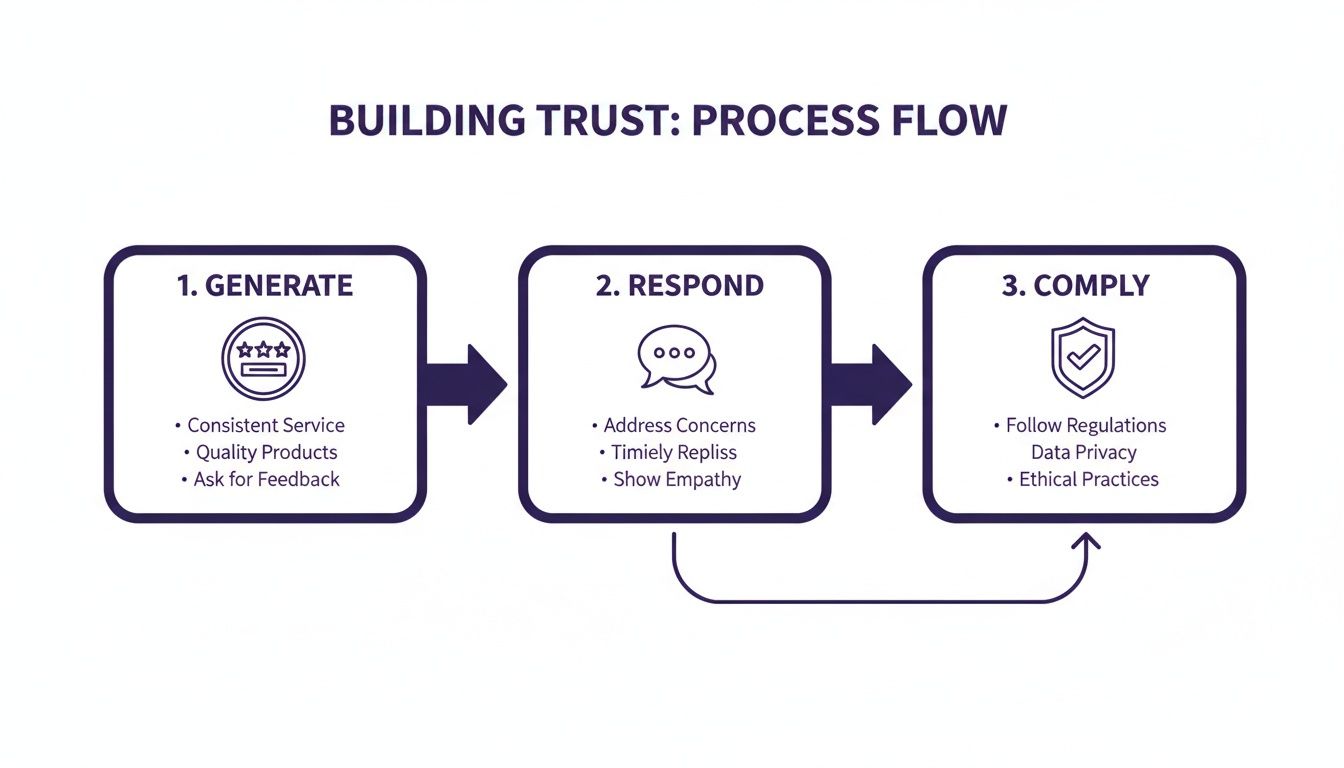
This loop is the engine that drives your online reputation. It turns happy customers into your best marketing assets and shows everyone that you're a business that listens.
Foundational Tasks (Do These Now)
First things first. These are the one-time setup jobs that lay the groundwork for everything else in your digital marketing for local businesses. Getting these right is non-negotiable if you want long-term success. Knock these out so your business is visible and protected from day one.
- Claim and Fully Optimize Your Google Business Profile: Honestly, this is your most important digital asset. Fill out every single section. Get at least 10 high-quality photos up there and write a business description that actually sells what you do.
- Audit Your NAP Consistency: Your business Name, Address, and Phone number (NAP) needs to be identical everywhere. Check it on major directories like Yelp, Angi, and especially your own website. Correct every little inconsistency you find.
- Set Up Google Analytics and Search Console: These are free tools from Google, and you need them. Install them on your website to start tracking who’s visiting and how they're finding you. This data is pure gold for making smart decisions down the road.
- Perform an Accessibility Audit: Your website has to be usable by everyone. Use a free online tool to scan for major ADA compliance issues. Focus on fixing critical errors like missing image alt text and make sure your site can be navigated with just a keyboard.
A strong foundation makes everything else so much easier. Seriously, a few focused hours on these tasks will pay off for years by making sure you’re visible, consistent, and accessible to every potential customer.
Weekly Actions (Build Momentum)
Now for the fun part: building momentum. Consistency is how you win online, period. These are the things you should be doing every week to keep your brand active, engaged, and on your local audience's radar. Just block out a little time each week.
- Post on Your Google Business Profile: Aim for at least one Google Post per week. It can be a special offer, a photo of a recent project, or just a helpful tip. Keep your profile looking fresh.
- Engage on Social Media: You don't need to live on social media, but you need to be present. Spend 15-20 minutes a day responding to comments and messages. Share something valuable that isn't just a sales pitch.
- Request and Respond to Reviews: Make asking for reviews a natural part of your process with every happy customer. Check for new feedback daily and respond to every single review—good or bad—within 24 hours. It shows you care.
Monthly Reviews (Refine Your Strategy)
Once a month, it's time to step back and look at the big picture. This is your chance to see what's working, ditch what isn't, and make smart adjustments.
- Analyze Your GBP Insights: Open up your Google Business Profile and see how people found you. How many called? What search terms did they use? This tells you what customers are actually looking for.
- Review Your Website Traffic: Dive into Google Analytics. Which pages are most popular? Where is your traffic coming from? This helps you double down on what’s effective.
- Assess Your Social Media Engagement: Look at your posts from the last month. Which ones got people talking, liking, or sharing? Use those insights to plan better content for the next month.
Your Top Questions Answered
When you're diving into digital marketing for your local business, a few questions always seem to pop up. It's totally normal. We've heard them all, so we’ve put together some straight-to-the-point answers to help you get moving.
How Much Should I Actually Budget for Digital Marketing?
There’s no magic number here, but a solid rule of thumb is to set aside 5-10% of your total revenue.
If you're a brand-new business trying to make a name for yourself, you’ll want to lean closer to that 10% mark to really gain some traction. On the other hand, if you're an established local favorite with a steady stream of customers, you can probably work effectively closer to 5%.
The key is to be smart about where that money goes.
- Go where the intent is: Put more of your budget into channels like Google Ads. People searching there are actively looking for what you offer, right now.
- Test the waters: Don't be afraid to earmark a smaller, experimental budget for platforms like Facebook or Instagram. Run some local ads, see what sticks, and learn what your community responds to.
Start with what you can manage, watch your return on investment like a hawk, and then double down on the channels that are actually bringing you customers.
How Long Does Local SEO Really Take to Work?
Let's be real: Local SEO is a marathon, not a sprint. You won't flip a switch and be number one overnight.
You might start seeing some positive movement within 3-4 months, but for the big, game-changing results—like owning the Google Map Pack for your most valuable keywords—you're typically looking at a 6-12 month commitment.
Think of it like planting a tree. Your initial Google Business Profile optimization and citation building are like planting the seed. The consistent, ongoing work is the sun and water that helps it grow strong enough to bear fruit.
Things like how competitive your industry is, where you're starting from, and how consistent you are with your efforts will all affect your timeline. Patience is your best friend here.
Which Social Media Platform is Best for My Local Business?
Simple: Go where your customers are. Don't spread yourself thin trying to be on every single platform. Get really good at one or two first, and then expand if it makes sense.
Here's a quick breakdown for local businesses:
- Facebook: Still king for community-focused businesses. If you run a restaurant, a retail shop, or provide local home services, this is your spot to build relationships with residents.
- Instagram: A must-have for any business that's visual. Think contractors showing off their work, salons with before-and-afters, bakeries with mouth-watering photos, or designers showcasing their projects.
- LinkedIn: The go-to for B2B. If you’re a law firm, financial advisor, or a marketing agency trying to connect with other local professionals, this is your network.
Pick the platform that gives you the most direct line to your ideal customer and own it.
Ready to stop guessing and start growing? The team at Site Igniters specializes in creating practical, results-driven digital marketing strategies for local businesses just like yours. Let's build a plan that works for you.
Seth Sanders is the founder of Site Igniters, a digital marketing agency in El Dorado Hills, California.