
A Guide to Generative Engine Optimization


Generative engine optimization (GEO) is all about making your website's content the go-to source for AI models when they whip up those direct, conversational answers you're starting to see everywhere.
- GEO optimizes your content to be the trusted source AI models cite when generating direct answers for users.
- Core GEO techniques include authority building, structured data, and creating content that answers questions comprehensively.
- Tracking AI citations and zero-click visibility is essential to measuring your GEO success.
This isn't just a small tweak to search; it's a total overhaul. We're moving away from the classic list of blue links to a single, synthesized answer. For businesses, understanding generative engine optimization isn't just a good idea anymore—it's absolutely critical for staying visible online.
Welcome to the New Search Landscape
Ever ask your phone a question and get a straight answer instead of just a page of websites? That’s the new reality of search, and it’s completely changing how we find information. This is a fundamental shift from traditional search engine optimization (SEO) to the new frontier of generative engine optimization (GEO).
To really get it, think of old search engines like a library catalog. You punch in what you're looking for, and the catalog tells you which books (websites) to check out. It works, but you still have to pull each book off the shelf, flip through the pages, and piece together the answer yourself.
Generative engines are totally different. They’re more like having a hyper-intelligent librarian on call.
This AI librarian doesn't just point you to the right books. It has already read them all, understands the information inside out, and gives you a perfect, concise summary crafted just for your question.
This new dynamic is a classic double-edged sword, bringing both a massive challenge and a huge opportunity.
The Challenge of Zero-Click Answers
When an AI serves up the perfect answer directly, the user's journey often ends right there. They got what they needed without ever having to click on a website. This "zero-click" environment means the old ways of driving traffic are quickly becoming obsolete. If your business depends on people actually visiting your site, this shift could make you practically invisible.
The Opportunity of Becoming the Source
But this is where generative engine optimization flips the script. GEO is the art and science of making sure your content is what that AI "librarian" trusts and relies on to create its answers. It’s about positioning your brand as the foundational source of truth in your field.
When you optimize for AI, you're not just hoping for a click. You're aiming to be cited and recommended directly within the AI's response, putting your brand in front of motivated users at the exact moment they need a solution.
This guide will walk you through why GEO is essential for staying visible and authoritative. You'll learn exactly how to adapt your strategy to not just survive but thrive in this new search world, ensuring your brand is the one providing the answers.
What Exactly Is Generative Engine Optimization?
Let's cut through the buzzwords and get straight to what generative engine optimization (GEO) really is. At its heart, GEO is all about positioning your content to be the clearest, most trustworthy, and most useful source for AI language models like ChatGPT and Google's AI Overviews.
The goal isn't just for an AI to find your content. The goal is to become a core part of the knowledge it uses to build its own answers.
Think of it this way: traditional search engine optimization (SEO) is about making your website's front door easy for search crawlers to find and rank. It's a game of visibility. GEO, on the other hand, is about making the information inside your house so well-organized and authoritative that an AI assistant confidently shares it with others as the definitive truth.
This is a huge shift in how we need to think about digital content. It's no longer enough just to rank; you have to be the source.
From Keywords to Concepts
While old-school SEO often lives and dies by specific keywords, GEO plays a much bigger game. It's focused on optimizing for entire concepts, questions, and the natural flow of conversation. An AI doesn't just scan for a keyword match; it tries to truly understand the context and meaning behind a user's prompt.
This means your content needs to be built differently. It should provide direct, self-contained answers that cover the "who, what, when, where, and why" of any given topic. The focus shifts from trying to get a click to earning a citation right inside an AI-generated answer.
Generative Engine Optimization is less about fighting for a top spot on a results page and more about becoming an indispensable part of the AI's knowledge base. It's the difference between being a book in the library and being the librarian's most trusted resource.
The explosive growth of this technology makes it impossible to ignore. By February 2025, ChatGPT had blown past 400 million weekly active users—a pace of adoption we've never seen before. At the same time, Google’s AI Overviews are already showing up in billions of searches every month.
Some industry analysts are even predicting that AI-driven search could slash traditional organic traffic by as much as 50% by 2028. The writing is on the wall.
This diagram perfectly captures the evolution from a simple search catalog to the new world of AI-driven librarians.
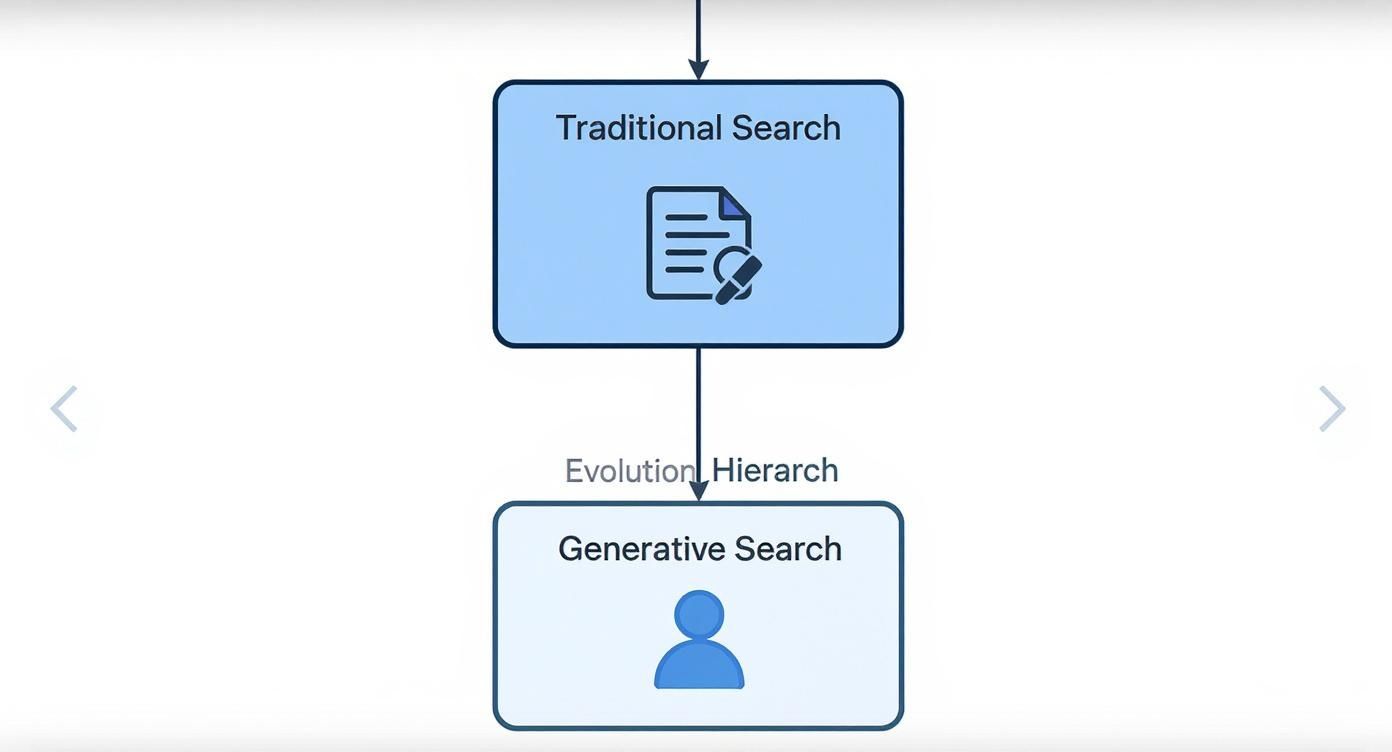
As you can see, the shift is from a system that just points users to information (Traditional Search) to one that synthesizes and delivers the answer directly (Generative Search).
The table below breaks down the fundamental differences between these two approaches.
Comparing SEO and GEO Core Philosophies
| Aspect | Traditional SEO | Generative Engine Optimization (GEO) |
|---|---|---|
| Primary Goal | Rank high on a search results page to earn clicks and drive traffic. | Become a cited, authoritative source within an AI-generated answer. |
| Content Focus | Targeted keywords, backlinks, and on-page technical factors. | Concepts, direct answers, verifiable facts, and data structure. |
| User Interaction | User clicks a link to find an answer on a webpage. | AI delivers a synthesized answer directly, often citing the source. |
| Core Metric | Organic traffic, keyword rankings, click-through rate (CTR). | Citations, brand mentions in AI answers, source visibility. |
Ultimately, while SEO is about getting found, GEO is about being trusted as the definitive answer.
The Four Pillars of GEO
While GEO shares some DNA with traditional search engine optimization (SEO), its execution is completely different. It really stands on four key pillars that all work together to build that critical AI trust and visibility. Getting a handle on these is the first step to mastering this new field.
- Establishing Authority: This is all about proving your expertise with hard facts, original research, and getting your brand mentioned by other credible sources.
- Structured Data: Using schema markup and clean formatting is like giving the AI a blueprint to your content. It helps it understand context and makes your information easier to pull from.
- Conversational Relevance: Your content needs to answer questions the way a real person would ask them. Think about the language people use when talking to an AI assistant.
- Absolute Clarity: Simple language, short sentences, and a logical flow are everything. AI models hate ambiguity and will always favor content they can understand without a single misstep.
By focusing on these areas, you’re not just optimizing for a machine. You're also creating higher-quality, more accessible, and more useful content for your human audience, too.
Why GEO Is Crucial for Digital Visibility
The shift to AI-driven search isn't some far-off trend—it's happening right now, and it's fundamentally changing how your customers find you. Ignoring generative engine optimization (GEO) isn't just a missed opportunity anymore. It's a direct threat to your digital visibility and, frankly, your future revenue.
The reason is simple. A huge chunk of your audience is already turning to AI for answers. If your brand isn't the one providing those answers, for all intents and purposes, you don't exist.
This isn't a slow burn; it's an explosion. The market for GEO services tells the whole story. By 2025, the global Generative Engine Optimization market is expected to reach $848.0 million. From there, analysts are calling for a massive compound annual growth rate of 50.5%, pushing the market to an incredible $33,680.3 million by 2034. This isn't just hype. It's a signal of a permanent change in how people search for information, as you can see from market research projections.

This new world demands a strategy built around one core idea: digital omnipresence.
Achieving Digital Omnipresence
What does that even mean? It means your brand becomes the source of truth wherever your audience is asking questions. It’s about being the answer not just on Google, but inside a ChatGPT conversation, a Bing Copilot summary, or a voice reply from a smart speaker.
GEO isn't just playing defense to stop traffic from dropping. It's an all-out offensive play to get in front of high-intent customers before they even land on a competitor's site. You become the trusted advisor, not just another blue link on a results page.
When an AI model cites your brand, it's like getting a powerful, third-party endorsement. This builds trust way faster than a traditional search result ever could, putting you directly in touch with users who have a clear and immediate need.
The Real Risks of Inaction
So, what happens if you just keep doing what you've always done and ignore this whole AI thing? The fallout can be pretty damaging, potentially wiping out years of hard work.
- Becoming Invisible to AI Users: A large and growing slice of your potential customers will simply never find you. As they lean on AI for recommendations and buying decisions, your brand will be completely left out of the picture.
- Loss of Brand Authority: Your competitors who get on board with GEO will become the go-to experts in your field. Their knowledge will literally shape the AI's understanding of the industry, leaving your expertise in the dust.
- Eroding Market Share: Every time a user gets an answer sourced from a competitor, that's a customer you just lost. Let that happen enough, and you’ll watch your customer base shrink as your rivals gain a permanent edge.
Connecting GEO to Business Goals
At the end of the day, adopting a generative engine optimization strategy is a direct investment in your bottom line. This isn't just another task for the marketing team; it's a strategic move for company growth.
By making GEO a priority, you’re future-proofing your content and ensuring your brand stays relevant and authoritative. You're building a digital presence that can ride out algorithm updates and still connect with customers, even when they don't click a single link. The goal is simple: be the source, build the trust, and win the customer.
Core Techniques for Effective GEO
Alright, let's move from theory to practice. Making generative engine optimization work for you boils down to a few key techniques. This is all about structuring your content to speak the language of AI. You want to set up your information so that a language model can not only understand it but actually trust it enough to use it as a source.
This isn’t about tricking an algorithm. It's about being radically clear.
Think of it like preparing a briefing for a brilliant but very literal assistant. You wouldn't hand them a dense, rambling report. You’d give them clean headings, bullet points with the main takeaways, and direct answers to the questions you know they'll have. That’s the exact mindset you need for GEO.

The name of the game is making your content as "parsable" as possible. AI models feast on well-organized data. The easier you make it for them to pull out the facts, the more likely they are to cite you. It means shifting how you create content to put structure and conciseness first.
Craft Content with Self-Contained Answers
The most fundamental technique in generative engine optimization is creating content that gives direct, self-contained answers. Every section, every paragraph should be able to stand on its own as a complete response to a potential question.
Imagine a user asks an AI, "What are the benefits of drip irrigation?" An article optimized for AI wouldn't bury that answer inside a long paragraph about the history of agriculture. Instead, it would have a bold heading like "Key Benefits of Drip Irrigation" followed by a simple, scannable list that the AI can easily grab and present.
This approach forces you to get inside your audience's head and anticipate the exact questions they're asking. It’s about breaking down big topics into a series of smaller, answer-focused chunks of content. Each block needs to be tight, factual, and straight to the point.
Use Conversational Headings That Mirror Questions
For an AI, your headings are the signposts. Vague, creative titles that might look good in a magazine are totally useless for GEO. Your H2s and H3s should be framed as the questions your users are actually typing or speaking into their phones.
This does two things. First, it directly matches the queries generative engines are trying to answer. Second, it builds a logical, easy-to-follow structure that helps the AI understand the hierarchy and context of your information. This is very similar to the best practices you'd follow when you https://siteigniters.com/optimize-your-website-for-voice-search/, where clarity is king.
Here’s what that transformation looks like:
-
Traditional: "Our Process"
-
GEO-Optimized: "How Do We Conduct a Website Audit?"
-
Traditional: "Product Features"
-
GEO-Optimized: "What Are the Core Features of the X-100 Model?"
This simple shift makes your content infinitely more useful to an AI that's been tasked with finding the single best answer to a direct question. And to really put these generative strategies to work, you need to master the tools of the trade; checking out the best AI content generators is a great place to start.
Leverage Structured Data and Schema Markup
Behind the curtain, structured data (like Schema.org markup) is one of the most powerful tools in your GEO toolbox. It’s basically code that gives search engines and AI models explicit context about what your content is.
Think of it as adding little descriptive labels to your information. You can use schema to tell an AI, "This block of text is a recipe," "this number is a price," or "this section is an FAQ."
By using structured data, you remove all the guesswork for the AI. You're handing it a perfectly organized map of your content, highlighting the most important bits and explaining exactly what they are.
This technical step is non-negotiable. It helps AI models parse your information with near-perfect accuracy, dramatically increasing the odds that your data will be used correctly in a generated response.
Build Authority Through Brand Mentions
In the world of GEO, brand mentions are the new backlinks. Traditional links still matter, of course, but AI models are looking at a much wider set of signals to figure out who the real authorities are. When other credible websites mention your brand in a positive light, it acts as a massive vote of confidence.
Recent data shows a powerful correlation of 0.664 between brand web mentions and a site's appearance in AI Overviews. For comparison, traditional backlinks had a correlation of just 0.255. It's a huge difference.
This means your strategy has to grow beyond just link building. You need to be actively looking for opportunities to get your brand featured, quoted, and discussed across the web. This could mean writing guest posts, getting involved in expert roundups, or publishing original research that other people will want to talk about and cite.
How to Implement Your GEO Strategy
Alright, so you get what generative engine optimization is. Now, how do you actually do it? It's easy to think of this as some huge, fuzzy project for "later," but that's a mistake. Putting GEO into practice is really a series of deliberate steps you can start taking right now to make your brand the go-to authority for AI.
We're going to break this down into five straightforward stages. It all starts with a deep dive into your current content to see where you stand. From there, we'll nail down the conversational questions your audience is asking AI, build out a content plan to answer them, and kick off a campaign to get the brand mentions that AI models treat like gold stars.
Conduct a GEO Content Audit
Before you build anything new, you have to know the lay of the land. A GEO content audit isn't about looking for keywords; it's about sizing up your existing content for its "AI-friendliness." The goal here is simple: find your strongest content that can be easily tweaked and spot the gaps you need to fill.
Go through your most important pages—blog posts, service pages, and guides. For each one, ask yourself a few questions:
- Does it give direct answers? A lot of great information gets lost in long, winding paragraphs. Find it and see if you can pull it out into a clear, concise answer.
- Is the structure clean? Check how you're using headings (H2s and H3s). Do they create a logical outline that an AI could easily follow?
- Are there hard facts? Pinpoint any stats, data, or expert quotes. These are things an AI can easily cross-reference and verify.
This audit will leave you with a clear to-do list. Some pages might just need a few formatting changes, while others will need a bigger overhaul to get them ready for generative engine optimization.
Identify Key Conversational Queries
Next up, you need to get inside your audience's head. What are they actually asking AI? Classic keyword research is a fine starting point, but for GEO, you have to think in complete sentences. Your mission is to map out the exact conversational questions your ideal customer is asking.
Fire up tools like AlsoAsked or just type your main topics into ChatGPT or Google's AI Overviews and see what questions pop up. They aren't just typing "local SEO." They're asking, "How can I get my local business to show up on Google Maps?" For example, knowing the ins and outs of how to optimize Google My Business is huge, because tons of real-world questions are about local discovery.
By zeroing in on these long-form, conversational questions, you're doing more than targeting keywords. You're lining up your entire content strategy with the natural way people think and ask for information—which is exactly what AI is built to understand.
This research becomes the bedrock of your content plan, making sure every single thing you create or update is aimed squarely at a real question from a real person.
Develop an AI-Friendly Content Framework
With your audit done and your questions identified, it's time to build a content framework that AI engines will love. This all boils down to two things: clarity and structure. Think of every piece of content as something that needs to be easily taken apart and used by an AI.
Your framework should always include these key elements:
- Question-Based Headings: Make your H2s and H3s mirror the user's question directly.
- Scannable Lists: Use bullet points and numbered lists to break down complex info into bite-sized chunks.
- Short, Punchy Paragraphs: Stick to 1-3 sentences per paragraph, max. This makes it a breeze for an AI to pull out specific information.
- Strategic Bolding: Use bold text to highlight key stats, facts, and takeaways. It's like a signpost telling the AI, "This part is important!"
This disciplined structure makes your content a perfect resource for both human readers and AI parsers.
Establish a Brand Mention Campaign
In the world of GEO, brand mentions from other authoritative sites are the new currency. Plain and simple. An AI is far more likely to cite your brand as a source if it sees other credible websites talking about you. This calls for a focused campaign to build your authority online.
Start looking for opportunities to guest post on respected industry blogs, get included in expert roundups, and publish original data or research that other people will want to link to. Every mention is another signal to AI models that you're a trustworthy voice in your space. This goes beyond old-school link building; it’s about creating a strong, positive story about your expertise all over the web.
Set Up GEO-Specific Metrics
Finally, you have to measure what matters. Old-school metrics like organic traffic and keyword rankings don't paint the full picture for generative engine optimization. Success here is all about your influence within AI-generated answers.
Start tracking these GEO-focused KPIs:
- Citation Rate: How often does AI cite your brand or content as a source?
- Share of Voice: For a specific set of questions, what percentage of the answers does your brand show up in?
- Sentiment Analysis: When you are mentioned, is it in a positive and authoritative way?
Keeping an eye on these numbers gives you a real feel for how you're performing with GEO. It helps you prove the value of your efforts in a world where a click isn't always the end goal.
Measuring Success in a Generative Search World

So, how do you know if your generative engine optimization strategy is actually working? The old SEO rulebook just doesn't apply when your goal is to be cited in an AI answer instead of just earning a click. Sure, traditional metrics like keyword rankings and organic traffic are still useful, but they don't come close to telling the whole story.
Relying on those alone is like trying to measure an email campaign's success by only counting website visits. You're completely missing the main point. The click is no longer king, and that means we need a totally new way to measure influence and prove the ROI of our GEO efforts.
We have to shift our thinking from tracking website performance to measuring our brand's presence inside AI conversations. Success is less about driving a ton of traffic and more about how often your brand shows up as a trusted source.
The New KPIs for Generative Engine Optimization
To really get a feel for your impact, you need to bring in a new set of key performance indicators (KPIs) built for this new AI-powered search world. These metrics look beyond your own website analytics to see how your brand is being portrayed across different AI platforms.
Here are the essential metrics you need to start tracking:
- Citation Rate: This is the most direct measure of GEO success. It simply tracks how often your brand, your content, or your data is explicitly named as a source in AI-generated answers for your target questions.
- Share of Answer: Think of this like share of voice. This metric calculates the percentage of relevant AI responses where your content is a primary source of information. It shows you just how dominant your brand is for a particular topic.
- Sentiment Analysis: This KPI digs into how your brand is being mentioned. Is the AI presenting your products or expertise in a positive, neutral, or negative light? This gives you a crucial gut check on brand perception.
Tools and Methods for Tracking GEO
Measuring these new KPIs takes a different toolkit and a more hands-on approach. You can't just log into Google Analytics and find your Citation Rate. Instead, you'll need to mix manual spot-checks with some of the new analytics platforms that are popping up.
The real challenge in measuring GEO is that you’re tracking your visibility on platforms you don’t own. Success means becoming a core part of the AI's knowledge base, which requires looking far beyond your own website to see how your expertise is being used.
A good starting point is to manually ask platforms like ChatGPT and Google AI Overviews your target questions to see if your brand gets mentioned. Beyond that, specialized GEO tools are starting to appear that can automate this for you, offering dashboards that monitor your Share of Answer and citation frequency over time. Looking past traditional rankings, a key metric for evaluating GEO performance is mastering your overall share of visibility in the market. By pulling these methods together, you can build a solid framework to show the powerful ROI of your generative engine optimization strategy.
Of course. Here is the rewritten section, crafted to sound completely human-written and natural, following the provided style examples.
Your Top Questions About GEO, Answered
Jumping into AI-powered search can feel a little confusing. It’s a new frontier, and it’s natural to have questions. Let's clear up some of the most common things people ask about generative engine optimization so you can move forward with a solid game plan.
Is Generative Engine Optimization Just the New SEO?
Not exactly. Think of GEO as the next evolution of your SEO work, not a replacement for it.
Here’s a simple way to look at it: Traditional SEO is all about getting search engines to see and rank your website. GEO is about getting AI models to trust your content enough to use it in their answers. They work together.
The fundamentals you already know, like creating high-quality content and building strong E-E-A-T (Experience, Expertise, Authoritativeness, and Trustworthiness), are more important than ever. A solid SEO foundation is what you'll build your GEO strategy on top of.
How Is GEO Different From SEO?
The biggest difference is the goal. With traditional SEO, you're trying to win a high ranking so someone will click through to your website. With generative engine optimization, the goal is to have your brand or content cited directly in the AI's answer—often meaning the user never has to click anywhere.
This shifts your focus from keywords to whole concepts and questions.
- Search Intent: SEO often goes after short keywords like "CRM software." GEO is built for longer, more conversational questions, such as, "What is the best CRM for a small sales team?"
- What Success Looks Like: In SEO, you track rankings and traffic. In GEO, you’re looking at brand mentions and how often your information appears in AI answers.
- Content Design: GEO demands content that is highly structured, easy for a machine to scan, and provides immediate answers. SEO can be a bit more flexible.
The real difference is optimizing for a click versus optimizing for a citation. One brings people to your site; the other builds your authority on someone else's platform.
Where Do I Even Begin With GEO?
The best place to start is with a GEO content audit. Before you write a single new word, take a hard look at what you already have.
Comb through your existing blog posts and pages to find content that's almost AI-ready. Can you add some question-based headings? Break up that wall of text into bullet points? Highlight a few key statistics? This audit will give you a list of quick wins and show you exactly where your biggest content gaps are.
At Site Igniters, we help businesses turn these big digital changes into real growth. From creating an AI-proof content strategy to making sure your website is seen as a trusted source, we're here to help you win in this new era of search.
Ready to become the go-to answer in your industry? Contact Site Igniters today!
Seth Sanders is the founder of Site Igniters, a digital marketing agency in El Dorado Hills, California.