
A Guide to Geo Generative Engine Optimization


So, what exactly is geo generative engine optimization (Geo-GEO)? Think of it as the art and science of making your business the direct, conversational answer when someone asks an AI for a local recommendation. It's about moving past just showing up on a map. The real goal is to become the top recommendation an AI assistant gives to a nearby customer.
- Geo-GEO combines geolocation signals with generative AI optimization to make your business the top local recommendation in AI answers.
- Strong local signals like Google Business Profile, reviews, and NAP consistency are the foundation of any Geo-GEO strategy.
- Implementing Geo-GEO now positions your business ahead of competitors in the rapidly evolving AI-powered local search landscape.
This is where local search is heading, and it's changing how businesses connect with people in their community.
Why Local Search Is Changing Forever
Let's say you own a coffee shop. For years, you've poured your energy into traditional local SEO. You worked hard to land in that coveted "map pack" when someone typed "coffee shop near me." That old approach basically turned your business into a pin on a digital map—you were there, but you were just one option on a long list.
Now, fast forward to today. A potential customer is walking down the street and, instead of typing, asks their phone's AI, "Where's a quiet coffee shop nearby that has oat milk and free Wi-Fi?"
The AI doesn't just spit out a list. It gives a single, confident answer: "The best spot for that is The Daily Grind, just around the corner. They get great reviews for their quiet vibe, and they definitely have oat milk and solid Wi-Fi."
That simple shift is the entire point of geo generative engine optimization. It’s no longer about just being on the map; it’s about being the definitive answer.
The New Local Search Conversation
This move from a list of results to a direct, conversational answer is all thanks to generative AI. Search is becoming more like a dialogue and less like a simple query. This new reality requires a completely different strategy for any business that relies on local foot traffic—restaurants, retail shops, plumbers, you name it.
The goal now is to build so much trust with AI engines that they recommend your business without a second thought.
Geo-GEO is a mashup of two powerful forces:
- Generative AI: The tech that gets what people are asking in plain language and pulls together information to give a single, helpful answer.
- Geolocation Data: All those hyper-local signals (like GPS and Wi-Fi) that tell the AI where someone is and what they need right now.
Geo generative engine optimization isn't some far-off idea. It's a real-world strategy for winning local customers in an AI-first world. It’s the difference between being a name in a phone book and getting a personal recommendation from a trusted local expert.
Moving Beyond Keywords to Context
This new game forces you to think beyond simple keywords like "plumber Sacramento." You have to start optimizing for the real, detailed questions your customers are asking, like, "Who's a reliable plumber in East Sacramento that can handle an emergency leak right now?"
Answering that kind of question takes more than a slick website. It means you have to build a digital reputation that screams trustworthiness, local authority, and specific expertise—all in a way that AI algorithms can understand. This guide will show you exactly how to build that reputation and turn your business from just another pin on the map into the go-to answer for your community.
How AI and Geolocation Power Local Search
At the core of geo generative engine optimization, you've got two powerhouse technologies working together: generative artificial intelligence and pinpoint-accurate geolocation data. On their own, they’re impressive. But when they team up, they create a local search experience unlike anything we've seen before. Getting a handle on how they play off each other is the first step to mastering this new space.
Think of generative AI—the kind powered by Large Language Models (LLMs)—as your own hyper-local digital concierge. This isn't just a search bar spitting out links. It's more like an expert who's read every local blog, customer review, restaurant menu, and service page in town. It gets the vibe of different neighborhoods and can give you solid advice based on a simple, conversational question.
This digital concierge doesn't just throw a list of options at you. It pulls all that information together to give you a single, confident recommendation, just like a trusted friend would. That completely changes how people find what they're looking for.
The Rise of Conversational AI
The absolute explosion of platforms like ChatGPT has totally reset what users expect from search. The platform hit 100 million users faster than any app in history, which led to an 800% year-over-year jump in website traffic referrals from LLMs by early 2025. You can't ignore the numbers: global AI search adoption is at 38%, and traditional click-through rates have plummeted by 54%.
This shift toward asking questions naturally is also a huge part of voice search. If you want to dive deeper into that, check out our guide on how to https://siteigniters.com/optimize-your-website-for-voice-search/.
This infographic really nails the difference between old-school local SEO, which was all about getting on the map, and the new conversational approach of Geo-GEO.
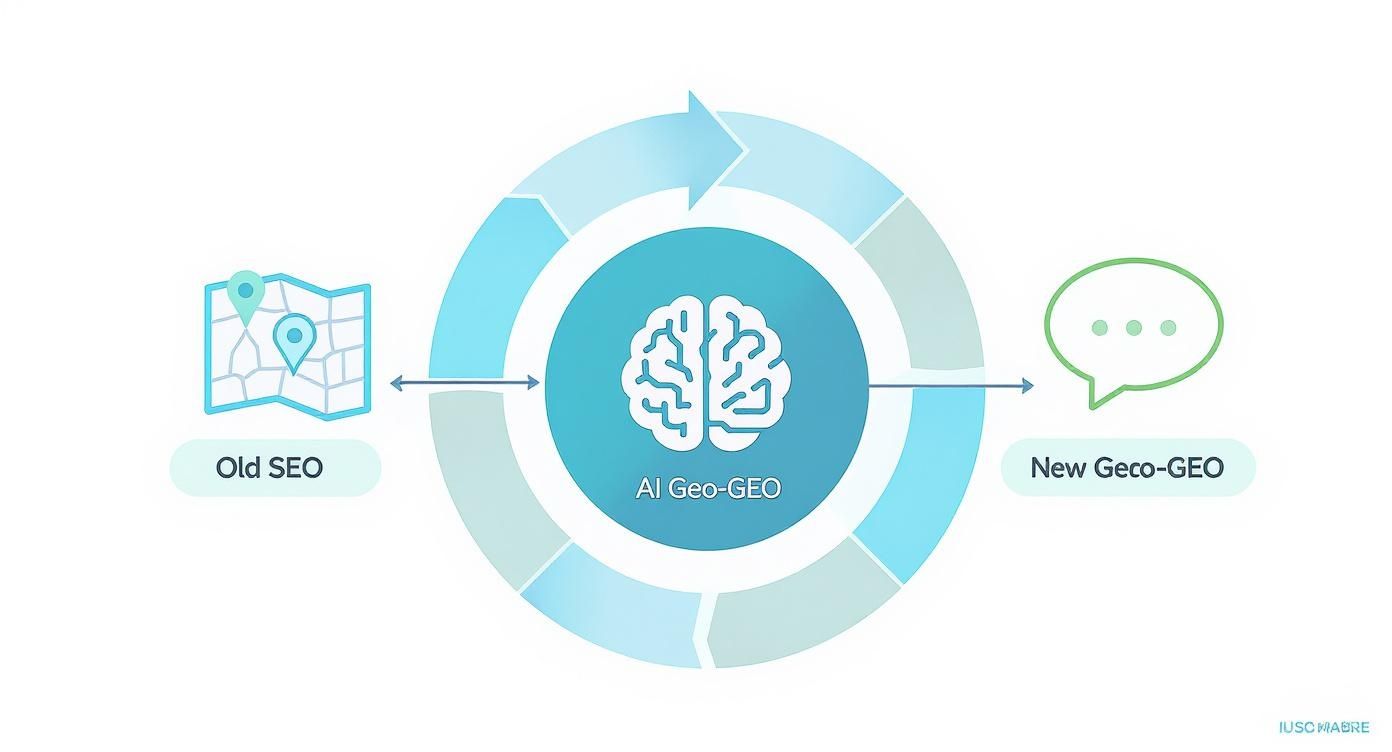
As you can see, we're moving from a static pin on a map to a dynamic chat bubble, where your business becomes the direct answer to a person's question.
Geolocation Beyond GPS
The other piece of this puzzle, geolocation, is way more advanced than the simple GPS signal from a user's phone. To dish out truly relevant local answers, AI engines have to figure out a user's location and what they really want by looking at a bunch of different data points.
Geolocation in Geo-GEO isn't just about where a user is. It's about understanding the context of that location to predict what they need in that exact moment.
AI engines analyze a mix of signals to get this hyper-local read on a user:
- IP Address: This gives a general idea of the area, like a city or neighborhood.
- Wi-Fi Networks: Known Wi-Fi hotspots can pinpoint a user’s position with incredible accuracy, even when they're indoors.
- Cell Tower Triangulation: By measuring signals from multiple cell towers, the AI can triangulate a user's location.
- Search Context: The words in the query itself offer clues, like "near the capitol building" or "downtown."
This multi-layered approach gives the AI a deep understanding of the user's situation. It knows if you're sitting at home planning a trip for next week or if you're walking down Main Street looking for coffee right now.
By combining this deep locational awareness with the conversational smarts of generative AI, geo generative engine optimization delivers answers that feel personal, immediate, and incredibly helpful. If you want to really get ahead, you should explore strategies to rank higher in ChatGPT with geo-specific optimizations.
The Pillars of a Strong Geo-GEO Strategy

To really nail geo generative engine optimization, you need a solid framework. Think of it like a building supported by three critical pillars. Each one has a specific job, and together they convince AI engines that your business is the most relevant, trustworthy, and authoritative answer for anyone searching nearby.
These aren't just optional add-ons. They're the foundation. By building up these three core areas, you create a powerful strategy that can weather any algorithm update and consistently bring local customers to your door.
Let's break down what each pillar actually looks like in practice.
Create Hyper-Local Content
This is your first, and arguably most important, pillar. It’s all about creating content that speaks directly to your local community. We're talking way beyond generic blog posts. Hyper-local content answers the super-specific, nuanced questions that people in your neighborhood are actually asking their AI assistants.
Picture a user asking, "Where can I find a dog-friendly cafe with strong Wi-Fi near McKinley Park?" A generic page about your coffee shop just won't cut it. An AI needs to see content that explicitly mentions your pet-friendly patio, the reliability of your internet, and your proximity to that exact park. That’s the level of detail this new game demands.
The goal of hyper-local content is to pre-emptively answer every possible local question, turning your website into an indispensable resource for the community and a trusted data source for AI.
This means getting granular and creating content that covers:
- Neighborhood Guides: Write about local events, landmarks, and other businesses right in your immediate area.
- Service-Specific Pages: Instead of a single "services" page, build out dedicated pages for each service, tailored to different neighborhoods you serve. A huge part of this is building winning location landing pages that are designed to capture customers from a specific geographic zone.
- Answering Local FAQs: Create content that directly answers questions like, "Do you have vegan options?" or "Is there free parking nearby?"
Implement Structured Data and Entity Optimization
The second pillar is all about making it incredibly easy for AI to understand who you are, what you do, and where you're located. You do this with structured data, specifically something called Schema markup. Think of Schema as a detailed, neatly-labeled business card that you hand directly to search engines, leaving zero room for guesswork.
Without it, an AI has to try and figure out what your content means. With structured data, you’re explicitly defining key "entities" like your business name, address, phone number (NAP), hours, services, and even customer reviews. This precise labeling makes your business a known, verifiable entity in the AI's "brain."
This kind of clear organization is fundamental. A well-optimized Google Business Profile is a massive part of this pillar, as it feeds directly into the AI's understanding of your local relevance. If you want to dive deeper, you can learn more about optimizing your Google Business Profile in our guide: https://siteigniters.com/how-to-optimize-google-my-business-2018/.
Build Local Authority Signals
The final pillar is all about proving your relevance through outside validation. Local authority signals are basically shout-outs—mentions, links, and citations from other reputable sources in your community. These signals act as third-party endorsements, confirming to AI that your business is a legitimate and respected part of the local scene.
Think of it this way: anyone can claim to be the best plumber in town on their own website. But when the local newspaper, a popular neighborhood blog, and the chamber of commerce all mention that plumber? That becomes a much more powerful signal of authority.
Recent industry data really drives this point home. A 2025 report showed that brand web mentions have a 0.664 correlation with showing up in AI-generated answers. That's way higher than the 0.255 correlation for traditional signals like getting links from random websites. In fact, brands in the top quartile for web mentions see up to 10 times more AI visibility.
Here are the key local authority signals to focus on:
- Mentions in local news articles or online publications.
- Features on community blogs or event calendars.
- Sponsorships of local sports teams or non-profits.
- Positive reviews on platforms that matter in your industry.
By strengthening these three pillars—hyper-local content, structured data, and local authority—you build a complete geo generative engine optimization strategy that positions your business as the go-to answer for local search.
A Step-by-Step Geo-GEO Implementation Guide
Alright, so you get the theory behind geo generative engine optimization. Now it's time to roll up our sleeves and actually put it to work. Think of this section as your practical roadmap, breaking down the entire process into five clear, manageable steps.
Following this game plan will help you build a local presence that's so strong and clear, AI engines won't just find you—they'll trust you and confidently recommend you to the right customers. Each step builds on the last, so let's get started.

Step 1: Perform a Hyper-Local Query Audit
Before you can be the answer, you have to know what people are asking. A hyper-local query audit is your first mission: figure out the specific, conversational questions your potential customers are asking AI assistants about businesses like yours.
This goes way beyond old-school keyword research. We’re not looking for "plumber in Sacramento." We're digging for the real stuff, like, "Who can fix a leaky pipe in the Land Park neighborhood on a weekend?" or "Find me a coffee shop near the Capitol with outdoor seating."
Here's how to find those golden nuggets:
- Talk to your team: What are the most common questions you get on the phone or in person? Start there.
- Scour online forums: Dive into local community groups, Reddit threads, and Nextdoor posts related to your industry and town.
- Use question-focused tools: Platforms like AlsoAsked are great for uncovering the nuanced questions people are typing into search engines.
This audit is the foundation of your entire strategy. It gives you the raw material to create content that speaks directly to what your neighbors actually need.
Step 2: Standardize Your NAP Data
For an AI, consistency is everything. Your NAP (Name, Address, Phone Number) data is your business's digital fingerprint. If it's different across the web, it sends up a huge red flag and signals that you're unreliable.
Think about it: if your business has three slightly different addresses floating around online, an AI trying to give a confident answer will hesitate. It might just skip you and recommend a competitor with clean, consistent info to play it safe.
Your goal is absolute NAP consistency across every single online platform. That means your website, Google Business Profile, social media, Yelp, Apple Maps—everywhere.
You absolutely have to do a full NAP audit. Create a master spreadsheet with your correct info and meticulously check every listing. Better yet, use a local listing management tool to automate this and lock in your data so old, incorrect information can't creep back in.
Step 3: Build a Local Content Plan
Now that you know what people are asking, it's time to build a content plan that gives them the answers. This is where you create that hyper-local content pillar we talked about earlier, producing articles and pages that are deeply rooted in your specific service area.
For instance, a local roofing company could create:
- A blog post on "Choosing the Right Roof for Sacramento's Hot Summers."
- A specific page for "Emergency Roof Repair in El Dorado Hills."
- An FAQ page answering, "How long does a roof replacement take in the Pocket-Greenhaven area?"
This laser-focused approach does two crucial things. First, it’s incredibly helpful for local residents. Second, it feeds AI engines a steady diet of context-rich, location-specific information that screams, "We are the experts here."
Step 4: Implement Local Business Schema
Schema markup is basically a translator for search engines. It's code that you add to your website to label your information, removing any guesswork for an AI about what your business is, where it is, and what you offer.
Implementing LocalBusiness schema is non-negotiable for geo generative engine optimization. This specific code lets you spell out the critical details:
- Your exact business address and geocoordinates.
- Your official business hours, including special holiday hours.
- The specific services you provide (e.g., "Emergency Plumbing," "Residential HVAC Repair").
- Customer reviews and your overall rating.
When you structure your data like this, you make it ridiculously easy for an AI to parse your information and confidently match your services to a user's local query. That clarity can be the one thing that gets you recommended over the competition.
Step 5: Launch a Local Mention and Review Campaign
The final piece of the puzzle is building social proof. You need to show the AI that you're not just relevant, but that you're also a trusted and respected part of the local community. You do this by proactively generating local brand mentions and real customer reviews.
Look for opportunities to get mentioned by other local businesses and organizations. This could mean sponsoring a little league team, partnering with a neighboring non-profit, or getting featured in a community blog. Every mention from a reputable local source is a powerful vote of confidence.
At the same time, make it easy for your happy customers to leave detailed reviews. Positive feedback builds your reputation and gives AI fresh, user-generated content that highlights your strengths. This combo of third-party validation and customer love solidifies your authority and completes your Geo-GEO foundation.
To help you get organized, here’s a simple checklist to guide you through the process from start to finish.
Geo-GEO Implementation Checklist
This checklist breaks down the core phases of a Geo-GEO strategy into actionable steps. Use it to track your progress and ensure you've covered all the essential bases for optimizing your local presence for AI search.
| Step | Action Item | Key Objective | Tool/Resource |
|---|---|---|---|
| 1. Audit | Perform a hyper-local query audit. | Understand the specific questions local customers are asking AI. | AlsoAsked, Reddit, Team Brainstorming |
| 2. Standardize | Conduct a full NAP audit and correct all inconsistencies. | Ensure 100% NAP consistency across all online platforms. | Local Listing Management Tool, Spreadsheet |
| 3. Content | Develop a content plan based on the query audit. | Create valuable, neighborhood-specific content that answers local questions. | Company Blog, Local Landing Pages |
| 4. Technical | Implement LocalBusiness schema markup on your website. |
Translate your business data into a language AI can easily understand. | Google's Schema Markup Testing Tool |
| 5. Outreach | Launch a campaign to generate local mentions and reviews. | Build external validation and social proof within your community. | Local Partnerships, Review Request Software |
Following these steps methodically will position your business as the go-to authority in your area, making it an easy and obvious choice for the next generation of generative search engines.
Geo-GEO Strategies in the Real World
Theory is great, but seeing geo generative engine optimization work in the wild is what really makes it click. Let's shift from the "what" to the "how" and walk through three different scenarios where local businesses use Geo-GEO to show up for customers right when they need them.
These examples will show you exactly how the principles we've covered turn into more phone calls, more foot traffic, and more customers walking through the door.
The Neighborhood Restaurant Targeting Specific Diners
Picture a family-owned Italian place, "The Olive Branch," tucked away in a busy neighborhood like the East Village. They want to bring in more families for dinner, but the usual ads just aren't connecting. Their big goal? Become the top AI recommendation for super-specific, family-friendly dining searches.
So, they roll out a focused Geo-GEO campaign.
-
Hyper-Local Content: First, they build a new page on their website: "Your Family-Friendly Dinner Spot in the East Village." This isn't just a menu. It’s designed to answer questions. It talks up their kid-friendly options, points out that the spacious, enclosed patio is perfect for families, and even mentions it’s near a popular park for a pre-dinner walk.
-
Entity Optimization: They jump into their Google Business Profile and add "patio seating" and "family-friendly" as specific attributes. They also use Schema markup on their new webpage to spell these features out for AI crawlers in a language they understand.
-
Local Authority Signals: The restaurant teams up with a local parenting blog for a feature titled "Our Top 5 East Village Patios for a Stress-Free Family Meal." Getting a nod from a trusted local voice is pure gold.
Now, when a parent asks their AI assistant, "Find me the best place for a family dinner with a patio in the East Village," the AI has all the pieces to put together a confident answer.
Potential AI Response: "For a family dinner with a patio in the East Village, The Olive Branch is a great choice. They have a kid-friendly menu and a spacious, enclosed patio that local parents highly recommend for a relaxed meal."
The result isn't just getting seen; it’s getting a direct, authoritative recommendation that actually drives reservations.
The Home Services Company Winning Emergency Calls
Next up is "Bright Spark Electric," a local electrician. Their best leads are homeowners with an urgent problem. They need to be the instant, no-brainer suggestion when someone searches for emergency help in their area. They know that in a panic, customers are looking for trust and reliability, fast.
Their geo generative engine optimization strategy is all about speed and authority.
-
Urgency-Focused Content: They create specific service pages for each neighborhood they serve, like "24/7 Emergency Electrician in Midtown." The content gets straight to the point, answering questions like "How fast can you get here?" and "Are your electricians certified for emergency repairs?"
-
Structured Data for Services: Using
LocalBusinessSchema, they clearly define their "Emergency Electrical Repair" service. They make sure to include 24-hour availability and their service area radius, leaving no room for an AI to guess. -
Trust Signals via Reviews: Bright Spark gets proactive about asking customers to leave reviews that mention their speed and reliability. Positive reviews are a huge trust signal, and managing them is a core part of their strategy. For anyone looking to dive deeper here, understanding effective review management is a smart move.
When a homeowner grabs their phone and says, "Find a reliable electrician near me now for a power outage," the AI can immediately process Bright Spark’s crystal-clear signals.
Potential AI Response: "Bright Spark Electric offers 24/7 emergency services in your area. They have excellent reviews for their fast response times and certified electricians, making them a reliable choice for an urgent issue like a power outage."
This kind of direct answer drives the high-value emergency calls that are the lifeblood of their business.
The Multi-Location Retailer Driving Foot Traffic
Finally, let's look at a regional sporting goods chain with five stores scattered across the suburbs. Their challenge is to get people into their physical stores by answering very specific questions about products. They need a system that works for every single location.
Their strategy is a smart mix of central content and local data. They write detailed blog posts on topics like "How to Choose the Right Running Shoes for Trail Running." But here’s the key: at the bottom of each post, they embed a dynamic tool that shows real-time inventory for the user’s closest store. This gives the AI constantly updated, location-specific info to work with.
So, when someone asks, "Where can I buy trail running shoes near the North Gate shopping center?" the AI can connect the dots between the user's location, the store's address, and the product.
Potential AI Response: "The North Gate branch of 'Summit Sports' has a great selection of trail running shoes. Their website shows they currently have several popular models in stock. It's located right in the shopping center."
This approach turns a generic online search into a direct trip to a specific store, boosting foot traffic and sales across all their branches.
Got Questions About Geo-GEO? We've Got Answers.
As geo generative engine optimization starts making waves beyond niche marketing circles, it’s only natural for questions to pop up. This isn't just a new coat of paint on local SEO; it's a whole different way of thinking about search.
Let's clear the air and tackle some of the most common questions. Think of this as your quick-reference guide to make sure you’re ready to step confidently into this new frontier.
How Is Geo-GEO Different From Traditional Local SEO?
The biggest difference is the end game. Traditional local SEO is all about getting your business to show up on a map or rank high in a list of search results. You spend your time optimizing your Google Business Profile and chasing reviews to climb that list. The goal is to be a top option among many choices.
Geo-GEO, on the other hand, is about becoming the only answer. The goal is for a generative AI to recommend your business directly, by name, in response to a user's conversational question. You do this by creating hyper-local content and building so much authority that AI engines see you as the single best solution.
It's the difference between being listed in a phone book and being the person everyone in town recommends. Geo-GEO makes your business the definitive local authority in the eyes of AI.
While both rely on providing good information, the execution couldn't be more different. Local SEO is about visibility in a list; Geo-GEO is about being the trusted, standalone answer.
What's the First Step for a Small Business?
For any small business just getting started with geo generative engine optimization, the absolute first thing you need to do is a complete NAP (Name, Address, Phone number) audit. Forget content, forget brand mentions for a minute. You have to make sure this core data is 100% identical everywhere it appears online—your website, Google Business Profile, Apple Maps, and every other directory.
AI systems lean heavily on this data consistency as a foundational signal of trust. Even a tiny variation, like listing "St." instead of "Street" or "(555)" instead of "555-," can create confusion and make an AI doubt your legitimacy.
Getting these details perfectly aligned is the bedrock of your entire Geo-GEO strategy. Without that solid, consistent digital identity, none of your other efforts will have the stable foundation they need to work.
How Can I Measure the Success of Geo-GEO?
Measuring Geo-GEO means you have to look beyond old-school metrics like website traffic. Since the whole point is for an AI to recommend you directly, a user might not click a link to your site. Instead, they might just call you or search for your brand by name after the AI gives them the answer.
You need to shift your focus to tracking metrics that show real customer intent and engagement happening in your local area.
Here are the key performance indicators for Geo-GEO:
- An increase in branded searches: This is when people hear about you from an AI and then Google your business name directly.
- A rise in direct traffic: These are users who type your website URL straight into their browser because they were told to go there.
- Growth in on-page local conversions: This includes direct actions like people clicking your phone number, asking for driving directions from your map listing, or filling out your contact form.
When it comes down to it, tracking these bottom-of-the-funnel actions gives you a much clearer picture of your Geo-GEO ROI than just watching traffic numbers. It’s about measuring direct local engagement, not just clicks.
Ready to transform your local search presence and become the go-to answer in your community? At Site Igniters, we specialize in AI-driven strategies that deliver measurable results. Let our team build a Geo-GEO plan that connects you with customers and drives real growth for your business. Learn more about our advanced digital marketing solutions at siteigniters.com.
Seth Sanders is the founder of Site Igniters, a digital marketing agency in El Dorado Hills, California.