
How Long Does SEO Take to Deliver Real Results

Let's get right to it. You want to know how long search engine optimization takes, and the honest answer is it’s a marathon, not a sprint. We typically see clients get some initial traction in 3-6 months, but the more significant, business-driving results really start showing up in the 6-12 month window.
- SEO typically takes 3-6 months for initial traction, with significant results building over 6-12 months of consistent effort.
- Factors like domain age, competition level, content quality, and technical health all influence your SEO timeline.
- Local SEO for less competitive markets can show results faster than national or highly competitive keyword campaigns.
The Realistic Timeline for SEO Results
Think of SEO like planting a garden. You can't just toss some seeds on the ground and expect a full harvest tomorrow. The first few months are all about preparing the soil—running technical audits, fixing site issues—and planting the right seeds, which is your content and keyword strategy.
You won’t see a huge return overnight. But with consistent care, like building quality links and optimizing your content, you'll start to see sprouts. Those sprouts eventually grow into a strong, sustainable source of leads and new business.
Mapping Out Your First Year
The journey to page one is a process with distinct stages. It takes 3 to 6 months to see meaningful results like a noticeable bump in organic traffic or leads. For businesses in really competitive industries, it might be closer to 6 to 12 months before you see substantial gains.
Why the wait? Search engines are constantly juggling over 200 different ranking factors. Things like content quality and your site's backlink profile take time to build as Google learns to trust your website.
SEO is a lot like investing: the returns feel slow at first, but they compound over time. The best part is, you get to focus on running your business while your online presence grows steadily in the background.
This phased approach ensures that all the foundational work we do translates directly into long-term, sustainable growth.
To help you visualize what this looks like in practice, we've broken down a typical first year. The table below outlines the key activities and expected outcomes at each major milestone, giving you a realistic roadmap for your campaign.
Typical SEO Timeline and Expected Milestones
| Timeframe | Key Activities | Expected Outcomes |
|---|---|---|
| Months 1-3 | Technical audit, keyword research, on-page optimization, Google Business Profile setup, initial content creation. | Technical issues resolved, foundational content published, initial indexing improvements, slight increase in keyword visibility. |
| Months 4-6 | Consistent content production, local citation building, initial backlink outreach, performance analysis. | Noticeable increase in organic traffic, rankings for long-tail keywords, improved local search visibility, first signs of lead generation. |
| Months 7-12+ | Advanced content creation (guides, case studies), strategic link building, conversion rate optimization (CRO), performance scaling. | Rankings for more competitive keywords, significant growth in organic traffic and leads, established authority, measurable ROI. |
This table gives you a bird's-eye view, but remember every business is different. Factors like your industry, budget, and starting point all play a role in how quickly you'll see these milestones.
The 7 Factors That Control Your SEO Speed
Ever wonder why one business starts seeing SEO results in a few months while another seems stuck in neutral? It’s not luck. The timeline for SEO isn't some fixed, one-size-fits-all schedule. It's a dynamic process, and the speed of your results depends on a few key variables that can either put the pedal to the metal or pump the brakes.
Understanding these factors helps set realistic expectations and shows you exactly what levers we can pull to speed things up. Think of it like tuning a race car—every small adjustment contributes to how fast you complete a lap. Your website is that car, and these seven factors are the critical components we need to dial in for peak performance.
1. Website History and Authority
Is your website a brand-new domain or an established local name? A site with a long, clean history is like a seasoned veteran; it already has a track record and some built-in credibility. Search engines tend to trust older domains more than brand-new ones that just popped up yesterday.
If your site has been around for years, publishing useful content and earning links along the way, you’ve got a serious head start. On the flip side, a new domain is starting from scratch. It simply takes time to prove its trustworthiness and build authority from the ground up.
2. Technical Foundation
Your website's technical health is its engine. A slow, buggy, or insecure site will never win the SEO race, no matter how great the content is. Google wants to send its users to sites that offer a smooth, safe experience.
This really comes down to a few core things:
- Site Speed: How fast your pages load is non-negotiable. A slow site frustrates people and hurts your rankings.
- Mobile-Friendliness: Your site has to look and work flawlessly on a phone. Period.
- Security: An SSL certificate (the little padlock that gives you HTTPS) is an absolute must-have for building trust.
- Crawlability: Can search engine bots easily find and understand all your important pages?
For example, a site built on a modern, lean framework often has an inherent speed advantage. Getting the technical details right, like optimizing a static website for search engines, lays a solid foundation for faster results.
3. Content Quality and Relevance
Content is the fuel for your SEO engine. High-quality, genuinely helpful content that answers your audience's questions is what ultimately earns top rankings. Just having a blog isn’t enough; the content needs to show real expertise and build trust.
A website with a deep library of useful articles, guides, and resources has a massive advantage over a site with just a few thin or generic pages. We focus on creating content that not only targets the right keywords but also provides real value to your customers here in Sacramento and beyond.
4. Industry Competitiveness
The level of competition in your field is a huge factor. Trying to rank for "plumber in El Dorado Hills" is a completely different ballgame than going after "national insurance company." Some keywords are just incredibly crowded, with big brands throwing massive budgets at them.
In these super-competitive markets, it's not unusual for SEO to take 6-12 months or even longer to gain traction. You have to build the authority to compete, and that doesn't happen overnight. This is especially true now that a lot of top results are AI-generated. We’ve found that well-crafted, AI-assisted content can sometimes rank faster—a strategy we use at Site Igniters to give our clients an edge.
Your SEO strategy can't exist in a vacuum. It has to be designed to outperform your direct competitors, which means the timeline is always relative to the strength of the other players on the field.
5. Backlink Profile
Think of backlinks as votes of confidence from other websites. When a reputable, relevant site links to yours, it sends a powerful signal to Google that your content is valuable and trustworthy. A strong backlink profile is one of the most important ranking factors.
If your site already has some quality backlinks, your timeline will be shorter. If you're starting with zero, we have to build that profile from the ground up through strategic outreach and by creating content so good that other sites want to link to it. That's a gradual process.
6. Geographic Targeting
Are you targeting a local, national, or even international audience? The scope of your target area dramatically changes how long SEO takes.
- Local SEO: Focusing on a specific city like Sacramento can bring faster results, often within 3-6 months. The competition is limited to a smaller geographic area, making it easier to stand out.
- National SEO: Competing across the entire country is much tougher. It requires a longer, more sustained effort to build the kind of authority needed to rank against established national players.
7. Budget and Resources
At the end of the day, your level of investment directly impacts speed. A larger budget allows for more aggressive content creation, quicker technical fixes, and more extensive link-building campaigns. It's the difference between having a full pit crew working on your car versus just one mechanic.
More resources mean we can execute our strategy faster and at a greater scale, accelerating your journey to the top of the search results.
Mapping Your SEO Journey From Day One to Year One
Everyone wants to know how long SEO takes, and the honest answer is that it's a journey, not a sprint. Think of it like building a house: you can't hang drywall before the foundation is poured and the framing is up. Every single step in an SEO campaign builds on the one before it, turning all that initial technical groundwork into real, lasting growth.
This timeline will walk you through what a typical SEO campaign looks like from the starting line. We'll break down how the early foundational work is directly responsible for the big wins you'll see down the road. The speed of this journey really depends on a few key things: your site's history, the quality of your content, and the authority you've built through backlinks.
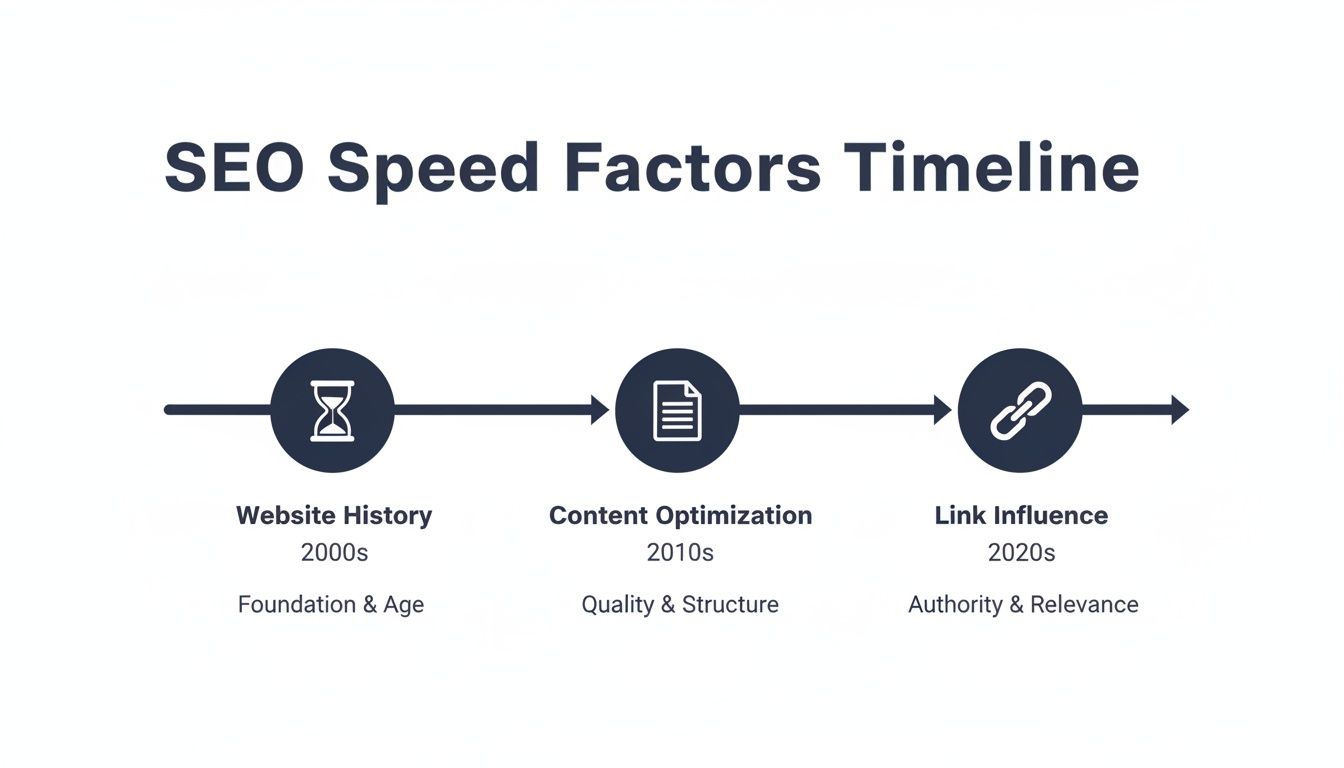
As you can see, things like your website's age, the depth of your content, and your link profile are all cumulative—their impact gets stronger and stronger over time. Let's map out what a successful 12-month journey looks like, stage by stage.
The Foundation Stage: Months 0–3
The first 90 days are all about rolling up our sleeves and getting the site in order. This is the blueprint and site prep phase. We're not looking for a sudden flood of traffic just yet. Instead, the entire focus is on getting the fundamentals right to support everything that comes next. Nailing this stage is absolutely critical.
Here’s what we’re tackling first:
- Deep-Dive Audits: We start by conducting comprehensive technical, content, and backlink audits. This is where we uncover those hidden gremlins—technical glitches or thin content—that might be holding you back without you even knowing it.
- Strategic Keyword Research: We dig in to find the exact phrases your ideal customers in Sacramento are typing into Google. This research becomes the backbone of your entire content plan.
- On-Page Optimization: We go through every important page on your site, optimizing titles, meta descriptions, and headers to send clear signals to search engines about what each page is about.
- Technical Fixes: We squash critical issues like slow page speed, mobile-friendliness problems, and indexing errors. A technically healthy website is the price of admission for ranking well today.
By the end of this stage, your website will be a clean, well-organized, and technically sound platform that Google can crawl and understand much more easily. To get a feel for what this deep dive looks like, you can learn more about our complete SEO discovery process.
The Growth Stage: Months 3–6
With a solid foundation poured, it's time to start building. This is where the seeds we planted in the first three months finally start to sprout. You'll begin to see the first real signs of life as your site gains traction in the search results.
This stage is all about building consistent momentum. Our focus shifts to:
- High-Value Content Creation: We start publishing authoritative blog posts, helpful guides, and detailed service pages based on our keyword research. This is content designed to attract, engage, and genuinely help your target audience.
- Local SEO Fortification: For our Sacramento clients, this is huge. We get to work optimizing your Google Business Profile, building local citations, and encouraging positive reviews to help you dominate the local map pack.
- Initial Link Building: We begin earning quality backlinks from other reputable websites. These links act like "votes of confidence" in Google's eyes and give your domain authority a serious boost.
Around this time, you should start seeing a noticeable uptick in your organic traffic. You might not be ranking for your biggest, most competitive keywords yet, but you'll see movement for longer, more specific search terms—bringing in that first wave of highly qualified visitors.
The Authority Stage: Months 6–12 and Beyond
This is the phase where the magic of compounding returns really kicks in. After establishing a strong technical base and a steady rhythm of creating great content, Google starts to see your website as an authority in your field. The progress you see now becomes more significant and starts to make a real impact on your bottom line.
Our focus shifts from just building to scaling up and refining our strategy. The main game plan now involves:
- Scaling Content Production: We double down on what’s working. This means creating more in-depth content like case studies, whitepapers, and ultimate guides that attract high-quality links and position you as a true thought leader.
- Strategic Link Acquisition: Our outreach becomes much more targeted. We go after high-authority links that will help solidify your position at the top of the search results for your most important keywords.
- Conversion Rate Optimization (CRO): Now that more traffic is flowing in, we analyze how users are behaving on your site. This allows us to make data-driven tweaks to turn more of those visitors into actual leads and customers.
By the end of year one, SEO is no longer just another marketing task—it's a reliable and predictable engine for growing your business. You’ll be seeing strong rankings for valuable keywords, a steady stream of organic traffic, and a clear, measurable return on your investment.
How SEO Timelines Differ Across Industries
Asking "how long does SEO take?" is a lot like asking, "how long does it take to get in shape?" The answer completely depends on your starting point and your goal. Are you trying to lose 10 pounds, or are you training for an Ironman triathlon?
The same logic applies to SEO. The game plan for a local Sacramento plumber is worlds away from a national shoe retailer. Understanding where your business fits in is the first step to setting goals you can actually hit. Let’s break down a few common scenarios.
The Local Home Service Provider
Picture a local plumber right here in Sacramento. They don't need to rank for "best toilets" across the country. They just need to show up when someone in Folsom has a burst pipe and frantically searches "emergency plumber near me."
For a business like this, local SEO is everything. The strategy is tight, focused, and geographically locked.
- Primary Focus: Getting to the top of the Google Map Pack and dominating local search results.
- Key Actions: Fine-tuning their Google Business Profile, consistently getting new customer reviews, and building citations on local directories.
- Timeline: You can often see the phone start ringing more from the map listing within just 1-3 months.
Because you're only competing against other plumbers in the greater Sacramento area, a concentrated effort can bring in results surprisingly fast. The goal here is immediate visibility that turns directly into service calls.
The National E-commerce Store
Now, let's switch gears to an online store selling running shoes nationwide. They aren't just up against the shop down the street; they're competing with giants like Zappos and Nike. Their battlefield is the entire United States, and they're targeting thousands of keywords, from broad terms like "men's running shoes" to hyper-specific product names.
This is a marathon, not a sprint. It demands patience and a serious investment.
For an e-commerce brand, SEO is an endurance race. Early progress involves ranking for long-tail keywords like "best trail running shoes for wide feet," while slowly building the authority needed to compete for broader, high-volume terms.
Success here isn't about a quick map ranking. It's about building a massive library of helpful content, earning powerful backlinks from trusted sites, and ensuring a website with thousands of pages is technically flawless. It’s a slow, methodical grind to build the kind of trust and authority needed to play on the national stage.
The B2B Technology Firm
Finally, let’s consider a B2B company that sells project management software. Their customers aren't making an impulse buy. They're dealing with long sales cycles, committees of decision-makers, and a purchase that could cost thousands of dollars. The point of their SEO isn't just to get a click; it's to prove they are the definitive expert.
Their entire strategy is built around content that screams expertise.
- Primary Focus: Earning trust and establishing authority with incredibly detailed, educational content.
- Key Actions: Publishing comprehensive guides, original research reports, case studies, and whitepapers that solve real, complex problems for their ideal customer.
- Timeline: It might take a solid 6-9 months just to start seeing meaningful traffic from this kind of content, and 12-18 months before that traffic reliably turns into qualified leads.
This is the slowest burn of all. Every article is a brick in a fortress of credibility. The timeline is longer because the goal isn't just a sale—it's to become the undisputed thought leader in a very specific niche, nurturing prospects through a complicated buying journey.
To really see how these timelines stack up, let's put them side-by-side.
SEO Timeline Comparison by Business Type
The table below gives you a clearer picture of what to expect based on your business model. It highlights where the main effort goes and how that impacts the timeline for seeing both initial movement and a real return on your investment.
| Business Type | Primary SEO Focus | Time to Initial Results | Time to Significant ROI |
|---|---|---|---|
| Local Service Provider | Google Business Profile, Local Citations | 1–3 Months | 4–6 Months |
| National E-commerce Store | Content Depth, Backlink Authority | 4–6 Months | 9–12+ Months |
| B2B Technology Firm | Expert Content, Thought Leadership | 6–9 Months | 12–18+ Months |
As you can see, the path and the pace are completely different for each. There’s no one-size-fits-all answer to the SEO timeline question. It always comes down to your industry, your specific goals, and just how crowded your market is.
Common Mistakes That Stall Your SEO Progress
Knowing what not to do in SEO is often just as valuable as knowing what you should be doing. I've seen countless businesses accidentally hit the brakes on their own SEO progress, which ends up delaying results and wasting a ton of time and money.
Spotting and fixing these common missteps is the key to keeping your SEO timeline on track. The good news? Every mistake is a chance to learn, and the fixes are usually pretty straightforward once you know what you’re looking for.

Setting Unrealistic Expectations
If you want to feel like SEO isn't working, just expect to see results overnight. That’s the fastest way to get discouraged. SEO is an investment that builds on itself over time—it's not an instant fix. Expecting to rank on page one for a super competitive keyword in your first month is only going to lead to disappointment.
The reality is, SEO timelines have gotten a lot longer. Before 2020, you might have scored some wins in 1–3 months. Today, with how complex the algorithms are, a 3–6 month baseline is far more realistic. In fact, research shows that only 22% of pages even make it to page one within a year, which really drives home the need for patience.
You have to play the long game. The only way to get those big, lasting results that make SEO so powerful is to commit to a consistent strategy.
Ignoring Technical SEO Fundamentals
You could write the best blog post in the world, but if your website is a technical mess, Google might not even be able to find or read it. Neglecting the basics is like trying to drive a car with a flat tire—you’re just not going to get very far.
A few common technical issues can bring your progress to a dead stop:
- Slow Page Speed: If your site takes forever to load, people will bounce, and search engines take that as a bad sign.
- Poor Mobile Experience: Your website absolutely has to work flawlessly on a smartphone. No excuses.
- Crawl Errors: Broken links and confusing site structures can stop search engine bots from accessing your content altogether.
A technically sound website is the price of admission for ranking in today's search results. Addressing underlying website issues is crucial, and understanding how to reduce technical debt can prevent significant roadblocks and stalled SEO progress.
Targeting the Wrong Keywords
Having ambition is great, but trying to rank for hyper-competitive keywords right out of the gate is a recipe for frustration. A brand-new website simply doesn't have the authority to go head-to-head with established national players for those massive, high-volume terms.
A much smarter play is to focus on long-tail keywords. These are longer, more specific phrases that might get fewer searches but have way higher purchase intent. For example, instead of just targeting "plumber," a Sacramento business should aim for something like "emergency leak repair in Folsom CA."
This strategy lets you rack up some early wins, build authority, and start driving qualified traffic to your site while you gradually work your way up to the bigger keywords. If you need help finding a partner who understands this, check out our guide on how to hire an SEO company in Sacramento.
Creating Inconsistent or Low-Quality Content
Success in SEO is built on a foundation of consistent, high-quality content. If you publish one amazing article and then go silent for six months, you’re sending mixed signals to search engines. Consistency shows Google that you're an active, reliable source of information in your niche.
At the same time, churning out thin, generic, or unhelpful content just for the sake of targeting a keyword won't get you anywhere. Every piece you publish should aim to be the absolute best answer to a user's question. It needs to show real expertise and provide genuine value. Without that commitment, your efforts will fall flat and just make the whole process take that much longer.
Frequently Asked Questions About SEO Timesses
After digging into the nuts and bolts of how long SEO takes, from the core factors to what you can expect in your specific industry, you probably still have a few questions rolling around. That’s perfectly normal. This section is all about giving you direct, no-fluff answers to the most common questions we hear from business owners right here in Sacramento.
The goal here is to provide that last bit of clarity you need. We want you to see SEO for what it is—a powerful, long-term investment—so you can move forward feeling completely confident in your strategy.
Can Anyone Guarantee First-Page Rankings?
Nope, and you should run—not walk—from any agency that tells you they can. Google’s algorithm is a massively complex system with hundreds of ranking factors that are constantly being updated. Nobody has a “special in” with Google or some secret recipe that guarantees a #1 spot.
What we can guarantee is a transparent process that’s been proven to work. We guarantee we’ll stick to best practices, focus squarely on your business goals, and build a sustainable strategy designed to earn you the best possible rankings over the long haul. Think of it less like a guarantee and more like our commitment to a smart, ethical, and effective approach.
Is SEO a One-Time Project or an Ongoing Investment?
That’s a great question because it cuts right to the heart of how search engine optimization actually works. SEO is absolutely an ongoing investment, not a project you can just check off a list. Your competitors are always working to outrank you, Google is always tweaking its algorithm, and customer search habits are always changing.
Think of your website’s SEO like maintaining a garden. You can’t just plant seeds and walk away, expecting a beautiful harvest. It needs consistent watering, weeding, and attention to stay healthy and productive. Hitting pause on your SEO is like letting the weeds take over—you'll quickly lose all the ground you've gained.
A one-time project might patch up a few technical problems, but real, lasting growth comes from the steady, consistent effort of creating content, earning links, and analyzing performance month after month.
How Does Local SEO Change the Timeline?
Here’s the good news: local SEO can often get you results much faster than a broad national campaign. When you’re focused on a specific area like Sacramento or El Dorado Hills, your competition is a much smaller, geographically-defined group of businesses. That alone makes it easier to pop up on the radar.
For local businesses, we can often see some real movement in the Google Map Pack within just 1-3 months by zeroing in on a few key things:
- Google Business Profile Optimization: Making sure your profile is 100% complete, accurate, and active.
- Local Citation Building: Getting your business name, address, and phone number (NAP) listed consistently across relevant local directories.
- Customer Reviews: Actively encouraging new reviews and responding to the ones you get.
While it’s often quicker to get that initial traction locally, remember that holding onto that top spot still requires consistent, ongoing work.
What Is the Fastest Way to See SEO Results?
While there's no magic button, the quickest way to see results is to build on a solid foundation. A brand-new website is always going to be a longer journey than an established site that already has some history and authority with Google. If speed is what you're after, the best thing to do is nail the fundamentals first.
This means making sure your website is technically sound—it needs to be fast, mobile-friendly, and secure. Once that’s handled, the quickest wins often come from creating high-quality, genuinely helpful content that targets specific, long-tail keywords. These longer, more niche search phrases have way less competition, letting you rank and pull in qualified traffic much sooner than you could for those big, highly competitive terms.
Ultimately, the fastest path is a smart, focused strategy—not a shortcut.
How Do I Know if My SEO Is Actually Working?
Measuring success is everything. It’s easy to get obsessed with watching your rankings go up and down, but true success is measured by how SEO actually impacts your business. We track a whole range of metrics to give you a clear, honest picture of your performance.
Some of the key performance indicators (KPIs) we keep a close eye on include:
- Organic Traffic: Are more people finding you through search engines?
- Keyword Rankings: Where do you stand for the search terms that matter most?
- Click-Through Rate (CTR): Of the people who see you in search results, what percentage is actually clicking on your site?
- Conversion Rate: What percentage of those visitors are taking action, like filling out a form or calling you?
- Leads and Sales: The bottom line—is SEO generating real business and revenue?
We provide regular, easy-to-digest reports that connect our SEO activities directly to these business-critical outcomes. You’ll never be left wondering if your investment is actually paying off.
Ready to stop guessing and start growing? The team at Site Igniters combines proven SEO strategies with a deep understanding of the Sacramento market to build campaigns that deliver real results. We handle the complexities of search marketing so you can focus on running your business. Contact us today for a free consultation and let's map out your journey to page one.
Seth Sanders is the founder of Site Igniters, a digital marketing agency in El Dorado Hills, California.