
How to Choose a Digital Marketing Agency That Delivers Results


Choosing the right digital marketing partner shouldn’t feel like guesswork. Start by pinning down your objectives, mapping out what you’re willing to invest, and listing non-negotiables—from ADA compliance to proof points in case studies. Once that’s clear, you can narrow the field, ask the right questions, and run candidates through a simple scoring framework.
- Define clear goals, budget, and non-negotiables before starting your agency search.
- Build a scoring matrix covering case studies, ADA compliance, and transparent reporting.
- Watch for red flags during interviews like vague guarantees and lack of documented processes.
How To Choose A Digital Marketing Agency Quickly
The graphic below breaks your search into three focused phases—Goals, Shortlist, and Compare—to keep you moving without backtracking.
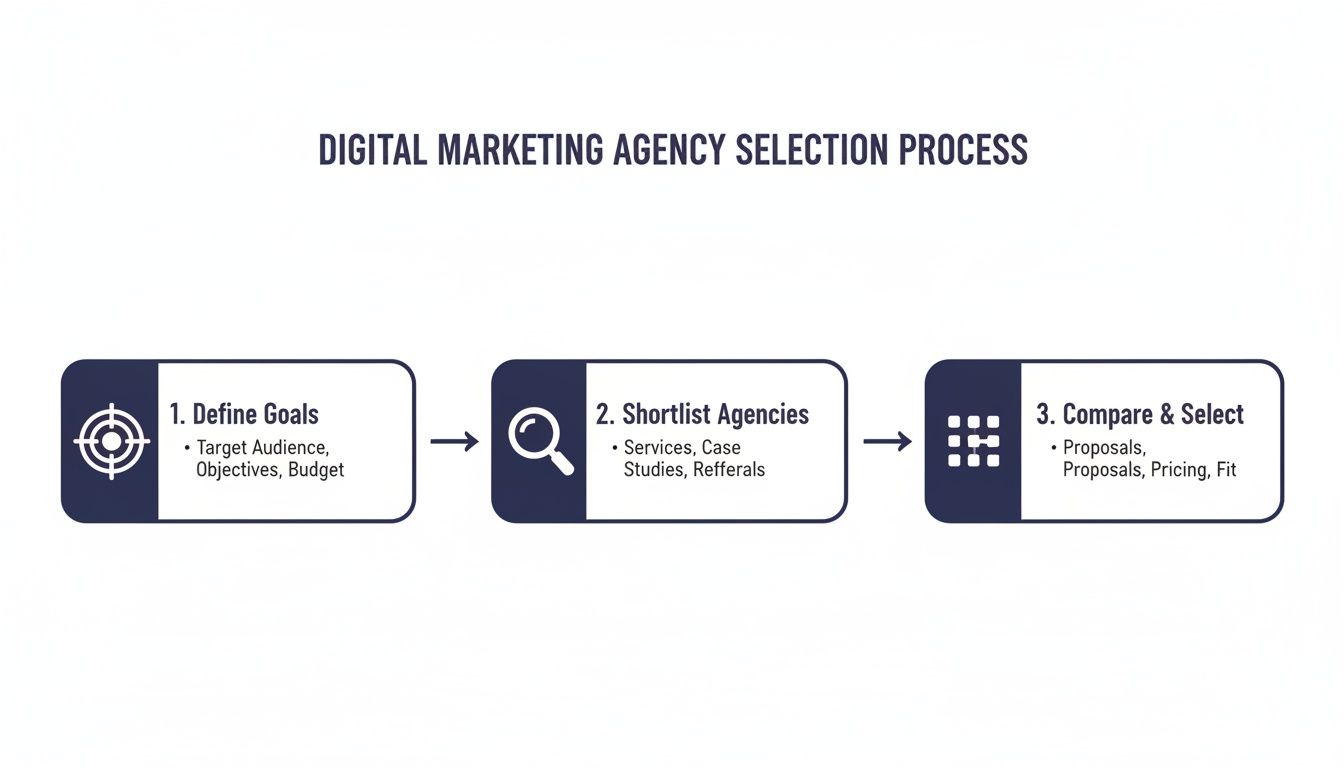
That snapshot shows how each stage tightens your focus, trims down options, and lets you side-by-side the finalists for a head-to-head match-up.
Core Phases At A Glance
Here’s what really happens in each phase and the result you’ll walk away with:
- Goals: Outline measurable targets and set your budget guardrails.
- Shortlist: Vet agencies for service mix, industry chops, and cultural fit.
- Compare: Score proposals on ADA/compliance, AI know-how, case studies, pricing model and KPIs.
Drawing a line between budget and targets—say, a 30% bump in MQLs—keeps your agency honest and your spend in check.
Summary Of Key Selection Phases
To keep everyone aligned, here’s a quick-reference table illustrating each phase, the key focus, and the core outcome you should expect:
| Phase | Key Focus | Outcome |
|---|---|---|
| Goals | Align Objectives And Budget | Clear Roadmap |
| Shortlist | Assess Expertise And Culture | Narrowed Options |
| Compare | Evaluate Proposals And Results | Best-Fit Partner |
With this blueprint in hand, you can dive into deeper due diligence armed with clarity and confidence.
Key Takeaway: A structured search keeps your team focused, slashes review time, and uncovers the agency that aligns with your business goals.
Next Steps
In the sections ahead, you’ll build a detailed evaluation checklist—covering everything from service breakdowns and real-world case studies to compliance safeguards. We’ll also share proven interview questions, red-flag warnings, and contract-negotiation pointers to set you up for success.
Set Clear Goals and Budget for Your Agency Search
Broad ambitions—like “we need more leads”—often stall the decision process. Pinning down exact targets helps you zero in on agencies that can deliver real results.
When the brief is vague, proposals tend to promise everything and deliver little. You’ll waste hours on calls that go nowhere and wrestle with misaligned expectations.
Defining Specific Targets
Start by pulling your previous year’s Marketing Qualified Leads and average cost per lead. You may discover, as one midsize B2B team did, that chasing a 50% uplift felt unrealistic—they settled on 35% after mapping lifetime value per lead. That data-driven goal instantly sharpened every agency conversation.
- Track last year’s MQL count and cost-per-lead metrics
- Calculate the percentage increase aligned with revenue objectives
- Set clear deadlines (quarterly, six months, annual)
- Tie each KPI back to a dollar figure to keep spending disciplined
Setting specific numerical goals filters out agencies that can’t meet your minimum performance bar.
Using a Goal to Budget Template
A simple spreadsheet can become your negotiation playbook. Lay out columns for Objective, KPI, Budget and Timeline, then plug in real numbers. Gaps jump off the page, helping you test assumptions before you even send an RFP.
- Objective: e.g., 30% MQL lift
- KPI: how success will be measured
- Budget: dollars assigned to each goal
- Timeline: target date for hitting milestones
“When you see numbers side by side, it’s easier to negotiate deliverables and fees.”
In one scenario, a $50 cost per lead paired with a $4,000 monthly budget revealed that 8 conversions were needed. Breaking spend down by channel—SEO, SEM, content—turns your template into a clear ROI comparison.
Benchmarking Historical Spend
Dig into last year’s invoices to map where every marketing dollar went. Compare retainers, project fees and ad spend against actual outcomes. This audit often surfaces overspend, underinvestment and seasonal patterns you can’t ignore.
- Total ad spend per channel over 12 months
- Hours billed for content creation versus traffic uplift
- Year-over-year changes in retainer fees
- Performance incentives paid and ROI delivered
| Objective | Target Increase | Estimated Budget |
|---|---|---|
| MQLs | +30% in 6 Months | $4,500/month |
| Organic Traffic | +20% over 3 Months | $3,200/month |
| Paid Ads Conversions | +25% in 4 Months | $5,000 + 10% bonus |
Review industry stability metrics to spot agencies that weather market shifts. According to the 2025 Digital Agency Industry Report by Promethean Research, firms averaged 12% annual revenue growth from 2015–2019 and bounced back strongly in 2021. That track record hints at partners who can hold your budget steady through ups and downs.
Balancing ambition with financial reality means you’ll only engage agencies within your budget guardrails. Locked-in budgets aligned to clear goals set expectations from day one.
Refine Goals Over Time
Treat your goals and budgets as living documents rather than one-and-done worksheets. Schedule quarterly check-ins to compare spend against results and pivot where necessary.
- Identify channels responsible for 80% of target metrics
- Shift unused funds to high-potential areas
- Tweak performance incentives based on real performance
Regular adjustments prevent sunk costs and ensure ongoing alignment.
To integrate these budgets with channel tactics, check out our guide on search engine marketing strategies. Explore the Search Engine Marketing guide.
Your upfront clarity ensures fair comparisons across every agency proposal. This approach fast-tracks your review and helps you zero in on the best-fit partner.
Build An Agency Evaluation Checklist

With your objectives and budget locked down, lining up agencies side by side keeps surprises at bay. This checklist steers you through SEO, paid media chops, AI analytics, compliance, pricing models and reporting practices. One B2B tech firm even scored custom AI dashboards against retainer fees—and discovered that a higher upfront investment paid dividends in rapid insights.
Define Core Evaluation Categories
Kick off a fresh spreadsheet and spread these headers across the top:
- Service Scope: Clear deliverables, deadlines, communication plan
- Industry Experience: Case studies, niche expertise, client referrals
- Local Presence: On-site workshops, face-to-face strategy sessions
- Compliance Workflow: ADA Title III, WCAG 2.1 processes, audit routines
- AI & Automation: Dashboards, anomaly alerts, custom spend thresholds
- Pricing Structure: Retainers, hourly rates, performance bonuses
- Reporting Rhythm: Frequency, formats, KPI alignment
- Social Proof: Testimonials, reviews, in-depth case studies
Weight each category by importance. Simple formulas will auto-tally scores and spotlight the top contenders.
Main Takeaway A detailed category matrix ensures you don’t overlook any critical capability.
Here’s a quick look at how these criteria stack up:
Comparison of Agency Selection Criteria
| Criteria | What to Look For | Why It Matters |
|---|---|---|
| Service Scope | Detailed deliverables, timelines, communication protocols | Sets clear expectations and prevents scope creep |
| Industry Experience | Sector-specific campaigns, measurable outcomes, client refs | Guarantees familiarity with your market and audience |
| AI Focus | Live dashboard demos, automated alerts, real-time insights | Drives faster optimizations and smarter budget decisions |
| Pricing Model | Retainer vs. hourly, performance incentives, fee transparency | Avoids hidden costs and aligns spend with results |
This simplified view helps you weigh priorities without drowning in data.
Assess Paid Media Expertise
Paid ads often deliver the quickest ROI—if you ask the right questions. Probe each agency on:
- ROAS Benchmarks: Average returns on ad spend from past campaigns
- Case Studies: Examples of 10–15% ROAS with similar budgets
- Tech Stack: Audience-segmentation tools, bid-automation platforms
One retailer saw a 30% drop in cost per acquisition just by refining ad creative and targeting after switching agencies. For more industry benchmarks, check the latest data at Digital Agency Network.
Compare AI Analytics Tools
AI dashboards can turn raw numbers into action items almost instantly. When agencies demo their platforms, look for:
- Integrated data sources (organic search, paid, social)
- Automated anomaly detection and spend pacing alerts
- Custom reporting thresholds and drill-down capabilities
- Multi-user access for collaborative reviews
One agency’s custom language model flagged underperforming keywords and drove a 22% lift in conversions within two weeks.
Review Compliance And Accessibility
Protect your brand by verifying ADA Title III and WCAG 2.1 compliance processes. Ask to see sample audit reports that outline:
- Pages scanned and severity levels
- Remediation steps taken and timelines
- Ongoing monitoring routines and checkpoints
Key points to clarify:
- Audit cadence and methods
- Roles responsible for fixes
- Code-review protocols before deployment
- Access to compliance specialists
A proactive compliance approach wards off legal headaches down the road.
Validate Industry Experience
Real results in your sector matter most. Compare case studies with a simple table:
| Industry | Client Outcome | Timeframe |
|---|---|---|
| B2B Tech | 22% more leads | 4 months |
| Healthcare | 35% traffic gain | 3 months |
| E-commerce | 15% conversion lift | 6 months |
This side-by-side makes it easy to see who’s delivered in environments like yours.
Score Pricing Models
Transparent fees keep budgets honest. Look for proposals that spell out:
- Monthly retainer vs. hourly billing
- Performance bonuses or incentive structures
- Tiered packages with clearly defined services
- Exceptions, add-ons, and exit clauses
Pro Tip Reviewing actual invoices reveals hidden fees faster than any proposal summary.
Consolidate Scores In A Template
Build a simple matrix to rank agencies:
- Criterion
- Weight
- Agency A Score
- Agency B Score
- Agency C Score
Let formulas do the heavy lifting and highlight top performers in bold. This data-driven approach removes guesswork from your final choice.
Finalize With Stakeholder Input
Don’t go it alone. Invite:
- Marketing to vet SEO and paid-media priorities
- Compliance for audit processes and legal checks
- Finance to validate pricing models and ROI forecasts
- Operations to confirm reporting syncs with your tools
“One standardized evaluation saved us two weeks of back-and-forth and landed our ideal partner in half the time,” says a Sacramento startup founder.
Tailor To Local Needs
If you serve Sacramento-area customers, zero in on agencies with regional know-how:
- Local office access and on-premise workshops
- Community partnerships, press outreach history
- Familiarity with El Dorado Hills and nearby demographics
A checklist built for local nuances ensures your agency truly grasps Sacramento buying behaviors.
This hands-on framework helps small teams move like seasoned pros. For deeper SEO tactics, explore our search engine optimization guide.
Interview Agencies And Spot Red Flags

Meeting face-to-face (or via video) with prospective partners quickly reveals their style, responsiveness, and how deeply they understand your vision. This is where you separate agencies that sell off-the-shelf packages from those ready to dive into your unique challenges.
Prepare Your Core Questions
Start with a focused list of questions that tie directly to your goals and budget. Invite each agency to share real-world success stories and walk you through their reporting tools.
- Ask for examples where 30% growth in leads was achieved within six months.
- Request live demos of their dashboards so you can see how metrics are tracked and updated.
- Drill into compliance: ADA checks, audit reports, remediation workflows.
These details show whether they can tailor their approach or will stick to a one-size-fits-all playbook.
Test Problem Solving Skills
Throw a realistic scenario at them—say, an unexpected dip in ad performance or an urgent compliance alert. Watch how they structure their response.
- Outline immediate steps they’d take to stabilize the situation.
- Ask about the long-term fixes they’d put in place to prevent a repeat.
- Check how they assign roles, set timelines, and establish milestones.
An agency that stalls on specifics or can’t name clear owners for tasks is a red flag.
Spot Key Red Flags
Not every smooth answer means you’re in safe hands. Pay attention to warning signs that can sabotage results.
- Vague compliance explanations can lead to costly legal headaches.
- Undefined KPIs make it impossible to measure progress.
- Lack of documented processes means you’ll reinvent the wheel each time.
- Slow follow-ups betray low prioritization—your project risks falling through the cracks.
“Slow follow-up speaks louder than glossy decks—it reveals priorities.” – Industry Leader
Use Our Curated Interview List
Here are targeted questions to dig beneath polished presentations:
- How do you measure success for my exact goals?
- Can you show us a live report with data from the past 30 days?
- Describe a time you fixed an urgent compliance issue under tight deadlines.
- What internal processes prevent scope creep?
- Which KPIs do you report weekly and which monthly?
These prompts uncover real methods and make apples-to-apples comparisons easier.
Gauge Cultural Fit
Technical chops matter, but shared values and communication style keep relationships healthy.
- Who will be my day-to-day contact, and how do I escalate urgent matters?
- Which collaboration tools do you use and how often will we meet?
- Tell me about a conflict you resolved with a client and how it turned out.
Ensuring a smooth working relationship now pays dividends down the road.
Compare Responses Side By Side
Create a simple markdown table to score each agency’s answers on depth and clarity:
| Criteria | Agency Answer Quality | Score |
|---|---|---|
| KPI Clarity | Detailed metrics if timelines included | /10 |
| Process Documentation | Shared templates and workflows | /10 |
| Follow-Up Speed | Response within 24 hours | /10 |
This lets you visualize strengths and weaknesses at a glance.
Check Pricing Transparency
A clear, written fee structure avoids surprises on your invoice.
- Confirm your retainer covers the agreed deliverables without hidden add-ons.
- Get all performance bonuses and overage rates in writing before signing.
Transparent pricing turns proposals into straightforward comparisons.
Align Expectations Before Signing
After each interview, send a concise recap email highlighting decisions and next steps. Then schedule a follow-up to clear up any open questions.
- Request a revised proposal detailing deliverables, dates, and costs.
- Share your summary with internal stakeholders for final alignment.
This last alignment step ensures everyone’s on the same page before ink hits paper.
Final Decision Checklist
- Aggregate interview scores, cultural fit impressions, and pricing transparency.
- Choose the agency that checks the most boxes and aligns with your growth plan.
By following this framework, you’ll land on a partner who not only talks specifics but also shares your commitment to growth.
Design A Scoring Matrix For Sacramento SMBs
When you’ve narrowed your list to a few agencies, a custom scoring sheet keeps emotion in check and insights front and center. Assign weighted values to factors like past ROI, local engagement, compliance expertise and clear pricing. Suddenly, subjective opinions convert into side-by-side numbers.

This template shows where to drop in your criteria and adjust the importance of each. As you build your version:
- Define a Weight for each criterion to mirror your top priorities.
- Establish a Score Range (for example, 1–10 or 1–5) so every agency is evaluated on the same scale.
- Use simple formulas to auto-sum total points and rank finalists.
Imagine you’ve given ROI history a 30% importance, local presence 20%, AI capabilities 15%, compliance know-how 20% and pricing clarity 15%. Tweak these slices until the model reflects what truly drives results for your Sacramento business.
Sample Scoring Matrix
Below is a starting point you can tailor immediately:
| Criterion | Weight | Score Range |
|---|---|---|
| ROI History | 30 | 1–10 |
| Sacramento Presence | 20 | 1–5 |
| AI Tools | 15 | 1–5 |
| Compliance Expertise | 20 | 1–10 |
| Pricing Transparency | 15 | 1–10 |
Notice the weights add up to 100—that keeps your final ranking crystal clear. Adjust any row or range and watch the totals shift in real time.
A transparent scoring system takes emotion out of agency selection and directs focus toward measurable results.
Invite colleagues to fill out the matrix independently, then:
- Share the sheet before interviews kick off.
- Set a firm deadline for completing scores.
- Compare average scores to spotlight the highest performers.
If Agency A shines on ROI but falls short on compliance, that gap jumps right out. Meanwhile, Agency B’s strong compliance score will rise in the overall tally.
Applying The Matrix
Let’s sketch a quick example with three contenders:
Agency A racks up 8/10 on ROI, 3/5 on local presence and 4/10 on compliance.
Agency B lands 7/10 on ROI, 2/5 locally but 8/10 in compliance.
Agency C scores mid-range across the board without any extreme highs or lows.
To see who leads:
- Multiply each agency’s score by the criterion weight.
- Add up the weighted scores for a final total.
- Rank them—highest sum gets the nod for contract talks.
This approach strips away guesswork and makes your decision defensible. For detailed tips on vetting SEO partners, check our guide on how to hire an SEO company in Sacramento.
Next Steps
Once the scores are in, loop in stakeholders for a quick review session. If someone’s results stray from the group, dig into the why. Then:
- Update any weights live if team goals shift.
- Document changes so you can compare future rounds.
- Book quarterly check-ins to refine the matrix over time.
Tracking these tweaks will reveal patterns and streamline your process for the next agency search.
Consistency in scoring leads to smarter agency partnerships.
With this framework in place, negotiations become straightforward and expectations are clearer. Celebrate every data-driven hire instead of relying on gut feeling.
Manage Onboarding and Contract Negotiation
Our relationship with an agency should start with crystal-clear expectations. The kickoff meeting is your chance to agree on deliverables, assign roles, and lock down communication rhythms.
Next, nail down performance clauses and trial periods to safeguard your budget. One Sacramento startup negotiated a 30-day trial complete with exit terms—no surprises when project priorities shifted.
Use this checklist to get started:
- Confirm all deliverables and deadlines in writing
- Assign primary contacts and escalation paths
- Schedule stakeholder intros and align goals
- Agree on communication channels and tools
Align Internal Stakeholders
A unified team avoids bottlenecks later on. Pull in marketing, finance, and operations for a kickoff review so everyone sees the success metrics firsthand.
Stakeholders you’ll want on the call:
- Marketing lead to discuss KPIs and reporting cadence
- Finance to vet budget, incentives, and renewal clauses
- Legal/compliance to cover contract terms, ADA requirements, and change requests
“Getting the right people on the call early cuts approval time and keeps projects on track.”
Once everyone’s aligned, finalize contract terms that spell out change-request processes. Define fee adjustments and approval steps before you need them.
Set Milestones And Reporting
Break the first 90 days into three clear phases, each with its own check-in and deliverable review. Tie every phase to a measurable target—think a 10% bump in traffic or specific content milestones.
Here’s a simple schedule:
- Week 2: Validate kickoff outcomes and tweak timelines
- Week 6: Review early data and refine tactics
- Week 12: Measure milestone success and plan the next quarter
Consistent reporting keeps everyone honest and maintains momentum. Don’t forget to negotiate renewal and exit options, like a month-to-month review window if results stall.
Keep these contract tips in mind:
- Define success metrics and acceptable ranges
- Set automatic alerts for budget or timeline overruns
- Outline renewal pricing options and notice periods
- Clarify responsibilities on both sides for any changes
Handle Change Requests
A clear change request clause eliminates billing disputes when new tasks pop up. Specify approval timelines and cost structures upfront so shifts in scope won’t derail your budget.
In one case, a retailer added extra landing pages mid-campaign but capped additional spend at just 12% of the original budget by following the form-driven process.
Whether you use a ticketing tool or an email thread, track every request for full transparency.
Negotiate Renewal Terms
When it’s time to renew, compare performance against your metrics and discuss any scope tweaks. Lock down notice periods for termination and see if you can secure pre-paid discounts for longer commitments.
Document everything in a shared contract repository and speed approvals with digital signatures. Clear terms around billing cycles, overages, and performance bonuses build trust from day one.
With a solid contract in place, both sides understand their obligations—and you’re protected right from the start.
Key Takeaway: A structured onboarding and negotiation process cuts down on scope creep, keeps communication clear, and sets a performance-driven tone for your agency partnership.
Frequently Asked Questions
Finding the right agency isn’t a one-size-fits-all puzzle. Below, I’ve gathered questions you’re probably wrestling with and paired each with practical insights to simplify your decision.
Criteria That Matter Most When Evaluating Agencies
When I start vetting partners, a few non-negotiables rise to the top:
- Proven ROI aligned with the channels you care about
- Transparent dashboards and consistent reporting
- A team whose working style gels with yours
- Documented compliance processes and detailed case studies
“An agency with transparent reporting saves hours of back-and-forth.” – A seasoned marketing leader
Setting Realistic Budgets
Budget conversations can get tricky. Here’s a strategy I swear by:
Convert each goal into a dollar figure based on past cost-per-lead and retention benchmarks. Then fold in a 10–15% buffer to experiment with new tactics or reward performance.
Finally, benchmark your numbers against industry averages and adjust according to your growth plan.
Spotting Red Flags
Nothing derails a partnership faster than unclear commitments. Keep an eye out for:
- Deliverables that feel vague
- Missing compliance workflows
- Slow response times
- Undefined KPIs that invite scope creep
Keeping Score Over Time
A reliable reporting rhythm can’t be overstated:
- Agree on core metrics upfront
- Hook into live dashboards for real-time visibility
- Host monthly check-ins to compare results against targets, tweak strategies, and rebalance budgets
Key Takeaway
Shared metrics and regular reviews are the engines of long-term growth.
Remember, agencies often bill media spend separately from management fees. Nail down who pays for third-party costs and demand crystal-clear media-buying terms.
Negotiation Tips
- Separate ad spend billing from management fees
- Set clear ROI caps or performance-based incentives
Ready to team up with a Sacramento agency that delivers measurable impact? Reach out to Site Igniters and let’s light the spark for your next growth chapter!
Seth Sanders is the founder of Site Igniters, a digital marketing agency in El Dorado Hills, California.