
how to write a press release: quick, proven steps to earn media attention

To get a press release right, you have to tell a newsworthy story, structure it with the most important stuff up top, and get it to the right people. A great release combines a killer headline, a short lead paragraph that hits all the key facts, and a professional layout that makes a reporter's job a whole lot easier.
- A great press release tells a newsworthy story with the most important facts front-loaded in the lead paragraph.
- Headlines must hook journalists instantly with clear, benefit-driven language.
- Strategic distribution to the right contacts and platforms multiplies your media coverage.
What Makes a Press Release Actually Work Today
Before you even think about writing, you need to get one thing straight: what separates a press release that gets covered from one that gets instantly deleted? A modern press release isn't just a stuffy announcement; it's a strategic piece of storytelling built for a media world that’s overflowing with noise. Think of it as the perfect key cut to unlock media attention.
The secret sauce is in the structure and the story. Journalists are drowning in pitches, getting hundreds every single day. They don’t have time to hunt for the “so what?” of your news. A good release serves it up on a silver platter, delivering the main point immediately and then laying out the context in a way that just makes sense.
The Anatomy of an Effective Release
There's a reason the classic "inverted pyramid" is still the gold standard—it respects a journalist's time. You have to put the most critical information right at the top. Supporting details come next, and general background info comes last.
This structure relies on a few core pieces working together:
- The Headline: This is your first shot—and maybe your only one—to grab their attention. It has to be compelling, clear, and scream "newsworthy."
- The Lead Paragraph: Right after the headline, this section needs to nail the essential questions: Who, What, When, Where, and Why.
- The Body: Here’s where you flesh out the story with supporting facts, data, and real quotes that add a much-needed human touch.
- The Boilerplate: This is your standard, short paragraph at the end that gives a quick snapshot of your organization.
This hierarchy is brilliant because even if a reporter only skims the first two sentences, they walk away knowing the most important part of your story. The chart below gives you a great visual of how this all fits together.
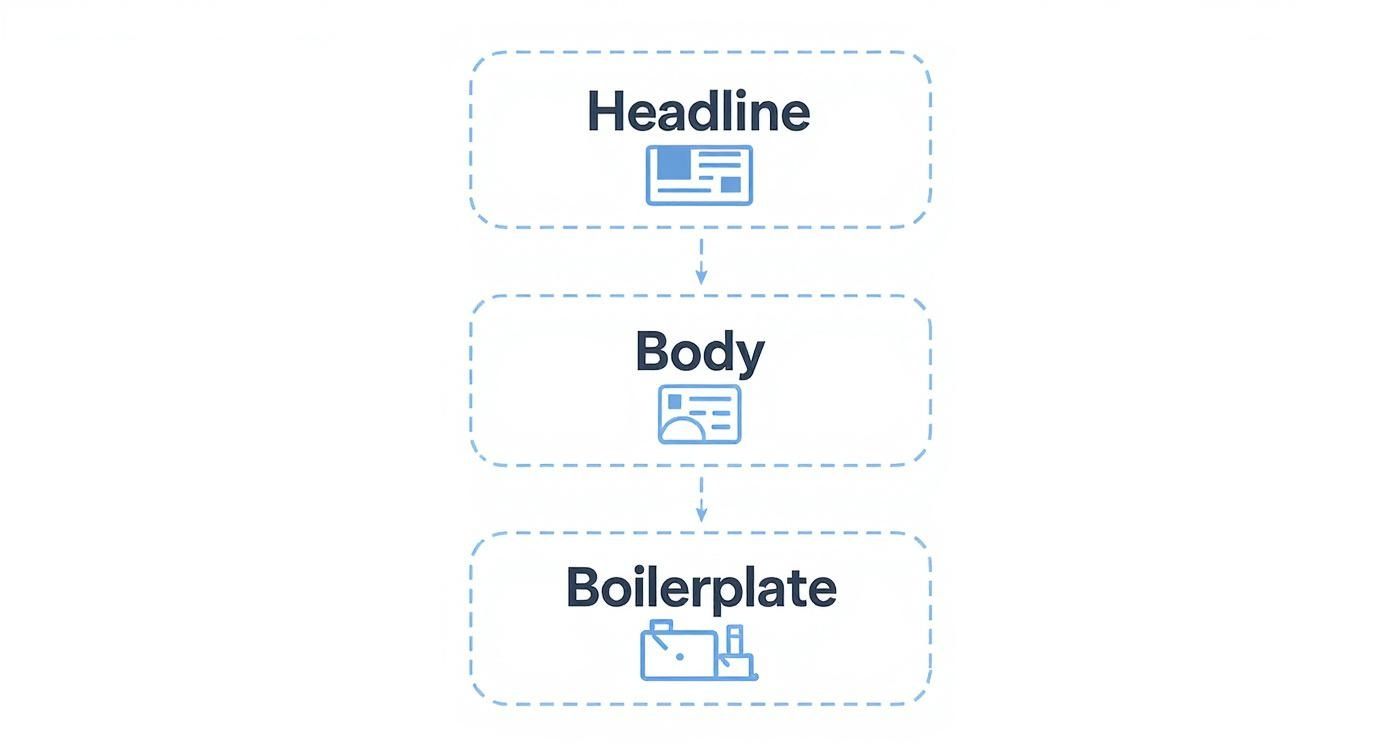
This simple flowchart really nails the top-down flow, showing how everything builds from that high-impact headline down to the foundational boilerplate.
The Anatomy of a Modern Press Release
To make it even clearer, here’s a quick breakdown of what every press release needs and why it's so important.
| Component | Its Core Function |
|---|---|
| Compelling Headline | Grabs a journalist's attention in a crowded inbox and summarizes the core news. |
| Concise Lead Paragraph | Answers the 5 Ws (Who, What, When, Where, Why) right away so the story is clear. |
| Informative Body | Provides supporting details, statistics, and context to build out the narrative. |
| Authentic Quotes | Adds a human voice and perspective, making the story more relatable and credible. |
| Standard Boilerplate | Offers a quick, consistent overview of your company for anyone unfamiliar with it. |
| Clear Contact Info | Makes it incredibly easy for journalists to follow up with questions or for an interview. |
Getting these components right is non-negotiable. They form the backbone of a release that journalists will actually want to read and use.
Modern Challenges and Strategic Considerations
These days, a well-written press release has to do more than just land in an inbox; it needs to be visible online. That means you should be thinking about how your announcement will show up in search results. Brushing up on the fundamentals of search engine optimization (SEO) can give your press release a massive leg up.
The data is clear: press releases work, but you have to earn the win. As of 2025, 68% of businesses see better brand visibility from their efforts. But with 42% saying their biggest headache is just reaching the right journalist, it's obvious that quality writing and sharp targeting are what make the difference.
To really understand your press release's impact, you need to get familiar with concepts like marketing share of voice. This metric helps you see how much of the conversation in your industry you actually own, which is a huge goal of any successful PR campaign.
Ultimately, a winning press release is a smart mix of old-school journalism principles and modern digital tactics. It’s about crafting a truly newsworthy story, formatting it for a quick read, and making sure it can be found by reporters and your audience alike. This is the blueprint for creating a document that doesn't just inform—it persuades.
Crafting Headlines That Hook Journalists
You’ve got about ten seconds. That’s it. In the time it takes a journalist to scan their inbox, they’ll see your subject line—your press release headline—and decide if it’s trash or treasure. A weak headline means your story is dead on arrival.
The goal isn't to be clever or cute. It's about being brutally clear, concise, and compelling. Your headline has to scream "this is news" and instantly answer the question, "why should I care?" Ditch the fluffy marketing jargon and think like a reporter. What’s the single most newsworthy piece of this announcement?
Let’s look at a real-world difference.
- Weak Headline: Innovatech Solutions Announces Revolutionary New Software Platform
- Strong Headline: Innovatech Launches AI-Powered Platform That Cuts Supply Chain Costs by 30%
The first example is full of empty buzzwords like "revolutionary." It's forgettable. The second one is packed with specifics. It gives a journalist a hard number (30%) and a tangible benefit (cuts costs) they can sink their teeth into. That's a story.
Elements of a Powerful Headline
When you're figuring out how to write a press release that actually gets you coverage, the headline is 80% of the battle. Journalists are conditioned to look for specific triggers that signal a real story, not a sales pitch.
Your headline needs to be:
- Action-Oriented: Kick things off with a strong verb. Words like “Launches,” “Acquires,” “Partners,” or “Reveals” are direct and get straight to the point.
- Specific and Data-Rich: Numbers are your best friend. Whether it's the amount of funding raised, a percentage of user growth, or a surprising research stat, data adds instant weight and credibility.
- Newsworthy: It absolutely must answer the "so what?" question. Why would anyone outside of your company's four walls care about this?
Here’s a pro tip I’ve learned over the years: write your headline last. After you've written the entire press release, you'll have a much clearer picture of what the single most important takeaway is. The process of telling the full story almost always reveals the perfect hook.
Think about a local angle, for instance. It can make all the difference.
- Before: Sacramento Charity Run Planned for Next Month
- After: Sacramento Charity Run Aims to Raise $50,000 for Local Animal Shelters
See the difference? The "After" version gives a local reporter everything they need: a specific goal and a clear local beneficiary. That’s a story their community will actually care about.
The Critical Role of the Subheadline
Don’t sleep on the subheadline. It's the valuable bit of real estate right below your main headline, and it's your chance to add that extra punch of context or a killer statistic that just wouldn't fit in the title.
Think of it as a one-two combo. The headline grabs their attention, and the subheadline provides the follow-up detail that convinces them to keep reading.
Headline: Tech Startup Aura Health Secures $15M in Series A Funding
Subheadline: Investment led by Capital Ventures will fuel development of its mental wellness app, which has already reached 1 million users.
That subheadline adds so much value. It tells us who led the round, what the money is for, and drops a huge social proof point with 1 million users.
Crafting a Lead Paragraph That Delivers
Once the headline and subheadline have done their job, your opening paragraph has to deliver the goods—fast. This is where you lay out the five Ws: Who, What, When, Where, and Why. No fluff. No long-winded company background. Get right to the news in the first sentence or two.
This first paragraph should be a complete mini-story. If a journalist read nothing else, they should have all the core facts needed to understand your announcement. Always start with your dateline (e.g., SACRAMENTO, CA – [Date] –) and then dive right in.
Let's put it into practice:
SACRAMENTO, CA – October 26, 2024 – Site Igniters, a local digital marketing agency, today announced the launch of OmniFire, a new press release amplification service designed to help Sacramento small businesses gain local media coverage. The service combines targeted distribution with personalized media pitching to increase visibility.
This lead is tight and professional. It tells us who (Site Igniters), what (launched OmniFire service), where (Sacramento), and why (to help local small businesses). It's direct, respects the journalist's time, and sets the stage for turning your announcement into a published story.
Building a Compelling Narrative

Your headline and lead paragraph did the heavy lifting—you’ve earned a journalist's attention. Now what? The body of your press release needs to deliver on that initial promise, turning a simple announcement into a story worth telling.
This is your chance to provide the context, evidence, and human touch a reporter needs to see the real narrative. Without a strong story, even the most exciting headline falls completely flat.
Following the Inverted Pyramid
Journalists are busy. The most effective way to structure your narrative is with the inverted pyramid, a classic model that puts the most critical information right at the top. This is followed by important supporting details and, finally, broader background context.
Think of it this way: a reporter might only read the first few paragraphs before deciding if there's a real story here. The inverted pyramid guarantees they get the must-know facts immediately.
- Top (The Essentials): This is the who, what, when, where, and why you already covered in your lead. It’s the absolute core of your news.
- Middle (The Details): Here's where you add depth with supporting stats, insightful quotes, and further explanations. This is the meat of the story.
- Bottom (The Background): This section includes less critical details, like general company history or your boilerplate. It's helpful but not essential.
This structure works because a journalist can essentially "cut" the story from the bottom up at any point and still have a complete, usable piece of news.
Weaving in Data and Statistics
Facts and figures are a reporter's best friend. They add instant authority and turn vague claims into objective proof. Don’t just say your new service is "popular." State that it "gained 10,000 users in its first month." See the difference?
Numbers give journalists concrete details they can easily reference to build their story around. Statistics from industry reports, internal data, or survey results are all powerful forms of evidence.
Don’t just drop numbers in without context. Frame them to highlight their significance. For example, “This 40% increase in efficiency translates to an average saving of $5,000 per client, addressing a major pain point in the local manufacturing sector.”
This approach not only adds credibility but also helps the journalist understand the real-world impact of your announcement—which is the heart of any great story.
Crafting Quotes That Sound Human
Quotes are your opportunity to inject personality into an otherwise factual document. Unfortunately, most press release quotes are stuffed with stiff, corporate jargon that no real person would ever actually say out loud.
Please, avoid quotes like this:
“We are thrilled to leverage our synergistic capabilities to provide a paradigm-shifting solution for our valued customers.”
Instead, write quotes that sound authentic and offer a unique perspective. A great quote should add color, opinion, or emotion that the rest of the press release can't.
Tips for Better Quotes:
- Keep them short and punchy. A quote should be easily digestible, ideally one or two sentences.
- Give them a point of view. A CEO could offer a forward-looking vision, while an engineer might provide a cool behind-the-scenes detail about the product's development.
- Read them aloud. If it sounds robotic, rewrite it until it sounds like a real person talking.
Let’s imagine a local bakery launching a new vegan line.
- Stale Quote: "Our company is pleased to announce the launch of our new vegan product line to meet market demand."
- Authentic Quote: "We've had customers asking for this for years," says owner Jane Doe. "My goal was to create a vegan croissant that was so buttery and flaky, you’d never know the difference. It took us six months to get the recipe just right."
The second quote tells a mini-story. It adds passion and a personal touch that makes the announcement far more engaging and memorable.
Adding Visuals and Multimedia
In today's media world, visuals aren't just a bonus—they're essential. Including high-quality images, infographics, or even a short video can dramatically increase engagement and pickup rates.
Many distribution services allow for multimedia attachments, giving journalists ready-to-use assets. This makes their job easier and makes your story more likely to get featured with some visual flair. Exploring the powerful benefits of video marketing can spark some great ideas for how to supplement your press release with compelling content.
By building your narrative with a clear structure, hard data, authentic voices, and supporting visuals, you give journalists all the ingredients they need to tell a rich and compelling story.
Getting the Final Details Right
You can craft the most powerful story in the world, but it can all be undone by a few sloppy mistakes. Once you’ve nailed the narrative, it’s these final details that separate a professional press release from something that looks amateurish and gets instantly deleted.
These finishing touches are non-negotiable. They signal to journalists that you get how their world works and you respect their time. Missing contact info or weird formatting can stop your news dead in its tracks. This is your last quality check before you hit "send."
Crafting the Perfect Boilerplate
At the very end of your press release, you’ll find a short, standardized paragraph called the boilerplate. Its one job is to give essential context about your company to a journalist who might have never heard of you. Think of it as your company’s elevator pitch, squished into just a few sentences.
A great boilerplate is a strategic tool, not an afterthought. It needs to concisely answer:
- Who are you?
- What do you do?
- Who is your audience?
- What makes you different?
This blurb should be the same on every single press release you send out, reinforcing your brand identity. Keep it factual, ditch the marketing fluff, and focus on a clear, high-level summary.
Here’s a solid example for a fictional local bakery:
About The Sweet Spot Bakery:
Founded in 2015, The Sweet Spot Bakery is an award-winning artisanal bakery located in the heart of Sacramento. Specializing in handcrafted sourdough bread and European-style pastries, The Sweet Spot is committed to using locally sourced, organic ingredients to serve the greater Sacramento community. Learn more at www.thesweetspotbakery.com.
It’s effective because it’s direct, informative, and gives a journalist all the context they need in seconds.
Including Clear Media Contact Information
If a journalist is actually interested in your story, the first thing they'll do is look for a contact. Making that information hard to find is a cardinal sin in PR. Your media contact section has to be obvious, complete, and easy to find—usually right below the boilerplate.
And please, this is not the place for a generic "info@" email. A designated media contact shows you’re prepared for calls and makes life easier for reporters on a crazy deadline.
Your media contact block should always have:
- Name: The full name of your go-to person.
- Title: Their actual title (e.g., Media Relations Manager).
- Email Address: A direct email for the quickest response.
- Phone Number: A direct line or cell number.
- Company Website: A link back to your home base.
Here’s how it should look:
Media Contact:
John Doe
Public Relations Manager
Site Igniters
johndoe@siteigniters.com
(916) 555-1234
www.siteigniters.com
Simple, clean, and gives a reporter everything they need at a glance.
Using Standard Formatting Conventions
Finally, you have to stick to standard press release formatting. These aren't arbitrary rules; they're universal signals to journalists that you know what you're doing.
One key element is the release timing, which always goes at the top. FOR IMMEDIATE RELEASE is what you'll use 99% of the time. It means the news can be published right away.
Another must-have is the dateline, which kicks off your first paragraph and establishes where and when the news is coming from (e.g., SACRAMENTO, CA – October 26, 2024 –).
To wrap it all up, you need the traditional sign-off. A centered line with three hash marks—###—is the standard journalistic symbol for "the end." This little marker prevents any confusion and cleanly separates your press release from your contact info. These small details are the professional polish that builds credibility.
Distributing Your Press Release for Maximum Reach
Writing an amazing press release is only half the battle. The real victory comes from getting it into the right hands. After all, a brilliant story that no one reads is a huge missed opportunity.
Modern distribution isn't about blasting your news into the void and hoping for the best. It's about precision and strategy. This is where your thoughtfully crafted message finally meets its audience, connecting you with journalists, bloggers, and industry influencers who will find your story genuinely valuable for their readers. It's a blend of targeted outreach, smart technology, and a little bit of old-fashioned relationship building.
Building a Targeted Media List
Your first move shouldn't be a newswire service. Instead, start by building a curated list of contacts. Trust me, a small list of 20 highly relevant journalists is infinitely more valuable than a generic list of 2,000 names.
Start by identifying the specific reporters and publications that cover your industry, your local area, or your particular niche. Look for journalists who have written about similar topics or even your competitors. Tools like X (formerly Twitter) or LinkedIn can be absolute goldmines for finding reporters actively discussing your field.
Once you have your list, get it organized with some key info:
- Journalist's Name: Get the spelling right. It matters.
- Publication: The specific blog, newspaper, or site they write for.
- Beat/Niche: What do they actually cover? (e.g., local business, SaaS startups).
- Recent Article: Note a recent piece they wrote that you genuinely liked.
This research does more than just build a list—it gives you the ammunition you need to craft a personalized pitch that truly stands out.
Crafting a Personalized Email Pitch
Journalists are drowning in emails—hundreds a day. A generic, copy-pasted pitch is a one-way ticket to the trash folder. Your email needs to show that you've done your homework and that you respect their time and their work.
Keep your pitch email brief, direct, and personal. Start by mentioning that recent article you noted in your research. A simple line like, "I really enjoyed your piece on the Sacramento startup scene last week," shows you're not just another spammer.
Then, get straight to the point. Briefly explain your news and, most importantly, tell them why it matters to their specific audience. You have to connect the dots for them. End the email by pasting the full press release text below your signature for easy access—never force them to open an attachment.
A common mistake is making the pitch all about your company. Instead, frame it as a story idea for the journalist. Your announcement is the basis for their potential article, not just a document you want them to publish verbatim.
Newswire Services vs. Direct Outreach
So, should you use a distribution service (a newswire) or rely on your own direct outreach? The right answer depends on your goals and budget. Each approach has its place.
| Approach | Pros | Cons |
|---|---|---|
| Newswire Services | – Broad, immediate distribution to hundreds of outlets. – Can boost online visibility and SEO. – Good for official announcements or financial news. |
– Can be very expensive. – Often results in low-quality syndicated placements. – Lacks the personal touch that secures feature stories. |
| Direct Outreach | – Builds real relationships with journalists. – High potential for securing original, in-depth stories. – Completely free (aside from your time). |
– Time-consuming and requires significant research. – Reach is limited to the contacts you can find. – Success depends heavily on your pitching skills. |
For many small businesses, a hybrid approach works best. Use your targeted list for the top-tier publications you're dreaming of, and maybe consider a budget-friendly newswire to get broader online visibility and ensure your news shows up in search results.
The Role of SEO and AI in Modern Distribution
In the past, press releases were just for journalists. Today, they are also powerful SEO tools that live online forever. Weaving relevant keywords naturally into your headline, subheadline, and body copy can help your announcement rank in Google search results, driving direct traffic and visibility long after the initial buzz fades.
This is where modern tools can give you an edge. The industry is rapidly adopting new technologies to make distribution smarter. In 2025, 69% of PR professionals report using generative AI for tasks like optimizing press releases for search engines, reflecting a major shift toward data-driven, personalized strategies.
AI can help you identify relevant keywords, refine your headline for better click-through rates, and even personalize email pitches at scale. To ensure your press release reaches its widest audience, exploring general effective content distribution strategies can provide a broader framework for your efforts. When you combine great writing with a strategic distribution plan and also ignite your social media presence to support the announcement, you significantly amplify your message and achieve your PR goals.
Common Press Release Questions Answered
Even after you’ve written the perfect press release, a few practical questions always pop up right before you hit send. Getting these final steps right is often the difference between your news getting noticed and getting deleted.
Navigating the timing, the follow-up, and the use of sensitive information like embargoes can feel tricky, but it's crucial for making sure your announcement lands with the impact it deserves. Let's walk through some of the most common questions that come up.
When Is the Best Day and Time to Send a Press Release?
I've found the sweet spot for sending a press release is generally mid-morning from Tuesday to Thursday. This timing neatly sidesteps the Monday morning chaos and the Friday afternoon wind-down when reporters are either buried in emails or already thinking about the weekend.
Try to schedule your send between 10:00 AM and 11:30 AM in the recipient's local time zone. Your pitch will arrive after journalists have waded through their first wave of overnight emails but before they break for lunch.
Of course, this is a rule of thumb. If your announcement is tied to a major breaking story, the "best time" is right now, no matter what day it is.
Should I Follow Up on My Press Release?
Yes, but you have to do it with a bit of finesse. A single, polite follow-up email sent 24 to 48 hours after your initial pitch is perfectly acceptable. My advice? Never call a journalist unless you already have a relationship with them.
Your follow-up can't just be a generic "Hey, did you see this?" You need to add something new to the conversation.
- Bad Follow-Up: "Just checking in on my press release."
- Good Follow-Up: "Hi [Journalist's Name], following up on my note yesterday. We just got some early data showing a 25% user increase in the first 24 hours, which might be an interesting angle for your readers."
This approach adds value and shows you’re thinking like a reporter, not just a marketer pushing a product. It gives them a fresh reason to look at your story.
What Is a Press Embargo?
An embargo is simply a request asking a journalist not to publish a story until a specific date and time. It’s a tool we use to give reporters a heads-up, allowing them to access your news early so they can prepare a thoughtful, well-researched story that's ready to go live the moment your announcement is public.
For instance, you could send an embargoed release on Monday for a product launching on Wednesday. This is standard practice for major news like funding rounds or big feature launches where you want to coordinate high-quality coverage.
To set one, make it impossible to miss. State it clearly at the top of your press release and in your email subject line in bold, all-caps: "EMBARGOED: FOR RELEASE AT 9:00 AM ET, WEDNESDAY, OCTOBER 30, 2024."
Keep in mind, an embargo is essentially a gentleman's agreement. While professional journalists almost always honor them, there's always a slight risk of a leak. Only use them when the benefit of giving reporters advance notice outweighs that risk.
At Site Igniters, we help businesses craft and amplify their stories to earn valuable media attention and achieve real growth. From strategic press release writing to targeted distribution, our team ensures your news reaches the right audience.
Learn how our PR and digital marketing services can boost your visibility
Seth Sanders is the founder of Site Igniters, a digital marketing agency in El Dorado Hills, California.