
Unlocking Growth with SEO Services for Small Businesses

Think of your Sacramento business like a fantastic shop, maybe the best in El Dorado Hills, but it’s tucked away on a street with no name. You could have the best products and services around, but if nobody can find you, you can't make a sale. That's exactly what your business is like online without search engine optimization (SEO)—invisible.
- SEO is the most cost-effective growth engine for small businesses that want consistent organic leads.
- Local SEO services are critical for winning nearby customers in your market area.
- Understand pricing models and measure ROI to choose the right SEO provider for your budget.
It’s time to stop thinking of SEO as just another technical expense. Instead, see it as your digital grand opening. A smart SEO plan turns your website from a simple online brochure into your hardest-working salesperson, bringing in qualified leads 24/7. This isn’t just about stuffing keywords onto a page; it’s about becoming the first and best answer for customers who are actively looking for what you do.
Why SEO Is Your Most Powerful Growth Engine
At its heart, a solid SEO strategy is built on a few core pieces that work together, building momentum over time. These aren't just one-and-done tasks, but an interconnected system that creates a powerful growth engine for your business.
The Foundation of Digital Visibility
A strong plan really boils down to three key areas:
- Local Visibility: This is about making sure customers in your service area, from Folsom to Placerville, can find you on Google Maps and in those critical "near me" searches.
- Technical Health: It also means ensuring your website is fast, secure, and easy for search engines to crawl and understand. No broken links or slow-loading pages here.
- Content Authority: Finally, it's about creating genuinely helpful content that answers your customers' questions and establishes your business as the go-to expert in your field.
This integrated approach is what delivers a real, measurable return on your investment. The value of SEO is impossible to ignore these days. Globally, spending on these services has hit about $79 billion. More importantly, for small businesses in the U.S. that are actively doing SEO, organic search traffic now drives over 40% of their revenue. That’s a direct financial impact you can take to the bank.
To give you a clearer picture, here’s a breakdown of how these core services translate into real-world business benefits.
Core SEO Services and Their Business Impact
| SEO Service Component | Primary Goal | Direct Business Benefit |
|---|---|---|
| Local SEO | Dominate local search results (e.g., Google Maps) | Drives foot traffic and local service calls from nearby customers. |
| Technical & Site Health | Ensure the site is fast, secure, and crawlable | Improves user experience, reduces bounce rates, and helps Google rank you higher. |
| Content Strategy | Become a trusted authority in your niche | Builds trust with potential customers and attracts qualified leads organically. |
| Citation Management | Maintain accurate business info across the web | Increases local search visibility and strengthens customer trust. |
| Review Management | Build a strong, positive online reputation | Boosts credibility and influences purchasing decisions. |
| Link-Building | Earn "votes of confidence" from other websites | Signals authority to Google, significantly improving search rankings. |
| Analytics & Reporting | Track what's working and what's not | Provides clear data to refine strategy and maximize ROI. |
As you can see, each piece plays a specific role in turning your website into a lead-generating machine.
SEO is no longer optional; it's the engine that powers sustainable business growth in a crowded digital marketplace. It connects you with high-intent customers at the exact moment they need you, turning searches into sales.
Ultimately, investing in the right SEO services for small businesses is about claiming your digital territory. It ensures that when someone in your area needs your expertise, your business isn't just one of the options—it's the obvious choice. To learn more, feel free to explore our other articles about SEO strategy.
Decoding the Essential SEO Services You Need
Diving into the world of SEO can feel like learning a new language. There are so many strategies and acronyms floating around that it's easy to get overwhelmed. But at its core, a powerful SEO plan is built on just a few key pillars that work together to get you real-world results.
Think of your website as a physical storefront. For that store to succeed, you need a solid building, clear signs out front, great products on the shelves, and a strong reputation in the community. The essential SEO services for small businesses work in the exact same way, with each part playing a crucial role in your online success.
Technical SEO: The Foundation of Your Digital Storefront
Before anyone can even see what you offer, they have to be able to get in the door and walk around. Technical SEO is the digital version of your building’s foundation, plumbing, and wiring. It’s all the behind-the-scenes work that makes sure search engines like Google can find, crawl, and understand your website without a hitch.
This service dials in on a few critical areas:
- Site Speed: A slow-loading website is like a shop with a door that’s hard to open. Research shows that 40% of users will give up and leave a page that takes more than three seconds to load. We optimize images, code, and server response times to make sure your site is lightning-fast.
- Mobile-Friendliness: With over 60% of all searches now happening on phones, your site absolutely must look and work perfectly on a smartphone. A mobile-friendly design isn't just a nice-to-have anymore; it's a non-negotiable for ranking well.
- Crawlability and Indexing: This is about making sure Google’s bots don't hit any dead ends. We fix broken links, error pages, and confusing site structures so that every important piece of content gets indexed. It’s like ensuring every aisle in your store is open and clearly marked for shoppers.
Without a solid technical foundation, even the most amazing content or local marketing will fall flat.
Local SEO: Your Megaphone for Nearby Customers
For a business in Sacramento or El Dorado Hills, getting customers from just down the street is everything. Local SEO is your digital megaphone, making sure you pop up right when people are searching for services "near me." A mind-blowing 46% of all Google searches have local intent.
This is where your Google Business Profile (GBP) becomes your single most valuable asset. It's not just a listing; it's your main digital storefront in local search results and on Google Maps. Optimizing it with accurate hours, services, photos, and customer reviews is one of the highest-impact moves you can make.
Local SEO also means managing your citations and reviews. We make sure your business name, address, and phone number (NAP) are consistent across all online directories. At the same time, we help you encourage and respond to customer reviews, because positive feedback builds trust and is a huge local ranking factor.
This visual shows how your online visibility, authority, and website health all feed into real, sustainable growth.
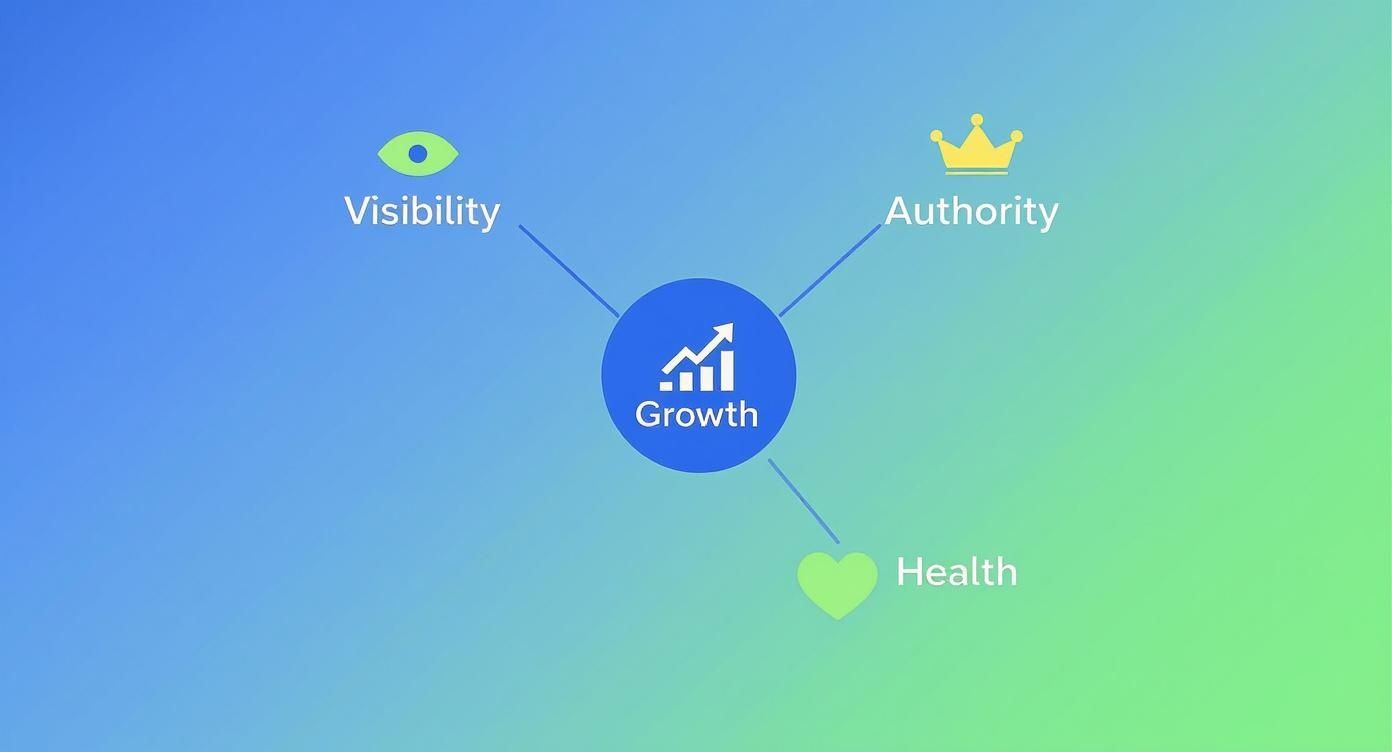
As you can see, growth isn't about doing just one thing. It's the outcome of improving your visibility, building authority, and maintaining a healthy site all at once.
Content Strategy and Link Building: Building Authority and Trust
If technical SEO is the foundation and local SEO is the sign on your door, then content is the expert conversation you have with every person who walks in. A sharp content strategy positions you as a trusted authority by answering the exact questions your customers are asking.
This isn't just about cranking out blog posts. Effective SEO relies on a whole range of comprehensive content optimization strategies to make sure your digital assets actually perform. It means creating genuinely helpful service pages, detailed guides, and informative articles that match what your audience is searching for.
Hand-in-hand with great content is link building. Think of a link from another respected website to yours as a personal referral. When a well-known local business or industry blog links to your site, it tells Google you're a credible source. This gives your website's authority a massive boost, helping you rank for those tough, competitive keywords.
Analytics and Reporting: Your Business Dashboard
None of this effort means a thing if you can't measure the results. Analytics and reporting are your business dashboard, giving you clear, actionable data on what’s actually working.
We track the key performance indicators (KPIs) that matter:
- Organic Traffic: How many people are finding you through search engines?
- Keyword Rankings: Where are you showing up for your most important search terms?
- Conversion Rate: How many visitors are actually calling you, filling out a form, or buying something?
- Click-Through Rate (CTR): Of all the people who see you in search results, what percentage is clicking through to your site?
By digging into this data, an SEO partner can fine-tune your strategy, put more resources into what's winning, and show you a clear return on your investment. It turns marketing from a guessing game into a data-driven growth engine. The best way to start is with a deep dive into your current situation; you can see what that looks like through a professional SEO discovery process.
Winning Your Local Market with Targeted SEO
Forget the global marketplace for a second. For most small businesses, the real battle is won or lost right in your own backyard, whether you're in downtown Sacramento or a suburb like El Dorado Hills. This is where local SEO becomes your secret weapon, completely changing how nearby customers find you online.
Think about it. When someone needs a plumber, a great cup of coffee, or a new outfit, they don't just search for "plumber." They search for "plumber near me" or "best coffee in Folsom." Winning those specific searches is the most direct way to make your phone ring and bring people through your door. The impact is massive; a staggering 46% of all Google searches are from people looking for something local.
Your Google Business Profile is Your Digital Storefront
In the world of local SEO, your single most valuable asset is your Google Business Profile (GBP). This isn't just another online listing; it's your digital storefront. It's often the very first impression a potential customer has of your business when they see you in Google Maps or the coveted "Local Pack"—that box of three businesses at the top of the search results.
You have to treat your GBP with the same care you give your physical shop. An empty, neglected profile suggests you might not be open for business or, worse, that you don't care. On the other hand, a completely filled-out profile builds instant trust and gives a customer everything they need to choose you over a competitor.
A complete and active Google Business Profile is the modern-day equivalent of having the best location on Main Street. It puts you directly in front of customers who have a high intent to buy, right when they're looking.
To turn your profile into a real customer magnet, you need to use every feature Google gives you. This goes way beyond just your hours and address. You should be consistently adding fresh, high-quality photos of your work, your team, and your location. Detailing your services with clear descriptions and even pricing helps people understand exactly what you do. The Q&A section is another goldmine; it lets you answer common questions before they're even asked, showing off your expertise. For a deeper look, check out our guide on how to optimize your Google Business Profile for maximum impact.
Building Trust with Citations and Reviews
Beyond your GBP, two other pillars form the foundation of a rock-solid local strategy: citations and reviews. They work hand-in-hand to build your online reputation and prove to Google that you're a legitimate, trusted local business.
First up, citations. A citation is just an online mention of your business's Name, Address, and Phone number (NAP). You'll find them on directory sites like Yelp, Angie's List, and countless other industry-specific portals. The key here is consistency. When your NAP information is identical everywhere, it gives Google confidence that your details are accurate, which is a huge local ranking factor. Inconsistent info, however, creates confusion and can seriously ding your visibility.
Second, online reviews. These are the digital version of word-of-mouth, and they're incredibly powerful. A steady flow of recent, positive reviews is one of the strongest signals of trust and quality you can send. A smart local SEO service doesn't just cross its fingers and hope for good reviews; it includes a system for encouraging happy customers to share their feedback and a plan for professionally responding to all reviews, good and bad.
By mastering these local SEO fundamentals, you create a direct line from a search like "cafe near me" to a new customer walking through your door. To really dominate your regional search results, it's worth exploring dedicated services like Local Boost SEO. For most small businesses, this focused approach delivers the highest return on investment, period.
Understanding SEO Pricing and Measuring Your ROI
Investing in SEO services for small businesses can feel like a leap of faith if you don't know what to expect. The costs can seem abstract, and the results definitely aren't instant. The trick is to stop thinking of SEO as a monthly expense and start seeing it for what it truly is: a long-term investment in a valuable business asset.
Think of it this way: when you stop paying for ads, your visibility disappears overnight. But with SEO, every piece of content published and every backlink earned keeps working for you, building on itself and compounding its value over time. Let’s pull back the curtain on how pricing works and, more importantly, how you can measure your return.
Demystifying SEO Pricing Models
SEO isn't an off-the-shelf product, so the pricing is never one-size-fits-all. Most agencies and consultants stick to one of three common models, each built for different business needs. Getting familiar with them will help you find a plan that makes sense for your budget and goals.
You'll almost always run into one of these three structures:
- Monthly Retainer: This is the most popular model by far. You pay a flat fee each month for a whole suite of ongoing SEO work—think content creation, technical site health monitoring, and link building. For small businesses, retainers typically run from $500 to $2,500+ per month, depending on how aggressive the strategy is.
- Project-Based Fees: Got a specific, one-off job? This is the model for you. It’s perfect for things like a deep-dive website audit, getting your local SEO foundation set up, or running a targeted campaign to build links. Project fees can be anywhere from a few hundred to several thousand dollars based on the work involved.
- Hourly Consulting: Sometimes you just need an expert’s brain for a bit. If you handle most SEO in-house but get stuck on a tricky problem or need strategic guidance, you can hire a pro by the hour. Rates often fall between $100 and $300 per hour.
A monthly retainer is your best bet for steady, sustained growth. A project-based fee, on the other hand, is great for getting specific foundational pieces right from the start.
How to Calculate Your SEO Return on Investment
Measuring the return on your SEO investment (ROI) is the moment it transforms from a perceived cost into a proven engine for growth. While metrics like website traffic and keyword rankings are good indicators, the real bottom line is how much cash SEO is putting back into your business.
Let’s walk through a real-world example: a local dental practice in Sacramento.
Imagine this dental practice invests $1,500 per month in a local SEO campaign. Their main goal is to show up when people search for terms like "dentist in Sacramento" or "emergency dental El Dorado Hills."
After six months, their total investment is $9,000. The campaign works, driving a noticeable increase in organic traffic to their website. This translates into 15 new patient inquiries every single month, coming directly from Google searches.
Here's how we figure out the return:
- Lead to Patient Conversion: Out of those 15 monthly inquiries, the office staff is great at their job and converts 30% into actual patients. That's about 5 new patients walking through the door each month thanks to SEO.
- Lifetime Value of a Patient: The average lifetime value (LTV) of a new patient—factoring in cleanings, fillings, and bigger procedures down the road—is around $1,200.
- Calculating Monthly Revenue: With 5 new patients a month, the SEO campaign is now generating $6,000 in new revenue (5 patients x $1,200 LTV).
- Determining ROI: The monthly profit is $4,500 ($6,000 in revenue minus the $1,500 SEO cost). Over those first six months, the $9,000 investment brought in $36,000 in revenue. That's a 300% ROI.
This simple math shows you the true power of SEO. It’s not just about getting seen online; it's about creating a predictable, repeatable system that attracts high-value customers and drives long-term revenue.
How to Choose the Right SEO Service Provider

Finding the right partner to provide SEO services for small businesses is one of the most important decisions you can make. The right agency becomes an extension of your team, driving real growth, while the wrong one can burn through your budget and set you back months.
So, with so many options out there, how do you cut through the noise and find a provider you can actually trust?
It all comes down to asking the right questions and knowing what to look for. A great SEO partner is transparent, obsessed with data, and focused on your business goals—not just chasing vanity metrics. They should be able to draw you a clear map from their proposed actions to your desired outcomes, whether that's more local leads or online sales.
Look For Proof and a Clear Strategy
When you start talking to potential agencies, don't just listen to their sales pitch—ask for proof. A reputable provider will have case studies and examples of their work with businesses similar to yours. Can they show you how they helped another Sacramento-area contractor or a local retail shop in El Dorado Hills climb the search rankings?
You also want a provider who is crystal clear about their strategy. They should be able to explain why they are recommending certain services and what kind of results you can expect. This level of transparency isn't just a "nice-to-have"; it's non-negotiable.
Look for a partner who offers:
- Proven Case Studies: Ask for tangible results from businesses in your industry or local area.
- Transparent Reporting: They should provide clear, easy-to-understand reports that track the metrics that actually matter to your business.
- A Clear Explanation of Strategy: You should understand exactly what they plan to do each month to earn your business.
Spotting the Red Flags Immediately
Just as important as knowing what to look for is knowing what to avoid. The SEO world, unfortunately, has its share of providers who make big promises they can't possibly keep. Learning to spot these red flags will protect your investment and save you a massive headache down the road.
Be wary of any agency that guarantees a #1 ranking on Google. No ethical provider can make that promise, as they don't control Google's algorithm. Guarantees are the biggest red flag in the industry.
Other warning signs include secretive or "proprietary" techniques they won't explain, a heavy focus on cheap, low-quality backlinks, or an inability to connect their work to your bottom line. SEO is complex, but it isn't magic; a good partner will always be willing to explain their methods in plain English.
SEO Provider Vetting Checklist
To help you make the right choice, we've put together a quick checklist. Use these questions as a guide when you're talking to potential SEO partners.
| Evaluation Criteria | What to Look For | Red Flags to Avoid |
|---|---|---|
| Track Record & Proof | Verifiable case studies with real data, especially for local businesses in your industry. | Vague success stories, no concrete data, or an unwillingness to share client examples. |
| Strategy & Planning | A customized plan based on a deep dive into your business, goals, and competitors. | A one-size-fits-all approach or a generic "package" that doesn't feel tailored to your needs. |
| Communication | Regular, clear reporting that explains what was done, why it was done, and what the results were. | "Proprietary methods" they can't explain, infrequent updates, or reports filled with confusing jargon. |
| Realistic Promises | Honest conversation about timelines, expected results, and the competitive landscape. | Guarantees of "#1 rankings," promises of overnight success, or claims that sound too good to be true. |
| Industry Knowledge | Up-to-date knowledge of algorithm changes, local search trends, and a focus on long-term, ethical SEO. | A focus on outdated tactics (like keyword stuffing) or a heavy reliance on cheap, low-quality link building. |
Choosing the right provider is less about hiring a vendor and more about finding a true partner for growth. The demand for specialized expertise is why 40% of small businesses now outsource some or all of their local SEO. It just makes sense to find a skilled partner to handle the complexities of search optimization while you focus on running your business.
You can find more insights on this trend in the latest SEO outsourcing trends from Search Atlas. Selecting the right provider isn't just a line item in your budget; it's an investment in long-term, sustainable growth.
Your Top SEO Questions Answered
Jumping into SEO is a big decision for any small business, and it's smart to have questions. Even when the benefits are clear, you're still thinking about the practical stuff: timelines, costs, and what to really expect. Let's tackle some of the most common questions we hear from business owners just like you.
How Long Until I Actually See Results From SEO?
Let’s be straight: real SEO is a long game, not an overnight miracle. While you might spot some encouraging little victories early on, you can expect to see real, meaningful movement in your traffic and keyword rankings within 4 to 6 months of dedicated effort.
Think of it like planting a garden. You do the hard work of tilling the soil and planting seeds, but you don't get a harvest the next day. That initial effort is what makes future growth possible. The kind of lasting, sustainable results that actually pad your bottom line—that often takes 6 to 12 months to fully bloom.
Is SEO a Better Bet Than Paid Ads?
This is a classic question, but it's not really about which one is "better." They're two different tools for two different jobs, and they work best when you use them together.
- Paid Ads (PPC): These are your sprinters. They're fantastic for getting eyeballs on your site right now. You can launch a campaign and see traffic in a matter of hours, making them perfect for a weekend sale or testing a new service. The catch? The moment you stop paying, the traffic stops cold.
- SEO: This is your long-distance runner. SEO builds a valuable, long-term asset for your business. The visibility you earn is yours to keep, and it continues to grow over time, usually delivering a much higher return on your investment down the road.
A smart marketing strategy uses both. Paid ads can give you that initial surge while your SEO work builds the solid foundation that will bring in free leads for years.
The most successful businesses don’t choose one or the other. They use paid ads to capture immediate demand and SEO to build the kind of organic authority that generates high-quality leads for free, year after year.
Can I Just Do My Own SEO?
You absolutely can, and you should! Getting your hands dirty with the basics is a great idea. Things like optimizing your Google Business Profile and writing helpful blog posts are fantastic starting points for any business owner. Taking those steps will definitely move the needle.
But SEO is a deep, complex field that’s always changing. A professional agency brings advanced tools, years of expertise, and—most importantly—the dedicated time that a busy business owner just doesn't have. We're talking about the nitty-gritty of technical site health, running a sophisticated link-building campaign, and constantly digging into the data to see what's working. That's a full-time job in itself.
Ready to stop guessing and start growing? The team at Site Igniters combines proven SEO strategies with a deep understanding of the Sacramento and El Dorado Hills market to deliver measurable results. Let us build your custom growth plan.
Seth Sanders is the founder of Site Igniters, a digital marketing agency in El Dorado Hills, California.