
Mastering PPC Advertising Campaign Management


Effective PPC advertising campaign management is all about the strategic process behind your paid ads. It's the engine that drives everything from planning and launching to optimizing your campaigns, ensuring every dollar you spend is pulling its weight to hit your business goals. It’s a mix of keyword research, audience targeting, constant bid adjustments, and performance analysis.
- Effective PPC management covers the full cycle from campaign setup to optimization and scaling.
- Smart bidding strategies and landing page alignment are the keys to profitable ad spend.
- Data-driven reporting and iterative testing turn good PPC campaigns into great ones.
Building Your PPC Campaign From the Ground Up
Before you ever write a single line of ad copy or place a bid, you have to lay a strong foundation. This is, without a doubt, the most critical part of managing a PPC campaign. It’s what separates the campaigns that make money from the ones that just spend money.
This isn't about throwing cash at a platform and hoping for the best; it’s about investing it wisely. The global paid search market is massive—it’s expected to hit US$351.55 billion by 2025. On top of that, paid search is responsible for 27.6% of all new visitor traffic. The opportunity is huge, but so is the competition. You need a solid plan to stand out.
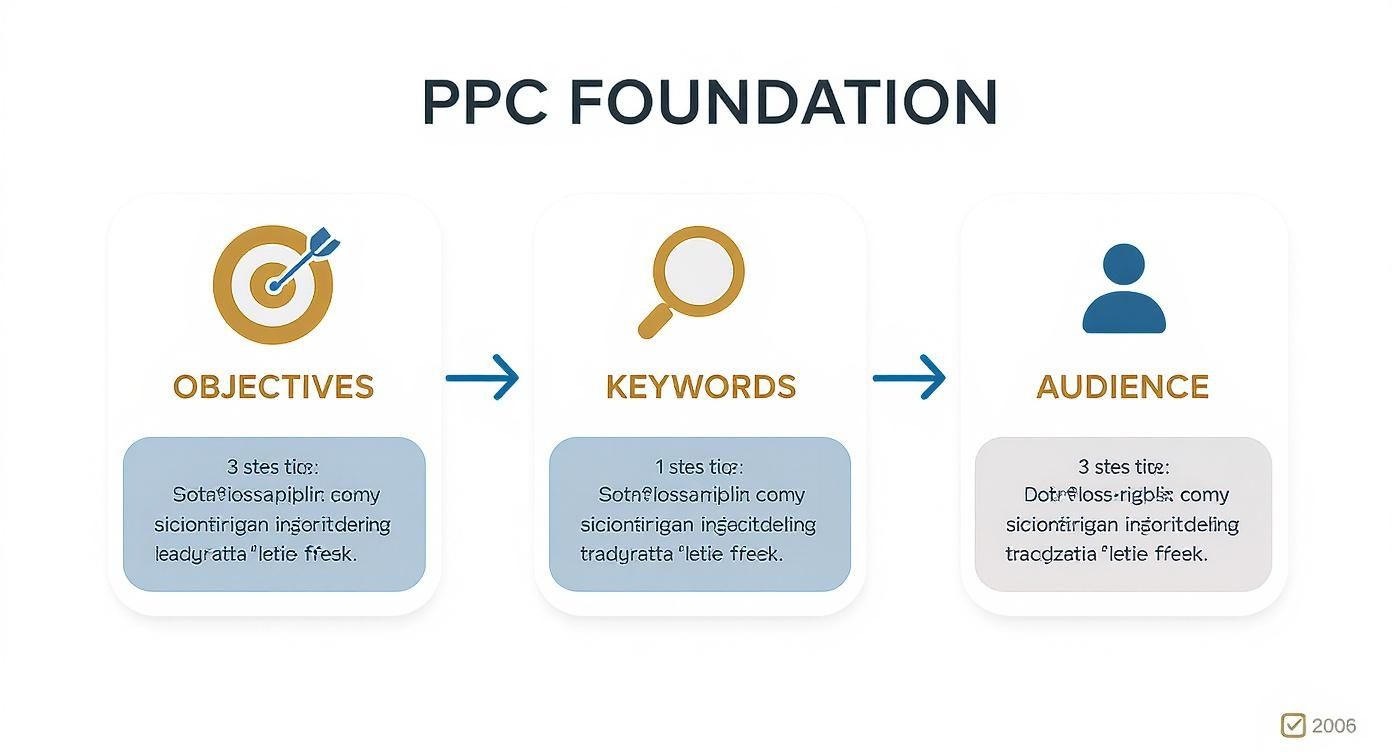
Defining Razor-Sharp Campaign Objectives
First things first: you have to define what success actually looks like. A vague goal like "get more traffic" is a surefire way to burn through your budget with nothing to show for it. You need specific, measurable objectives that will guide every single decision you make from here on out.
What are you really trying to accomplish?
- Driving E-commerce Sales: Is the main goal to sell products right off your website? Then your world revolves around maximizing Return on Ad Spend (ROAS).
- Generating Qualified Leads: Are you trying to fill your pipeline with potential customers for a service? You’ll live and die by your Cost Per Acquisition (CPA).
- Boosting Brand Visibility: Do you just need to get your name out there in front of a new audience? Your key metrics will be impressions and reach.
Your primary goal dictates everything—the keywords you target, the ad copy you write, and the landing pages you build. A lead generation campaign for a local plumber looks completely different from an e-commerce campaign selling handmade leather bags across the country.
Matching PPC Goals to the Right KPIs
To make sure your objectives are truly measurable, you have to pair them with the right Key Performance Indicators (KPIs). This isn't just about picking metrics at random; it's about choosing the data points that directly reflect the success of your specific goal. Think of it as giving your campaign a report card.
Here’s a quick-reference table to help you align your goals with the KPIs that matter most.
| Campaign Goal | Primary KPI | Secondary Metrics | Example Scenario |
|---|---|---|---|
| Increase Brand Awareness | Impressions / Reach | Click-Through Rate (CTR), Ad Frequency | A new coffee shop wants everyone in a 5-mile radius to know its name. |
| Generate Sales | Return on Ad Spend (ROAS) | Conversion Rate, Average Order Value (AOV) | An online boutique aims to get $4 in sales for every $1 spent on ads. |
| Capture Leads | Cost Per Acquisition (CPA) | Lead-to-Close Rate, Form Submissions | A law firm needs to book 20 new client consultations this month. |
| Drive Website Traffic | Cost Per Click (CPC) | Clicks, Bounce Rate, Pages/Session | A blogger wants to drive readers to their latest in-depth article. |
Choosing the right KPIs from the start keeps your reporting focused and your optimizations on track. It prevents you from getting distracted by vanity metrics that don't actually contribute to your bottom line.
Mastering Keyword Research and Search Intent
With your goals locked in, it’s time to figure out what your customers are actually typing into that search bar. This goes way beyond just grabbing broad, high-volume keywords. The real magic is in finding those high-intent, long-tail phrases that scream, "I'm ready to buy!"
Put yourself in your customer’s shoes. What problem are they trying to solve right now? Someone searching for "plumber" is in a very different mindset than someone searching for "emergency burst pipe repair Sacramento." That second one is a money keyword—it signals urgency and a high probability of conversion. This concept is fundamental to all search engine marketing, or SEM, where understanding what the user really wants is everything.
Pro Tip: Don’t just look at what people are searching for; dig into why they're searching. When you map keywords to different stages of the buyer's journey, you can craft ads and landing pages that speak directly to their needs at that exact moment.
Crafting Realistic Buyer Personas
Finally, you need to know exactly who you’re talking to. A buyer persona is a detailed, semi-fictional profile of your ideal customer, built from market research and real data you have on your existing customers.
This helps you move beyond basic demographics. Instead of targeting "women ages 25-40," you can start targeting "Sarah, a 32-year-old marketing manager who values sustainable products and shops on her phone during her morning commute." See the difference? That level of detail sharpens your ad copy, imagery, and audience targeting, making your campaigns far more effective. For a deeper dive into how all these strategic elements come together, it’s worth checking out expert guides on Pay Per Click Campaign Management.
Creating Ads and Landing Pages That Actually Convert
Look, a brilliant campaign strategy is only half the battle. If your ads don't grab attention and your landing pages don't persuade, you're just paying for clicks that go nowhere. The whole game of PPC campaign management comes down to mastering the art of conversion—turning that initial click into an actual customer.
This is where your execution has to be flawless. Think of your ad as the first handshake and your landing page as the conversation that follows. They have to work together perfectly to guide someone from a simple search to a finished sale.

Anatomy of an Irresistible Ad
The difference between an ad that gets ignored and one that gets clicked often boils down to a few key pieces. Your job is to stand out on a crowded search page and make an offer so relevant that the user feels like they have to learn more.
- Magnetic Headlines: Start with the user's search term or the direct solution to their problem. Don't say, "Reliable HVAC Services." Instead, try, "24/7 Emergency AC Repair | Get a Free Quote Now." It’s direct, it's benefit-driven, and it solves an immediate need.
- Benefit-Focused Descriptions: Don’t just list what your product does; explain how it makes the customer's life better. Instead of "We offer custom software," write, "Stop Wasting Time on Repetitive Tasks. Our Custom Software Automates Your Workflow." See the difference?
- Dominate with Ad Extensions: Sitelinks, callouts, and structured snippets aren't optional anymore. They literally make your ad bigger on the page, give people more info at a glance, and can seriously boost your click-through rate (CTR).
The Make-or-Break Landing Page Connection
Getting the click is a small win, but the war is won on the landing page. The single most important rule here is message match. The promise you make in your ad has to be the very first thing a visitor sees when they land on your page.
If your ad promotes a "50% Off Spring Sale," your landing page headline had better scream "50% Off Spring Sale." This immediately reassures the visitor they’re in the right place, which is huge for lowering bounce rates. Any disconnect between the ad and the page creates confusion and kills trust instantly.
Your ad buys you a few seconds of a user's attention. Your landing page has to earn the rest. The transition should feel so natural that the user barely notices they've switched from the search engine to your website.
Essentials for a High-Converting Landing Page
Once you’ve nailed the message match, your landing page needs to be a lean, mean, conversion machine. That means stripping away anything that doesn't push the user toward the main goal, whether that's filling out a form, making a purchase, or calling your business.
A powerful landing page absolutely must have:
- A Single, Obvious Call-to-Action (CTA): Don't give visitors analysis paralysis with a dozen options. Have one clear, compelling CTA button (like "Download Your Free Guide" or "Get Your Custom Quote") that stands out visually.
- Zero Distractions: Get rid of the main navigation menu, footer links, and anything else that could tempt the user to wander off. The landing page should be a focused, one-way street leading straight to the conversion.
- Mobile-First Design: The majority of searches happen on phones, so your landing page has to look and work perfectly on a small screen. Test your forms, buttons, and text on your own phone before you even think about launching.
- Engaging Visuals: High-quality images or a short, compelling video can make a massive difference in engagement. The powerful benefits of video marketing show just how effective a short clip can be at explaining your offer and building trust faster than text ever could.
Smart Bidding and Budgeting for Profitability
Welcome to the financial engine room of your PPC campaign. This is where your smarts about bidding and budgeting directly decide whether you make money or lose it. Getting this right is a core function of ppc advertising campaign management and what turns your ad spend from a simple expense into a powerful investment.
This isn't about setting a budget and just hoping for the best. It's about being strategic with your funds and using the right bidding strategies to squeeze the most value out of every single click. Let’s get into how to manage your money for maximum returns.

Choosing the Right Bidding Strategy
Your bidding strategy is basically your instruction manual for platforms like Google Ads, telling them how you want them to spend your money. There’s no single "best" option here; the right choice really depends on what you're trying to achieve, how mature your campaign is, and how much conversion data you've gathered.
The options range from full manual control to completely automated, AI-driven models.
- Manual CPC (Cost-Per-Click): You set the maximum price you're willing to pay for any given click. This gives you the most control, which is great for brand-new campaigns with zero conversion history or for tiny, tightly controlled budgets. The big downside? It's incredibly time-consuming to manage once you start to scale.
- Maximize Clicks: This is an automated strategy that, just as the name implies, tries to get you the most clicks possible within your daily budget. It's a solid starting point if your main goal is just driving traffic to your site and collecting that initial wave of data, but it's not focused on actual conversions.
- Maximize Conversions: Once your conversion tracking is properly set up and you have some data coming in (I usually look for 15-30 conversions in the last 30 days), this strategy becomes a real powerhouse. It uses machine learning to automatically find people who are most likely to convert and adjusts bids to go after them.
- Target CPA (Cost Per Acquisition): This is for when you know exactly how much you're willing to pay for a lead or a sale. You set your target CPA, and the system works to get you as many conversions as it can at or below that cost. It's perfect for lead generation campaigns where you have a clear value for each lead.
- Target ROAS (Return On Ad Spend): The absolute go-to for e-commerce. This strategy lets you set a target return for every dollar you put into ads. For example, a Target ROAS of 400% means you want to generate $4 in revenue for every $1 you spend.
Setting and Allocating Your Budget
Your budget is the fuel for your campaign. Set it too low, and you'll never get enough data to make good decisions. Set it too high without proper oversight, and you can burn through cash fast. A practical, common-sense approach is what you need.
Start by setting a daily budget for each campaign. A classic mistake is spreading a small budget too thin across too many campaigns. It's always better to fund one or two campaigns properly than to underfund ten of them.
A good rule of thumb I've always followed is to set your initial daily budget to at least 5-10 times your target CPA. If your Target CPA is $20, aim for a daily budget of $100-$200. This gives the ad platform's algorithm enough room to breathe, learn, and find those valuable conversions for you.
Once your campaigns are up and running, the real work of budget allocation begins. I recommend a simple, data-driven approach:
- Identify Your Winners: After a couple of weeks, you'll start to see which campaigns, ad groups, or even specific keywords are driving the most profitable results. These are your workhorses.
- Feed the Winners: Don't be shy about shifting your budget away from underperforming areas and doubling down on what’s clearly working. If a campaign is consistently hitting its CPA or ROAS goals and is being limited by its budget, give it more money to spend.
- Starve the Losers: On the flip side, if a campaign is just burning through your cash with little to show for it after a fair test, it’s time to act. You can either pause it entirely or drastically cut its budget while you figure out what’s wrong.
This dynamic reallocation isn't a one-time thing; it's a continuous process. Effective PPC advertising campaign management means treating your budget like an investment portfolio, constantly rebalancing your funds toward your highest-performing assets. That's how you ensure your ad spend is always working as hard as possible to grow your business.
How to Optimize and Scale Your Campaigns for Growth
Getting your campaign live is just the first step. The real work—and where the real money is made in PPC—happens after you launch. It’s all about creating a consistent, repeatable process to improve your results day in and day out. This is how you take a campaign that’s just okay and turn it into a genuine growth engine for your business.
This isn’t about random guesswork; it’s about building a solid routine around the data you’re collecting. A truly optimized campaign is the result of relentless testing, analyzing what the numbers tell you, and making smart adjustments.
Establishing a Practical Optimization Routine
To keep from getting overwhelmed, set up a simple and consistent schedule for checking in on your campaigns. You don't need to make massive changes every single day. The goal is to monitor the vital signs of your account and take deliberate, thoughtful action.
A great place to start is by focusing on the metrics that have a direct line to your profitability and efficiency.
- Quality Score: Think of this as Google’s rating of your ad's overall relevance. You should always be aiming for a score of 7/10 or higher. A good score means lower costs and better ad positions. A poor score is a huge red flag that there’s a mismatch between your keywords, ad copy, and landing page.
- Click-Through Rate (CTR): This number tells you how compelling your ad is to your audience. A low CTR means your ad isn't grabbing attention or isn't relevant enough to what people are searching for. Make it your mission to constantly beat the average CTR for your industry.
- Cost Per Conversion: This is your bottom-line metric. How much are you actually paying for each lead or sale? Every optimization you make should be aimed at driving this number down while keeping your conversion volume steady, or even better, increasing it.
The Power of A/B Testing
Gut feelings have no place in PPC. Your data is your best friend. A/B testing, also known as split testing, is a straightforward way to pit two versions of an ad or landing page against each other to see which one performs better. It completely removes the guesswork from the equation.
When you run an A/B test, remember the golden rule: only change one variable at a time. If you change the headline, the description, and the call-to-action all at once, you’ll have no idea which change actually made the difference.
Here’s a simple way to start testing your ad copy:
- Find an existing ad that’s performing well and duplicate it.
- Change only the headline. For instance, you could test a question ("Need Emergency Plumbing?") against a direct benefit ("Fast & Reliable Plumbing Service").
- Let both ads run until you have enough data to see a clear winner (usually at least a few hundred clicks).
- Pause the ad that lost and then create a new challenger to test against your new champion.
This continuous cycle of testing and refining is the secret to constantly improving your ad performance over time.
Digging for Gold in Search Query Reports
The search query report is one of the most powerful—and underused—tools you have. It shows you the exact search terms people typed into Google right before they clicked your ad. This is where you find amazing opportunities and plug the holes where your budget is leaking.
Make it a habit to review this report every week to do two critical things:
- Build Your Negative Keyword List: Are you a roofer getting clicks from people searching for "roof rack installation"? Add "rack" to your negative keyword list immediately. This one simple action prevents your ad from showing up for irrelevant searches, which can save you a surprising amount of money.
- Discover New Keyword Opportunities: You might find that people are converting on long-tail keywords you never would have thought of. These are often high-intent phrases that you can pull out to create new, hyper-targeted ad groups.
Your search query report is like a direct line into your customers' minds. It tells you exactly what they want, in their own words. Ignoring it is like throwing away free market research.
Scaling Your Success Strategically
Once you’ve dialed in a campaign that is consistently profitable, it’s time to think about scaling. But scaling isn't just about cranking up the budget—that’s a quick way to become inefficient. The key is to expand your success in a controlled, strategic manner.
Start by carefully increasing the budget on your top-performing campaigns. If a campaign is crushing your ROAS or CPA goals and is consistently being limited by its budget, give it more room to run. Increase the daily budget by about 15-20% at a time and watch the performance closely to make sure your efficiency holds up.
Next, look for ways to expand your reach. This could mean targeting new cities or states, or even exploring different ad platforms. For example, you could take what you’ve learned from a successful search campaign and adapt it for the Google Display Network to reach potential customers earlier in their buying journey. For more in-depth strategies on how to expand your reach and maximize results, it's worth checking out resources on Scaling Campaigns. This kind of systematic growth is a hallmark of advanced PPC management.
Using Data and Reporting to Make Better Decisions
Gut feelings don't drive profitable campaigns; data does. Managing a PPC campaign effectively is less about guesswork and more about making calculated moves based on what the numbers are telling you. Without solid measurement, you're just flying blind and burning through your budget with no real clue what’s working.
This all starts with one non-negotiable foundation: conversion tracking. Before you spend another dime, you have to get tools like Google Analytics and the Google Ads tag set up correctly. It's the only way to draw a straight line from your ad spend to real business results like sales, form fills, or phone calls.
Without that connection, a click is just a click. With it, every click tells a story that guides your next decision.
Moving Beyond Vanity Metrics
It's way too easy to get caught up in metrics like clicks and impressions. Sure, they show your ads are getting seen, but they don't tell you if you're actually making money. Real campaign management means digging deeper into the numbers that directly affect your bottom line.
A good report tells a story, connecting your ad spend to actual business outcomes. You want to highlight actionable insights, not just throw a bunch of surface-level data at your team.
Your reports need to be understood at a glance. Your boss or client shouldn't need a marketing degree to see the value you’re bringing. The data must answer one simple question: "Is this investment paying off?"
Essential PPC Reporting Metrics Explained
To build a report that actually helps you strategize, you have to know what each metric is really telling you about your campaign's health. Not all numbers are created equal.
| Metric | What It Really Measures | Why You Should Care |
|---|---|---|
| Cost Per Conversion/Acquisition (CPA) | The average price you pay to get one lead or sale. | This is your core profitability metric. If your CPA is higher than what that conversion is worth, you're losing money. Simple as that. |
| Conversion Rate (CVR) | The percentage of clicks that actually turn into a conversion. | This tells you how effective your landing page and offer are. A low CVR usually signals a problem after the click. |
| Return On Ad Spend (ROAS) | The revenue you generate for every single dollar spent on ads. | For e-commerce, this is the ultimate measure of success. A ROAS of 4:1 means you're making $4 for every $1 you spend. |
| Click-Through Rate (CTR) | The percentage of people who saw your ad and were compelled to click it. | This measures how relevant your ad copy is. A higher CTR often leads to a better Quality Score and lower costs. |
This table breaks down the essentials, helping you focus on the data that truly matters for growing the business, not just inflating vanity stats.
Structuring Your Performance Dashboard
Think of your performance dashboard as your command center. It needs to give you a quick, clear snapshot of campaign health, showing off wins, flagging challenges, and justifying every dollar of your ad spend.
A great dashboard should be organized to show a clear funnel:
- Top-Level Performance: Kick things off with the big business outcomes—total conversions, CPA, and ROAS. This gives an immediate pulse on overall profitability.
- Campaign & Ad Group Breakdown: Next, drill down to see which specific campaigns and ad groups are your heavy hitters. This is how you figure out where to push more budget.
- Ad-Level Insights: Look at how individual ads are performing. Which headlines and descriptions are actually connecting with your audience? This is pure fuel for your A/B tests.
- Keyword & Search Query Data: Finally, analyze which keywords are your top performers and sniff out irrelevant search terms to add as negative keywords, saving you money.
Mastering your data is how you go from just running ads to strategically managing a profitable marketing channel. It’s how you prove ROI, make smarter moves, and get the buy-in you need for future campaigns. To get even more granular, you can explore the advanced tracking and remarketing features of tools like the Site Igniters OmniPixel, which helps unify data across platforms for even deeper insights.
Answering Your Top PPC Management Questions
Even with a killer strategy, running PPC campaigns can feel like you're constantly second-guessing yourself. It's totally normal. Let's walk through some of the most common questions that pop up and get you some straight answers so you can manage your campaigns with more confidence.
Getting these details right is the difference between just "running ads" and actually driving profitable growth.
How Long Until I See Real PPC Results?
This is the big one, isn't it? While you'll see clicks and impressions almost the second you hit "go," stable, money-making results require a bit of patience.
Think of the first 2-4 weeks as your data collection phase. This is when the ad platform's algorithm is just getting to know you, and you're gathering the baseline performance numbers you need to start making smart moves.
You'll usually start seeing meaningful trends and a positive return on your ad spend (ROAS) within about 2-3 months. This gives you enough time and data to confidently tweak keywords, A/B test your ads, and let any automated bidding strategies really figure out what works. Of course, things like your budget, how competitive your industry is, and the quality of your initial setup can speed this up or slow it down.
What Is a Good Quality Score?
Quality Score is Google's 1-to-10 rating of how relevant and high-quality your ads are. It’s not just a vanity metric; it directly impacts your ad rank and, more importantly, how much you pay for each click.
A score of 7/10 or higher is what you should be shooting for. Hitting this target generally means lower ad costs and better ad positions. If you're seeing scores below that, it's a huge red flag that something in your campaign needs fixing.
To pump up your score, you need to get laser-focused on three things:
- Ad Relevance: Your ad copy must be tightly connected to the keywords in its ad group. The language should feel like a direct answer to the user's search.
- Expected Click-Through Rate (CTR): You have to write compelling ads that make people want to click. A strong call-to-action and highlighting what makes you different are key here.
- Landing Page Experience: The page someone lands on after clicking your ad has to deliver on the ad's promise. It needs to be relevant, easy to use, and have a clear next step for the visitor.
The fastest way to boost a low Quality Score? Create smaller, super-specific ad groups. When your keywords, ads, and landing pages are all perfectly aligned, your score will almost always go up.
Should I Use Automated or Manual Bidding?
This is a classic "it depends" situation. Your choice between automated and manual bidding really comes down to your campaign goals, your budget, and how much conversion data you've got in the bank.
Manual bidding gives you maximum control. You get to set the specific maximum cost-per-click (CPC) for every single keyword. This is a great fit for smaller budgets, brand-new campaigns that have zero conversion history, or when you need to be surgically precise with your spending.
Automated bidding strategies, like Target CPA or Maximize Conversions, use the platform's machine learning to do the heavy lifting for you. They can be incredibly powerful, but they are data-hungry. Google usually suggests having at least 15-30 conversions over the last 30 days before you even think about switching to a conversion-focused automated strategy.
For most businesses with solid conversion tracking, a good path is to start with an automated strategy like 'Maximize Clicks' to get the data flowing, then pivot to 'Maximize Conversions' once you have a steady stream of results coming in.
Ready to take the guesswork out of your digital marketing and drive real growth? The team at Site Igniters combines expert PPC management, SEO, and AI-driven solutions to build campaigns that deliver measurable results. Contact us today to see how we can help your business thrive.
Seth Sanders is the founder of Site Igniters, a digital marketing agency in El Dorado Hills, California.