
Search Ads Vs Display Ads Which Is Right for Your Business

The fundamental difference in the search ads vs display ads debate is all about timing and intent. Search ads are there to capture existing demand, while display ads work to create new demand.
- Search ads capture existing demand from users actively looking for your product or service.
- Display ads build brand awareness and create new demand through visual placements across the web.
- Combining both in a full-funnel strategy delivers the strongest return on ad spend.
Think of it this way: search ads are like having your business listed in the phone book right when someone realizes they need a plumber. Display ads are more like a billboard they see every day—it shows people you exist before their pipes ever burst. The right choice depends entirely on whether you need immediate, intent-driven leads or you're playing the long game of building broad brand awareness.
Choosing Your Digital Advertising Path

Jumping into paid advertising means you need to get comfortable with two very different strategies. First up is search advertising, a classic form of pull marketing. This approach puts your business directly in front of people who are already looking for a solution to their problem.
Then you have display advertising, a perfect example of push marketing. Instead of waiting for users to come to you, you're proactively putting eye-catching ads across websites, apps, and social media feeds to introduce your brand and spark some interest. Neither one is automatically "better"—their real value is tied directly to what you're trying to accomplish.
The Core Strategic Difference
Let’s get practical. A person typing "emergency roof repair near me" into Google has a serious, immediate need. Their intent couldn't be higher. A search ad at the top of the page meets that need head-on, making it the perfect tool for grabbing leads who are ready to buy right now.
Now, imagine a homeowner who's just browsing a home improvement blog. They aren't actively shopping for a roofer. But a well-designed display ad from a local roofing company can plant a seed. When a big storm rolls through a few months later, that familiar brand is far more likely to be the first one they think of.
This distinction is what shapes your entire campaign, from budget and creative to how you even measure success.
- For immediate sales and leads: Search ads are almost always your most direct path, connecting you with motivated customers at the perfect moment.
- For brand visibility and top-of-funnel growth: Display ads are fantastic for reaching a wide audience and building that crucial brand recognition over time.
The smartest digital strategies rarely stick to just one channel. The real magic happens when you understand how to use each one—or better yet, combine them—to guide a customer all the way from their first impression to the final sale.
Before we get into the nitty-gritty of formats, costs, and targeting, let's start with a quick, high-level look at how these two approaches stack up.
Search Ads Vs Display Ads At a Glance
This table breaks down the core characteristics and primary use cases for search and display ads. It’s a great starting point for figuring out where to focus your budget.
| Attribute | Search Ads (Pull Marketing) | Display Ads (Push Marketing) |
|---|---|---|
| Primary Goal | Generate leads and sales from active searchers. | Build brand awareness and create future demand. |
| Ad Format | Mostly text-based ads on search engine results pages. | Visual formats like images, videos, and banners. |
| User Intent | High; users are actively looking for a solution. | Low to passive; users are browsing content. |
| Targeting Method | Keyword-based targeting to match user queries. | Audience-based targeting (demographics, interests). |
| Typical Cost Model | Cost-Per-Click (CPC), paying for each engagement. | Cost-Per-Mille (CPM), paying for impressions. |
| Best For | Businesses with a clear value proposition for specific needs. | New brands or products needing broad exposure. |
As you can see, the choice isn't just about text versus images. It’s a strategic decision rooted in understanding your customer's mindset at different stages of their journey. Now, let’s dig deeper.
Mastering Search Ads to Capture User Intent
Search advertising is all about meeting customers at the exact moment they need you. It works on a simple but incredibly powerful idea: when someone types a query into Google or Bing, they aren't just browsing—they're on a mission. They have a problem to solve or a specific product in mind.
This makes them a high-intent audience, and search ads are built to capture that intent instantly. Unlike ads that interrupt what someone's doing, search ads are often a welcome sight. Think about it: an electrician bidding on "emergency electrical repair" isn't just advertising. They're offering a lifeline to someone in a jam. This direct connection is the real magic of search ads.
How the Ad Auction Works
When you search for something, an automated auction kicks off behind the scenes to decide which ads show up and where. It’s not just about who has the deepest pockets, either. Search engines use a formula that weighs your maximum bid (Cost-Per-Click, or CPC) against your Quality Score.
Your Quality Score is a rating from 1 to 10 that grades your ads, keywords, and landing pages. A higher score means lower costs and better ad positions because you're giving the searcher a relevant, useful result. To really win at search, understanding Google Quality Score is non-negotiable.
Tapping into the Searcher Mindset
Someone using a search engine has a problem and is ready to do something about it. Whether they’re looking for "CRM software for small business" or "best running shoes for flat feet," they’ve moved past idle curiosity and are actively evaluating their options.
This is exactly why search advertising is a pillar of performance marketing. You’re not measuring success with fuzzy metrics like impressions. It's all about tangible actions—clicks, calls, form fills, and sales. The whole system is designed to convert people who have already raised their hands. Our complete guide to https://siteigniters.com/search-engine-marketing-sem/ dives deeper into turning these clicks into actual customers.
“The beauty of search advertising lies in its purity. You are not trying to convince someone they have a problem; you are positioning your business as the best solution to a problem they already know they have.”
The numbers don't lie. Global search ad spending is projected to hit $351.55 billion in 2025, proving it’s a dominant force in marketing. Search ads work because they target people actively looking for answers. The average click-through rate (CTR) for Google search ads is 3.17%, which blows the 0.46% average for display ads out of the water. Yes, the average CPC is higher—around $2.69 versus $0.63 for display—but that price reflects the incredible value of capturing someone who is ready to buy.
Leveraging Display Ads to Build Brand Awareness

While search ads are fantastic at capturing existing demand, display advertising is the art of creating it. This strategy shifts your focus from making an immediate sale to playing the long game of brand building. You’re introducing your business to potential customers before they even know they need you.
Think of display ads as the visual storytellers of the internet. They show up across millions of websites, apps, and platforms, using compelling images, animations, and videos to grab attention and build familiarity. Instead of waiting for someone to type a query into a search bar, you're proactively putting your brand where they already spend their time.
This approach is absolutely essential for top-of-funnel marketing. You aren't just selling a product; you're building a mental shortcut that pays off in a big way later on.
Targeting Audiences Before They Search
The real magic of display advertising is in its sophisticated targeting capabilities, which go way beyond simple demographics. This is how you reach highly specific groups of people based on their actual online behaviors and interests.
You can build entire campaigns that connect with users based on what they're passionate about or what they've been up to online. For instance, a home security company could target people who have been researching smart home gadgets or browsing real estate sites.
A few key targeting methods include:
- In-Market Audiences: These are users actively researching and considering products or services just like yours.
- Custom Affinity Segments: This lets you build a unique audience from scratch based on specific websites they visit, apps they use, and interests they've shown.
- Contextual Placements: You can place your ads on specific web pages, articles, or videos that are directly related to what you sell.
This kind of precision means your message gets in front of people who are likely to be receptive, even if they aren't in "buy now" mode at that exact moment.
The Visual Advantage of Display Ads
Unlike the text-heavy world of search, display is a visual medium. This gives you the creative freedom to show off your brand’s personality, demonstrate products in action, and forge a memorable emotional connection. A powerful image or a short, compelling video can say more in two seconds than a few lines of text ever could.
Incorporating video into your display strategy is especially powerful. The movement and sound of video ads slice through the digital noise, making them incredibly engaging and effective for storytelling. Exploring the 10 powerful benefits of video marketing can give you a much deeper understanding of how to maximize this format's impact.
The true value of display advertising isn't always measured in immediate clicks. Its primary role is to build brand recall, so when a potential customer eventually does have a need, your business is the first one that comes to mind.
Display advertising commands a huge portion of digital ad spend, hitting roughly $207.4 billion in 2023 and projected to reach $266.6 billion by 2026. While its average click-through rate is admittedly low, its influence is anything but. Retargeting with display ads can boost brand-related search queries by a staggering 1,046%. On top of that, consumers who see display ads are 59% more likely to convert after a later search, proving just how effective it is at warming up future customers.
When you're looking at your display campaign's performance, it's crucial to look beyond clicks. You need to focus on metrics like understanding view-through conversions. This metric tracks when someone sees your ad, doesn't click, but later comes to your site to convert. It's the perfect way to measure the direct influence that visual exposure has on their decision to buy.
A Detailed Comparison of Key Advertising Metrics
When you're trying to choose between search ads vs display ads, you have to get past the surface-level definitions and really dig into the metrics that matter. These two channels couldn't be more different, and each one has specific strengths that will either line up perfectly with your business goals or fall completely flat.
It’s not about finding a single "best" option. It's about understanding the trade-offs and mapping the unique DNA of each ad type to your specific campaign goals. This is how you build a media plan that actually works.
Targeting Precision and User Intent
The most fundamental difference between search and display is how you find your audience. It all comes down to intent.
Search ads are built around keyword intent. You're showing up right at the moment someone is actively looking for a solution you provide. Think of it as "pull" marketing; you're simply fulfilling an existing, immediate need. It’s incredibly precise.
Display ads, on the other hand, operate on audience profiles. You're targeting people based on who they are and what they do online—their demographics, browsing habits, and interests. This is classic "push" marketing. You're introducing your brand to people who fit your ideal customer profile, even if they aren't in buying mode right now.
- Search Ads Example: A plumber bids on the keyword "emergency drain cleaning" to connect with a homeowner whose basement is currently flooding. The user's intent is crystal clear and urgent.
- Display Ads Example: That same plumber runs banner ads on home improvement blogs, targeting an audience of "recent homebuyers" in their city. The intent is inferred, not explicit.
Feature Breakdown: Search Ads Vs. Display Ads
To really see how different these two channels are, it helps to put them side-by-side. I've put together a quick breakdown that covers the most critical distinctions, from how you target your audience to how you'll pay for the ads and measure the results.
| Criterion | Search Ads | Display Ads |
|---|---|---|
| Targeting Basis | Keyword Intent: Captures users actively searching for solutions. | Audience Profiles: Targets users based on demographics, interests, and behavior. |
| Cost Model | Primarily Cost-Per-Click (CPC); you pay for direct engagement. | Primarily Cost-Per-Mille (CPM); you pay for impressions (views). |
| Creative Focus | Text-Driven: Success depends on powerful headlines and ad copy. | Visually-Driven: Success hinges on compelling images, videos, and graphics. |
| Measurement Goal | Direct Response: Measured by clicks, leads, sales, and CPA/ROAS. | Brand Awareness: Measured by impressions, reach, and view-through conversions. |
This table isn't about picking a winner. It's about clarifying the job of each ad type so you can deploy them for the right tasks. Search is your direct-response workhorse, while display is your brand-building megaphone.
Cost Dynamics and Budget Allocation
The way you pay for search and display ads is a direct reflection of their relationship with user intent. Because search clicks come from highly motivated users, you can expect to pay more for them. Each click is a qualified lead knocking on your door.
Display ads are priced for mass exposure, making them a much more budget-friendly way to get your brand name out there. You get a lot more eyeballs for your buck. The trade-off is simple: high cost for high intent versus low cost for broad reach.
One of the biggest mistakes I see is business owners comparing CPCs between search and display without any context. A $3.00 CPC on a "buy now" search keyword could be wildly profitable, while a $0.50 CPC from a display ad that never converts is just money down the drain.
Creative Requirements and Ad Formats
The creative lift for each channel is worlds apart. Search advertising is almost entirely text-driven. Your success lives and dies by the quality of your ad copy. It’s about writing killer headlines, using keywords strategically, and crafting a call-to-action that people can't ignore.
Display advertising is a visually-driven game. It demands strong design chops to create eye-catching images, animations, or videos that can stop someone mid-scroll and tell a story in a split second. Here, the creative asset is the entire campaign.
This difference has real resource implications for your business:
- Search campaigns need someone with strong copywriting and analytical skills to constantly test and optimize text.
- Display campaigns require a graphic designer or video producer who can create engaging visual content.
Measurement of Success and Key KPIs
You can't measure these two channels with the same yardstick. With search ads, you’re laser-focused on direct-response metrics. You're tracking tangible actions that have a clear line back to your revenue.
Display ads, especially when used for branding, are often judged by softer metrics tied to reach and influence. While you can absolutely get direct conversions from display, it's often not the main point. You have to look beyond the click to see its real impact.
A perfect example is tracking how display ads influence what people do later. Advanced tools and strategies, like those you can use when learning about the OmniPixel, help you connect the dots between someone seeing your display ad and then searching for your brand by name a week later.
Key Performance Indicators (KPIs)
-
Search Ads KPIs:
- Click-Through Rate (CTR): How many people who see your ad actually click it.
- Conversion Rate: The percentage of clicks that turn into a sale or lead.
- Cost Per Acquisition (CPA): Exactly what it costs to get one new customer.
- Return on Ad Spend (ROAS): The revenue you generate for every dollar you spend.
-
Display Ads KPIs:
- Impressions: The total number of times your ad was displayed.
- Reach: How many unique individuals saw your ad.
- View-through Conversions (VTC): When someone sees your ad, doesn't click, but converts later on.
- Brand Lift: An increase in people searching for your brand name or visiting your site directly after a campaign.
Choosing the Right Strategy for Your Business
Okay, let's move from theory to the real world. The whole search ads vs. display ads debate really comes down to a single question: what do you need your ads to accomplish right now?
Your answer will change everything, and it depends entirely on your industry, your business model, and what you’re trying to achieve today. There’s no single "best" choice here—just the right tool for the job at hand.
The decision gets a lot clearer when you look at different business scenarios. Each one has a unique customer journey that makes one ad type a much better fit than the other. When you line up your strategy with how your customers actually think and behave, you can put your budget where it will have the biggest impact.
This decision tree helps simplify things based on your main goal.
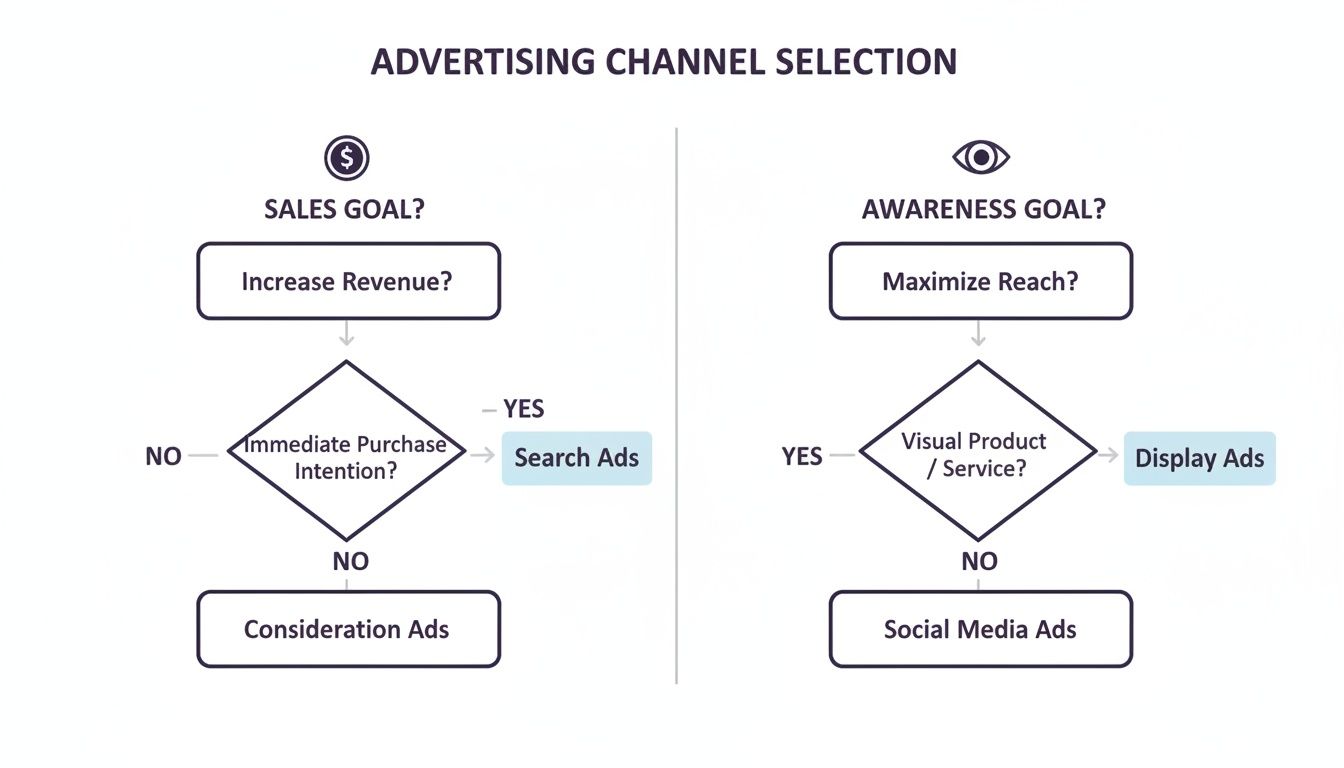
As you can see, there's a clear strategic split. If your top priority is driving direct sales and capturing people who are ready to buy, search ads are your go-to. If you’re playing the long game and need to build broad brand awareness, display ads are the way to go.
Urgent Demand in Local and Home Services
For businesses that solve immediate, high-stakes problems, search advertising isn't just an option—it's a lifeline. Think about a locksmith, a plumber dealing with a burst pipe, or an electrician responding to a power outage. Their customers aren't just browsing; they're in a panic, actively searching for a fix.
In these situations, the user's intent couldn't be clearer. Someone Googling "emergency locksmith Sacramento" needs help now. The first text ad they see with a click-to-call number is almost guaranteed to get the business. It makes sense to put 80-90% of your budget into geo-targeted search campaigns so you show up in that critical moment. Display ads would be a waste of money here because you can't guarantee they'll appear at the exact second a crisis hits.
Creating Buzz for E-commerce and New Products
Now, let's flip the script. Imagine you're launching a slick new consumer tech gadget. The problem? Nobody is searching for it because nobody knows it exists yet. This is where display advertising truly shines, helping you create demand out of thin air.
Visually engaging display ads that show off your gadget’s cool design and features can pop up on tech review sites, popular blogs, and YouTube channels that your target audience loves. The goal isn't to make a sale on the spot but to build excitement and brand recognition. A budget that leans heavily into display—say, 70-80%—is perfect for building that top-of-funnel awareness. Later, once people know your name, you can shift more budget to search to capture those branded queries.
The right strategy isn't about picking a permanent winner. It’s about adapting your approach based on the immediate needs of your business and the specific mindset of your target customer.
High-Consideration B2B Services
For B2B companies, especially in fields like legal or enterprise software, the sales cycle can be incredibly long and involve a whole committee of decision-makers. While display ads can introduce your brand, search ads are absolutely crucial for grabbing leads when people are actively researching and comparing their options.
A law firm specializing in business litigation should be all over search ads, targeting specific, high-value keywords like "commercial contract dispute lawyer." At this stage, people are looking for expertise and comparing firms. A smart strategy might look like this:
- Initial Budget: Put 60% into search to capture high-intent prospects who already know they have a problem.
- Supporting Budget: Use the other 40% for display remarketing. Show case studies and testimonials to people who clicked on your search ad but didn't convert right away.
This balanced approach uses search to hook the initial lead and display to nurture them through that long consideration phase. Your industry dictates your starting point, but the ability to stay flexible and adapt is what will ultimately drive your success.
Combining Search and Display for a Full-Funnel Approach
Experienced advertisers know the search ads vs display ads debate isn't about picking a winner. The real magic happens when you make them work together, guiding customers from the first moment they hear about you to the final click to buy.
Don't think of them as separate channels. See them as two sides of the same coin. Search is your closer, capturing people who are already looking for what you offer. Display is your opener, creating that initial spark of interest and keeping the conversation going. Combine them, and you create a powerful cycle that boosts your overall return.
Amplifying Your Efforts with Remarketing
The easiest and most powerful way to link these two is through remarketing (you might also hear it called retargeting). The concept is simple, but the results are incredible. A potential customer clicks your search ad, browses your site, but gets distracted and leaves without converting.
That's where display ads jump in. Because you've tagged that visitor, you can now show them beautiful, compelling banner ads as they browse other sites across the web. This simple act keeps your brand fresh in their mind, reminding them why they were interested in the first place and giving them an easy path back to your site.
Remarketing with display ads is like getting a second chance with your most qualified leads. You’re reconnecting with an audience that has already raised their hand, making your ad spend significantly more efficient.
Building a Long-Term Brand Flywheel
Beyond just chasing down unconverted visitors, running a broader display campaign has another huge advantage: it feeds your search campaigns over the long haul. The more people see your brand's logo and messaging in display ads, the more familiar they become with you.
That growing awareness leads directly to more branded search queries—people typing your company's name right into the Google search bar. These aren't just any searches; they are gold. They carry incredibly high intent and almost always convert at a much higher rate.
Ready to connect your search and display efforts? Here's a quick checklist for a basic remarketing campaign:
- Install Your Tracking Pixel: Make sure the Google Ads tag or a more advanced tool like our OmniPixel is on every single page of your website.
- Create an Audience: In your ad platform, build a new remarketing list that targets "All Website Visitors" from the last 30 days.
- Launch a Display Campaign: Set up a new campaign and specifically target the audience you just created.
- Design Compelling Creatives: Your banner ads don't need to be complicated. Just make them visually clean, on-brand, and reinforce your core message.
- Set a Modest Budget: You don't need to break the bank. Start small, see what kind of traffic you get, and adjust your budget as you start seeing results.
Frequently Asked Questions
When you're digging into search ads vs display ads, a few practical questions always come up. Here are some straight answers to help you feel confident about where you put your ad dollars.
If I Have a Small Budget Where Should I Start?
For most small businesses watching their pennies, search ads are the smartest place to start. You’re targeting people who are actively looking for what you offer, so every click has a much higher chance of turning into a real lead or sale.
This lets you prove your return on investment (ROI) quickly. Once you have a reliable flow of traffic and business coming from your search campaigns, you can start funneling some of those profits into display ads for things like remarketing and building broader brand awareness.
How Long Does It Take to See Results?
With search ads, you can see results almost instantly. As soon as your campaign gets the green light, traffic and leads can start rolling in within hours. Success is easy to track through clicks and conversions right from the get-go.
Display ads are more of a long game, especially when you're using them to get your name out there. You measure their impact through things like better brand recall, more people searching for your business by name, and view-through conversions—and that can take weeks or even months to really show up in the data.
Should I Run Search and Display Ads in the Same Campaign?
Absolutely not. I can't stress this enough: never run search and display ads in the same campaign. The way you bid, the way you target, and what you're trying to achieve are completely different for each network.
Lumping them together makes it a nightmare to optimize and usually just ends up wasting your money. To keep control and actually measure what's working, you have to create separate campaigns for the Search Network and the Display Network. That way, each one is built to do what it does best.
Ready to build a strategy that uses the best of both search and display ads? The team at Site Igniters creates custom digital marketing plans that get real results. Contact us today to get started.
Seth Sanders is the founder of Site Igniters, a digital marketing agency in El Dorado Hills, California.