
In-House Marketing vs Agency A Complete Comparison Guide


The whole in-house marketing vs. agency debate really comes down to one thing: trading deep, baked-in brand knowledge for broad, specialized expertise. An in-house team lives your company culture every single day. That gives you unmatched brand consistency and total control. On the flip side, an agency parachutes in a whole team of ready-to-go specialists with high-end tools, saving you the headache and overhead of hiring.
- In-house teams offer deep brand knowledge while agencies provide broad specialized expertise.
- A hybrid model combining both often delivers the best cost efficiency and strategic flexibility.
- Factor in AI capabilities and scalability needs when deciding between in-house and agency support.
Choosing Your Marketing Model: In-House vs. Agency
Deciding whether to build your own team or bring in an outside partner is a pivotal moment for any business. The choice you make will directly shape your budget, how quickly you can react to market changes, and the kind of talent you can access. An in-house team truly becomes part of your company's DNA, making sure every single campaign feels authentic to your core values.
An agency, on the other hand, is like getting an entire marketing department delivered to your door. You instantly get experts in everything from SEO to content creation, letting you ramp your marketing efforts up or down whenever you need to. If you want to dig deeper into the different ways of working with external partners, this guide on outsourcing your marketing is a great resource.
Quick Comparison: In-House Marketing vs. Agency
To make the choice a bit clearer, let's break down the key differences in a simple table. This gives you a quick snapshot of what you gain and what you give up with each option.
| Factor | In-House Team | Marketing Agency |
|---|---|---|
| Control | Full control over strategy and day-to-day priorities | Shared control; success hinges on clear communication |
| Cost Structure | Fixed overhead like salaries, benefits, and software | Flexible retainer or project-based fees |
| Expertise | Deep, focused knowledge of your brand and products | Broad, specialized skills across many marketing channels |
| Scalability | Slower and more expensive to scale up or down | Quick to add resources for new campaigns or needs |
Ultimately, neither path is universally "better"—it's about finding the right fit for your specific goals, budget, and company culture at this exact moment.
A Realistic Breakdown of Costs and Scalability

It’s easy to fall into the trap of comparing an in-house marketer's salary to an agency’s monthly retainer. But that’s a dangerously simplistic view. To get the real story, you need to look at the fully loaded cost of an internal hire versus the flexible investment of partnering with an agency.
An in-house team costs a lot more than just paychecks. Benefits alone can tack on another 25-35% to a salary. Then you have to factor in recruiting fees, onboarding, continuous training, and the hefty monthly subscriptions for essential marketing software. These hidden costs can make an in-house budget swell unexpectedly.
The True Cost of an In-house Team
Bringing marketing in-house means you’re signing up for some serious fixed overhead. These aren't just one-time expenses; they are ongoing commitments of money, time, and resources that can pull your focus away from running the business.
For perspective, the U.S. Bureau of Labor Statistics puts the median annual salary for a marketing manager at around $140,000 as of 2023. If you want to build a small, well-rounded team to handle SEO, content, and paid ads, you could easily be looking at a loaded annual cost north of $500,000. An agency can offer that same range of expertise for a fraction of that, without the long-term overhead. For a deeper dive, check out these cost comparisons for marketing teams on f22labs.com.
A full breakdown of in-house costs usually includes:
- Salaries and Benefits: The biggest and most obvious line item.
- Recruitment and Onboarding: This includes recruiter fees or internal HR time, plus the lost productivity while a new hire gets up to speed.
- Software and Tools: SEO platforms, analytics dashboards, and design software can run thousands of dollars every month.
- Training and Development: To keep their skills sharp, your team needs ongoing investment in courses and industry conferences.
- Office Space and Equipment: Every new employee needs a desk, a computer, and a place to sit.
This model locks you into a high fixed-cost structure that’s slow and expensive to change.
Agency Pricing Models and Financial Flexibility
Agencies work on a completely different financial model, typically using retainers or project-based fees. This approach transforms a massive fixed cost into a much more manageable variable operating expense, giving you incredible flexibility.
An agency retainer gives you immediate access to a full team of specialists—from a technical SEO analyst to a creative director—without having to hire each one. You can tap into diverse, senior-level expertise whenever you need it.
With an agency, you pay for the services you need, right when you need them. It's a model that’s built to adapt to your changing business priorities. You can ramp up your investment for a big product launch or scale back during a quiet period without the headache of hiring or laying people off.
Scalability: The Decisive Factor
This is where the difference becomes crystal clear. Growing an in-house team is a slow, methodical process. It involves posting jobs, sifting through resumes, conducting interviews, and then spending months on onboarding. And if you need to scale down? You’re facing some tough, expensive decisions.
Agencies, on the other hand, are built to scale at a moment's notice. They can pull in more resources from their existing talent pool and get them working on your account almost overnight to support a new campaign or a push into a new market. In today's fast-moving world, that kind of agility isn't just a nice-to-have—it's a serious competitive advantage.
When it comes down to it, any marketing investment is only as good as the results it delivers. Looking at in-house versus agency performance, the real difference often boils down to the depth and breadth of the team's expertise. Each setup builds a totally different kind of skill set, which means they excel in different situations.
The biggest plus for an in-house team is its complete immersion in the brand. These team members live and breathe your company's culture, product details, and customer voice every single day. That deep connection creates a level of brand consistency and strategic alignment that’s incredibly tough for any outside partner to truly match.
But that depth often means sacrificing breadth. A typical in-house team at a small or mid-sized business is made up of marketing generalists who have to juggle multiple channels. They're dedicated, for sure, but they might not have the highly specific, up-to-the-minute skills needed for super technical disciplines.
The Specialist Advantage of an Agency
Marketing agencies are built on specialization. They create entire departments focused on a single area, like technical SEO, programmatic advertising, or advanced analytics. This structure lets them pull in and keep top-tier talent—people who spend all day, every day, mastering one specific craft.
Agencies are like a hub of collective intelligence. Their specialists work across dozens of different industries, constantly testing new strategies and tools. This cross-pollination of ideas means they can often solve problems faster and spot opportunities an in-house team might overlook.
This specialist model gives them a clear performance edge in complex, fast-moving channels. An agency can bring a level of technical precision to a campaign that a generalist, no matter how talented, would struggle to match. This is especially true for tasks that demand deep technical know-how. For businesses looking to master organic search, our guide on search engine optimization (SEO) offers a solid foundation of what's involved.
The data backs this up. A report from HubSpot found that 64% of companies said working with an agency gave them better access to specialized expertise than relying solely on their internal teams. For SaaS companies, the difference can be huge; one study showed that businesses supported by an agency saw their organic traffic grow 2.3x faster than their peers who only used in-house teams. You can find more of these SaaS marketing statistics on revenuezen.com.
Real-World Scenarios and Performance Outcomes
So, which model is right for you? It really depends on the specific marketing challenge you're trying to solve. Let's walk through two common business scenarios to see how each model stacks up.
Scenario 1: Deep Product Integration
- The Goal: A B2B software company needs to produce highly technical content. This requires daily collaboration with product managers and engineers to stay aligned with a complex, ever-changing product roadmap.
- The Better Model: In-House Team. An internal marketer can sit in on engineering stand-ups, grab a product lead for a quick interview, and make sure every piece of content is technically perfect and strategically on point. An external agency would find it nearly impossible to match that speed and level of deep integration.
Scenario 2: Aggressive Multi-Channel Customer Acquisition
- The Goal: An e-commerce brand is launching a new product line. They need to run a sophisticated, multi-channel campaign using Google Ads, social media remarketing, and influencer partnerships—all within a tight 90-day deadline.
- The Better Model: Marketing Agency. An agency can hit the ground running with a team of specialists for each channel. Their PPC expert has managed millions in ad spend, their social media strategist is on top of the latest platform algorithms, and their influencer manager already has a network of contacts. Trying to staff up and train an in-house team for a campaign of this scale would take months, whereas an agency can start delivering results almost immediately.
Accessing Advanced AI and Technical Capabilities

Today’s marketing success isn't just about killer content or a slick brand voice anymore. It's often won or lost in the technical trenches—navigating complex legal requirements and deploying sophisticated AI that can easily overwhelm a generalist in-house team. This is where the in-house marketing vs agency debate gets really interesting.
A good agency is built from the ground up to tackle these kinds of challenges. They have dedicated experts for legally sensitive areas like website accessibility, where one wrong move can trigger a costly lawsuit. They also invest heavily in proprietary tech and advanced AI models that most businesses simply can't afford to build or license on their own.
Navigating Complex Compliance
One of the most critical, and frankly, most overlooked areas of digital marketing is accessibility. Mandates like the Americans with Disabilities Act (ADA) and Web Content Accessibility Guidelines (WCAG) aren't just suggestions; they're legal requirements. Falling short can lead to demand letters and some seriously expensive litigation.
Unless you've hired for it specifically, your in-house team probably isn't equipped to perform a deep accessibility audit. They likely don't know the ins and outs of the code changes needed to make your site work properly with screen readers, keyboard-only navigation, and other assistive tech.
An agency’s accessibility specialists live and breathe this stuff. They can run comprehensive audits against standards like WCAG 2.1 AA, spot risks you didn't know you had, and fix the problems way faster than an untrained team. It’s a proactive move that shields you from legal trouble and opens your doors to a much wider audience.
The AI and Analytics Gap
Artificial intelligence is here, and it’s a practical tool that’s already driving insane levels of personalization and efficiency. While an in-house team might be using off-the-shelf AI writers or basic analytics, a top-tier agency is playing a completely different game. They deploy powerful, often proprietary, systems that give their clients a huge competitive advantage.
Agencies can afford to develop or license advanced tech stacks because they spread the cost across their entire client base. It's an economy of scale that gives you access to enterprise-level tools for a fraction of what you'd pay directly.
Here’s a quick look at how the capabilities usually stack up:
| Capability | In-House Team | Specialized Agency |
|---|---|---|
| AI Usage | Sticks to public, off-the-shelf tools for basic content creation or simple automations. | Deploys custom AI models trained on proprietary data for predictive analytics and hyper-personalization. |
| Data Tracking | Relies on standard platforms like Google Analytics, which only tells part of the story. | Implements multi-touch attribution models and proprietary tracking pixels for a complete view of the customer journey. |
| Reporting | Puts together manual reports, often focused on vanity metrics like traffic and impressions. | Delivers automated, real-time dashboards that tie marketing spend directly to revenue and customer lifetime value. |
You really see the difference in performance marketing. For instance, an agency might use a tool like our Omni-Pixel for cross-platform remarketing. This tech tracks user behavior across multiple devices and platforms to create highly targeted ad campaigns—something that’s practically impossible to build and maintain in-house without a full-blown engineering team.
Custom LLMs and Proprietary Tools
The most forward-thinking agencies are now going beyond basic AI and are building custom Large Language Models (LLMs) for their clients. These models are trained on a company’s own customer data, product info, and brand voice. The result is truly unique and effective automation, from hyper-personalized email campaigns to smart chatbots that can handle complex support tickets.
Plus, getting help from dedicated LLM visibility tracking agencies can be essential for staying ahead. For most small to mid-sized businesses, the cost and expertise needed to create these custom AI solutions are just too high. When you partner with the right agency, you get to tap into this advanced tech, letting you compete with much larger players without sinking a fortune into R&D.
The Power of Hybrid Marketing Models
That rigid choice between an in-house team and an agency often feels like a trade-off you shouldn’t have to make. What if you didn’t have to choose at all? A third, more flexible path has emerged that blends the strengths of both, creating a seriously powerful and adaptable structure.
This is the hybrid approach. It's where a business builds a lean internal team to steer the ship while partnering with specialized agencies to power the engine. It’s a model built for both speed and control, offering a real-world solution to that classic in-house vs. agency dilemma.
Structuring Your Hybrid Team for Success
In a good hybrid model, your in-house people are the strategic core. This small group, sometimes just a single marketing director, owns the brand strategy, the customer data, and the final say on everything. They are the keepers of the company’s voice and vision.
Meanwhile, all the execution-heavy and highly specialized tasks get handed off to agency partners who live and breathe that stuff. This setup lets your internal leader guide the external specialists, making sure every campaign is strategically sound without getting bogged down in the tactical weeds.
Here’s how that division of labor usually shakes out:
- Kept In-House: Core brand strategy, budget allocation, customer journey mapping, final creative approval, and performance analysis.
- Outsourced to Agency: Technical SEO audits, complex PPC campaign management, high-volume content production, and advanced analytics implementation.
This way, all that deep institutional knowledge stays right where it belongs—inside your company—while you still get access to top-tier, specialized talent whenever you need it.
Finding the Sweet Spot Between Speed and Control
The real beauty of a hybrid model is that it solves the central conflict between control and scalability. You keep full strategic oversight with your in-house leader, so the marketing never strays from your business goals. At the same time, you gain the agility to scale specific marketing functions up or down instantly just by adjusting agency retainers.
Think about it: an in-house marketing director can set the quarterly goals for a new product launch and then task an agency partner with running a multi-channel PPC campaign. The director provides the brand guidelines and target audience insights, while the agency brings its deep expertise in bidding strategies and ad creative to deliver results, fast.
A hybrid approach gives you the best of both worlds—you get the dedicated brand focus of an internal team paired with the diverse, specialized skill sets of an agency. It’s about building a marketing function that is both deeply integrated and highly adaptable.
Research is already backing this up. A hybrid model—where core strategy stays in-house while execution is outsourced—delivers some big wins. Businesses report up to ~15–20% faster turnaround times and 10–15% lower costs when agencies use specialized, AI-driven workflows. You can dig into more of these agency trends on research.mountain.com. This balance of in-house governance and external expertise creates a cost-effective and efficient marketing machine that’s tough to replicate with a pure in-house or pure agency model.
Making Your Final Decision
You've done the analysis, and now it's time to make a call. The in-house vs. agency debate doesn't have one right answer—the best choice is always tied to your specific situation. Your budget, your timeline, and the skills you actually need to hit your goals will determine the right path forward.
Let's cut through the noise. A quick, honest look at your internal resources and top priorities will make it clear whether building in-house, hiring an agency, or blending the two makes the most sense for your business right now.
A Checklist for Choosing Your Model
Before you post a job opening or start taking sales calls from agencies, walk through these questions. The answers will paint a clear picture of what you need, pointing you toward the structure that fits your company's current stage of growth.
- What's our real budget? You need to calculate the fully loaded cost of an in-house hire, which includes salary, benefits, software, and training. Compare that total number against a monthly agency retainer, not just the base salary.
- Do we need a jack-of-all-trades or a deep specialist? If you need a little bit of everything done, a generalist hire might be perfect. But if your success hinges on highly technical SEO or a complex PPC strategy, a specialized agency brings that deep expertise from day one.
- How fast do we need to see results? An agency can hit the ground running and launch campaigns almost immediately. Hiring, onboarding, and getting a new in-house team member up to speed can take months before you really start building momentum.
- How much control do we absolutely need? If you require daily oversight and the ability to change direction on a dime, an in-house team offers the most direct control. Working with an agency means trusting their process and collaborating on management.
Answering these will probably make one option feel like the obvious choice, or it might show that a hybrid model is the smarter play.
This flowchart breaks down how different business needs and resources point toward each model.
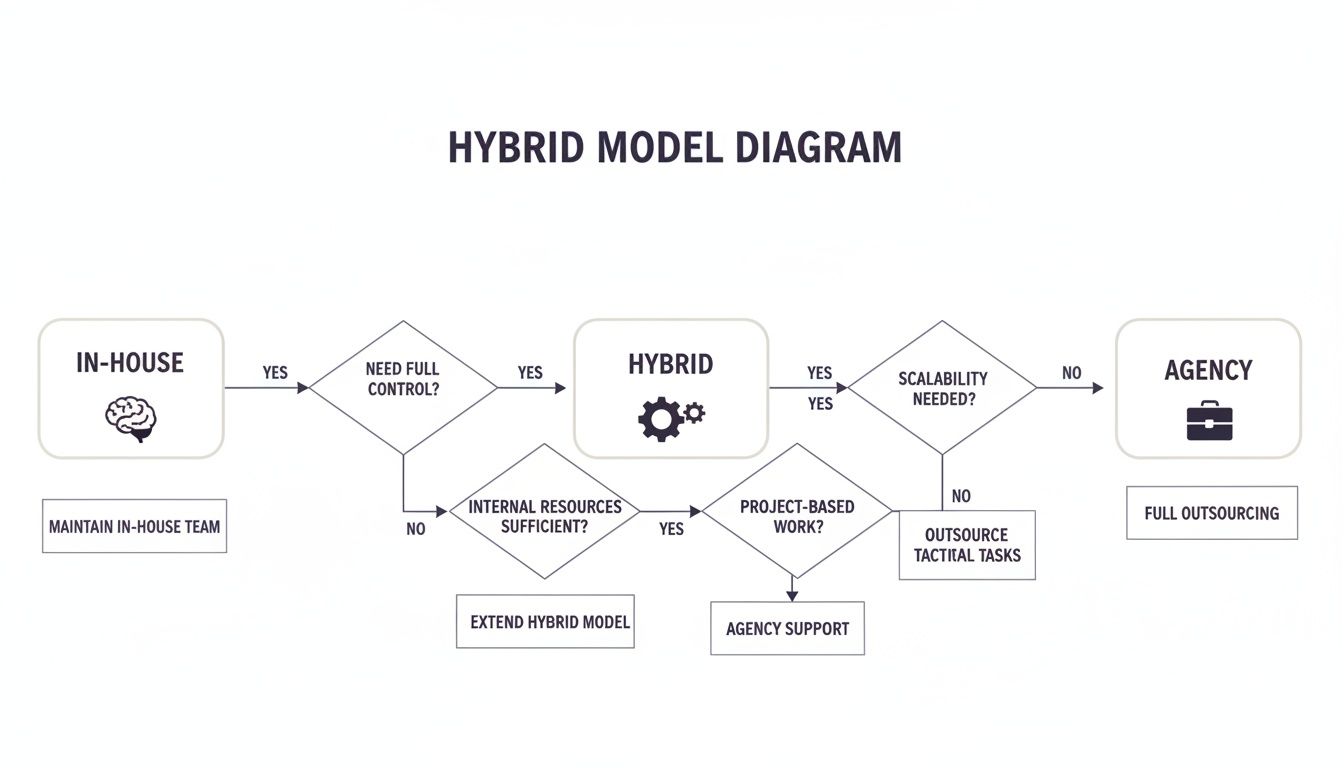
As you can see, the decision really comes down to balancing your needs for control, specialized expertise, and how quickly you need to scale up.
For a more quantitative approach, you can score each model based on what matters most to you.
Decision Matrix: In-House vs. Agency vs. Hybrid
Use this matrix to score each model from 1 (poor fit) to 5 (excellent fit) based on your business priorities. This will give you a simple, visual way to see which option aligns best with your goals.
| Priority | In-House (Score 1-5) | Agency (Score 1-5) | Hybrid (Score 1-5) |
|---|---|---|---|
| Budget Control (Lowest Cost) | |||
| Speed to Implementation | |||
| Deep Specialization | |||
| Brand Immersion & Control | |||
| Scalability (Up or Down) | |||
| Access to Advanced Tools | |||
| Long-Term Knowledge Retention |
Tally up the scores. The highest number isn't automatically the winner, but it should give you a very strong indication of which direction to lean.
How to Properly Vet a Potential Agency Partner
If your evaluation points you toward hiring an outside team, the vetting process is your next critical step. This isn't just about finding someone who knows marketing; it's about finding a partner who gets your business, fits your culture, and communicates the way you need them to.
Don't rush this part. So many businesses make the mistake of signing on too quickly, leading to mismatched expectations and wasted money. A little due diligence now saves a lot of headaches later.
The whole point of vetting an agency is to get past the sales pitch. You need to understand their actual process, how they communicate, and what "success" really looks like for clients like you.
When you get on a call with a potential agency, have your questions ready. You want to dig into their capabilities and how they manage their client relationships.
Key Questions to Ask Potential Agencies:
- Can you show me case studies from our industry for a company our size? You need to see proof they’ve solved similar problems for businesses like yours. Great results for a giant e-commerce brand don't mean much if you're a local B2B service provider.
- How do you measure and report on performance? A real partner will talk about business outcomes—leads, sales, and revenue—not just vanity metrics like traffic. Ask them to walk you through a sample report so you know exactly what to expect.
- What does your communication process look like? Find out how often you’ll meet, who your main point of contact is, and how they handle things when a campaign isn’t performing as expected.
- Who, exactly, will be working on our account? Get to know the people who will be in the weeds doing the work, not just the person selling you the contract. What’s their experience level?
This process is absolutely essential for finding a partner you can stick with for the long haul. For anyone looking for help with search marketing, our guide on how to hire an SEO company in Sacramento offers more specific vetting advice that’s useful for any agency search. By asking the right questions, you can find a team that feels like a true extension of your own.
Common Questions About In-House vs. Agency Teams
When you're weighing the choice between building an in-house team or hiring a marketing agency, a few key questions always come up. Getting straight answers is the only way to make a decision you feel good about—one that actually lines up with where your business is headed.
Will I Lose Control If I Hire an Agency?
This is probably the number one fear we hear, but the short answer is no—not if you set up the partnership the right way. You don't lose control just by hiring an agency. You lose control when you don't have a dedicated person on your team to manage them.
Think of it this way: your in-house marketing lead is your quarterback. They own the playbook (the strategy), call the shots on major initiatives, and make sure every play the agency runs moves you closer to the end zone. The only time you lose control is when you treat an agency like a vending machine you put money into, instead of what they should be: an extension of your own team.
What Happens to All Our Knowledge If an Agency Leaves?
This is a very real risk with a pure agency model, but it’s exactly why a hybrid approach is so powerful. When you have a dedicated in-house marketer, all that institutional knowledge—what worked, what didn't, why—stays right where it belongs: inside your company.
Your internal team member soaks up the agency's expertise, documents the critical processes, and keeps a close eye on campaign history. If you ever decide to part ways with that agency, you're only losing the hands-on execution, not the years of strategic insights and hard-won data. This setup gives you the freedom to switch partners without having to start over from square one every single time.
Your in-house lead in a hybrid model becomes the keeper of your marketing intelligence. They absorb the specialized knowledge from your partners, ensuring that incredibly valuable asset is retained for the long haul.
What Does Communication with an Agency Actually Look Like?
Solid communication is the glue that holds an agency partnership together. It prevents projects from going off the rails and keeps everyone on the same page. A well-run relationship should have a clear, consistent rhythm.
A typical communication schedule usually looks something like this:
- Weekly Syncs: A quick, focused meeting (usually Mondays) to set priorities for the week ahead.
- Asynchronous Updates: Mid-week check-ins and progress notes shared through a project management tool like Asana or a shared Slack channel.
- Monthly Performance Reviews: A deeper dive into the numbers to see how you’re tracking against goals and to plan for the next month.
- Real-Time Dashboards: Shared access to performance data so you can check in on progress whenever you want.
Total transparency is the hallmark of a healthy partnership. If an agency seems cagey about providing this level of visibility, that's often a major red flag.
Should We Start with an Agency and Hire In-House Later?
Yes, this is an incredibly common—and effective—growth strategy. It works especially well for businesses with revenue under $5 million. Starting with an agency lets you hit the ground running and get marketing programs launched quickly, without the huge upfront cost and time sink of recruiting and hiring.
Once you’ve got consistent revenue flowing and a much better handle on your marketing needs, you can bring on your first in-house marketing manager. They can spend a few months learning the ropes from the current agency before gradually taking on more strategic duties. This creates a smooth, low-risk transition and helps you build your internal team from a position of strength.
Ready to build a marketing strategy that delivers real results without all the guesswork? The team at Site Igniters blends expert SEO, advanced AI solutions, and full-service digital marketing to help businesses like yours grow. Get in touch with us today to see how we can build a plan that fits your unique goals.
Seth Sanders is the founder of Site Igniters, a digital marketing agency in El Dorado Hills, California.