
Demystifying SEO Cost for Small Business


The typical seo cost for a small business is anywhere from $500 to $5,000 per month. That's a big range, I know. But the final number really boils down to your goals, how tough your industry is, and what services you actually need to see real growth.
- Small business SEO typically costs $500 to $5,000 per month depending on goals, competition, and service scope.
- Understanding pricing models (monthly retainer, project-based, hourly) helps you choose the right fit for your budget.
- Avoid providers offering suspiciously cheap packages or guaranteeing specific rankings, as these are red flags.
How Much Should a Small Business Budget for SEO?
Trying to nail down the right SEO budget can feel like you're trying to hit a moving target. There’s no magic number because every business is in a unique situation.
Think of it this way: hiring an SEO expert is a lot like hiring a personal trainer. Some people just need a basic workout plan to get started. Others need intense, daily coaching to compete at a high level. Your SEO investment works the exact same way—it has to match your ambition.
Are you a local bakery that just wants more people in the neighborhood to find you through Google Maps? Or are you an online store trying to go toe-to-toe with national brands? The bakery’s goal will require a smaller, more focused investment, while the e-commerce store needs a much bigger push to get noticed.
Typical Investment Tiers
To help you get a real-world sense of what to expect, let's look at how costs usually break down. Industry data shows that while the numbers can be all over the place, most small businesses find a comfortable spending level that aligns with their growth plans.
According to a 2025 survey of 439 SEO pros, 63% of small businesses are investing between $500 and $5,000 a month. On average, an agency-led campaign runs about $3,209, while freelancers tend to be closer to $1,348. For businesses laser-focused on local customers, that monthly retainer usually lands between $1,000 and $2,500. You can dig deeper into these numbers in Backlinko’s 2025 data analysis.
This infographic gives you a quick visual breakdown of those common monthly budget ranges, from a simple local campaign all the way up to a more aggressive national strategy.
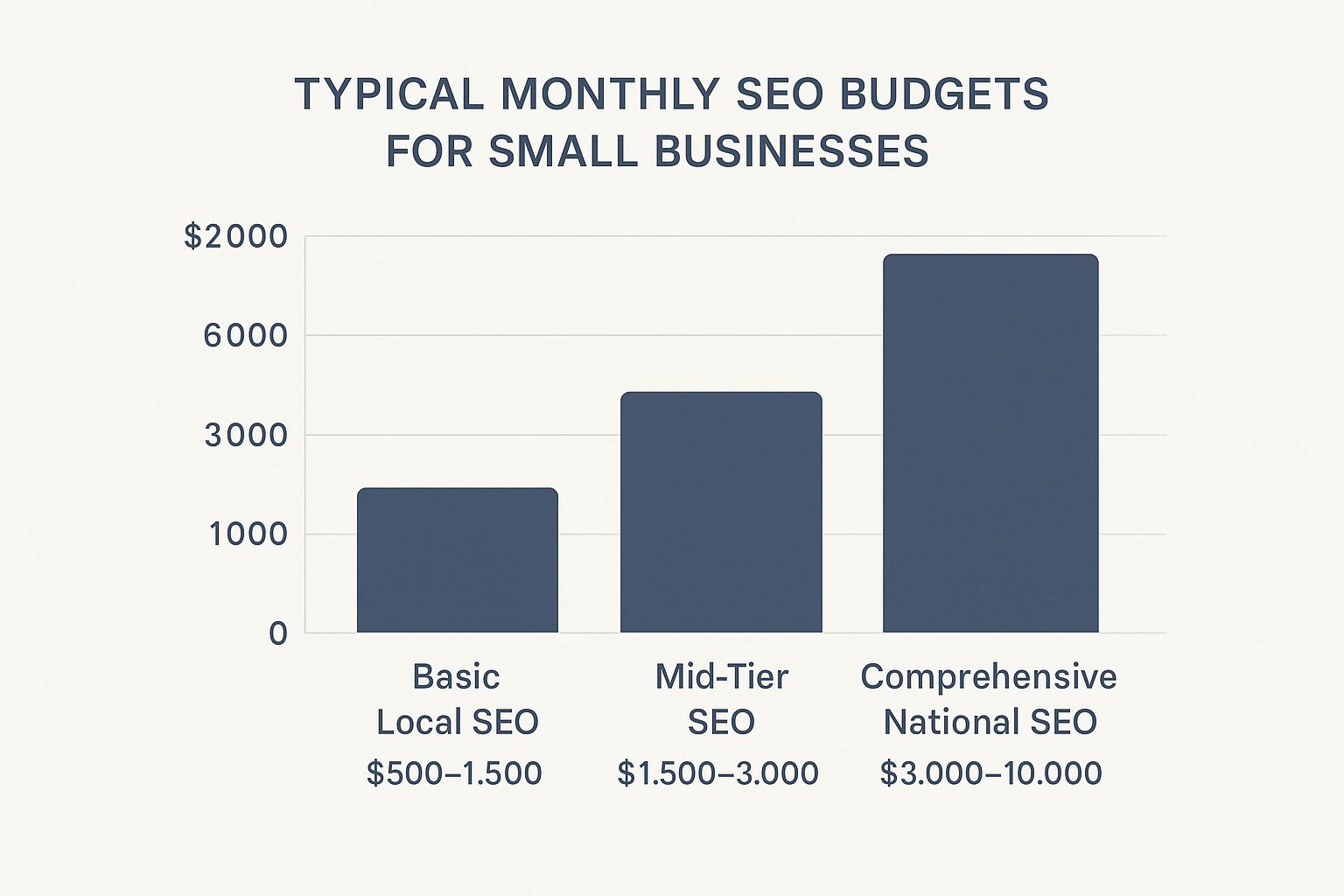
As you can see, the investment really scales with how big and how intense you want your SEO efforts to be.
Matching Your Budget to Your Goals
At the end of the day, your budget is what determines the level of service you get and how quickly you can expect to see results. A smaller budget will likely cover the foundational stuff, while a larger one can fuel aggressive content creation and link-building campaigns designed to get you ranking faster.
To make this crystal clear, here’s a look at what different investment levels typically get you.
Typical Monthly SEO Budgets for Small Businesses
This table breaks down common investment levels, what services you can generally expect for your money, and what kind of business goals each tier is best suited for.
| Budget Tier | Monthly Cost Range | Included Services | Best For |
|---|---|---|---|
| Basic Local SEO | $500–$1,500 | Keyword research, on-page optimization, Google Business Profile management, local citation building. | Small local businesses (like cafes, plumbers, or salons) that want to rank in their immediate service area. |
| Mid-Tier Growth | $1,500–$3,000 | All the basic services, plus regular content creation (blogs), technical SEO audits, and foundational link building. | Businesses in competitive local markets or those looking to expand their reach across a region. |
| Comprehensive National | $3,000–$10,000+ | All mid-tier services, plus an advanced content strategy, extensive link acquisition campaigns, and deep competitor analysis. | Companies targeting a national audience or highly competitive e-commerce stores that need to stand out. |
Choosing the right tier isn't just about what you can afford; it's about aligning your investment with a clear, achievable objective. A plumbing company doesn't need a national budget, but an online clothing brand will struggle with a basic local plan.
Decoding Different SEO Pricing Models

Trying to make sense of an SEO proposal can feel like learning a new language. You'll see terms like "retainer," "project-based," and "hourly" thrown around, and it's not always obvious what you're actually paying for.
Let's cut through the jargon. SEO services are usually packaged in one of three ways. Each model has its own strengths and weaknesses, and the best fit for your business really boils down to your goals, your budget, and how hands-on you want to be.
The Monthly Retainer Model
The most common structure you'll come across is the monthly retainer. Think of it like a gym membership for your website. You pay a set fee every month, and in return, an agency or consultant works continuously to boost your site's health and visibility in search results.
This model is designed for long-term, sustainable growth. SEO isn’t a one-and-done deal; it’s an ongoing marathon of building authority, creating content, and adapting to Google's constant algorithm changes. A retainer ensures someone is always in your corner, pushing your rankings forward.
This model is a great fit for:
- Businesses ready to make SEO a core part of their marketing strategy.
- Companies that need a wide range of services, from content writing to technical fixes.
- Owners who like predictable monthly expenses for easier budgeting.
The biggest win here is the consistent momentum. Just like regular gym sessions get you better results than a few random workouts, a monthly retainer keeps your SEO efforts on track for steady progress. The only real downside is that it takes a longer-term commitment to see the full payoff.
Project-Based Pricing
Next up, we have project-based pricing. This is more like hiring a contractor to build a new deck. You have a very specific, defined goal, and you agree on a fixed price to get that single outcome. Once the project's done, the engagement ends.
This is a fantastic option when you have a clear, isolated need. You're not looking for an ongoing partner; you just need an expert to come in, knock out a task, and hand over the keys. This approach gives you total cost certainty and a crystal-clear deliverable.
Common examples of project-based SEO work include:
- A deep-dive technical audit of your website.
- A keyword research and content strategy package.
- A one-time local SEO setup for a new brick-and-mortar business.
The main advantage of project-based work is its clarity—you know exactly what you’re getting and exactly what it will cost. The trade-off is that it doesn't cover the ongoing work needed to maintain and improve your results after the project wraps up.
Hourly SEO Consulting
Finally, there’s hourly consulting. This is the most straightforward model of all: you pay an expert for their time, just like you would a mechanic or a lawyer. It’s perfect for businesses that need specialized advice, some training, or help with a specific, tricky problem.
Hourly rates for SEO pros in 2025 can swing from $50 to over $300 per hour, but most agencies and seasoned consultants fall in the $100 to $200 range. For instance, a basic link profile audit could run anywhere from $500 to $7,500, depending on how deep they go. You can check out more detailed pricing benchmarks from SEOprofy's 2025 analysis.
This model gives you maximum flexibility. You can buy as much or as little time as you need. The catch is that costs can get unpredictable if the scope isn't tightly managed, which is why it's less common for a full-blown SEO campaign.
Hourly consulting works best for:
- Businesses with an in-house team that just needs some expert guidance.
- Specific tasks like recovering from a Google penalty or helping with a site migration.
- One-on-one training sessions for you or your staff.
At the end of the day, understanding these models helps you figure out the best seo cost for your small business. A monthly retainer invests in long-term growth, a project fee solves a specific problem, and hourly consulting gets you targeted expertise right when you need it.
What Actually Drives Your SEO Costs

If you've started shopping around for SEO services, you've probably noticed the prices can feel like they're all over the map. One agency might quote you $1,500 a month, while another says it'll take $5,000 to get the job done. It's not because someone's trying to pull a fast one; it's because the real seo cost for a small business is shaped by a handful of powerful, interconnected factors.
Think of it like building a custom home. You can't get a single, flat price for "a house." The final cost depends on the square footage, the quality of the materials, the complexity of the design, and a dozen other details. SEO works exactly the same way. The final price tag is built from the specific "ingredients" needed to hit your goals.
Once you understand these core drivers, you can have much smarter conversations with potential SEO partners. You'll know exactly what you're paying for and why one proposal might be more expensive—and likely more effective—than another.
Your Industry's Competitiveness
The single biggest factor dictating your SEO cost is how crowded your market is. Are you a local plumber in a small town, or are you an e-commerce store trying to sell sneakers to a national audience? The difference in effort is massive.
Imagine you're opening a coffee shop. Setting up in a quiet suburban neighborhood with no other cafes is one thing. But trying to launch a new shop in the middle of downtown Seattle, surrounded by established giants? That’s a completely different battle that requires a much bigger marketing budget to even get noticed.
SEO is no different. Ranking for a local term like "plumbers in Folsom" takes a certain amount of effort. Ranking for a national term like "best running shoes for men" puts you up against huge brands with massive marketing departments and years of authority. More competition means way more work to climb the ranks, and that translates directly to a higher cost.
The Geographic Scope of Your Campaign
Tied directly to competition is the geographic area you want to target. The bigger the playing field, the more people you're competing against for that valuable first-page real estate.
-
Local SEO: This focuses on a specific city or service area, like "Sacramento family law attorney." It’s often the most budget-friendly option because you're only competing against other businesses in a limited geographic pool.
-
Regional SEO: This expands the target to multiple cities or an entire state—think "Northern California solar installers." The scope is bigger, demanding more content and authority-building to cover a wider area.
-
National SEO: This is the most complex and expensive tier. You're no longer just up against local businesses; you’re fighting every other company in the country for the same keywords.
Key Takeaway: A wider geographic target dramatically increases the number of competitors you need to outperform. This requires a more aggressive strategy involving more content, more backlinks, and a more sophisticated technical approach, all of which drive up the cost.
The Current Health of Your Website
Your website is the foundation of any SEO campaign. A brand-new site, or one with a history of technical problems, is like starting a race a hundred yards behind the starting line. It just needs more work upfront to get into a competitive position.
Any good agency will start with a technical audit to see what they're working with. They'll look for problems like slow page speed, a confusing site structure, or duplicate content—all things that can hold you back in Google's eyes. If your site needs a major overhaul, that initial work will be factored into the overall cost.
For a deeper dive into the components of a campaign, you can learn more about our approach to search engine optimization (SEO) and how these foundational elements fit together.
The Caliber of Your SEO Provider
Finally, the experience and track record of the agency you hire play a huge role in the price. You'd expect to pay more for a seasoned surgeon than a recent medical school graduate, right? The same logic applies to proven SEO expertise.
A cheaper provider might cut corners with outdated tactics or low-quality content that can actually get your site penalized down the road. An experienced team brings strategic insight, a history of real results, and the ability to pivot when Google's algorithm changes. That level of skill and reliability comes at a premium, but it almost always delivers a much stronger return on your investment over time.
Understanding the True ROI of SEO
It’s easy to get fixated on the SEO cost for a small business, but that's only half the story. The real question isn't just "What does it cost?" but "Is it actually worth it?" The answer is a resounding yes, but you have to think about SEO differently than other marketing expenses.
Paid advertising is like renting an audience. The moment you stop paying for a Google Ad, your visibility disappears. Poof. SEO, on the other hand, is like buying an asset. Every blog post you publish and every backlink you earn becomes a permanent part of your digital foundation, continuing to pull in traffic long after the initial work is done.
This creates a powerful compounding effect. Your early efforts lay the groundwork for future growth, and each new success builds on the last. You end up with a sustainable source of leads and customers that doesn't demand a constant flow of ad dollars.
From Clicks to Customers
The true power of SEO clicks into place when you see where your best customers are coming from. Organic search isn’t just another traffic source; it's often your highest-quality one. Think about it: someone actively typing a problem into Google is much closer to buying than someone just scrolling through their social feed.
They weren't interrupted by an ad—they came looking for a solution you offer. This high-intent traffic is exactly why organic leads tend to convert at a much higher rate than leads from other channels.
SEO is a long-term investment that builds a valuable asset for your business. It's not a short-term expense. By focusing on organic growth, you create a marketing engine that runs on its own momentum, generating leads and sales for years to come.
This is especially true for local businesses. When someone searches "plumber near me" or "best coffee shop in downtown," they aren't just browsing. They're ready to act. This is where local SEO shines, turning those online searches into real-world customers walking through your front door.
The Tangible Returns of an SEO Investment
The return on investment for small business SEO can be huge. Studies show an average ROI of 400% within two years for businesses that stick with it. This makes sense when you realize that organic search drives 53% of all website traffic, making it the single biggest visibility driver online.
For local businesses, the numbers are even more dramatic. A staggering 78% of mobile local searches result in an in-person purchase within 24 hours, and 46% of all Google searches are for local information. You can dig deeper into how these SEO cost breakdowns translate to ROI to see the full picture.
Let's walk through a quick example to see what this looks like.
Imagine a local bakery invests $1,500 per month in SEO.
- Months 1-3: The first phase is all about fixing technical glitches, beefing up their Google Business Profile, and building local citations. Traffic starts to nudge up, slow and steady.
- Months 4-6: Things start to pop. They begin ranking on the first page for "bakery in [their city]" and similar terms. Foot traffic from people who found them online increases, and they start getting online orders for custom cakes.
- Months 7-12: Now, the bakery is sitting at the top for several key search terms. That initial $1,500 monthly investment is now bringing in thousands of dollars in new revenue every single month.
This growth is an appreciating asset. The rankings they've earned will keep driving business without needing a dollar-for-dollar spending increase. That’s the opposite of an ad campaign, where doubling your results means doubling your budget. SEO is the blueprint for sustainable, predictable, and profitable growth.
Red Flags to Avoid When Hiring an SEO Provider

Trying to find a good SEO partner can feel a little like the Wild West. For every expert who delivers real, tangible results, there’s someone else selling smoke and mirrors. But protecting your investment is easier when you know what to look for.
Think of this as your field guide for vetting a potential SEO agency. If you learn to spot these critical red flags before signing a contract, you can avoid scams and build a partnership that actually moves your business forward.
Guarantees of #1 Rankings
This is the oldest trick in the book. If an agency promises you the top spot on Google—especially in a short, specific timeframe—run the other way.
Here’s the deal: no one can guarantee a #1 ranking because no one controls Google's algorithm. It's a complex system that's constantly changing. A good SEO knows rankings are earned through consistent, high-quality work, not by flipping some secret switch.
A trustworthy partner will guarantee their commitment to best practices, transparent communication, and a clear strategy. They sell a proven process, not an impossible outcome.
A Vague or Secret Strategy
Does their process sound like a "secret sauce" or a "proprietary method" they can't quite explain? This is a huge warning sign. While every agency has its own approach, the fundamentals of good SEO are not a mystery.
A transparent partner should be able to walk you through their strategy in plain English. They need to explain what they plan to do, why they're doing it, and how it will help your specific business.
A solid SEO plan will almost always include:
- Technical SEO: Fixing issues with your site's health and backend structure.
- Content Creation: Developing valuable blog posts, service pages, and other resources.
- On-Page Optimization: Improving individual pages to target the right keywords.
- Link Building: Earning authoritative links from other relevant websites to build trust.
If they’re cagey about their methods, it could mean they're using outdated or "black-hat" tactics that can get your site penalized by Google. You don't want that kind of trouble.
Lack of Transparent Reporting
You should never be in the dark about how your campaign is doing. Vague reports that only show off vanity metrics like "increased visibility" are a sign that there's nothing real to report. It's fluff.
A professional SEO partner provides regular, detailed reports that connect their efforts directly to your business goals. These reports should track key performance indicators (KPIs) that actually matter to your bottom line.
Your reports should always track essential metrics like:
- Organic Traffic Growth: How many more visitors are you getting from search engines?
- Keyword Ranking Improvements: Are you moving up for the terms that drive business?
- Conversion Rates: Are more of those visitors turning into leads or customers?
- Backlink Profile Health: What quality links have they built for you?
Without this data, you have no way of knowing if your investment is paying off. For more guidance on finding the right fit, our guide on how to hire an SEO company in Sacramento offers a more detailed checklist.
Choosing the right partner is the most important part of managing the SEO cost for your small business. A bad hire is far more expensive than just their monthly fee—it can set your growth back by months, or even years.
Building a Smart SEO Budget for Your Business
Alright, you get the different ways agencies charge and what drives those costs up or down. Now comes the important part: building a plan for your own business. Creating a smart SEO budget isn't about plucking a number out of thin air. It's a strategic investment, plain and simple, and every dollar should be tied directly to growing your business.
Think of it like planning a road trip. You wouldn't just hop in the car and start driving aimlessly. You need a destination, you need to know if your car is in good shape, and you have to account for traffic along the way. Budgeting for SEO is no different.
First, you need that destination. What does "success" actually look like for you? Is it getting 20 new qualified leads every month? Driving more foot traffic into your brick-and-mortar shop? Making 50 more sales through your e-commerce site? Your goals set the entire tone for the campaign and are the biggest factor in what it will cost.
Start with a Strategic Audit
Before you can even think about a budget, you have to know where you're starting from. That means taking a good, hard look at your current online footprint and the competitive landscape you're up against. A solid audit is the first step to setting a realistic budget.
This initial deep dive needs to cover three crucial areas:
- Your Business Goals: Get specific. "More traffic" is a wish, not a goal. "25 qualified leads per month from organic search" is a goal. When your objectives are crystal clear, it’s much easier to put money toward the tactics that will actually get you there.
- Competitor Analysis: Who’s showing up on Google for the keywords you want? See what they're doing right—and how much effort they're putting in. If you're in a cutthroat market, you'll need a bigger investment to make a dent.
- Your Website's Health: Is your site technically sound? Is it easy for people to use? A website with major technical problems will need a chunk of the budget just for foundational fixes before you can even think about new content or building links.
Allocate Your Funds Effectively
Once you have a baseline, you can start mapping out where the money goes. A classic mistake is dumping the entire budget into one basket, like just churning out blog posts. A balanced strategy that hits all the core pillars of SEO is always going to be more effective.
For instance, a typical local business might split its budget something like this:
- 40% to Content Creation and On-Page SEO: This is the fuel for your engine—the blog posts, service pages, and guides that attract your ideal customers.
- 30% to Technical SEO and Website Maintenance: This keeps the engine running smoothly, ensuring your site is fast, secure, and easy for Google to understand.
- 30% to Local SEO and Link Building: This is all about getting your name out there, from optimizing your Google Business Profile to earning shout-outs from other respected local sites.
A well-planned budget moves SEO from a confusing expense to a predictable investment. By starting small, focusing on high-impact activities, and scaling up as you see results, you create a sustainable engine for growth.
Remember, for most small businesses, local SEO offers the biggest bang for your buck right out of the gate. A strong local presence can drive real, tangible results almost immediately. For some actionable tips on that front, check out our guide on how to optimize your Google Business Profile. It's one of the most powerful and cost-effective ways to kickstart your visibility.
Your budget isn't set in stone; it should grow with you. Start with a focused, manageable investment, track your returns, and then confidently scale up as your business grows.
A Few Common Questions About SEO Costs
Stepping into the world of SEO pricing can definitely raise a few questions. Let's walk through some of the most common ones we hear from business owners. This should give you a clearer picture and help you feel more confident about your next move.
How Long Does It Take to See Results?
This is the big one, and the honest-to-goodness answer is: it really depends. SEO is a marathon, not a 100-yard dash. You’ll likely spot some positive signs within the first 3-4 months—maybe some keywords start climbing the ranks or you see a nice little bump in traffic.
But for the kind of results that truly move the needle for your business, you’re typically looking at a 6 to 12-month timeline. Think of it like planting a garden. The first few months are all about prepping the soil, planting the seeds, and watering everything. You don't get a full harvest overnight, but that early work is exactly what leads to strong, sustainable growth down the line.
Can I Do SEO Myself?
You absolutely can. There’s a whole universe of resources out there for DIY SEO, and tackling the basics is a great place to start, especially if the budget is super tight. Things like optimizing your Google Business Profile, starting a blog, and learning the fundamentals of on-page SEO are all within reach.
The real trade-off here is time. SEO isn't a "set it and forget it" task; it’s a complex, full-time job that demands constant learning just to keep up with Google's latest whims. While you can go it alone, most business owners find that the time commitment pulls them away from running their actual business. Bringing in an expert usually gets you there faster and helps you sidestep some expensive rookie mistakes.
What's the Difference Between Local and National SEO Costs?
The main things that separate the two are competition and sheer scope. Think of it this way: a local campaign is like running for mayor, while a national campaign is like running for president.
A local SEO campaign for a plumber in Sacramento might target a dozen or so keywords and go up against 20 other local shops. An e-commerce store selling nationwide, on the other hand, is competing with thousands of businesses—including giants like Amazon—for incredibly tough keywords. That requires a much bigger, more aggressive, and pricier strategy.
A broader reach simply demands more of everything: more content, a stronger backlink strategy, and deeper technical work. All of those things naturally drive up the seo cost for a small business.
Ready to invest in an SEO strategy that delivers real, measurable growth? At Site Igniters, we build transparent, results-driven campaigns tailored to your business goals. Start the conversation with our team today!
Seth Sanders is the founder of Site Igniters, a digital marketing agency in El Dorado Hills, California.